Explore jobs
Find specific jobs
Explore careers
Explore professions
Best companies
Explore companies
Job outlook for client server programmers in the United States
Client server programmer job growth summary. After extensive research, interviews, and analysis, Zippia's data science team found that:
The projected client server programmer job growth rate is -7% from 2018-2028.
About -17,900 new jobs for client server programmers are projected over the next decade.
Client server programmer salaries have increased 12% for client server programmers in the last 5 years.
There are over 19,032 client server programmers currently employed in the United States.
There are 99,485 active client server programmer job openings in the US.
The average client server programmer salary is $82,336.
Are client server programmer jobs in demand?
Client server programmer job and salary trends over time
Client server programmer jobs over time
Client server programmer job growth rate over time
| Year | # of jobs | % of population |
|---|---|---|
| 2021 | 19,032 | 0.01% |
| 2020 | 41,807 | 0.01% |
| 2019 | 37,614 | 0.01% |
| 2018 | 109,124 | 0.03% |
| 2017 | 117,278 | 0.04% |
Average client server programmer salary over time
Client server programmer salary by year
| Year | Avg. salary | Hourly rate | % Change |
|---|---|---|---|
| 2025 | $82,336 | $39.58 | +3.4% |
| 2024 | $79,623 | $38.28 | +2.3% |
| 2023 | $77,821 | $37.41 | +2.5% |
| 2022 | $75,937 | $36.51 | +3.0% |
| 2021 | $73,721 | $35.44 | +0.4% |
Client server programmer jobs by state
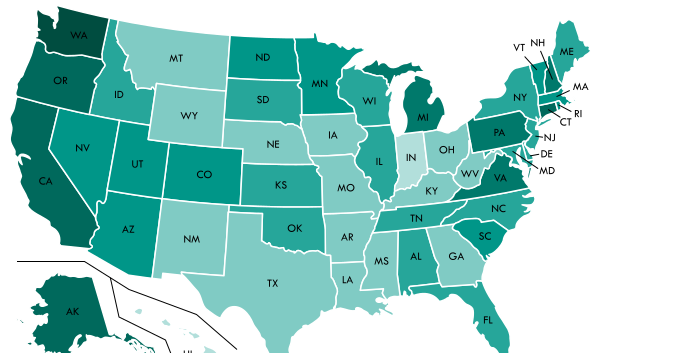
Most common states for client server programmers
| Rank | State | Population | # of jobs | Employment/ 1000ppl |
|---|---|---|---|---|
| 1 | District of Columbia | 693,972 | 277 | 40% |
| 2 | Montana | 1,050,493 | 282 | 27% |
| 3 | Rhode Island | 1,059,639 | 266 | 25% |
| 4 | New Hampshire | 1,342,795 | 317 | 24% |
| 5 | Wyoming | 579,315 | 139 | 24% |
| 6 | Colorado | 5,607,154 | 1,283 | 23% |
| 7 | Utah | 3,101,833 | 710 | 23% |
| 8 | Virginia | 8,470,020 | 1,837 | 22% |
| 9 | Oregon | 4,142,776 | 924 | 22% |
| 10 | Delaware | 961,939 | 207 | 22% |
| 11 | Vermont | 623,657 | 136 | 22% |
| 12 | Massachusetts | 6,859,819 | 1,430 | 21% |
| 13 | North Carolina | 10,273,419 | 2,016 | 20% |
| 14 | New Jersey | 9,005,644 | 1,788 | 20% |
| 15 | Tennessee | 6,715,984 | 1,341 | 20% |
| 16 | Missouri | 6,113,532 | 1,250 | 20% |
| 17 | Maryland | 6,052,177 | 1,219 | 20% |
| 18 | Pennsylvania | 12,805,537 | 2,412 | 19% |
| 19 | Illinois | 12,802,023 | 2,382 | 19% |
| 20 | Minnesota | 5,576,606 | 1,057 | 19% |
Most common cities for client server programmers
| Rank | City | # of jobs | Employment/ 1000ppl | Avg. salary |
|---|---|---|---|---|
| 1 | Tallahassee | 1 | 1% | $78,990 |
Client Server Programmer job outlook: Expert opinions
Our panel of client server programmer experts
University of Wisconsin - Eau Claire
Nova Southeastern University
Mount St. Joseph University
University of Richmond

Wright State University

University of Guam

University of Hawaii at Hilo

Indiana University Southeast

Gannon University

Weber State University
Auburn University at Montgomery

University of New Haven

Allegheny College

Saint Xavier University

Taylor University
John Brown University
Rider University

Union University

Seminole State College of Florida
What general advice would you give to a Client Server Programmer?
Lyle Ford: Having a broad base of skills, both technical and interpersonal are very valuable. Often, physics majors are hired to be problem solvers and each problem has its own set of unique conditions that may require a different set of skills to solve. The ability to be an effective team member is vital and proof of that will make you stand out. Evidence of independent work is also helpful so highlight and research or internship experiences you have had.
What general advice would you give to a Client Server Programmer?
Dr. Frank Mitropoulos Ph.D.: As you begin your career in Computer Applications, remember that the technology industry highly values adaptability and continuous learning. Commit to staying current with emerging technologies, programming languages, tools, and methodologies. Engage in online courses, attend workshops, and network with other professionals in your field. This dedication to self-learning and the connections you make can lead to job opportunities, mentorship, and collaborations that could shape your future career path.
What will help Client Server Programmers increase their earning potential?
Dr. Frank Mitropoulos Ph.D.: As we look toward the future of careers in Computer Applications, several skills stand out for their growing importance. These skills revolve around specific technologies that are expected to continue to grow and evolve. Technologies related to Cloud Computing, Artificial Intelligence (AI), Cybersecurity, and Data Science are quickly evolving and being applied across the technology sector. Cloud Computing: Given the widespread adoption of Cloud services, Cloud computing expertise is indispensable. Understanding how to leverage platforms like Azure, AWS, and Google Cloud is crucial to developing scalable, efficient solutions that meet business needs. Artificial Intelligence: AI and Machine Learning are transforming the world. Skills in these areas to solve real-world problems will be even more critical in the future. Cybersecurity: Digital threats are becoming more sophisticated. Safeguarding data, networks, and systems will require encryption, intrusion detection, development, and regulation skills. Data Science: Skills in Data Science will be increasingly sought after as businesses embrace data-driven decision-making. Extracting meaningful insights from extensive datasets and effectively communicating these findings will be essential. Soft skills: Finally, soft skills such as teamwork, problem-solving, and effective communication cannot be overlooked. Adapting, communicating, and leading will be essential for success.
MARLA KRAMER
Assistant Vice President of Marketing and CommunicationsWhat general advice would you give to a Client Server Programmer?
MARLA KRAMER: Do the necessary course work from a reputed institution, where you can get the necessary hands-on experience under the tutelage of an established expert. Create a portfolio of your work on GitHub so that you can share your projects with potential employees. It is more important to demonstrate your skills through code, than it is to provide a list of classes that you have taken. Certification courses are expensive, but getting an accredited certificate in Mobile Application Development or any of the rapidly growing fields is always an advantage. The internet has a lot of uncurated, self-published, and incorrect information, especially when it comes to computer science. It is important that you pick your sources wisely as you build your skills.
Rebecca Allen
Mount St. Joseph University
Special Education And Teaching
What general advice would you give to a Client Server Programmer?
Rebecca Allen: AI, for sure. I have heard it said that AI might not replace humans, rather humans who know how to use AI well may replace humans who don't.
What will help Client Server Programmers increase their earning potential?
Rebecca Allen: I'd suggest that you hop in to coding and just get started. Even a tiny bit helps. Python is a very popular language, and free to download (Python.org). Once you download, there are some many ways to start learning coding. My personal favorites are Mimo and LearnPython.org. You can also ask ChatGPT for suggestions-remember that ChatGPT can often help your write and explain simple code. Don't understand something? Ask ChatGPT!
Ahmed Temani
Senior InstructorUniversity of Richmond
Computer/Information Technology Administration And Management
What general advice would you give to a Client Server Programmer?
Ahmed Temani: A lot of the buzz is about using chatbots to improve coding efficiency. However, there is a great need for systems level thinking and design as software is deployed across cloud and edge computing devices. Gaining more experience in systems design provides you with additional skills that complement whatever AI-based technology gets deployed.
Daniel Asamoah Ph.D.
Associate Professor and Interim ChairWright State University
Information Systems and Supply Chain Management Department
What skills stand out on Client Server Programmer resumes?
Daniel Asamoah Ph.D.: Web Developer: JavaScript, HTML5, CSS, PHP, Python, APIs, Web user interface design.
James Sellmann Ph.D.
Dean, Professor of Philosophy and Micronesian StudiesUniversity of Guam
College of Liberal Arts & Social Sciences
What general advice would you give to a Client Server Programmer?
James Sellmann Ph.D.: General advice is to keep in mind that you must leverage your skills, especially your soft skills of being able to work with people, to communicate effectively and to be able to solve problems. Be real. Don't try to pretend to be someone else to impress others. Be your authentic self. And show up on time.
What Client Server Programmer skills would you recommend for someone trying to advance their career?
James Sellmann Ph.D.: General advice is to keep in mind that you must leverage your skills, especially your soft skills of being able to work with people, to communicate effectively and to be able to solve problems. Be real. Don't try to pretend to be someone else to impress others. Be your authentic self. And show up on time.
What will help Client Server Programmers increase their earning potential?
James Sellmann Ph.D.: Computer skills, especially being able to work effectively with artificial intelligence will be most important. Being able to work with actual intelligence, that is living people, will always be an important skill.
Travis Mandel Ph.D.
Assistant ProfessorUniversity of Hawaii at Hilo
Department of Computer Science
What soft skills should all Client Server Programmers possess?
Travis Mandel Ph.D.: Although computer science seems like a highly technical field, soft skills are really what differentiates software engineers. One of the most important qualities of any software engineer is explaining their code clearly at various levels of technical depth and explaining why certain design decisions were made. You could write code that does amazing things, but if that code consists of snippets you pasted from StackOverflow without really fully understanding them, it will be a huge headache for anyone who needs to come into the codebase later and maintain or update it.
Another one is asking the right questions. Imagine you are dropped into a huge codebase and asked to add a new feature (very common!). There's no time to understand everything that is going on, but on the other hand, you need to understand enough of the code to do your task effectively, which involves asking questions. A failure to ask questions will likely result in you wasting a huge amount of time working on something that is ultimately not useful, for instance, re-implementing a complex function that already exists somewhere in the codebase.
Chris Sexton
Visiting Lecturer of Computer ScienceIndiana University Southeast
Computer Science Department
What skills stand out on Client Server Programmer resumes?
Chris Sexton: The biggest thing that stands out to me in a candidate is how much effort in self-improvement is apparent on the resume. A candidate that lists a few jobs and bullet points of skills is acceptable but not impressive. But on the other hand, a candidate that lists a portfolio of projects to show those skills are real and how those skills made them a game-changing employee at their previous jobs is a clear winner.
What soft skills should all Client Server Programmers possess?
Chris Sexton: Teamwork is the obvious soft skill that is vital. It encompasses more than just being willing to work together but also includes strong documentation skills, textual communication skills, and precision in language. For an example of precision, which of the following is a task that can be completed:
"The login system will require strong passwords."
or
"The login system will require passwords of no less than 16 characters including at least two numbers and two non-alpha numeric characters."
It is easy for an engineer to be lax and use informal language that subtly confuses development efforts, but the valuable candidate will have strong technical communication skills.
What skills will help Client Server Programmers earn the most?
Chris Sexton: My expectation for high earners is generally that they have relevant experience in real projects using the platforms used in the industry, but also that they know why and how those tools work. A candidate who has finished a computer science degree is going to be a candidate that has taken a class on algorithmic analysis, programming languages, software engineering, and of course, many other courses that reveal why we make the choices that we make with technology. Mistakes and shortsightedness are often the result without that key viewpoint of the "why." Leadership comes from confidence and understanding of fundamentals.
What hard/technical skills are most important for Client Server Programmers?
Chris Sexton: As with soft skills, technical skills in teamwork matter, a candidate must have the ability to work with revision control, be it git or some similar system. In addition, it is vital that fundamental computing skills such as operating the shell of a Linux machine are good signs that a candidate will be able to adapt to new systems.
Are there any particularly good places in the United States for Client Server Programmers to find work opportunities?
Dr. Stephen Frezza Ph.D.: Computing is ubiquitous, and with more industries moving to remote work, location is becoming less critical. If the internet reaches a place reliably, computing jobs can be located there.
How do you envision technology impacting Client Server Programmers in the next 5 years?
Dr. Stephen Frezza Ph.D.: Breadth and depth: Computing is becoming more like engineering; where the value of the product, its lifetime risks, costs, and benefits are more critical than just it's roll-out. So the engineering competencies that have always been a part of computing will become more central. Computing is also expanding; the role of data and the shift of once-research technologies (like machine learning) into production applications will continue to require computing graduates to broaden their base and continue as learners. This will cause shifts in what is considered 'fundamental' and the need for professionals to continue to hone and redevelop their technical skill sets.
What certifications/licenses/courses can have the biggest impact for Client Server Programmers?
Dr. Kyle Feuz Ph.D.: Any time you have a certification, license or degree it's going to give you a leg up compared to your peers with similar skill sets but no certification. Often the certification or degree will help your resume make it through an initial screening process but then it's up to you to demonstrate that you have the knowledge and skills the certification is supposed to represent. It's also important to know what career you want to pursue. Certifications are usually targeted to a very limited skill set. If that skill set is a critical part of the job description then the certification will be a strong mark in your favor. Some fields even require certification before you will be considered for the position. However, if the skill set is only tangentially related to the job description then there is little benefit in having the certification.
What soft skills should all Client Server Programmers possess?
Dr. Kyle Feuz Ph.D.: The top three things I hear from employers when talking about soft-skills are communication, collaboration, and ethics. They need employees who know how to communicate professionally in both written communications and oral communications. They also need employees who can work with others. You may be working internally with colleagues or externally with customers, clients and business partners but there are very few positions where collaborating with others is not a large part of the job. Finally, employers are looking for trustworthy employees. Many technical positions involve working with sensitive data, and no amount of technical controls can compensate for unethical or untrustworthy employees. All three of these soft skills are only going to increase in importance with the rise in remote work. Remote work cannot function successfully without good communication, collaboration and ethical behavior.
Will there be an enduring impact of the coronavirus pandemic on Client Server Programmers?
Dr. Kyle Feuz Ph.D.: Change is often a slow process. For years, we have been hearing about the potential benefits of having employees work remotely and many companies had even started moving in that direction prior to the pandemic. However, the pandemic forced rapid change in the workplace environment with remote work becoming a necessity if businesses wanted to stay open. As I talk with different employers I am hearing a consistent message: remote work is here to stay.
This should not be interpreted to mean that every company is suddenly committed to allowing their employees to work remotely on a full-time basis (although some are). Instead, many companies see this as an opportunity to allow increased flexibility with work schedules and remote work. I do not anticipate that these changes will be immediate. Remember, change is often a slow process. I cannot predict the ripple effect such changes will cause in the job market.
With that in mind, we can start to consider the broader effects such policies will have. This has the potential to open the job market up to a wider audience. Previously, a graduate would have to decide if they were willing to relocate before looking at an opening outside of their immediate geographic area. With full-time remote work, those geographic constraints no longer apply. Similarly, individuals with other commitments that may prevent them from working a traditional 9-5 job may find opportunities that would previously have been unavailable to them. This just barely scratches the surface of the enduring impacts the pandemic may cause but one thing is certain, the world will never be the same.
Will there be an enduring impact of the coronavirus pandemic on Client Server Programmers?
Dr. Semih Dinc: I personally think there may be a positive impact of this pandemic for CS graduates in medium/long term. Even if many companies have frozen or slowed down their hiring process now, I believe this is a temporary decision. There is still a big need for new CS graduates in the industry. And to me it is more clear that people realized they can work remotely for many CS related positions. This means that many companies can cut their physical office budgets and hire more remote people. One of the factors for our students is the challenges/expenses of the city they would work. Some of them do not want to move to big cities. I am assuming with more remote working opportunities graduates will have more options.
What's a good job out of college for Client Server Programmers?
Christopher Martinez Ph.D.: The best job you can have out of college is a job you have passion for and will set you up to advance your career. If you have always wanted to work in aerospace, then you should seek out that field from the start. I hate to see students settle for a job because of pay or because they feel they can move to their dream field later.
Oliver Bonham-Carter Ph.D.
Assistant ProfessorAllegheny College
Department of Computer Science and Affiliated Faculty in Integrative Informatics
What are the biggest trends we'll see in the Client Server Programmer job market given the pandemic?
Oliver Bonham-Carter Ph.D.: Pandemic has accelerated social connectivity trends using technology, including technology for remote work, and e-learning, and technology to make e-commerce more comfortable and faster. I foresee these accelerated technology trends to continue, even after the pandemic, and therefore job markets in these areas to continue to grow. Another big surge we have seen is in data analytics, which has been increasing over the last decade, and COVID-19 has spotlighted this field. I expect data analyst jobs to continue to be in demand and to grow. Also, the pandemic showed us the interconnectedness of technology with other areas. As the need to develop better solutions to fight various diseases heightens, for example, I expect jobs in biotech to grow.
What technology do you think will become more important and prevalent for Client Server Programmers in the next 3-5 years?
Oliver Bonham-Carter Ph.D.: In the next few years, technologies related to artificial intelligence, data analytics, cloud computing, container-orchestration systems, and cybersecurity will continue to become more important and prominent. These technologies have the foundation to improve the quality of life in terms of health, education, fighting misinformation, creating better connections, fighting climate change, etc. IoT with smart devices connected online will continue to rise, thus producing more data, which will necessitate AI, data analytics, and security solutions. Additionally, I foresee 5G technology to play an essential role in the next few years, as e-commerce expands into autonomous delivery services. In the software engineering field, to enable fast, secure, and connected software development, technologies allowing to automate a part of that process, such as version control, containerization, and Kubernetes, will also become increasingly important.
What are the best companies to work for a Client Server Programmer?
James Vanderhyde: The best companies to work for are companies that respect you as a person and not just a cog in the machine. They are inclusive, and they recognize and appreciate diversity. They have a track record of handling sick leave and family leave as needed. They will not expect you to eat dinner in your office and then go back to work after an already long day. All software companies experience crunch times around release dates, but the best companies do not experience constant crunch. That is a sign of poor management. The best companies will give you challenging problems to work on and reward innovation.
Will there be an increase or decrease in demand for Client Server Programmers in the next 5 years?
James Vanderhyde: There has been a steady increase in software and IT jobs for the last 20 years, and this is not going to slow down any time soon. In the next 5 years, demand will increase, particularly in software development and cybersecurity. The technology field changes so quickly that beyond 5 years, it is difficult to make predictions. That is why we thoroughly prepare our computer science and information systems students for technology changes and career shifts to discover the best in themselves and to be prepared to meet the demand and excel within the field.
Are there any particularly good places in the United States for Client Server Programmers to find work opportunities?
James Vanderhyde: Any big city will have lots of opportunities for computing, software, and IT work. Silicon Valley and the rest of the west coast are the most famous, but innovation is happening everywhere around the country and around the world, including here in Chicago. Chicago tech companies have hired our students upon graduation, and likewise, our graduates have found success and gratification in the field.
Dr. Jonathan Geisler
Associate ProfessorTaylor University
Department of Computer Science and Engineering
What are the best companies to work for a Client Server Programmer?
Dr. Jonathan Geisler: The best companies to work for are the ones that are responsive to both their customers' and employees' needs. They are the ones that have tried to be proactive during the pandemic and not just survive until everything got "back to normal." They know that a damaged workforce leads to a damaged company, and so they provide good management, encouraging everyone to be healthy mentally and physically.
Will there be an increase or decrease in demand for Client Server Programmers in the next 5 years?
Dr. Jonathan Geisler: There will be a continued increase in demand for computer engineering
graduates as computers become more heavily integrated into the fabric
of our lives. Things like self-driving cars, the Internet of Things, and
mobile computing will become more commonplace and increase the demand for engineering talent; the long-term trend of using smartphones and web-based applications will not slow, leading to an increase in the
demand for computing talent.
Are there any particularly good places in the United States for Client Server Programmers to find work opportunities?
Dr. Ted Junseok Song: Due to COVID-19, people have more choices on location as more companies allow their employees to work remotely.
How do you envision technology impacting Client Server Programmers in the next 5 years?
Dr. Ted Junseok Song: The question is not whether technology will advance or not. It is, rather, how it will advance. Professionals in the industry need to be equipped to see the customers' demand and where our society is headed. I would recommend college students to be interested in broad topics apart from topics in their major. Well-rounded people will have more opportunities to impact the future.
Dr. Howard Rees
Adjunct Assistant Professor of Information SystemsRider University
Information systems
Will there be an enduring impact of the coronavirus pandemic on Client Server Programmers?
Dr. Howard Rees: We're moving into a volatile time for the economy, and planning for an uncertain future is what big companies are concerned with. In many ways, the pandemic and concerns over future pandemics that we now know can be globally devastating will be a boon for CS and IT graduates. Face to face business interactions and transactions will be dramatically reduced, both in the short term and in the long run, as there will be a need to hedge against future pandemics. Everything changes from production and operations to supply chain and risk management and diversification to the nature of "office work." And all of that must be underpinned by computer technology: communications, security, data analytics. These are trends that have been developing for the past few decades but the pandemic will accelerate them, and that's all useful, if you're a CS or IT graduate with a broad base of knowledge, which provides you the freedom to adapt.
What general advice would you give to a Client Server Programmer?
Brian Glas: Build relationships: Different technologies will interest and challenge you, but throughout your career, you'll find that it's the relationships that are the most important. This is harder to grasp earlier in your career, but much easier to understand after 15-20 years.
Gain different perspectives: Spend time with people in other roles that your job interacts with, and gain a solid understanding of how they view things; this is most valuable for career progression and understanding of how your work fits into the big picture.
Craig Tidwell Ph.D.
Professor/Program ManagerSeminole State College of Florida
Center for Information Technology
What technology do you think will become more important and prevalent for Client Server Programmers in the next 3-5 years?
Craig Tidwell Ph.D.: Understanding cloud technologies such as Amazon Web Services, Microsoft Azure, and Google are needed. Since many organizations have a hybrid structure, where they have internal and external cloud technologies, learning how to integrate them with existing technologies is critical.
Will there be an enduring impact of the coronavirus pandemic on Client Server Programmers?
Craig Tidwell Ph.D.: Many I.T. employees already have the option to work remotely (telecommute), but this will become even more important with the Coronavirus challenges. Employees must be able to work remotely and be organized and self-directed. Employers are looking for teleworkers that can work on a task from anywhere.