Explore jobs
Find specific jobs
Explore careers
Explore professions
Best companies
Explore companies
Job outlook for clinical statistical programmers in the United States
Are clinical statistical programmer jobs in demand?
Clinical statistical programmer job and salary trends over time
Clinical statistical programmer jobs over time
Clinical statistical programmer job growth rate over time
| Year | # of jobs | % of population |
|---|---|---|
| 2021 | 2,903 | 0.00% |
| 2020 | 6,401 | 0.00% |
| 2019 | 6,293 | 0.00% |
| 2018 | 16,650 | 0.01% |
| 2017 | 17,894 | 0.01% |
Average clinical statistical programmer salary over time
Clinical statistical programmer salary by year
| Year | Avg. salary | Hourly rate | % Change |
|---|---|---|---|
| 2026 | $83,894 | $40.33 | +3.4% |
| 2025 | $81,129 | $39.00 | +2.3% |
| 2024 | $79,293 | $38.12 | +2.5% |
| 2023 | $77,373 | $37.20 | +3.0% |
| 2022 | $75,115 | $36.11 | +0.4% |
Clinical statistical programmer jobs by state
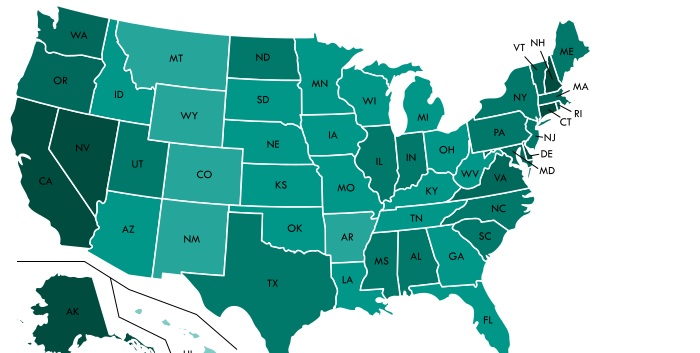
Most common states for clinical statistical programmers
| Rank | State | Population | # of jobs | Employment/ 1000ppl |
|---|---|---|---|---|
| 1 | District of Columbia | 693,972 | 208 | 30% |
| 2 | Maine | 1,335,907 | 186 | 14% |
| 3 | Rhode Island | 1,059,639 | 144 | 14% |
| 4 | South Dakota | 869,666 | 116 | 13% |
| 5 | North Dakota | 755,393 | 97 | 13% |
| 6 | Vermont | 623,657 | 81 | 13% |
| 7 | Montana | 1,050,493 | 124 | 12% |
| 8 | Washington | 7,405,743 | 807 | 11% |
| 9 | Oregon | 4,142,776 | 474 | 11% |
| 10 | Connecticut | 3,588,184 | 401 | 11% |
| 11 | Arizona | 7,016,270 | 673 | 10% |
| 12 | Maryland | 6,052,177 | 619 | 10% |
| 13 | Minnesota | 5,576,606 | 546 | 10% |
| 14 | Delaware | 961,939 | 100 | 10% |
| 15 | Florida | 20,984,400 | 1,876 | 9% |
| 16 | New Jersey | 9,005,644 | 817 | 9% |
| 17 | Virginia | 8,470,020 | 758 | 9% |
| 18 | Wisconsin | 5,795,483 | 521 | 9% |
| 19 | Utah | 3,101,833 | 283 | 9% |
| 20 | Nebraska | 1,920,076 | 172 | 9% |
Most common cities for clinical statistical programmers
| Rank | City | # of jobs | Employment/ 1000ppl | Avg. salary |
|---|---|---|---|---|
| 1 | South Plainfield | 9 | 37% | $85,458 |
| 2 | Annapolis | 2 | 5% | $90,399 |
| 3 | Durham | 9 | 3% | $88,145 |
| 4 | Hartford | 4 | 3% | $94,452 |
| 5 | Boston | 12 | 2% | $92,764 |
| 6 | Overland Park | 4 | 2% | $74,090 |
| 7 | Atlanta | 7 | 1% | $78,740 |
| 8 | Miami | 5 | 1% | $78,533 |
| 9 | Arlington | 2 | 1% | $87,730 |
| 10 | Chicago | 6 | 0% | $85,113 |
| 11 | New York | 5 | 0% | $86,527 |
| 12 | San Diego | 5 | 0% | $92,518 |
| 13 | Jacksonville | 4 | 0% | $81,206 |
| 14 | Phoenix | 4 | 0% | $80,339 |
| 15 | San Francisco | 4 | 0% | $103,003 |
| 16 | Baltimore | 3 | 0% | $90,375 |
| 17 | Indianapolis | 3 | 0% | $82,911 |
| 18 | Washington | 3 | 0% | $98,200 |
Clinical Statistical Programmer job outlook: Expert opinions
Our panel of clinical statistical programmer experts
Adelphi University
Pennsylvania State University
San Francisco State University
Pacific University
Bowling Green State University
Michigan State University
Lewis & Clark College
University of Connecticut
Georgetown University
Denison University
Saint Peter's University
Butler University
University of Florida

Wright State University

Villanova University
What will help Clinical Statistical Programmers increase their earning potential?
Dr. Partha Sengupta: Fit to jobs like Data Controllers and Data Processors understanding both USA and International data privacy and protection laws, implementing data protection into system and processes, auditing, authentication, and access control. Creators of robust and secured databases and recommender systems using collaborative, content, hybrid and contextual filtering. One such example is Deep Learning Recommendation Learning (DLRM). Data storage, processability and usage in edge computing in IoT devices including personalized chatbots. Running A.I. (AIoT), analytics, and other business capabilities on IoT devices, consolidate edge data at scale and eliminate data silos, deploy manage and help secure edge workloads remotely, optimize the costs of running edge solutions, and enable devices to react faster to local changes. Handling data related to medical instruments, medical chatbots, and usage of A.I for data analytics in application of telemedicine, diagnosis accuracy, and medical laboratories. Medical data analytics of A.I application in mental health disorders (MHD) and medical image classification. Another important aspect of genetic data and the application of A.I on it. Language Model architectures using human language data, deep learning algorithms, and application of generative transformers
What will help Clinical Statistical Programmers increase their earning potential?
Dr. Devin Rafferty PhD: Read anything and everything, especially history. There is an enormous value that someone can gain simply from understanding how different disciplines fit together, because the real-world is not segmented into sociology, politics, economics, etc.; rather it is all one dynamic system. For example, when students ask me what they should really focus on reading to prepare for their careers, I usually respond by asking what *exactly* will be their careers in fifteen years--which is frequently met with indecision. The point is that one should not tailor their knowledge and skill sets to an expected career; rather, just the opposite, one should learn *everything* that the brain can absorb and then the skill sets needed for the career will already be there--and obtaining promotions will be fairly straightforward.
What general advice would you give to a Clinical Statistical Programmer?
Warren Johnson: Statistics/data science and computer science are great professions to enter now. Mathematics is involved in these fields. It allows working with talented students and gaining new insights.
What Clinical Statistical Programmer skills would you recommend for someone trying to advance their career?
Warren Johnson: Some of us prove theorems on the frontiers of mathematics, but most of us really don't. A good mathematical training allows one to work on many different things in many contexts. Teaching is rewarding if you have good students.
What will help Clinical Statistical Programmers increase their earning potential?
Warren Johnson: Many of the greatest ideas that men and women have had are mathematical ideas. The thrill of understanding something difficult and explaining it to talented young people is rewarding. Dislike the grading aspect of the job.
What Clinical Statistical Programmer skills would you recommend for someone trying to advance their career?
Dr. Shana Caro: Graduates beginning their careers should always think about their personal growth and strengths. When picking a career, consider what your strengths are. If you are good at computer programming, pick a career like software design. If you are good at translating complex scientific results into clear English, pick a career like data sciences, sales for a biotech company, or medical writing. In every job, have goals for the skills you want to develop and work on those. Find a mentor in your work who can help you accomplish those.
What will help Clinical Statistical Programmers increase their earning potential?
Dr. Shana Caro: In the next 3-5 years, graduates will want to have a mix of hard and soft skills. As AI and LLMs become more powerful and prevalent, being able to use these new tools effectively will be incredibly helpful in a variety of industries. Coming up with the right prompts to direct these models is a high-level skill that takes practice. In data science jobs, which Biological and Physical Science majors would excel at, basic computer programming in any language, data visualization, and understanding A-B testing will be important. The value-add of graduates in these majors is frequently that they can translate mathematical results into business insights in plain English and clear data visualizations. Additionally, graduates will also have to focus on their soft skills -- especially communicating with their managers and teammates in a professional and effective manner. Finally, flexibility is a key soft skill in any field. Graduates should be able to take criticism and improve their work, and be excited to learn new technical skills.
Dr Paul Milewski
Head, Department of MathematicsPennsylvania State University
Applied Mathematics
What Clinical Statistical Programmer skills would you recommend for someone trying to advance their career?
Dr Paul Milewski: We live in an age of mathematics: everything around you runs on math. Cell phones, AI and chat GPT, weather prediction, supply chains, drug development and modern medicine, etc… A math major or a minor is a springboard to many different areas for work and further study.
What Clinical Statistical Programmer skills would you recommend for someone trying to advance their career?
Luella Fu: I think Statisticians enjoy the quantitative reasoning aspect of their jobs, whether it’s designing the data collection, visualizing data, or creating insights from it. It’s also a pretty stable job with good pay. What Statisticians probably don’t like is the amount of time they spend in front of a computer to do their data analyses. It can create eye strain. Also, data cleaning can be full of unexpected challenges that take much longer to solve than one expects.
What will help Clinical Statistical Programmers increase their earning potential?
Dr. John Wilson PhD, MBA: Many of the jobs that will be in demand in the next few years don’t even exist yet, so be prepared for rapid changes in the way work gets done. This means that the ability to be flexible and adaptable is as important, or more so, than your field of study. Look for people who are experts in their field yet are challenging assumptions and pressing the frontier in terms of technology and innovation – learn from them, ask questions, volunteer to get involved rather than sitting on the sidelines waiting to see what happens.
What will help Clinical Statistical Programmers increase their earning potential?
John Mayberry PhD: A degree in mathematics will always pay off. Students of the subject have the adaptability to work in a large number of fields including finance, economics, engineering, biostatistics, data science, actuarial science, education, machine learning, and software development. The problem-solving and critical thinking skills that math majors learn are heavily sought after by employers. For students who want to teach, there are numerous opportunities at the secondary level and math teachers are some of the most sought after in the current market. For students who want to work in government/industry, it is often advisable to combine your math degree with a secondary major or minor such as economics, computer science, public policy, business, or engineering. Unexpected combinations with fields such as graphic design, literature, or communication can also open up opportunities in data visualization and storytelling.
John Chen
Professor of StatisticsBowling Green State University
Biomathematics, Bioinformatics, And Computational Biology
What general advice would you give to a Clinical Statistical Programmer?
John Chen: It depends on different companies, biostatisticians work on multiple comparisons such as dose-response analysis in pharmaceutical companies; protocol analyses in government agencies such as NIH or FDA, etc.
What will help Clinical Statistical Programmers increase their earning potential?
Hanne Hoffmann PhD: Being able to code will be a required skill for many jobs in the future. More and more research is based on large datasets, and knowing how to manage large amounts of data and data analysis will be an important skill. I also think that being able to use AI, and understand its limits and strengths, will be a skill that will be sought after. Critical thinking and data interpretation is an old timer, which is a skill gained in graduate school, which is key for success in most jobs requiring a graduate degree. Jobs that require technical skills will look for individuals who can trouble shoot and further improve current techniques to meet changing demands of the field.
Associate Professor Peter Drake
Associate Professor of Computer ScienceLewis & Clark College
Computer Science
What will help Clinical Statistical Programmers increase their earning potential?
Associate Professor Peter Drake: Data science, cybersecurity, and AI. In my AI & Machine Learning class, I talk about the history of "AI Winters", where everyone gets excited about the possibilities of AI, then a few years later the technology fails to deliver and funding dries up. This time, I thought, things are different: AI systems really can do impressive things with automatic translation, image recognition, etc. The problems now relate to privacy, equity, and security. What are the risks if corporations or law enforcement can recognize your face everywhere you go? Do systems trained on past human decisions magnify racism, sexism, etc.? Then ChatGPT came out. I soon realized that I had vastly underestimated the hype cycle. Staggering amounts of money are being thrown at generative AI, which (unlike some other AI systems) has no internal model of what it's talking about. There may be another collapse in the future -- but right now, AI skills are an excellent way to get a first job.
What general advice would you give to a Clinical Statistical Programmer?
Xin Dong: Over the next few years, I anticipate a growing demand for mathematicians equipped with advanced data analytics capabilities and expertise in machine learning. Mastery of programming languages such as Python, R, and tools like MATLAB or SAS, will be beneficial. Furthermore, soft skills like effective communication, problem-solving, and project management will be crucial as technical prowess. Those who can clearly articulate complex mathematical concepts to non-experts will particularly stand out in the job market.
Ao Yuan
ProfessorGeorgetown University
Biomathematics, Bioinformatics, And Computational Biology
What general advice would you give to a Clinical Statistical Programmer?
Ao Yuan: For a career in Biostatistics, getting a position in a pharmaceutical company/industry will have a higher salary than working in an academic institution. If you can get a higher management position, your salary can be maximized.
What Clinical Statistical Programmer skills would you recommend for someone trying to advance their career?
Bernd Schroeder: The foundation of mathematics is logical and computational precision. Mathematical results are eternal in that there is no update needed once a result has been shown to be true. Consider Pythagoras' Theorem. It's rather old, but its statement and truth are unchanged, as is its applicability. This logical and computational precision will be of primary importance for as long as human beings practice mathematics, science, as well as have interactions in general. For the future, we need to continually refine our ability to use fundamental skills in mathematics/logic/computations to validate and improve results obtained through complex computations: For example, the computations that underly AI cannot and should not be double checked step-by-step, because they are much too intricate. However, simple test cases can often reveal problems in the system as well as features.
What Clinical Statistical Programmer skills would you recommend for someone trying to advance their career?
Miles Williams: As I alluded to in the previous response, the quantitative aspects of social science are becoming increasingly important. To be sure, not all social scientists need quantitative skills. Many UX jobs often entail using qualitative research methods and process tracing. However, over the past couple of decades most empirical social scientists have become, effectively, data scientists who happen to specialize in a particular sub-field or issue area. Statistical programming (particularly with Python and R) is therefore a key skill, and it will only grow in importance over the next 3-5 years.
What will help Clinical Statistical Programmers increase their earning potential?
Nickolas Kintos PhD: Don't think that you have to limit yourself to specific areas. Mathematics is used in many different fields. Keep your options open.
Dr. Lee Farquhar
Associate ProfessorButler University
Radio, Television, And Digital Communication
What Clinical Statistical Programmer skills would you recommend for someone trying to advance their career?
Dr. Lee Farquhar: Storytelling is still at the heart of the industry. Start with good reporting and writing. From there, broaden your technical skills so that your stories can connect with audiences in a variety of platforms. A certain fluidity is necessary for the modern and future reporter, crossing from one medium to another seamlessly. The reporter must be resolute in their reporting and nimble in their delivery to the audience.
Rhonda Bacher PhD
Assistant ProfessorUniversity of Florida
Biomathematics, Bioinformatics, And Computational Biology
What Clinical Statistical Programmer skills would you recommend for someone trying to advance their career?
Rhonda Bacher PhD: In terms of biostatistical skills, techniques for analyzing longitudinal biomedical data are increasingly relevant. Artificial intelligence models are likely to be helpful for programming across languages and tools (e.g. R, Python, TensorFlow), and the next generation of biostatisticians will be in a great position to leverage AI tools to their full potential. On the other side of that, understanding and contributing to AI tool development is an area that biostatisticians can play important roles, especially in the fields of bioinformatics and genomics.
Daniel Asamoah Ph.D.
Associate Professor and Interim ChairWright State University
Information Systems and Supply Chain Management Department
What skills stand out on Clinical Statistical Programmer resumes?
Daniel Asamoah Ph.D.: Statistics and other quantitative methods, analytical skills, programming such as Python and R, data visualization skills, and data management skills.
What skills will help Clinical Statistical Programmers earn the most?
Daniel Asamoah Ph.D.: Statistics, ability to grasp and understand domain knowledge, analytical skills, programming.
Paul Bernhardt
Associate Professor of Statistics, Director of the Applied Statistics Graduate ProgramVillanova University
Department of Mathematics and Statistics
What skills will help Clinical Statistical Programmers earn the most?
Paul Bernhardt: Experience and willingness to grow and learn more. Because statistics is needed by so many different fields and involves so many different methods, procedures, and skills, time is needed to build up the knowledge that helps an individual acquire a top-earning job as a manager or other team leader. This can often be done within a large company, such as in pharmaceuticals, but it can also be done by moving to new jobs. In many cases, only a few years of experience are needed to move to higher-level positions. For individuals with a Master's degree or Ph.D., earning more often happens much sooner.
Bottom line: If a statistician has the experience, strong communication skills, and is good with a variety of software programs and with database management, they will likely be able to earn a good living with relatively reasonable working hours. For this reason, "statistician"/"data scientist" consistently ranks as one of the top jobs among a variety of rankings. For example, the last six years running, it has been listed in the top three jobs to have by Glassdoor.com