Explore jobs
Find specific jobs
Explore careers
Explore professions
Best companies
Explore companies
Job outlook for communication lecturers in the United States
Are communication lecturer jobs in demand?
Communication lecturer job and salary trends over time
Communication lecturer jobs over time
Communication lecturer job growth rate over time
| Year | # of jobs | % of population |
|---|---|---|
| 2021 | 1,577 | 0.00% |
| 2020 | 1,641 | 0.00% |
| 2019 | 1,681 | 0.00% |
| 2018 | 1,679 | 0.00% |
| 2017 | 1,660 | 0.00% |
Average communication lecturer salary over time
Communication lecturer salary by year
| Year | Avg. salary | Hourly rate | % Change |
|---|---|---|---|
| 2025 | $65,118 | $31.31 | +0.6% |
| 2024 | $64,751 | $31.13 | +2.5% |
| 2023 | $63,174 | $30.37 | +3.6% |
| 2022 | $60,974 | $29.31 | +1.3% |
| 2021 | $60,177 | $28.93 | +3.5% |
Communication lecturer jobs by state
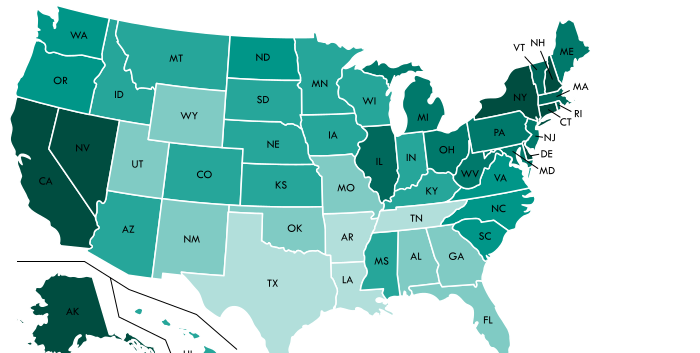
Most common states for communication lecturers
| Rank | State | Population | # of jobs | Employment/ 1000ppl |
|---|---|---|---|---|
| 1 | West Virginia | 1,815,857 | 52 | 3% |
| 2 | District of Columbia | 693,972 | 18 | 3% |
| 3 | New Jersey | 9,005,644 | 140 | 2% |
| 4 | Colorado | 5,607,154 | 121 | 2% |
| 5 | Massachusetts | 6,859,819 | 106 | 2% |
| 6 | South Dakota | 869,666 | 16 | 2% |
| 7 | New York | 19,849,399 | 223 | 1% |
| 8 | Illinois | 12,802,023 | 136 | 1% |
| 9 | Virginia | 8,470,020 | 107 | 1% |
| 10 | Michigan | 9,962,311 | 80 | 1% |
| 11 | Pennsylvania | 12,805,537 | 75 | 1% |
| 12 | Maryland | 6,052,177 | 71 | 1% |
| 13 | Connecticut | 3,588,184 | 22 | 1% |
| 14 | Maine | 1,335,907 | 11 | 1% |
| 15 | Delaware | 961,939 | 8 | 1% |
| 16 | Rhode Island | 1,059,639 | 8 | 1% |
| 17 | New Hampshire | 1,342,795 | 7 | 1% |
| 18 | Vermont | 623,657 | 7 | 1% |
| 19 | Alaska | 739,795 | 4 | 1% |
| 20 | North Dakota | 755,393 | 4 | 1% |
Most common cities for communication lecturers
| Rank | City | # of jobs | Employment/ 1000ppl | Avg. salary |
|---|---|---|---|---|
| 1 | Amherst | 1 | 3% | $72,929 |
| 2 | Lawrence | 1 | 1% | $58,069 |
| 3 | Los Angeles | 1 | 0% | $75,381 |
| 4 | Phoenix | 1 | 0% | $58,739 |
| 5 | San Jose | 1 | 0% | $81,588 |
Communication Lecturer job outlook: Expert opinions
Our panel of communication lecturer experts
Christopher Newport University

University of New Orleans
Clemson University

University of Massachusetts, Amherst
AGWA - American Grant Writers' Association, Inc.

Washington University in St Louis
University of Minnesota Crookston

University of West Georgia
Chicago State University
University of Central Florida
Elmira College
What general advice would you give to a Communication Lecturer?
Dr. Mike Levine: In the next 3–5 years, I anticipate that research will be expected that explores more interdisciplinarity; owing both to intellectual trends in the academy, and to an ever-shrinking job market, which means that more will be demanded by less people. As well, you will be expected to be an expert in the exciting, interesting research niche that you have found and written about in your dissertation; but also quite knowledgeable about a broad range of information applicable towards teaching large general education (GE) classes filled with non-major students. Expertise in both of these areas will make you more competitive and give you a broader network to work with.
What Communication Lecturer skills would you recommend for someone trying to advance their career?
Dr. Mike Levine: Academia is most definitely not a career for those that want to get rich quick. It can take 5–6 years before your salary really starts to pick up steam (getting tenured, in other words). To get tenure: publish, publish, publish, while teaching and mentoring. Do some service to your department or college as well, but not so much that you get burnt out. As in any career, being seen and working with other people in your discipline, school, and area is key. So go to as many conferences as you can find funding for, and meet and work with as many people as you can. The 'cultural currency' you'll get from these interactions will come a lot sooner than actual currency will, but in academia, these two areas are often one and the same.
Christine Day Ph.D.
Professor and ChairUniversity of New Orleans
Department of Political Science
What soft skills should all Communication Lecturers possess?
Christine Day Ph.D.: For anyone going on the job market with a Bachelor's degree (or higher) in political science, there are many opportunities in national, state, and local government; elective office; nonprofits and political advocacy; campaign management and polling; teaching; journalism; and business (because there is much overlap between politics/government and business, with business regulations, contracting out for public services, etc.). There are further opportunities for those who go on to graduate school or law school, as many political science majors do. Soft skills like communicating effectively both orally and in writing, researching and solving problems, and civic knowledge and engagement, are emphasized in political science, and they transfer well into a variety of careers.
Bo Clements
Lecturer of American Sign LanguageClemson University
Department of Languages
What experience really stands out on Communication Lecturer resumes?
Bo Clements: 1) teaching ASL included four parts: Educational background, Teaching background, Professional Development evidenced with hours, and Deaf Community Service. 2)Degrees (Must have MA or higher). 3) ASLPI score of 4 or higher, SLPI: ASL rating of Advanced Plus or higher or other proficiency interviews approved in the future. 4) List of courses you took to teach ASL - ASL Literature, ASL Linguistics, Deaf Culture/Deaf Community, Teaching Methods (ASL or Foreign Language), Assessment Tools, and Curriculum Development or Language Acquisition. Hold certification of American Sign Language Teachers Association, Inc. Also, show your expertise in using technology, such as the ZOOM platform, plus know how to edit a video, etc.
Will there be an enduring impact of the coronavirus pandemic on Communication Lecturers?
Bo Clements: Pandemic during life after Graduation is very obviously tricky. Look at the unemployment rates. Millions of job positions are in a freeze. No jobs out there. A positive note that a student has a degree in American Sign Language with specialization in Interpretation Education & Training, Wireless Technology, or Development & Innovative of Social Media allows working from home to create thousands of online jobs - Teaching, Marketing, Engineering, Spectrum of Technology, and many more.
We cannot remove our masks, making it so difficult to communicate, as it's hard to read people's lips. That is the number 1 communication barrier for all of us. We cannot be close or touch each other in a public place, even at work, to communicate in person. That makes it so difficult to find jobs.
What technology do you think will become more important and prevalent for Communication Lecturers in the next 3-5 years?
Allison Butler Ph.D.: Anything that allows for mobility and flexibility. Many of us are craving being back in our offices for the human connection, while we also see that the work can get done in a variety of different locations. I think a blend of human connection and digital flexibility will be a primary focus over the next few years.
Will there be an increase or decrease in demand for Communication Lecturers in the next 5 years?
Allison Butler Ph.D.: Assuming that we look at demand within the context of a struggling economy, I would say that there will be an increase in demand for graduates with a Communication degree in the next five years. Our students graduate with strong transferrable skills, including thinking on their feet, writing, speaking clearly, and thinking critically. They are up to speed on current events and are technologically savvy. That being said, I think there will be less of a demand for new hires across multiple fields because it will take some time to build back the economy, and it will be a difficult job market for all recent graduates.
What technology do you think will become more important and prevalent for Communication Lecturers in the next 3-5 years?
John Porter Ph.D.: There is not a lot of technology required in grant writing. The most critical and prevalent skill in grant writing, which is lacking, is appropriately writing. Over the past decade, there has been an increase in abbreviation and slang. When put into a standard text, these expressions can become confusing.
The technology is that younger, individual writers may like to stay up on the most recent software and communication methods. Whereas funders, private, corporate, and government, tend not to keep up as fast and have older software versions. This means that the newest and glitziest software may not be compatible with the funder's software when submitting grant proposals and applications.
Are there any particularly good places in the United States for Communication Lecturers to find work opportunities?
Catherine Dunkin: Graduates who can combine healthy critical thinking and communication skills should find positions available nearly anywhere they would like to live and work. They will find growth areas in healthcare, management consulting, technology, and operations/supply chain.
Graduates have an opportunity to think carefully about and pursue rewarding careers in line with their personal goals, values, and geographical preferences. They may consider entrepreneurial start-ups, local nonprofits with compelling community missions, or larger management consulting firms and corporations offering global clients and projects exposure.
How do you envision technology impacting Communication Lecturers in the next 5 years?
Catherine Dunkin: Technology will continue to transform the public relations professional's job over the next five years. Today's professional will continue managing with a dramatically reduced number of traditional media outlets and an ever-increasing array of social media platforms, all with 24/7 deadline requirements.
To grow as leaders and trusted advisors to business executives, public relations professionals must continue to understand how to use data and technology in developing strategies, messages, and plans to engage sophisticated stakeholders. Technology will help measure results and show the impact of public relations efforts, which will continue to be critical in showing value and implications for their organizations.
Dr. Margaretha Rudstrom
LecturerUniversity of Minnesota Crookston
Agriculture and Natural Resources Department
What Communication Lecturer skills would you recommend for someone trying to advance their career?
Dr. Margaretha Rudstrom: I am taking this from the perspective of an agribusiness major.
If a student isn't able to land a position within their field of study, I would suggest they work on their people skills and stay up to date with what is happening in the markets, ag policy, and agriculture. Staying up to date means following the popular press in the areas you have a career interest in. That could mean following the news from places like Drovers, local and national producer associations, or congressional or senate ag committees. This will help keep you up to date on what's happening in the areas you have an interest in or are looking for a career.
I seem to be harping on the people skills piece. Get experience in working with customers, customer service, customer complaints. These experiences will help you develop critical thinking skills, problem-solving skills, and communication skills sought after by employers.
Are there any particularly good places in the United States for Communication Lecturers to find work opportunities?
Ye Chen Ph.D.: You could go to higheredjobs.com, https://jobs.chronicle.com/, or university websites for a higher ed job, go-to company, or other organization websites (e.g., Google) industry/government jobs; or use LinkedIn, attend job fairs and professional conferences, to search for job opportunities.
Will there be an enduring impact of the coronavirus pandemic on Communication Lecturers?
Alvin Daniels: As with all industries, the pandemic will have a lasting impact on the Media Industry. Jobs that were once held by people will probably be eliminated or replaced by automation as management sees that there is another way to cut costs. HOWEVER, there has never been a better time for Media Creatives as 'Content is King" for streaming and cable. With more people staying home for entertainment, people are always looking for something to watch. That means that digital creatives are looked upon for new TV, movie, and audio content.
Will there be an enduring impact of the coronavirus pandemic on Communication Lecturers?
Dr. Kathleen Hohenleitner: Sure, I think a negative economic impact is almost inevitable. The good news is that the pandemic caused a lot of companies to operate primarily via the internet, even more so than did before, so I can only hope that means that more internet writing and editing will be available for our graduates.
How do you envision technology impacting Communication Lecturers in the next 5 years?
Dr. Kathleen Hohenleitner: We're also seeing an increase in writers of copy for the internet, for websites, for Search Engine Optimization, and social media marketing (which is more complex than merely creating a Facebook page). I think that will only grow. Two of our alums started their own successful internet company doing SEO and social media marketing, and I'm so proud of them for seeing the future and blazing that trail. Their success indicates that this bodes well for the future of internet writing.
What general advice would you give to a Communication Lecturer?
Rebecca Sarver: Listen more than you talk. There is so much to be learned from clients, seasoned human service workers, and the community that you work within. By listening and observing versus always feeling compelled to speak, you will learn job skills, people skills, and your clients' needs.
What technology do you think will become more important and prevalent for Communication Lecturers in the next 3-5 years?
Rebecca Sarver: The use of remote and virtual meetings will continue even after COVID-19. Face to face meetings may still be the preferred method of contact, but the reality is that many clients who need to access services do not have reliable and consistent transportation to get to the services. Phones and computers enable more convenient meetings that are less costly in terms of time and travel. Some clients may prefer not to leave their homes.