Explore jobs
Find specific jobs
Explore careers
Explore professions
Best companies
Explore companies
Job outlook for community aides in the United States
Are community aide jobs in demand?
Community aide job and salary trends over time
Community aide jobs over time
Community aide job growth rate over time
| Year | # of jobs | % of population |
|---|---|---|
| 2021 | 1,535 | 0.00% |
| 2020 | 1,541 | 0.00% |
| 2019 | 1,558 | 0.00% |
| 2018 | 1,512 | 0.00% |
| 2017 | 1,480 | 0.00% |
Average community aide salary over time
Community aide salary by year
| Year | Avg. salary | Hourly rate | % Change |
|---|---|---|---|
| 2026 | $23,688 | $11.39 | +2.6% |
| 2025 | $23,095 | $11.10 | +3.9% |
| 2024 | $22,232 | $10.69 | +1.9% |
| 2023 | $21,817 | $10.49 | +4.1% |
| 2022 | $20,954 | $10.07 | +3.2% |
Community aide jobs by state
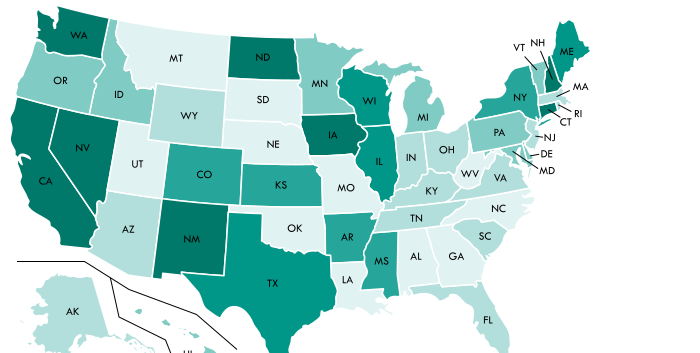
Most common states for community aides
| Rank | State | Population | # of jobs | Employment/ 1000ppl |
|---|---|---|---|---|
| 1 | Montana | 1,050,493 | 142 | 14% |
| 2 | Indiana | 6,666,818 | 879 | 13% |
| 3 | District of Columbia | 693,972 | 92 | 13% |
| 4 | Massachusetts | 6,859,819 | 792 | 12% |
| 5 | Minnesota | 5,576,606 | 644 | 12% |
| 6 | Iowa | 3,145,711 | 355 | 11% |
| 7 | Kansas | 2,913,123 | 328 | 11% |
| 8 | Nebraska | 1,920,076 | 220 | 11% |
| 9 | Maine | 1,335,907 | 149 | 11% |
| 10 | Alaska | 739,795 | 78 | 11% |
| 11 | Vermont | 623,657 | 60 | 10% |
| 12 | Pennsylvania | 12,805,537 | 1,163 | 9% |
| 13 | Michigan | 9,962,311 | 910 | 9% |
| 14 | New Jersey | 9,005,644 | 770 | 9% |
| 15 | Illinois | 12,802,023 | 1,000 | 8% |
| 16 | Wisconsin | 5,795,483 | 492 | 8% |
| 17 | Maryland | 6,052,177 | 463 | 8% |
| 18 | West Virginia | 1,815,857 | 154 | 8% |
| 19 | Delaware | 961,939 | 80 | 8% |
| 20 | North Dakota | 755,393 | 62 | 8% |
Most common cities for community aides
| Rank | City | # of jobs | Employment/ 1000ppl | Avg. salary |
|---|---|---|---|---|
| 1 | White Lake | 1 | 3% | $22,780 |
| 2 | Richmond | 1 | 1% | $27,580 |
| 3 | Rochester Hills | 1 | 1% | $22,823 |
Community Aide job outlook: Expert opinions
Our panel of community aide experts

North Dakota State University

Seattle University

East Tennessee State University

American University
Joel Hektner Ph.D.
Professor and Department HeadNorth Dakota State University
Human Development and Family Science
What skills will help Community Aides earn the most?
Joel Hektner Ph.D.: The ability to adapt your skills to the context you are in.
Theresa Earenfight Ph.D.
Professor of History, Director, Women, Gender, and Sexuality Studies ProgramSeattle University
History Department
Will there be an enduring impact of the coronavirus pandemic on Community Aides?
Theresa Earenfight Ph.D.: As a historian of the European Middle Ages, I'm struck by how students this past year have acquired something scarce: historical empathy. The past can seem so remote, so very different from our lived experiences today, and this can make history seem irrelevant. But this fall, I was teaching a section on the bubonic plague, which historians of medicine now know was a global pandemic, not just an epidemic in Europe. Usually, students are fascinated by the gruesome medical details, but not this group.
They did not need or want to look death in the eyes. They wanted to know how did people react? How did they get back to normal? When we ticked off the list of reactions--fear, distrust of science (such as it was in 1348), xenophobia, scapegoating, economic collapse, hoarding supplies, turn to religion, gallows humor about worms crawling about corpses--they got it. When we talked about the aftermath--eat, drink, be merry, and protest the inequality--they got it. That is historical empathy, and I'm sad that this was how it had to be learned, but it will give them broader compassion that can encompass people alive today.
Will there be an enduring impact of the coronavirus pandemic on Community Aides?
Dr. Frederick Gordon Ph.D.: Graduate students will need to refocus on the changing institutional role, being both remote and in-person, and impacting agency goals and performance.
What experience really stands out on Community Aide resumes?
Dr. Adelaide Kelly-Massoud: Special Education may be unique in a COVID-19 era because the demand is not expected to waver. I would argue now, more than ever; the school will be looking deeply at candidates' qualifications. A teacher candidate entering the field will want the resume to reflect their abilities and what they can offer to school culture. During this time, schools will want to see that candidates have varied experiences with face to face, virtual, and possibly, hybrid instruction. Some, if not many, teacher candidates are entering the field with all of their clinical experience being a reflection of virtual COVID-19 era teaching. If that is the case, I would advise candidates to highlight experiences with pre-K-12 students that informed their decision to join the field. Highlight the spark of passion moment and past jobs working with kids.
Current trends and future directions of special education will require candidates that have a pulse on the social justice issues that face today's children. Candidates' resumes should reflect their ability to create a safe and inclusive classroom for all learners. The achievement gaps that already existed in education will continue to grow in the face of the global pandemic. A resume reflecting a special education teacher has the passion and skills to use data-driven, research-based interventions to narrow the gap and show a more profound commitment to creating meaningful change.
How do you envision technology impacting Community Aides in the next 5 years?
Dr. Adelaide Kelly-Massoud: Well, every teacher and teacher candidate was thrust into distance learning. Misguided attempts to foster understanding often leaned our adult distant learning pedagogy. Teachers, and those who prepare teachers, found their job to research, define, design, and implement meaningful teaching and learning using a virtual platform. Words such as synchronous and asynchronous are now a part of our everyday vernacular. But there is a much more optimistic change on the horizon that we can thank coronavirus for.
Communication and collaboration have been forced to change. Parents and Teachers are more connected and have been put in a position to leverage technology to build networks of support and consistent dialog. I urge teachers to leverage this in their future as we work to reopening schools; we should learn from this experience to leverage technology to keep us connected.