Explore jobs
Find specific jobs
Explore careers
Explore professions
Best companies
Explore companies
Job outlook for community program assistants in the United States
Community program assistant job growth summary. After extensive research, interviews, and analysis, Zippia's data science team found that:
The projected community program assistant job growth rate is 12% from 2018-2028.
About 52,400 new jobs for community program assistants are projected over the next decade.
Community program assistant salaries have increased 13% for community program assistants in the last 5 years.
There are over 16,054 community program assistants currently employed in the United States.
There are 123,129 active community program assistant job openings in the US.
The average community program assistant salary is $35,093.
Are community program assistant jobs in demand?
Community program assistant job and salary trends over time
Community program assistant jobs over time
Community program assistant job growth rate over time
| Year | # of jobs | % of population |
|---|---|---|
| 2021 | 16,054 | 0.00% |
| 2020 | 16,116 | 0.00% |
| 2019 | 16,299 | 0.00% |
| 2018 | 15,809 | 0.00% |
| 2017 | 15,478 | 0.00% |
Average community program assistant salary over time
Community program assistant salary by year
| Year | Avg. salary | Hourly rate | % Change |
|---|---|---|---|
| 2026 | $35,093 | $16.87 | +2.6% |
| 2025 | $34,214 | $16.45 | +3.9% |
| 2024 | $32,936 | $15.83 | +1.9% |
| 2023 | $32,321 | $15.54 | +4.1% |
| 2022 | $31,043 | $14.92 | +3.2% |
Community program assistant jobs by state
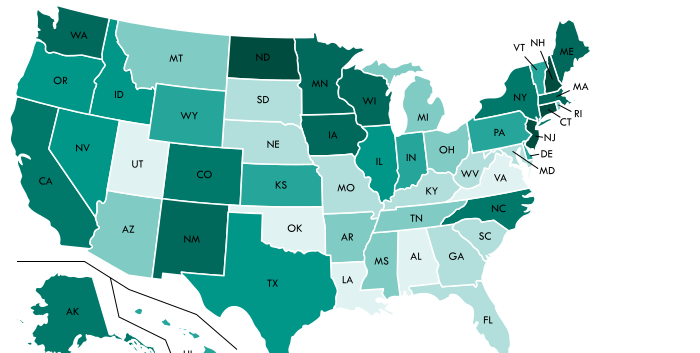
Most common states for community program assistants
| Rank | State | Population | # of jobs | Employment/ 1000ppl |
|---|---|---|---|---|
| 1 | District of Columbia | 693,972 | 218 | 31% |
| 2 | North Dakota | 755,393 | 208 | 28% |
| 3 | Minnesota | 5,576,606 | 1,519 | 27% |
| 4 | New Hampshire | 1,342,795 | 311 | 23% |
| 5 | Delaware | 961,939 | 211 | 22% |
| 6 | Rhode Island | 1,059,639 | 219 | 21% |
| 7 | Montana | 1,050,493 | 211 | 20% |
| 8 | Colorado | 5,607,154 | 1,025 | 18% |
| 9 | Oregon | 4,142,776 | 729 | 18% |
| 10 | Connecticut | 3,588,184 | 608 | 17% |
| 11 | Nebraska | 1,920,076 | 327 | 17% |
| 12 | South Dakota | 869,666 | 150 | 17% |
| 13 | Utah | 3,101,833 | 488 | 16% |
| 14 | Maine | 1,335,907 | 211 | 16% |
| 15 | Alaska | 739,795 | 117 | 16% |
| 16 | Massachusetts | 6,859,819 | 1,023 | 15% |
| 17 | Wisconsin | 5,795,483 | 863 | 15% |
| 18 | Iowa | 3,145,711 | 476 | 15% |
| 19 | New Mexico | 2,088,070 | 305 | 15% |
| 20 | New Jersey | 9,005,644 | 1,284 | 14% |
Most common cities for community program assistants
| Rank | City | # of jobs | Employment/ 1000ppl | Avg. salary |
|---|---|---|---|---|
| 1 | Needham | 1 | 3% | $40,533 |
| 2 | Plant City | 1 | 3% | $30,504 |
| 3 | Brookline | 1 | 2% | $40,551 |
| 4 | Burnsville | 1 | 2% | $39,813 |
| 5 | Fond du Lac | 1 | 2% | $40,910 |
| 6 | Charleston | 1 | 1% | $30,852 |
| 7 | Concord | 1 | 1% | $41,273 |
| 8 | New York | 1 | 0% | $37,906 |
| 9 | Pittsburgh | 1 | 0% | $34,280 |
| 10 | Saint Paul | 1 | 0% | $39,986 |
| 11 | Seattle | 1 | 0% | $41,242 |
| 12 | Spokane | 1 | 0% | $41,060 |
Community Program Assistant job outlook: Expert opinions
Our panel of community program assistant experts
Adelphi University
Saint Xavier University
Western Illinois University
SUNY at Buffalo

Lewis University
University of the Incarnate Word
Saint Xavier University
Louisiana State University at Shreveport
Elon University

North Dakota State University

Austin Community College
Tiffin University

University of New Orleans

California University of Pennsylvania
Missouri State University

Grace Christian University
Morningside College

Auburn University
What Community Program Assistant skills would you recommend for someone trying to advance their career?
Katherine Stavrianopoulos Ph.D.: Digital Literacy and Teletherapy Skills: With the continued integration of technology in mental health care, counselors will need to enhance their proficiency in digital platforms and teletherapy modalities. This includes utilizing secure video conferencing tools, managing electronic health records (EHR), and maintaining ethical standards in online therapy settings. Cultural Competence and Diversity Awareness: As awareness of cultural diversity and social justice issues grows, counselors must deepen their understanding of intersectionality and cultural humility. Competence in working with diverse populations and addressing systemic barriers to mental health care will from an antiracism lens will be essential for providing inclusive and culturally responsive services. Trauma-Informed Care: Given the prevalence of trauma and its impact on mental health, counselors will need to adopt trauma-informed approaches across various settings. This includes recognizing the signs of trauma, creating safe environments for disclosure, and integrating trauma-sensitive interventions into counseling practice. Resilience-Building and Positive Psychology: In addition to addressing mental health challenges, there will be a greater emphasis on promoting resilience and well-being. Counselors will incorporate positive psychology principles, such as strengths-based interventions and mindfulness techniques, to empower clients and enhance their coping skills. Collaborative and Interdisciplinary Care: With the recognition of the interconnectedness of physical and mental health, counselors will collaborate more closely with other healthcare professionals in integrated care settings. Strong communication skills and the ability to work collaboratively within multidisciplinary teams will be essential for providing holistic and comprehensive care to clients. Data Literacy and Outcome Measurement: Increasing emphasis on evidence-based practice and outcome measurement will require counselors to develop skills in data collection, analysis, and outcome evaluation. Ethical Decision-Making in Complex Situations: As counseling scenarios become increasingly complex, counselors will face ethical dilemmas that require nuanced decision-making. Strengthening skills in ethical reasoning, consultation, and ethical sensitivity will enable counselors to navigate challenging ethical issues with integrity and professionalism.
What will help Community Program Assistants increase their earning potential?
Katherine Stavrianopoulos Ph.D.: Continued Learning and Development: Stay committed to lifelong learning by attending workshops, pursuing advanced certifications, and staying updated on the latest research and therapeutic techniques. Supervision and Mentorship: Seek out supervision and mentorship opportunities from experienced professionals in the field. Consider participating in a peer supervision group where you can support one another and be open to constructive criticism as part of your development. Engage in regular self-reflection for personal growth. Prioritize Self-Care: Establish healthy boundaries between work and personal life, engage in activities that recharge you and help prevent burn out. Cultural Competence and Diversity: Cultivate cultural humility and strive to understand the diverse backgrounds and perspectives of your clients. Continuously educate yourself on multiculturalism and antiracism to provide competent and inclusive counseling services. Ethical Practice: Adhere to ethical guidelines and professional standards in your practice. Strive to Build Strong Therapeutic Relationships: Establish rapport, demonstrate empathy, and create a safe and trusting environment where clients feel comfortable exploring their thoughts and feelings. Evidence-Based Practice: Stay informed about research findings and utilize interventions that have been empirically validated for specific client populations and presenting issues. Networking and Collaboration: Build professional connections within the counseling community. Attend conferences, join professional organizations, and participate in networking events to expand your professional network. Collaboration with colleagues can lead to referrals, consultation opportunities, and mutual support. Consider doing some pro bono work: Pro bono services help bridge the gap to access mental health services for individuals who cannot afford them.
Errol Rodriguez Ph.D., MAC, CRC
Assistant Dean & Program Director, Master's programs in General Psychology and Mental Health CounselingAdelphi University
Mental And Social Health Services And Allied Professions
What Community Program Assistant skills would you recommend for someone trying to advance their career?
Errol Rodriguez Ph.D., MAC, CRC: Given the complexities of the world today, emerging counseling professionals must be flexible in their treatment approach, inclusive in their understanding of diverse cultures and sub-cultures, and mature professionally through humility, self-reflection, and self-care.
What will help Community Program Assistants increase their earning potential?
Errol Rodriguez Ph.D., MAC, CRC: One way to maximize your earning potential when starting your career is to develop a focus, not just a specialization. A focus requires a broader lens when it comes to earnings. For example, specializing in clinical treatments for addiction is important and will generate referrals. However, having a focus in addiction treatments extends your reach into other adjacent areas such as business applications and services offered outside of the therapy office. It might start with the question, 'what other groups or organizations might benefit from my focus area?' This might lead to a consultation opportunity at a business that is interested in reducing burnout for its employees and by extension the sequelae of problems associated with burnout (e.g., depression, addiction). One opportunity often leads to another. The second way to maximize income early in your career is to consider ways to translate what you do into a public-facing profile. Whether using LinkedIn or your own website, it is crucial for the public to become acquainted with you professionally. Investing in this process will pay off quickly.
What general advice would you give to a Community Program Assistant?
Kristen Toole: Remember that this is a marathon, not a sprint. Personal and professional development are
lifelong processes that are never really finished. So, it is essential to pace yourself and establish a
foundation of healthy practices from the outset. Creating habits and routines in the beginning
with the end in mind can be a good strategy for success and sustainability.
Keep work-life balance and boundaries in mind from the start because breaking bad habits can
be tricky once established. Think about where you ultimately want to be and build toward that
future one step at a time. Also, it is okay if plans change! You never know where open-
mindedness and willingness to learn may take you.
What Community Program Assistant skills would you recommend for someone trying to advance their career?
Emily Yowell Ph.D.: There is a critical need for mental health care in our world. Many want to help with this need, making counseling a good profession to enter now.
What will help Community Program Assistants increase their earning potential?
Emily Yowell Ph.D.: Psychologists should be aware of what others in their field are making for similar positions. It is important to ask for what your work is worth in an initial position to assure raises are based on a solid starting salary. Newer psychologists may also consider asking for an early review that prompts an early conversation around potential raises, bonus, or other job benefits.
Leigh Ann Tipton-Fisler, PhD, BCBA
Associate Professor and Program Coordinator of Specialist in School Psychology and Clinical/ Community Mental Health Graduate ProgramsWestern Illinois University
Clinical, Counseling And Applied Psychology
What general advice would you give to a Community Program Assistant?
Leigh Ann Tipton-Fisler, PhD, BCBA: - The best I can give to graduates is to focus on taking small steps at first. Often the first year in the field can be exciting and overwhelming at the same time. The system we work in (the helping profession broadly) often has a lot of challenges, and new professionals want to re-envision a path for changes. This is tangible, but at first, it is important to understand the roles and functions in the workplace before flipping everything upside down. I suggest taking one small change at a time in an area that is important to you and build relationships and trust with your professional colleagues before overloading yourself with the new job and new goals.
Alaina Steele Ph.D.
Assistant Professor of Criminal JusticeSUNY at Buffalo
Educational Assessment, Evaluation, And Research
What will help Community Program Assistants increase their earning potential?
Alaina Steele Ph.D.: This is vital to institutional effectiveness, research, and continuous improvement for higher education institutions. Those working in this field will conduct assessment, evaluation, and research in the service of diversity, equity, inclusion, and transparency. It is important for students and families to know how colleges and universities are performing and, in turn, for institutions to be able to market their programs and leverage data to tell their stories. Educators are also empowered to create more innovative and robust courses with this information. In essence, this work (much of what goes on behind the scenes) powers the institution.
Lisa Brown
Assistant ProfessorLewis University
School Counseling Program
What soft skills should all Community Program Assistants possess?
Lisa Brown: School counselors must be efficient. They may have large caseloads of students for which they are responsible. Being able to prioritize, manage their time, and have a strong work ethic are necessary components to success. Attitude is also key. School counselors are to be empathic, approachable, and nonjudgmental. This means school counselors need to be open to learning from others and be willing to confront any bias or prejudice they may hold.
School counselors are collaborators within the school system and may work as part of a large team that may include the student, parents, teachers, coaches, deans, social workers, psychiatrists, and so forth. School counselors must understand and demonstrate teamwork and conflict resolution.
What hard/technical skills are most important for Community Program Assistants?
Lisa Brown: Because of the prevalence of social/emotional issues within K-12, especially in the last few years, school counselors need to have assessment skills. School counselors need to identify any red flags in their students that may indicate the student is struggling. This goes beyond academics and includes aspects such as interpersonal skills and self-worth.
Similar to assessment is data analysis. The gathering of data does not stop after a student is assessed but rather is just beginning. School counselors are held accountable to demonstrate the interventions they are utilizing are working. Data is also used to secure future funds. If an intervention used within the fall resulted in little change, a school district might not allocate funds to continue to use the same program. School counselors utilize data to demonstrate how effective they are and advocate for additional resources to address social/emotional issues within their student body.
As we learned during COVID-19, school counselors need to be tech-savvy. Many students are still learning remotely or are utilizing a hybrid format. While this has been quite helpful for some students, others are falling through the cracks. School counselors have had to get creative in checking in with their students and are doing so through technology.
What skills will help Community Program Assistants earn the most?
Lisa Brown: Earning potential for school counselors is not likely to vary based on skillset, but rather the state or school district. Salary may vary based on the type of degree (master's versus doctorate) and level of experience. I am unsure of what skills may increase one's salary. As a counselor educator, I advise my students to remain relevant. Part of being successful in our field understands how current events shape the lives and needs of our students. Currently, there is a great need for school counselors to understand trauma, LGBTQ+ identities, and how to establish an anti-racist school.
David Perryman Ph.D.
InstructorUniversity of the Incarnate Word
Department of Communication Arts
What soft skills should all Community Program Assistants possess?
David Perryman Ph.D.: I value the following soft skills:
-Organizational skills: managing multiple assignments concurrently, understanding priorities, setting project timelines, meeting deadlines.
-People skills: the ability to listen carefully and ask good questions, appreciation for the importance of teamwork, relational focus (vs. transactional focus), ability to communicate verbally/face-to-face in a credible, authentic and professional manner.
-Strategic thinking: the ability to understand how their day-to-day work and individual projects help advance an organization's mission and achieve long-term strategic goals.
What hard/technical skills are most important for Community Program Assistants?
David Perryman Ph.D.: I value the following hard skills:
-Reading: Ability to read complex material, identify key concepts/most important facts, discern the bottom line.
-Research: Ability to sift through myriad traditional and digital sources of information, discern fact/credible sources from fiction/unreliable sources, and extract information that is most pertinent to the project they're working on.
-Writing: Ability to write clearly, actively, and concisely while adhering to the basics of grammar and style (e.g., AP Style).
Laura Laskowski-Ferrell
Assistant Professorial Lecturer and Program CoordinatorSaint Xavier University
Education Department
What hard/technical skills are most important for Community Program Assistants?
Laura Laskowski-Ferrell: -Understanding of school code and federal policies that impact programming
-Background in budgeting
-Understanding of job trends and endorsement growth areas
-Leadership in recruitment efforts
Kacie Blalock Ph.D.
Associate Professor; Director, Master of CounselingLouisiana State University at Shreveport
Department Of Psychology
What soft skills should all Community Program Assistants possess?
Kacie Blalock Ph.D.: Soft skills that are essential for counselors include emotional intelligence, empathy, multicultural competency, interpersonal abilities, and authenticity.
What hard/technical skills are most important for Community Program Assistants?
Kacie Blalock Ph.D.: It is important that counselors are able to effectively take notes and summarize progress, interpret assessments, memorize and recall information, and keep clear yet concise records.
What skills will help Community Program Assistants earn the most?
Kacie Blalock Ph.D.: Skills that will help you earn the most include teletherapy and trauma-informed care.
What skills stand out on Community Program Assistant resumes?
Monica Burney: Human Service professionals are glad to see skills such as grant writing, new presentation and database technology, a strong background in diversity/equity training when hiring. They also feel more confident about candidates with prior experience in internships or jobs that involve direct contact with clients and professional communication.
What skills will help Community Program Assistants earn the most?
Monica Burney: Professionals who have additional certifications, including any technology, language, or clinical training certifications, can sometimes negotiate higher salaries depending on if the agency they are applying to have a unique need for those services. Also, professionals with proven fundraising and/or grant writing experience may have opportunities in non-traditional roles or settings that offer higher salaries.
Joel Hektner Ph.D.
Professor and Department HeadNorth Dakota State University
Human Development and Family Science
What hard/technical skills are most important for Community Program Assistants?
Joel Hektner Ph.D.: Solid knowledge of developmental milestones for children, issues faced by aging adults, and common family relationship challenges.
What soft skills should all Community Program Assistants possess?
Joel Hektner Ph.D.: Interpersonal skills, communication, ability to work collaboratively. Respect for individual and cultural differences.
What skills will help Community Program Assistants earn the most?
Joel Hektner Ph.D.: The ability to adapt your skills to the context you are in.
Michelle Kelley Shuler Ph.D.
Department Chair: Human ServicesAustin Community College
Human Services Department
What soft skills should all Community Program Assistants possess?
Michelle Kelley Shuler Ph.D.: I would refer to this skill set as "essential" and consist of compassion, empathy, teamwork, the ability to listen, a sense of humor, and most importantly, the ability to practice self-care. I include self-care in this list because working in the human service field can be exhausting and emotionally overwhelming. Taking care of ourselves helps to prevent burnout and possibly leaving the profession.
What skills stand out on Community Program Assistant resumes?
Michelle Kelley Shuler Ph.D.: a. Service to the community such as volunteer work at a food bank or camp counselor for those with physical or mental exceptionalities.
b. Consumer or customer service experience is essential, and experience dealing with the retail industry, food industry, and case management definitely stand out.
What hard/technical skills are most important for Community Program Assistants?
Michelle Kelley Shuler Ph.D.: a. Must have strong basic computer skills and knowledge of software such as excel spreadsheets, google docs, etc. Most, if not all, agencies use electronic health records and treatment planning, so it is necessary to be competent in this area.
b. A degree and additional certifications will assist you in seeking employment. It will also increase your level of competency and diversify the communities you serve. For example, at Austin Community College, we offer our students a chance to complete a certification in Mental Health First Aid Training. This increases their marketability and skill level.
Jonathan Appel Ph.D.
Professor of Psychology, Counseling & Criminal JusticeTiffin University
Department of Behavioral and Social Sciences
What will help Community Program Assistants increase their earning potential?
Jonathan Appel Ph.D.: Mixing unusual majors and minors-to stand out in the crowd often can help student marketability. For example I recently have been working with a psychology student to establish a business minor. This can prepare the student work in human resource management as well as the human service field.
Obtaining an advanced graduate degree often helps.
Will there be an enduring impact of the coronavirus pandemic on Community Program Assistants?
Christopher Todd Belser Ph.D.: 100 percent, yes. The coronavirus pandemic has greatly impacted the training experiences that emerging graduates have received, especially those who have been working at practicum and internship sites in 2020 and 2021. Many students had to navigate school site closures and pivots to online learning both in their K-12 field site and their graduate coursework. On one hand, this has likely limited some of the experiences they were able to gain as a graduate student, and on the other hand, it forced them to become acquainted with new technologies and new real-world crises while working under a supportive network of university and site supervisors. In addition to the direct impacts on the graduates themselves, the coronavirus pandemic has also sparked conversations about what role school counselors will play in responding to student needs as we move toward a new normal. The events of 2020, including both the coronavirus pandemic and racial justice efforts, will likely be watershed moments for the current generations of K-12 students, and the impacts will be both immediate and long-term. School counselors will need to dive head first into helping K-12 students work through grief/loss, fears and anxieties, academic challenges, motivation loss, career and postsecondary concerns, and a myriad of other issues related to reintegrating into on-site school environments. And as K-12 employees whose identity bridges education and mental health, there will be a great need for school counselors to act as leaders, advocates, collaborators, and change agents in response efforts that are equitable and systems-oriented.
Will there be an enduring impact of the coronavirus pandemic on Community Program Assistants?
Dr. T. Thao Pham Ph.D.: Having the field placements to allow graduates to learn about needed clinical and administrative skills in social work. The pandemic has resulted in reduced required field hours from our accrediting body but also the availability of field internships with face-to-face contact. Students often use telehealth to work with clients. On the other hand, students are graduating with more telehealth experience so that is an added skill set. They also must learn to be more resilient and better organized with the pandemic.
What's a good job out of college for Community Program Assistants?
Dr. Abby Templer Rodrigues Ph.D.: A good job out of college is one that allows you to continue to grow your skills and abilities and deepen your character. Your degree and existing skills get you in the door, and continual acquisition of skills is required to maintain employment and to advance.
What technical skills for a Community Program Assistant stand out to employers?
Dr. Abby Templer Rodrigues Ph.D.: Employers look for oral and written communication skills, the ability to work effectively in diverse teams, analytical and quantitative reasoning, and the ability to adapt to new technologies (Ciabattari et al. 2018). Employers specifically prefer college graduates who have experience applying these skills through internships, service learning, senior projects or collaborative research, field projects, or study abroad (Ciabattari et al. 2018).
References
Ciabattari Teresa, Lowney Kathleen S., Monson Renee A., Senter Mary Scheuer, and Chin
Jeffrey. 2018. "Linking Sociology Majors to Labor Market Success." Teaching Sociology 46 (3): 191-207.
Handwerker, Elizabeth Weber, Peter B. Meyer, and Joseph Piacentini. 2020. "Employment
Recovery in the Wake of the COVID-19 Pandemic." Monthly Labor Review, December, 1-24.
Langin, Katie. 2020. "U.S. faculty job market tanks." Science 370(6514): 272-273.
Scott Shaw Ph.D.
Dean / Professor of Human Services, School of Social Sciences and Human ServicesGrace Christian University
School of Social Sciences and Human Services
What are the biggest trends we'll see in the Community Program Assistant job market given the pandemic?
Scott Shaw Ph.D.: The biggest trends in the current job market include both technical skills and people skills that can be adapted to multiple settings and with a high degree of cultural intelligence (CQ). Many services are adapting to an online, virtual, or personal-delivery format. This has impacted everything from higher education with virtual classes, and telehealth and virtual service delivery models in medical and mental health services, to products ordered online and being delivered to one's doorstep in lieu of large malls and physical stores. Current job applicants must be able to respectfully engage with people from diverse racial, ethnic and cultural backgrounds, as well as help meet the needs of their communities as a direct reflection of the companies and careers they represent.
I encourage my students to embrace 'comfort being uncomfortable' and always be learning. What appears to be a "hot market" or "best" career option today may not be the same answer next year. Being able to engage with all people respectfully, listen well, and provide innovative solutions in a sensitive way will go a long way in whatever developments come along in the current and future job market. I also encourage those looking for work to review their social media accounts - employers check social media accounts and one's digital footprint can make or break an interview based on what one posts, as well as reveal a great deal about one's character and values. Skills and technical abilities should be as diversified and multidisciplinary as possible; however, one's character and values should consistently tell a single story about the applicant as a person.
What's a good job out of college for Community Program Assistants?
Scott Shaw Ph.D.: The best job out of college is the one that provides an opportunity for learning, development and advancement. There is no one "best job" and anyone can learn something from every experience - employers often ask about experiences and lessons learned in job interviews. With a growth mindset and willingness to work hard, applicants who can demonstrate integrity, critical thinking, cultural intelligence, and drive can take whatever job they obtain and use this opportunity for advancement. Job applicants may find opportunities that do not look quite like they initially envisioned and enjoy the process of finding something new and innovative, as well as discern more clearly what one truly enjoys. Most employers understand that employees will potentially leave or outgrow the job, yet capitalizing on opportunities to learn and serve others in the present can illustrate a great deal about an applicant's character and work ethic.
I had a recent graduate who majored in psychology who had initially planned on a career as a therapist. While in college, she began working for a major retailer and through applying her knowledge of psychology and people skills, advanced in the company. Upon graduating with her psychology degree, she was offered a higher-level executive promotion and actually loved her job, but felt conflicted because she was now in a position to take on more responsibility with a significant pay increase, yet she had studied psychology and felt like she might be 'wasting her education' by not practicing psychology. I encouraged her to consider her values, immediate and long-term goals, yet not be dismissive of the applications of her psychology training. Her engaging with customers from different backgrounds, leading fellow employees and applying critical thinking and leadership that she learned in college were what helped her earn this opportunity. She was using her knowledge and psychology degree every day, even though it did not look like what she had initially envisioned. She later told me she had taken the promotion and was very happily growing into her new role, and now felt confident she was using her degree and what she trained to do. She also acknowledged she could change course if and when she decides.
Stacie Hays
Associate Vice President of Career Services & Professional DevelopmentMorningside College
Career Services Department
What are the biggest trends we'll see in the Community Program Assistant job market given the pandemic?
Stacie Hays: I think one of the biggest trends we will see is an increase and continuation for remote work or work from home opportunities. Specifically, I think the pandemic has allowed employers to really see and understand that you don't need someone in the office to succeed with work tasks. I think this will cause employers to increase their searches for the right candidate, not only the local candidate, or one that is willing to relocate. This opens up opportunities in a way that perhaps we have not seen before.
Adam Greer
Career Services SpecialistAuburn University
Department of Human Development and Family Science
What skills stand out on Community Program Assistant resumes?
Adam Greer: Clearly, the distance/online working skills will stand out with our HDFS majors. Our students have a strong foundation in learning to work with people, and now they have a new way to work with people and remove barriers that might have previously prevented an in-person meeting.