Explore jobs
Find specific jobs
Explore careers
Explore professions
Best companies
Explore companies
Job outlook for compliance program managers in the United States
Compliance program manager job and salary trends over time
Compliance program manager jobs over time
Compliance program manager job growth rate over time
| Year | # of jobs | % of population |
|---|---|---|
| 2021 | 6,454 | 0.00% |
| 2020 | 49,731 | 0.01% |
| 2019 | 48,249 | 0.01% |
| 2018 | 6,000 | 0.00% |
| 2017 | 5,575 | 0.00% |
Average compliance program manager salary over time
Compliance program manager salary by year
| Year | Avg. salary | Hourly rate | % Change |
|---|---|---|---|
| 2026 | $98,403 | $47.31 | +4.2% |
| 2025 | $94,391 | $45.38 | +1.3% |
| 2024 | $93,171 | $44.79 | +1.8% |
| 2023 | $91,550 | $44.01 | +0.6% |
| 2022 | $90,996 | $43.75 | +0.1% |
Compliance program manager jobs by state
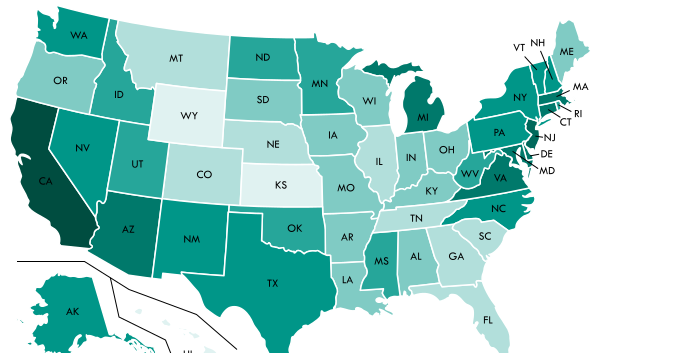
Most common states for compliance program managers
| Rank | State | Population | # of jobs | Employment/ 1000ppl |
|---|---|---|---|---|
| 1 | District of Columbia | 693,972 | 535 | 77% |
| 2 | Washington | 7,405,743 | 2,747 | 37% |
| 3 | Delaware | 961,939 | 225 | 23% |
| 4 | Rhode Island | 1,059,639 | 235 | 22% |
| 5 | New Hampshire | 1,342,795 | 287 | 21% |
| 6 | Montana | 1,050,493 | 217 | 21% |
| 7 | Massachusetts | 6,859,819 | 1,405 | 20% |
| 8 | Oregon | 4,142,776 | 826 | 20% |
| 9 | Virginia | 8,470,020 | 1,616 | 19% |
| 10 | Utah | 3,101,833 | 593 | 19% |
| 11 | Minnesota | 5,576,606 | 1,023 | 18% |
| 12 | Colorado | 5,607,154 | 935 | 17% |
| 13 | Nebraska | 1,920,076 | 324 | 17% |
| 14 | Connecticut | 3,588,184 | 592 | 16% |
| 15 | North Dakota | 755,393 | 119 | 16% |
| 16 | New Jersey | 9,005,644 | 1,329 | 15% |
| 17 | Maryland | 6,052,177 | 910 | 15% |
| 18 | South Dakota | 869,666 | 131 | 15% |
| 19 | California | 39,536,653 | 5,526 | 14% |
| 20 | Arizona | 7,016,270 | 958 | 14% |
Most common cities for compliance program managers
| Rank | City | # of jobs | Employment/ 1000ppl | Avg. salary |
|---|---|---|---|---|
| 1 | Frankfort | 2 | 7% | $88,225 |
| 2 | Juneau | 2 | 6% | $95,437 |
| 3 | Annapolis | 2 | 5% | $104,325 |
| 4 | Dover | 2 | 5% | $105,663 |
| 5 | Hartford | 2 | 2% | $102,558 |
| 6 | Lansing | 2 | 2% | $106,852 |
| 7 | Springfield | 2 | 2% | $72,370 |
| 8 | Boston | 4 | 1% | $101,632 |
| 9 | Baton Rouge | 2 | 1% | $87,663 |
| 10 | Des Moines | 2 | 1% | $83,036 |
| 11 | Little Rock | 2 | 1% | $86,236 |
| 12 | Montgomery | 2 | 1% | $83,013 |
| 13 | Tallahassee | 2 | 1% | $80,245 |
| 14 | Atlanta | 2 | 0% | $76,636 |
| 15 | Indianapolis | 2 | 0% | $86,084 |
| 16 | Phoenix | 2 | 0% | $106,108 |
| 17 | Sacramento | 2 | 0% | $128,308 |
Compliance Program Manager job outlook: Expert opinions
Our panel of compliance program manager experts
Freed-Hardeman University
University of Tennessee

Swarthmore College

Auburn University at Montgomery
Western Carolina University
Auburn University at Montgomery
Maryville University

Davenport University

Azusa Pacific University
Will there be an enduring impact of the coronavirus pandemic on Compliance Program Managers?
Kristen Roberson: The workplace will forever be altered due to the pandemic, and the effects of those in career transitions, not just those graduating now, will be impacted for some time. It will take some time for the new normal to be normal.
What's a day at work look like for a Compliance Program Manager?
Kristen Roberson: That depends on the role they are in, but the big hurdle is going to be landing that first role. They need to be willing to shift their plans, be ready to try contract or project-based work. No matter where they land, the ability to self-manage will be more critical than before 2020 since more work will be remote and much more video conferences, and a lot less travel.
Scott Gilpatric
Professor and Department HeadUniversity of Tennessee
Department of Economics, Haslam College of Business
What's a good job out of college for Compliance Program Managers?
Scott Gilpatric: That really depends on the individual. The most important factor in a first job coming out of college might be the opportunity to learn about yourself, learn what you are good at, and find a good direction for furthering your own growth in skills and understanding what you want your career to be. Obviously compensation matters, but often the work environment will impact job satisfaction more than money. Finding a place where you look forward to working with your colleagues most days is incredibly valuable, and a lot of compensation is required to offset the unpleasantness if you dread going to work every morning.
What will help Compliance Program Managers increase their earning potential?
Scott Gilpatric: The easy answer is being really proficient with handling data, including being comfortable with learning to code in whatever manner might be needed. There's no question those skills are likely to open doors. But in a very different way, one thing that really matters is being able to talk comfortably about ideas and developments in economics, business, or policy areas, signaling a strong base of knowledge. Towards that end, reading deeply, not just the headlines but long-form analysis in places like The Economist and other high-quality publications can be really beneficial.
What's a good job out of college for Compliance Program Managers?
Stephen O'Connell: Work that uses your skills and builds new ones. There is a premium on your own flexibility over the couple of years, with a lot of job-market volatility due to uncertain structural impacts of the pandemic.
What technical skills for a Compliance Program Manager stand out to employers?
Stephen O'Connell: The organization, presentation and interpretation of data are probably particularly valued. Comfort with all kinds of online productivity tools. As always, capacity for critical thinking. For now especially, ability to work independently within a team that meets only remotely.
Brett Lehman Ph.D.
ProfessorAuburn University at Montgomery
Department of Sociology, Anthropology, and Social Work
What certifications/licenses/courses can have the biggest impact for Compliance Program Managers?
Brett Lehman Ph.D.: Sociology students with research and public speaking experience will have improved job prospects. This could be developed in many courses, though some core areas for us are Research Methods and Statistics. Most employers collect and analyze data of some kind. Then they have to organize the results properly and present the findings to a variety of audiences. Any course that require students to do their own projects, make difficult decisions, justify those decisions, and then explain the results give students a leg up in critical thinking skills and much more. Students might also have similar experiences through community service, independent/supervised research projects, or an internship.
What's a good job out of college for Compliance Program Managers?
Brett Lehman Ph.D.: There is a business side and a human side to this answer. On the business side, I hope graduates are provided benefits like health insurance, a gainful salary, and opportunities for advancement. The way to hit a home-run is to get a job where those needs are taken care of and you still get to use your skills for something you feel is important. Most sociology students get into the subject because they care about the human side, want to help people, and see opportunity for creating positive social change. You'll get motivated sociology graduates when you show them a path towards achievement on the human side; then when we there's less worry about the business side, some impressive results could follow!
Will there be an enduring impact of the coronavirus pandemic on Compliance Program Managers?
Angela Sebby Ph.D.: While jobs may be slower to return to the capacity pre-Covid, the industry and tourism employment will rebound as people still want to travel and explore diverse foods, cultures, and experiences. However, the enduring impact will be the rapid onset of technology that allowed for limited contact with employees and others has become the new norm. Although human interaction is an important aspect of service in the tourism industry, employers have found that they can reduce the number of personal interactions but still deliver an acceptable level of quality service. What would have taken years to adopt, COVID created an amplified adoption.
What technical skills for a Compliance Program Manager stand out to employers?
Angela Sebby Ph.D.: Business, creative, and organizational skills - I would recommend that upcoming graduates are proficient in Word, Excel (highly used), Powerpoint, Outlook (especially how to send meeting requests and calendar organization), TEAMS, Gantt charts for team management, Mindmapping for creativity, and design software. Additionally, I would recommend that they learn how to properly utilize social media for marketing and PR, not just personal posting. Finally, email etiquette would be essential.
What soft skills should all Compliance Program Managers possess?
TeWhan Hahn Ph.D.: Writing skills including email writing, being able to work in teams, and knowing the workplace etiquettes.
What's a day at work look like for a Compliance Program Manager?
TeWhan Hahn Ph.D.: They should be able to contribute to the increase in productivity and learn how to be patient.
Meaghan Goodman Ph.D.
Program Director & Assistant ProfessorMaryville University
Speech-Language Pathology
What's a day at work look like for a Compliance Program Manager?
Meaghan Goodman Ph.D.: A bachelor's in communication sciences and disorders can prepare you for three different tracks. First, it can prepare you to become a licensed Speech-Language Pathology Assistant (SLPA). This is someone who works under a fully credential speech-language pathologist. Often times, they carryout intervention plans developed by a fully credentialed speech-language pathologist. If graduate school is on your horizon, a bachelor's degree in communication sciences and disorders will prepare you for acceptance into a Speech-Language Pathology program, or an Audiology program. If you are not accepted into a graduate program right away, working as a speech-language pathology assistant (SLPA) is a great way to get experience in the field!
What soft skills should all Compliance Program Managers possess?
Todd Terry: Graduates as they prepare to enter the workforce should pay particular attention to their ability to communicate with coworkers. This communication could happen through face-to-face interactions, remote meetings with the aid of technology for example, meeting by computer software, written communication through instant messaging, or emails. Also, part of communicating is being a good listener.
Graduates should have good critical thinking skills. They will need to be adaptive and able to analyze data to make good informed decisions.
In today's work environment, working on teams is a regular function. Therefore, employers are looking for the candidate who can professionally interact with other team members, have a positive attitude and a good work ethic.
What's a day at work look like for a Compliance Program Manager?
Todd Terry: What once was well defined with working hours, an office space, coworkers being close by to develop relationships with seems to be misplaced during the current working environment. In the working situation we are in today, graduates will need to be flexible with working hours as work hours may not be defined and could change by day. Office space may mean that one is working remotely from home. Building of relationships with coworkers will be done using technology as coworkers may be located in many different areas or time zones.
In general business will continue to function remotely. The pandemic has created a sense of creativity in how business is done. The one major component the pandemic has created is where large and small businesses are conducting daily business functions from remote locations. This practice has proven that business can be effectively done without having to travel to distant locations. Consequently, business travel will be continue to be slow.
What's a good job out of college for Compliance Program Managers?
Bala Musa Ph.D.: A good job out of college is one that allows you to apply creative and critical thinking skills. Future work environments will require employees to innovate and adapt. Any job that helps you cultivate, sharpen and apply those skills will serve you and your organization well. It will prepare you to adapt in the face of change and future disruptions.