Explore jobs
Find specific jobs
Explore careers
Explore professions
Best companies
Explore companies
Job outlook for computer applications developers in the United States
Are computer applications developer jobs in demand?
Computer applications developer job and salary trends over time
Computer applications developer jobs over time
Computer applications developer job growth rate over time
| Year | # of jobs | % of population |
|---|---|---|
| 2021 | 30 | 0.00% |
| 2020 | 61 | 0.00% |
| 2019 | 40 | 0.00% |
| 2018 | 90 | 0.00% |
| 2017 | 84 | 0.00% |
Average computer applications developer salary over time
Computer applications developer salary by year
| Year | Avg. salary | Hourly rate | % Change |
|---|---|---|---|
| 2025 | $97,158 | $46.71 | +3.4% |
| 2024 | $93,956 | $45.17 | +2.3% |
| 2023 | $91,829 | $44.15 | +1.8% |
| 2022 | $90,207 | $43.37 | +1.7% |
| 2021 | $88,692 | $42.64 | +1.9% |
Computer applications developer jobs by state
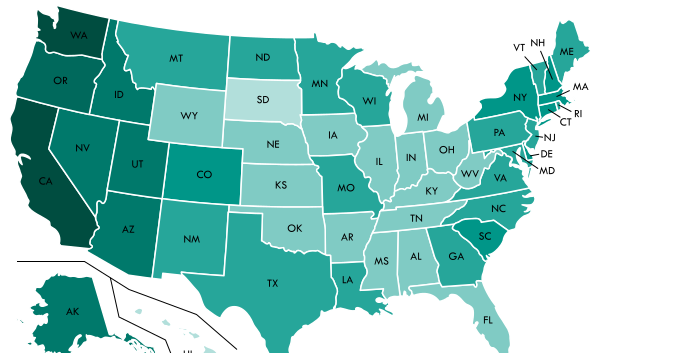
Most common states for computer applications developers
| Rank | State | Population | # of jobs | Employment/ 1000ppl |
|---|---|---|---|---|
| 1 | District of Columbia | 693,972 | 512 | 74% |
| 2 | Vermont | 623,657 | 220 | 35% |
| 3 | Virginia | 8,470,020 | 1,939 | 23% |
| 4 | New Hampshire | 1,342,795 | 309 | 23% |
| 5 | Montana | 1,050,493 | 218 | 21% |
| 6 | Wyoming | 579,315 | 120 | 21% |
| 7 | Maryland | 6,052,177 | 1,196 | 20% |
| 8 | Rhode Island | 1,059,639 | 210 | 20% |
| 9 | North Dakota | 755,393 | 143 | 19% |
| 10 | Colorado | 5,607,154 | 1,009 | 18% |
| 11 | Alaska | 739,795 | 135 | 18% |
| 12 | Washington | 7,405,743 | 1,239 | 17% |
| 13 | Massachusetts | 6,859,819 | 1,138 | 17% |
| 14 | Utah | 3,101,833 | 542 | 17% |
| 15 | Nebraska | 1,920,076 | 320 | 17% |
| 16 | Idaho | 1,716,943 | 289 | 17% |
| 17 | Delaware | 961,939 | 161 | 17% |
| 18 | Pennsylvania | 12,805,537 | 1,995 | 16% |
| 19 | Minnesota | 5,576,606 | 889 | 16% |
| 20 | South Dakota | 869,666 | 140 | 16% |
Most common cities for computer applications developers
| Rank | City | # of jobs | Employment/ 1000ppl | Avg. salary |
|---|---|---|---|---|
| 1 | Livermore | 2 | 2% | $131,766 |
| 2 | East Hartford | 1 | 2% | $95,366 |
| 3 | Chicago | 1 | 0% | $79,880 |
Computer Applications Developer job outlook: Expert opinions
Our panel of computer applications developer experts
Portland State University
Kettering University

University of Guam

Indiana University Southeast

Weber State University
What general advice would you give to a Computer Applications Developer?
Wu-chang Feng: It's hard to generalize across an entire discipline, but I'd say the vast majority of time, we are constantly learning what is being done, constantly building on top of that, and constantly solving any problems along the way.
What Computer Applications Developer skills would you recommend for someone trying to advance their career?
Wu-chang Feng: This is subjective, but I think people enjoy the creative act of thinking about a problem, figuring out how to solve it, then building software to do so. What they disliked before was the inability to quickly go from thought to working implementation. This gap is now much narrower.
What will help Computer Applications Developers increase their earning potential?
Wu-chang Feng: I believe so. With the advent of generative AI, it is now much easier to go from idea to implementation. We can now build things closer to the limits of our imagination.
What general advice would you give to a Computer Applications Developer?
Dr. Jim Huggins: Computer science is a problem-solving discipline. Computer scientists help people solve problems. Typically, those problems deal with data; someone has a large set of data and needs to answer questions about that data, or process it in some way. Computer scientists write programs that run on computers to help their clients answer those questions and perform those processing tasks. On a given day, a computer scientist might do any or all of the following tasks, working alone or in teams: - Meet with clients to understand their problems and how a computing system might help them solve their problems. - Design computing systems to meet client needs. - Build computing systems to meet design specifications. - Test computing systems in order to find errors in their construction and fix those errors. - Repair computing systems that are not functioning properly. - Instruct users how to use the computing systems the computer scientist has designed for them. - Brainstorm new ideas for computing systems that would meet the needs of new customers.
What Computer Applications Developer skills would you recommend for someone trying to advance their career?
Dr. Jim Huggins: Demand for computer scientists in the marketplace is high right now. The US Bureau of Labor Statistics states that employment in computer science is projected to grow much faster than all other occupations in the next ten years and currently pays salaries twice the national average. Working conditions for computer scientists are generally good: pleasant office environments, with the potential for flexible work environments and flexible schedules. But beyond the economic reasons, choosing computer science as a career means choosing a career that helps people solve their problems. Everyone uses computers to perform hundreds of tasks per day; computer scientists design the systems that people are using to make their everyday life more fulfilling.
What will help Computer Applications Developers increase their earning potential?
Dr. Jim Huggins: Computer scientists enjoy the opportunity to be creative every day. Every computing system being designed is different from the last one or the next one; creativity is required to solve new problems every day. Computer scientists enjoy the opportunity to solve problems. There is a great feeling of accomplishment when a team finishes developing a computing system or helps a client solve their problems by using a computing system they designed. Computer scientists are innovative. By definition, they create systems that never existed beforehand. People enjoy knowing that they're creating the future of our world. Each benefit of being a computer scientist can also be a challenge. Working with people, both to determine the requirements for a system that's never existed, and to build that system, can be subject to the same interpersonal conflicts of any discipline. Problem-solving can be frustrating if the solution is not immediately apparent. Building computing systems requires technical skills that can take time to learn and to master.
James Sellmann Ph.D.
Dean, Professor of Philosophy and Micronesian StudiesUniversity of Guam
College of Liberal Arts & Social Sciences
What general advice would you give to a Computer Applications Developer?
James Sellmann Ph.D.: General advice is to keep in mind that you must leverage your skills, especially your soft skills of being able to work with people, to communicate effectively and to be able to solve problems. Be real. Don't try to pretend to be someone else to impress others. Be your authentic self. And show up on time.
What will help Computer Applications Developers increase their earning potential?
James Sellmann Ph.D.: Computer skills, especially being able to work effectively with artificial intelligence will be most important. Being able to work with actual intelligence, that is living people, will always be an important skill.
Chris Sexton
Visiting Lecturer of Computer ScienceIndiana University Southeast
Computer Science Department
What hard/technical skills are most important for Computer Applications Developers?
Chris Sexton: As with soft skills, technical skills in teamwork matter, a candidate must have the ability to work with revision control, be it git or some similar system. In addition, it is vital that fundamental computing skills such as operating the shell of a Linux machine are good signs that a candidate will be able to adapt to new systems.
What soft skills should all Computer Applications Developers possess?
Chris Sexton: Teamwork is the obvious soft skill that is vital. It encompasses more than just being willing to work together but also includes strong documentation skills, textual communication skills, and precision in language. For an example of precision, which of the following is a task that can be completed:
"The login system will require strong passwords."
or
"The login system will require passwords of no less than 16 characters including at least two numbers and two non-alpha numeric characters."
It is easy for an engineer to be lax and use informal language that subtly confuses development efforts, but the valuable candidate will have strong technical communication skills.
What certifications/licenses/courses can have the biggest impact for Computer Applications Developers?
Dr. Kyle Feuz Ph.D.: Any time you have a certification, license or degree it's going to give you a leg up compared to your peers with similar skill sets but no certification. Often the certification or degree will help your resume make it through an initial screening process but then it's up to you to demonstrate that you have the knowledge and skills the certification is supposed to represent. It's also important to know what career you want to pursue. Certifications are usually targeted to a very limited skill set. If that skill set is a critical part of the job description then the certification will be a strong mark in your favor. Some fields even require certification before you will be considered for the position. However, if the skill set is only tangentially related to the job description then there is little benefit in having the certification.