Explore jobs
Find specific jobs
Explore careers
Explore professions
Best companies
Explore companies
Job outlook for computer instructors in the United States
Computer instructor job growth summary. After extensive research, interviews, and analysis, Zippia's data science team found that:
The projected computer instructor job growth rate is 12% from 2018-2028.
About 159,400 new jobs for computer instructors are projected over the next decade.
Computer instructor salaries have increased 10% for computer instructors in the last 5 years.
There are over 27,945 computer instructors currently employed in the United States.
There are 37,876 active computer instructor job openings in the US.
The average computer instructor salary is $52,708.
Are computer instructor jobs in demand?
Computer instructor job and salary trends over time
Computer instructor jobs over time
Computer instructor job growth rate over time
| Year | # of jobs | % of population |
|---|---|---|
| 2021 | 27,945 | 0.01% |
| 2020 | 24,054 | 0.01% |
| 2019 | 24,672 | 0.01% |
| 2018 | 22,287 | 0.01% |
| 2017 | 22,137 | 0.01% |
Average computer instructor salary over time
Computer instructor salary by year
| Year | Avg. salary | Hourly rate | % Change |
|---|---|---|---|
| 2026 | $52,708 | $25.34 | +0.4% |
| 2025 | $52,486 | $25.23 | +3.6% |
| 2024 | $50,662 | $24.36 | +4.6% |
| 2023 | $48,450 | $23.29 | +1.4% |
| 2022 | $47,797 | $22.98 | +3.6% |
Computer instructor jobs by state
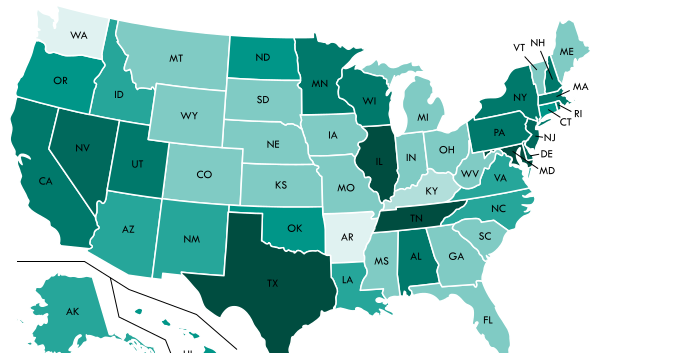
Most common states for computer instructors
| Rank | State | Population | # of jobs | Employment/ 1000ppl |
|---|---|---|---|---|
| 1 | Alaska | 739,795 | 95 | 13% |
| 2 | District of Columbia | 693,972 | 89 | 13% |
| 3 | Wyoming | 579,315 | 74 | 13% |
| 4 | Virginia | 8,470,020 | 901 | 11% |
| 5 | Colorado | 5,607,154 | 629 | 11% |
| 6 | Montana | 1,050,493 | 119 | 11% |
| 7 | Maryland | 6,052,177 | 600 | 10% |
| 8 | Oregon | 4,142,776 | 414 | 10% |
| 9 | Delaware | 961,939 | 98 | 10% |
| 10 | Georgia | 10,429,379 | 924 | 9% |
| 11 | South Carolina | 5,024,369 | 441 | 9% |
| 12 | New Hampshire | 1,342,795 | 116 | 9% |
| 13 | North Dakota | 755,393 | 68 | 9% |
| 14 | Vermont | 623,657 | 59 | 9% |
| 15 | North Carolina | 10,273,419 | 796 | 8% |
| 16 | Massachusetts | 6,859,819 | 551 | 8% |
| 17 | New Mexico | 2,088,070 | 162 | 8% |
| 18 | Hawaii | 1,427,538 | 110 | 8% |
| 19 | Rhode Island | 1,059,639 | 84 | 8% |
| 20 | South Dakota | 869,666 | 70 | 8% |
Most common cities for computer instructors
| Rank | City | # of jobs | Employment/ 1000ppl | Avg. salary |
|---|---|---|---|---|
| 1 | Hobbs | 1 | 3% | $48,143 |
| 2 | Bristol | 1 | 2% | $50,141 |
| 3 | Grand Prairie | 1 | 1% | $64,415 |
| 4 | Hartford | 1 | 1% | $49,954 |
| 5 | Waterbury | 1 | 1% | $50,332 |
| 6 | Dallas | 1 | 0% | $64,304 |
Computer Instructor job outlook: Expert opinions
Our panel of computer instructor experts

Wright State University
Franklin and Marshall College
AGWA - American Grant Writers' Association, Inc.
Texas State University

Northwestern University

Youngstown State University

New York University

University of West Georgia
What technology do you think will become more important and prevalent for Computer Instructors in the next 3-5 years?
Dr. Karla Huebner Ph.D.: Have no idea about technology for the future.
What general advice would you give to a Computer Instructor?
David McMahan Ph.D.: Keep open to possibilities beyond the narrow range of what your diploma lists as your major or minor. Whatever job you get trained for today, in 10-20 years, it may be very different. Or it may not exist. Focus on obtaining and maintaining flexibility, critical thinking, creativity, and passion for learning. Being an interesting person is as vital as any credential.
What technology do you think will become more important and prevalent for Computer Instructors in the next 3-5 years?
John Porter Ph.D.: There is not a lot of technology required in grant writing. The most critical and prevalent skill in grant writing, which is lacking, is appropriately writing. Over the past decade, there has been an increase in abbreviation and slang. When put into a standard text, these expressions can become confusing.
The technology is that younger, individual writers may like to stay up on the most recent software and communication methods. Whereas funders, private, corporate, and government, tend not to keep up as fast and have older software versions. This means that the newest and glitziest software may not be compatible with the funder's software when submitting grant proposals and applications.
Are there any particularly good places in the United States for Computer Instructors to find work opportunities?
Dr. Rodney Rohde Ph.D.: There are large vacancy rates all over the country. This is a good news/bad news issue. However, with a degree in medical laboratory science (also known as a clinical laboratory science) AND certification, one can find employment anywhere in the U.S. One of the great things about this career is that graduates honestly can decide where they "fit best" with regard to geography and employer (urban, rural, large, or small).
How do you envision technology impacting Computer Instructors in the next 5 years?
Dr. Rodney Rohde Ph.D.: Technology in laboratory automation and laboratory information systems (LIS) will continue to explode in the future. We've seen this over the past decade or two, and there is no reason to believe that technology, especially in the area of molecular diagnostics, will not continue to increase.
What experience really stands out on Computer Instructor resumes?
Helen Callus: It depends on what kinds of position you are applying for, and for performance students, it's going to be playing or teaching mostly. I recommend that students tailor their resumes to suit the positions, so teaching should be prioritized, and the outline should lead to that. I encourage them to put together their overview and then look at gaps - teaching experience, perhaps some administrative experiences that are always helpful.
If they don't have those things, actively search for them to add that line to their resumes. It can be a terrific way to develop the document in ways that can lead to better job success. A range of skills is most likely to appeal to a broader set of jobs. Doing multiple things (things we don't even realize we do, as musicians, daily) can be helpful. The student is then willing to be creative and open to start out doing things that are related but perhaps not their first choice.
What experience really stands out on Computer Instructor resumes?
Dragana Crnjak: Real-life - outside of the classroom - experiences always stand out, such as exhibitions, internships, museum assistantships, public art projects, community projects, etc. We encourage students to participate in many different activities throughout their college years with a range of experiences provided from exhibiting independently, in group exhibits, working on collaborative projects, community public art projects (such as the mural class this semester where students were involved in all stages of decision-making, from sketching and ideation, communication, site preparation, and painting, writing art proposals, etc.), internships, etc. Problem-solving and critical thinking skills are essential to all art projects and processes, and these skills not only contribute well to so many professions and fields, but they are also life-lasting skills that develop creative, engaged, and open-minded thinkers and citizens.
Marlene McCarty
Clinical Professor of Visual ArtsNew York University
Department of Art and Art Professions
How do you envision technology impacting Computer Instructors in the next 5 years?
Marlene McCarty: One could argue that technical skills are a must; however, such gifts have a shelf-life and must be continually reacquired. As AI automates work, the kind of independent, creative thinking taught in the arts becomes a critical skill. Technical skills are beneficial only if a visionary mind fuels their use.
Are there any particularly good places in the United States for Computer Instructors to find work opportunities?
Ye Chen Ph.D.: You could go to higheredjobs.com, https://jobs.chronicle.com/, or university websites for a higher ed job, go-to company, or other organization websites (e.g., Google) industry/government jobs; or use LinkedIn, attend job fairs and professional conferences, to search for job opportunities.
How do you envision technology impacting Computer Instructors in the next 5 years?
Ye Chen Ph.D.: Technology is an integral part of this field. Technology advances will no doubt bring in new exciting research opportunities and practice innovations. As people better leverage new important technology such as virtual reality, augmented reality, artificial intelligence, machine learning, innovative research, and practices will emerge in personalized and immersive e-learning. The black swan event, the COVID 19 pandemic, will further accelerate this trend by placing an urgent call for improving people's e-learning experience.