Explore jobs
Find specific jobs
Explore careers
Explore professions
Best companies
Explore companies
Job outlook for computer network administrators in the United States
Computer network administrator job growth summary. After extensive research, interviews, and analysis, Zippia's data science team found that:
The projected computer network administrator job growth rate is 5% from 2018-2028.
About 18,200 new jobs for computer network administrators are projected over the next decade.
Computer network administrator salaries have increased 9% for computer network administrators in the last 5 years.
There are over 86,870 computer network administrators currently employed in the United States.
There are 96,276 active computer network administrator job openings in the US.
The average computer network administrator salary is $69,113.
Are computer network administrator jobs in demand?
Computer network administrator job and salary trends over time
Computer network administrator jobs over time
Computer network administrator job growth rate over time
| Year | # of jobs | % of population |
|---|---|---|
| 2021 | 86,870 | 0.03% |
| 2020 | 168,195 | 0.05% |
| 2019 | 72,552 | 0.02% |
| 2018 | 58,874 | 0.02% |
| 2017 | 60,263 | 0.02% |
Average computer network administrator salary over time
Computer network administrator salary by year
| Year | Avg. salary | Hourly rate | % Change |
|---|---|---|---|
| 2025 | $69,113 | $33.23 | +3.4% |
| 2024 | $66,835 | $32.13 | +2.3% |
| 2023 | $65,322 | $31.40 | +1.2% |
| 2022 | $64,566 | $31.04 | +1.8% |
| 2021 | $63,451 | $30.51 | +2.4% |
Computer network administrator jobs by state
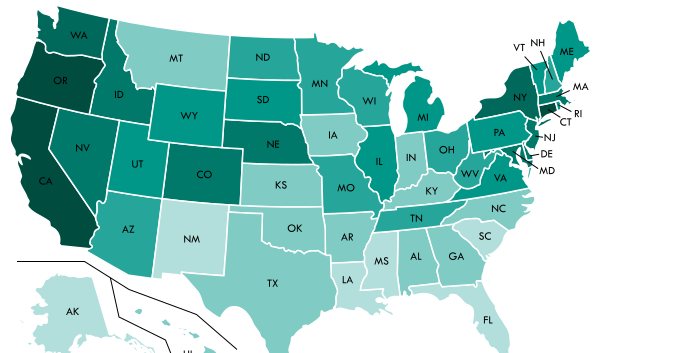
Most common states for computer network administrators
| Rank | State | Population | # of jobs | Employment/ 1000ppl |
|---|---|---|---|---|
| 1 | District of Columbia | 693,972 | 489 | 70% |
| 2 | Maryland | 6,052,177 | 1,706 | 28% |
| 3 | Virginia | 8,470,020 | 2,248 | 27% |
| 4 | Alaska | 739,795 | 202 | 27% |
| 5 | Colorado | 5,607,154 | 1,241 | 22% |
| 6 | Vermont | 623,657 | 128 | 21% |
| 7 | Massachusetts | 6,859,819 | 1,276 | 19% |
| 8 | New Hampshire | 1,342,795 | 244 | 18% |
| 9 | Utah | 3,101,833 | 500 | 16% |
| 10 | North Dakota | 755,393 | 123 | 16% |
| 11 | Wyoming | 579,315 | 93 | 16% |
| 12 | Oregon | 4,142,776 | 608 | 15% |
| 13 | New Mexico | 2,088,070 | 309 | 15% |
| 14 | Hawaii | 1,427,538 | 212 | 15% |
| 15 | Rhode Island | 1,059,639 | 160 | 15% |
| 16 | Delaware | 961,939 | 143 | 15% |
| 17 | Washington | 7,405,743 | 1,020 | 14% |
| 18 | Arizona | 7,016,270 | 979 | 14% |
| 19 | Minnesota | 5,576,606 | 712 | 13% |
| 20 | South Dakota | 869,666 | 117 | 13% |
Computer Network Administrator job outlook: Expert opinions
Our panel of computer network administrator experts
Hampton University
University of Nebraska - Omaha
University of Colorado at Colorado Springs
Texas A&M University San Antonio

University of West Florida

University of Washington

American University

SUNY Oswego
Lawrence Technological University

University of Nebraska at Omaha

Grand Valley State University
Tiffin University
What general advice would you give to a Computer Network Administrator?
Dr. Yohannes Bekele: By entering the computer engineering profession now, individuals can take advantage of the high skilled-power demand in the field, diverse career paths broadly classified under hardware and software sub-areas, lucrative salaries as compared to other fields, continuous learning opportunities, and the potential for entrepreneurship in changing ideas into startup businesses easily. It is a field that offers long-term growth prospects and the chance to contribute to the development of cutting-edge technologies.
What general advice would you give to a Computer Network Administrator?
Janice Garnett Ed.D.: Negotiate based on research, develop a career development plan, focus on enhancing performance, professional growth, and continuous learning.
Dr. Darshika Perera Ph.D.
Associate ProfessorUniversity of Colorado at Colorado Springs
Computer Engineering
What general advice would you give to a Computer Network Administrator?
Dr. Darshika Perera Ph.D.: One of my main advice for Computer Engineering students is that they should get hands-on experience as much as possible through various courses comprising labs and projects. In order to excel in this field, it is imperative for the students not only to learn the fundamentals but also to get hands-on experience. Also, as professors and educators, we are here to help students to get through their coursework and degree program successfully. Therefore, I would encourage students to have an open dialogue with their professors/instructors, and not to hesitate on approaching them with any concerns/problems encountered during the courses or degree program. My advice is not to get deterred by the years that you have to spend or some of the difficult courses that you have to take, instead consider this as a journey that you are taking to enhance your life and career.
What Computer Network Administrator skills would you recommend for someone trying to advance their career?
Dr. Darshika Perera Ph.D.: Most of our computer engineering students at UCCS get job offers before they graduate with salaries ranging from $80k to $110k. Students should go for industry internships before graduating to familiarize themselves with industry settings and boost their career as well as salary potential. Students should emphasize their technical skills and know-how gained throughout their computer engineering degree program, demonstrate how those skills differentiate from other degree programs (such as computer science) and match with the expertise that companies are looking for, and highlight how they can be a valuable asset to the company to maximize their salary potential when seeking careers in this field.
Laura Kier
Network Design and Administration InstructorWhat general advice would you give to a Computer Network Administrator?
Laura Kier: Students graduating from the Computer Network Design and Administration program will enter the job market with a solid foundation in networking technologies. Above that they should also be able to develop and demonstrate excellent communication and interpersonal skills. Networking has a strong emphasis on teamwork and being able to communicate well with customers, co-workers and teammates is vital. Attaining certifications in Cisco, Linux, Windows, and security will also help the student stand out within the industry (classes in the program help to learn the knowledge needed to attain certifications). Students should participate in any local or online communities and groups to enhance skills and knowledge and find networking opportunities.
What Computer Network Administrator skills would you recommend for someone trying to advance their career?
Laura Kier: Computer Networking is a dynamic field with a wide variety of opportunities in many different industries. Some skills that will be more important in general are skills in software defined networking and automation. Skills in the DevOps field will be necessary, as well as skills leveraging AI tools. Cybersecurity is always important and using AI tools to enhance security and monitoring is necessary.
What will help Computer Network Administrators increase their earning potential?
Laura Kier: Learn to present your skills well from the interview and into your career. Those communication skills count! Industry certifications like CCNA matter. They help you demonstrate a willingness to grow and learn beyond what was required for your degree. Be willing to take on new challenges with your new job and keep learning new skills. It is really important for graduates to understand that talented IT professionals can move up quickly in a company, but they often must start at the bottom to showcase their technical and soft skills. Because of that, they should not shy away from entry level jobs if there is potential for growth.
Robert Vinaja Ph.D.
Assistant Professor of Computer Information SystemsTexas A&M University San Antonio
Computer Information Systems Department
What soft skills should all Computer Network Administrators possess?
Robert Vinaja Ph.D.: -Ability to work as part of a team.
-Attention to detail.
-Problem-solving and analytical skills.
What hard/technical skills are most important for Computer Network Administrators?
Robert Vinaja Ph.D.: -Programming.
-Understand algorithms and data structures.
What skills will help Computer Network Administrators earn the most?
Robert Vinaja Ph.D.: My personal view is that instead of following the skills that command higher salaries, one should focus on a field that you like and feel at ease with. Instead of following the money, one should follow your heart, and money will eventually follow.
Dr. Thomas Gilbar Ph.D.
Chair and LecturerUniversity of West Florida
Electrical and Computer Engineering
What hard/technical skills are most important for Computer Network Administrators?
Dr. Thomas Gilbar Ph.D.: There are quite a few hard/technical skills that are important for Computer Engineers. We've found a lot of managers are looking for comfort in a variety of programming languages, including C++, C#, Java, Python, etc. Also, try to have a background in a variety of operating systems (certainly windows and mac, but also having experience on Apple iOS, Android, and even Linux will give you a leg up on the competition). Having at least some experience in data/cyber security is also important these days. On the hardware side, programming and applying microcontrollers and VHDL/Verilog programming are extremely important. VLSI design is also a nice addition to skill sets, though in most cases, not a deal-breaker. Circuit and electronic design are also very important skills to supplement your microcontroller skills.
Rania Hussein Ph.D.
Associate Teaching ProfessorUniversity of Washington
Department of Electrical and Computer Engineering
What soft skills should all Computer Network Administrators possess?
Rania Hussein Ph.D.: Being coachable, know how to learn and figure things out, effective communication skills, continuous self-development.
Anthony Baron
Teaching Assistant, Associate Software EngineerAmerican University
What hard/technical skills are most important for Computer Network Administrators?
Anthony Baron: The main technical/ hard skills, I would say, are mainly the same as in part 1. Another hard skill that will come through with experience in programming is learning how to Google, more specifically knowing exactly what to search to solve an issue in the code.
What skills will help Computer Network Administrators earn the most?
Anthony Baron: By earning, do you mean financially, career-wise, or most growth? Career-wise, it really depends on what the final goal is. For web developers, learning the programming languages and frameworks for web development would be the way to go. In general, any experience with programming and knowing a little about a lot will be helpful. Having top-level theory knowledge (some but not in-depth) is also very helpful. It will help you better understand what is happening under the hood and determine which methods are more efficient than others. Financially, it really depends on what skills are most in-demand today. Also, getting a Masters opens doors to more job opportunities, and in some companies, allows for a pay increase. However, this is not the case everywhere.
How do you envision technology impacting Computer Network Administrators in the next 5 years?
Mario Bkassiny Ph.D.: There has been recently a great focus on certain engineering technologies that enable smart systems with fast communications abilities. This has led to a revolution in several technologies such as robotics, artificial intelligence, wireless communications and cloud computing. Innovation in these fields will be essential in the upcoming years in order to keep up with the social and economic needs of modern life. The benefits of these innovations will have a long-lasting effect on our society.
Will there be an enduring impact of the coronavirus pandemic on Computer Network Administrators?
Oriehi Destiny Anyaiwe: There is a high possibility that the impact of the coronavirus pandemic will endure but one cannot easily put a time frame to it. This impact will be felt by everyone, not just graduates or computer science graduates in particular. Jobs have been lost, companies are finding it hard to turn a profit and some are needing to close, whereas some others like the tech companies are prospering and doing well. Due to the coronavirus pandemic, the scope and teaching of computer science courses including students' senior projects and research have been coined to groom students to meet unprecedented standards. Thus, I can confidently say that computer science graduates stand at an advantageous position in the post pandemic marketplace; however, there will still be hills to climb so long as the synergy that hitherto existed between the crop of companies suffer.
What's a day at work look like for a Computer Network Administrator?
Oriehi Destiny Anyaiwe: What's a day at work going to look like for a recent graduate?
This pandemic has highly promoted keeping to one's space. A typical day at work be it work-from-home (online), traditional in-person or hybrid will naturally divide the work force into two groups; employees who perform best as lone players vs the socialists/collaborationist. Today, most companies keep as many employees as they can online. Workers are beginning to reorganize their lives around this type of schedule, and they are growing their comfort with this new norm. I think that there are sundry reasons why expectations from employers and employees will have to be adjusted in this regard post pandemic era.
What technical skills for a Computer Network Administrator stand out to employers?
Oriehi Destiny Anyaiwe: Attitude. Anyone can memorize a programming language and have a perfect syntax, but if you cannot find your way out of a paper bag you do the company no good. In today's marketplace, problems/business are tackled with a collaborative view. Employers will like to hire employees that have the skill set and potential to explain problems/solutions to non experts as well as working amicably with them.
Deepak Khazanchi Ph.D.
Associate Dean for Academic Affairs, Community Engagement & Internationalization Officer, Professor of Information Systems & Quantitative Analysis, Director, Executive Master’s of Science in Information Technology (EMIT) Program, Executive Director, Center for Management of IT (CMIT), Fulbright Grantee (Specialist 2014; Core 2020-21)University of Nebraska at Omaha
College of Information Science & Technology
What technical skills for a Computer Network Administrator stand out to employers?
Deepak Khazanchi Ph.D.: Please refer to the prior response for purely technical skills; however, I believe that beyond "technical" skills, capabilities such as abstraction, computational thinking, problem solving, sensemaking, empathy, and multidisciplinarity of thinking will become important assets.
What's a good job out of college for Computer Network Administrators?
Deepak Khazanchi Ph.D.: I think the "best" and "interesting" jobs in my view will be those that leverage emerging technical skills such as AI/ML, data analytics, cybersecurity and medical informatics, with the nontechnical capabilities mentioned above.
What are the biggest trends we'll see in the Computer Network Administrator job market given the pandemic?
Chirag Parikh Ph.D.: The biggest trend according to me right now would be digital transformation of workplace. Workplace activities that were happening in-person has now become virtual and technology literacy is going to play a vital role. Cross disciplinary expertise is also going to be very crucial.
Biggest trends in job market according to me would be in the area of robotics, automation, AI, software development, cyber-security and healthcare for sure. This pandemic has created a sense of health awareness among people and we are seeing lot of students opting for healthcare programs (undergraduate and graduate).
What's a good job out of college for Computer Network Administrators?
Chirag Parikh Ph.D.: It is given that technical skills are required as you enter the job market. In the area of Computer Engineering, I feel that graduates should have a breadth of knowledge in most areas of computer engineering and a greater depth of knowledge in at least one area. Programming skills are of utmost importance, as you might not know every possible programming language or its syntax but the basic understanding of programming logic is necessary.
I personally value debugging skills as a must to have as having this makes you a well-rounded engineer no matter what area of engineering you belong to. Next in my list is technical writing and verbal communication skill. Most of the engineers are known to underperform in this skill. I value this skill, as employers would want their engineers to be able to create technical documents as well as present their design to other co-workers and sometimes to other stakeholders.
The last skill I feel that employers would like their employees to have would be to work in a multidisciplinary environment with co-workers from different branches of engineering and other backgrounds.
What technical skills for a Computer Network Administrator stand out to employers?
Chirag Parikh Ph.D.: If you ask me, I consider valuable experience over good paycheck. Once you have gained that experience the paycheck will follow. As soon as you are out of college, the knowledge gained is very fresh and raring to go. If put into the right place can enhance your technical skills and you can do wonders.
As a Computer Engineering professor, I would say the job opportunities are tremendous for students out of college as they can venture into hardware field (technical support, hardware engineer, test engineer and much more) as well as software field (software engineer, software developer, software tester and much more). The possibilities are endless.
With COVID and employees working remotely there is still ample opportunity to enhance your technical and interpersonal skills as I believe remote working might stay for a while till things get back to normal.
What type of skills will young Computer Network Administrators need?
George Miller: Many organizations realize graduates cannot learn everything in college about their major but want the graduate to have a solid foundation on their field of study. The organization wants to mold the graduate to their company environment with how they do things related to the field of study. Most companies want college graduates to have good communication skills (both oral and written), critical thinking skills and be able to work well in teams. These skills have been a staple for graduates since I can remember. This is why a college graduate takes many general education courses related to these skills and many of their major courses emphasize these skills.
Going back to the previous answer I believe graduates in all fields of study will need a better knowledge of technology and easier adaptability to changing technology. Again, an IS degree is already preparing students for this.
What experience really stands out on Computer Network Administrator resumes?
George Miller: For graduates any experience stands out on a resume and it does not need to be related to their field of study. I tell students to do whatever to get experience. This can be with community volunteer work, at their college through clubs and organization and with professional employment.
There are many organization and government paid internship and co-op opportunities for students within all fields. There is no reason why every student cannot find some sort of internship/co-op during a summer break. Many times, an internship/co-op turns into full time employment. Often high schools and colleges are doing major technology upgrades within the summer months (because they are shut down during this period) and would welcome a student as an IS major as an intern. But volunteer work at the local church or favorite charity can also provide valuable experience. As I opened with this answer any experience stands out on a resume. The experience shows that a graduate has drive and determination.