Explore jobs
Find specific jobs
Explore careers
Explore professions
Best companies
Explore companies
Job outlook for computer science instructors in the United States
Computer science instructor job growth summary. After extensive research, interviews, and analysis, Zippia's data science team found that:
The projected computer science instructor job growth rate is 12% from 2018-2028.
About 159,400 new jobs for computer science instructors are projected over the next decade.
Computer science instructor salaries have increased 10% for computer science instructors in the last 5 years.
There are over 17,713 computer science instructors currently employed in the United States.
There are 41,956 active computer science instructor job openings in the US.
The average computer science instructor salary is $79,337.
Are computer science instructor jobs in demand?
Computer science instructor job and salary trends over time
Computer science instructor jobs over time
Computer science instructor job growth rate over time
| Year | # of jobs | % of population |
|---|---|---|
| 2021 | 17,713 | 0.01% |
| 2020 | 15,183 | 0.00% |
| 2019 | 14,980 | 0.00% |
| 2018 | 15,277 | 0.00% |
| 2017 | 15,183 | 0.00% |
Average computer science instructor salary over time
Computer science instructor salary by year
| Year | Avg. salary | Hourly rate | % Change |
|---|---|---|---|
| 2026 | $79,337 | $38.14 | +0.4% |
| 2025 | $79,003 | $37.98 | +3.6% |
| 2024 | $76,258 | $36.66 | +4.6% |
| 2023 | $72,928 | $35.06 | +1.4% |
| 2022 | $71,945 | $34.59 | +3.6% |
Computer science instructor jobs by state
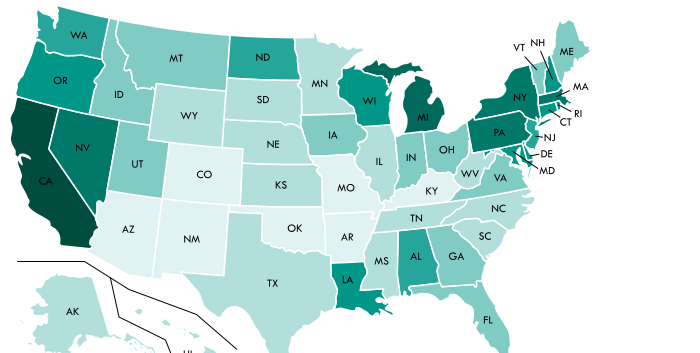
Most common states for computer science instructors
| Rank | State | Population | # of jobs | Employment/ 1000ppl |
|---|---|---|---|---|
| 1 | District of Columbia | 693,972 | 130 | 19% |
| 2 | Wyoming | 579,315 | 93 | 16% |
| 3 | Montana | 1,050,493 | 155 | 15% |
| 4 | Alaska | 739,795 | 108 | 15% |
| 5 | Vermont | 623,657 | 78 | 13% |
| 6 | Virginia | 8,470,020 | 1,032 | 12% |
| 7 | Colorado | 5,607,154 | 699 | 12% |
| 8 | Oregon | 4,142,776 | 497 | 12% |
| 9 | New Hampshire | 1,342,795 | 158 | 12% |
| 10 | Delaware | 961,939 | 114 | 12% |
| 11 | Massachusetts | 6,859,819 | 757 | 11% |
| 12 | Maryland | 6,052,177 | 693 | 11% |
| 13 | North Dakota | 755,393 | 84 | 11% |
| 14 | Georgia | 10,429,379 | 1,010 | 10% |
| 15 | South Carolina | 5,024,369 | 504 | 10% |
| 16 | Rhode Island | 1,059,639 | 109 | 10% |
| 17 | South Dakota | 869,666 | 88 | 10% |
| 18 | New Jersey | 9,005,644 | 782 | 9% |
| 19 | Utah | 3,101,833 | 271 | 9% |
| 20 | Iowa | 3,145,711 | 268 | 9% |
Most common cities for computer science instructors
| Rank | City | # of jobs | Employment/ 1000ppl | Avg. salary |
|---|---|---|---|---|
| 1 | Moline | 1 | 2% | $64,584 |
| 2 | Washington | 2 | 0% | $88,540 |
| 3 | Des Moines | 1 | 0% | $73,152 |
| 4 | Detroit | 1 | 0% | $105,041 |
Computer Science Instructor job outlook: Expert opinions
Our panel of computer science instructor experts
College of the Marshall Islands
Grambling State University

SUNY Potsdam

Wittenberg University

University of Idaho

Gannon University
University of North Carolina Greensboro

University of Oregon
University of North Carolina at Charlotte

High Point University

University at Albany - SUNY
Northern Seminary

Lafayette College
Franklin and Marshall College

University of Mount Union

Gustavus Adolphus College

Youngstown State University

New York University

Seattle University

University of West Georgia
What general advice would you give to a Computer Science Instructor?
Alexander Velasquez: My general advice to any graduate beginning their career in their field is to continue to learn and be a student of your craft. Be open to learning new things because you never know how they will improve your skills and qualifications. For example, I am currently learning video editing. I never thought I would bother to learn video editing, but it makes me a more versatile instructor being able to give students the option of doing video projects, combining and editing them, and having a digital record of what students have learned in the classroom. And given the rise of online learning, it's important nowadays to be an effective instructor both in the traditional in-person format and within the digital landscape.
Yenumula Reddy
IEEE Senior Member, ACM Senior Member, IARIA FellowGrambling State University
College of Arts and Sciences
What's a day at work look like for a Computer Science Instructor?
Yenumula Reddy: It is entirely new world and lot of enthusiasm and many new faces. Try to adjust and socialize and try to have new friends. But, for a student had internship first day work may not much difference.
My students share their experience and I saw this difference between the student had internship and the one entered without.
But it is an unforgettable day.
What skills stand out on Computer Science Instructor resumes?
Brian Ladd: Evidence you can teach the introductory courses. The introductory sequence is difficult for students, so the instructor has to have multiple ways of explaining things and a good handle on a lot of homework problems.
If the school uses a particular programming language, knowing that (and it being more than just a bullet on the resume).
Experience writing computer games will make a resume stand out. Having used them to teach is an even bigger boost.
What soft skills should all Computer Science Instructors possess?
Brian Ladd: Writing in standard English. This applies to technical writing, memos and proposals, and even student feedback. In getting hired, your cover letter needs to be correct (hiring committees are looking for reasons to not read the rest of your materials).
What hard/technical skills are most important for Computer Science Instructors?
Brian Ladd: Knowing the right programming language(s).
I am biased in wanting a general CS instructor to have a good grasp of what the operating system is doing (I am a systems guy). This makes explaining files, multiprocessing, and safe concurrency easier, even if students do not tax your knowledge.
What skills will help Computer Science Instructors earn the most?
Brian Ladd: I think the ability to write clearly and explain your experience in the cover letter and then teach clearly, using technology appropriately while teaching, are things that will help with early salary offers.
I am not an expert on how to maximize earnings. Just ask my bank. That said, over time, the skill that has kept my teaching fresh and relevant is a willingness and desire to keep learning new technology and find ways to work it into my classroom.
Alyssa Hoofnagle Ph.D.
Assistant Professor of MathematicsWittenberg University
Mathematics Department
What skills will help Computer Science Instructors earn the most?
Alyssa Hoofnagle Ph.D.: Careers in data science and computer science are in high demand right now due to many industries collecting and analyzing data in new ways, so I think the skills necessary to be successful in those careers will most likely lead to the highest earning potential. Again, technical skills involving mathematics, statistics, and computer programming are essential. However, these careers also involve working in both the technical arena as well as non-technical areas. So, applicants should be able to not only work on solving these technical problems but also be able to explain the process and results to those outside of their field. This means applicants need to develop and refine their communication skills so that they can share the necessary and relevant information with others.
Robert Rinker Ph.D.
Associate Professor, Associate ChairUniversity of Idaho
Department of Computer Science
What skills stand out on Computer Science Instructor resumes?
Robert Rinker Ph.D.: There have been several new research areas that have emerged in the last few years - data science, artificial intelligence, machine learning, software for robotics, cybersecurity. Many of these areas didn't exist in their present form just a few years ago. So new faculty with one or more of these skills are in demand. More experienced faculty that have been in place for a few years (like me!) don't have these newer skills.
What soft skills should all Computer Science Instructors possess?
Robert Rinker Ph.D.: I think the traditional view of CS people is they are holed up in padded cells and don't interact with other people. That is a very wrong perception. CS professionals are problem solvers, and they must communicate with non-CS "customers" to understand the problems. Several recruiters have mentioned that a candidate's technical skills are easy to discern from a resume, but their soft skills are much more difficult to determine - they have to be determined from face-to-face interviews. Perhaps the most difficult skill in problem-solving is to listen carefully and not try to impose a solution to the problem right away.
What hard/technical skills are most important for Computer Science Instructors?
Robert Rinker Ph.D.: As I mentioned already, employers are interested in emerging skills. However, in order to understand the new skills, a good fundamental background is also necessary.
What skills will help Computer Science Instructors earn the most?
Robert Rinker Ph.D.: The good news in Computer Science is that the job market is so good that anyone who is halfway decent will get a very good job. However, more than in the past, the new topics in CS are most relevant. Part of the reason for this is that these new topics have become "buzzwords" with the general public, so they are very visible. As a result, employers are especially looking for them and are willing to pay top dollar for them.
What will help Computer Science Instructors increase their earning potential?
Dr. Stephen Frezza Ph.D.: In computing, this will still remain similar to what it has been: Competency development, e.g., both 'soft skills' of working well to make technology work well, and the 'hard skills' related to specific technology needs. The latter are always changing.
Apoorva Patipati Ramesh
Lecturer & Director - Graduate ProgramsUniversity of North Carolina Greensboro
Department of Information Systems and Supply Chain Management
What certifications/licenses/courses can have the biggest impact for Computer Science Instructors?
Apoorva Patipati Ramesh: For students, courses and certificates that provide hands-on experience in skills like Tableau, Python, R, etc. can have a very positive impact on job prospects. Some of our academic graduate certificates also align very closely with industry certifications such as CISSP, CompTIA Network+ etc. These are highly valuable assets to have.
Hayden Harker
Senior Instructor, Head Undergraduate AdvisorUniversity of Oregon
Department of Mathematics
What soft skills should all Computer Science Instructors possess?
Hayden Harker: For math majors, there are many jobs that specifically use mathematical techniques learned in a specific course and you don't prove theorems in jobs. However, these students need to be flexible and willing to solve many different problems even if they don't necessarily feel like a math calculation. Solid problem solving skills and logical thought process are some of the greatest assets for math majors.
Dr. Patrick Madsen
Executive DirectorUniversity of North Carolina at Charlotte
University Career Center
What will help Computer Science Instructors increase their earning potential?
Dr. Patrick Madsen: What tends to help individuals do well in any field and increase their earning potential is to pay close attention to building a strong professional network, staying on top of the competencies/skills that the industry demands in candidates, and remembering to have a mindset of a "lifelong learner" - the future of work demands agile knowledge workers that are flexible to new situations and environments. The current pandemic is a perfect example of the need for an agile and flexible workforce.
Will there be an enduring impact of the coronavirus pandemic on Computer Science Instructors?
Dr. Michael Oudshoorn: I suspect that for Computer Science graduates that this is likely - in a positive sense. During the pandemic many businesses opted to have employees work from home for an extended period of time. Many of these organizations have found that productivity did not fall and they save costs. If no one goes into the office then you save money on cleaning, office supplies, utilities, and maybe even rent. I suspect that some employers will opt to continue having employees work from home after the pandemic is over and hence continue to save money. This creates an opportunity to develop software products to support these businesses either through the development of enhanced video conference and collaboration tools, or through industry specific tools to help increase productivity when one has remote workers. Also if you have staff working from home, then those staff members could literally be anywhere in the world, so this opens the door for graduates to work for an employee irrespective of where they might physically be located.
There was a large, and growing, demand for computing professionals before the pandemic www.bls.gov, and that need has not gone away! In fact, the demand for computing professionals such as Information security analysts is expected to grow by 31% in the next 10 years. There continues to be unfiled demand for computing professionals and the number of vacancies continues to grow paloaltoonline.com .
What will help Computer Science Instructors increase their earning potential?
Dr. Michael Oudshoorn: Earning potential is attached to 2 things: technical expertise and life skills. The technical skills are essential in order to do the job, but to be truly successful and move up the corporate ladder you need to demonstrate skills such as clear and concise communication, honest and ethical behavior, interpersonal skills, and leadership. Being a good team member and contributing in interdisciplinary teams are skills that cannot be underestimated.
How have salaries changed over time for Computer Science Instructors?
Charalampos Chelmis: Computer scientists and engineers have seen a steady growth in salaries up to the years before the pandemic. Although I don't anticipate this trend to slow down, entry-level positions and positions whose profiles include a significant portion of remote activities may incur reduced salary as compared to on site positions.
What technology do you think will become more important and prevalent for Computer Science Instructors in the next 3-5 years?
Rev. Tracey Bianchi: It is likely that once the pandemic ends, doing church at home will remain an option for millions of people of faith. As the epidemic goes on, families and communities have become comfortable with the flexible, on-demand church option. It may be hard to get many of them back into the pews once it is safe to return to worship. The technology to support this reality will be necessary for the foreseeable future. Career options in production, streaming, and recording will be more prevalent in religious organizations than in the past.
What technology do you think will become more important and prevalent for Computer Science Instructors in the next 3-5 years?
Karina Skvirsky: That's hard to predict! I believe Facebook will become dated, and no one under 30 will be using it in the future.
What general advice would you give to a Computer Science Instructor?
David McMahan Ph.D.: Keep open to possibilities beyond the narrow range of what your diploma lists as your major or minor. Whatever job you get trained for today, in 10-20 years, it may be very different. Or it may not exist. Focus on obtaining and maintaining flexibility, critical thinking, creativity, and passion for learning. Being an interesting person is as vital as any credential.
Dr. Jerome Miksell
Professor (Musicianship, Technology, Viola), Department ChairUniversity of Mount Union
Music Department
What technology do you think will become more important and prevalent for Computer Science Instructors in the next 3-5 years?
Dr. Jerome Miksell: Anything that makes live sound reinforcement and home studio recording better and more affordable will always have a future. I also think the digitization of sheet music could enjoy great success if someone released a cheap tablet.
Are there any particularly good places in the United States for Computer Science Instructors to find work opportunities?
Dr. Kathleen Keller Ph.D.: Our students find employment in various fields: business, education, non-profit, government, etc. It's hard for me to say where in the United States would be the best place to find employment. Our graduates (including 2020 grads) have had a lot of success in the Twin Cities.
How do you envision technology impacting Computer Science Instructors in the next 5 years?
Dragana Crnjak: Technology has expanded the potentials of art professions tremendously within the last decade and more, and helped creative professionals find connections between fields traditionally separated from art, such as science, engineering, medicine, etc. By exposing students to new technologies, such as 3D printing or laser cutting, for example, with open and creative objectives given, students are not only learning how to use these tools, they are directly engaged in the processes of discoveries where they become leaders and owners of the outcomes. These outcomes often trigger discoveries and new challenges, technical and conceptual, with technology providing ways to expand our understanding of humanity, our time, our cultures, the fundamental questions artists have been dealing with for centuries - what it means to be a human?
Marlene McCarty
Clinical Professor of Visual ArtsNew York University
Department of Art and Art Professions
How do you envision technology impacting Computer Science Instructors in the next 5 years?
Marlene McCarty: One could argue that technical skills are a must; however, such gifts have a shelf-life and must be continually reacquired. As AI automates work, the kind of independent, creative thinking taught in the arts becomes a critical skill. Technical skills are beneficial only if a visionary mind fuels their use.
Alexander Mouton
Chair, Associate ProfessorSeattle University
Department of Art, Art History & Design
How do you envision technology impacting Computer Science Instructors in the next 5 years?
Alexander Mouton: The next five years will most likely find design going ever more into screen-based media, UI/UX design, app development, etc. We hope that there will also be a new wave of more conscientious students/employees who move the needle in terms of how we relate to social media, how companies take responsibility for their products, etc.
What type of skills will young Computer Science Instructors need?
Ye Chen Ph.D.: Graduates with educational technology (Ed Tech) degrees commonly work as instructional designers, technology/media specialists, trainers, e-learning developers in k12 school, university, military, company, or government. The skills employers usually want in Ed Tech graduates include:
- Instructional design skills for analyzing instructional needs and designing & developing effective instructional solutions.
- Technical skills in utilizing technology to develop and implement instruction. At the same time, they are expected to understand how to integrate technology into instructional settings in a pedagogically meaningful way.
- Communication skills are essential as their work roles heavily rely on effective communication with content experts, clients, trainees/students, etc. throughout the instructional design process
Are there any particularly good places in the United States for Computer Science Instructors to find work opportunities?
Ye Chen Ph.D.: You could go to higheredjobs.com, https://jobs.chronicle.com/, or university websites for a higher ed job, go-to company, or other organization websites (e.g., Google) industry/government jobs; or use LinkedIn, attend job fairs and professional conferences, to search for job opportunities.
How do you envision technology impacting Computer Science Instructors in the next 5 years?
Ye Chen Ph.D.: Technology is an integral part of this field. Technology advances will no doubt bring in new exciting research opportunities and practice innovations. As people better leverage new important technology such as virtual reality, augmented reality, artificial intelligence, machine learning, innovative research, and practices will emerge in personalized and immersive e-learning. The black swan event, the COVID 19 pandemic, will further accelerate this trend by placing an urgent call for improving people's e-learning experience.