Explore jobs
Find specific jobs
Explore careers
Explore professions
Best companies
Explore companies
Job outlook for computer systems managers in the United States
Computer systems manager job growth summary. After extensive research, interviews, and analysis, Zippia's data science team found that:
The projected computer systems manager job growth rate is 16% from 2018-2028.
About 82,400 new jobs for computer systems managers are projected over the next decade.
Computer systems manager salaries have increased 11% for computer systems managers in the last 5 years.
There are over 26,388 computer systems managers currently employed in the United States.
There are 93,235 active computer systems manager job openings in the US.
The average computer systems manager salary is $133,879.
Are computer systems manager jobs in demand?
Computer systems manager job and salary trends over time
Computer systems manager jobs over time
Computer systems manager job growth rate over time
| Year | # of jobs | % of population |
|---|---|---|
| 2021 | 26,388 | 0.01% |
| 2020 | 26,276 | 0.01% |
| 2019 | 24,936 | 0.01% |
| 2018 | 21,283 | 0.01% |
| 2017 | 19,956 | 0.01% |
Average computer systems manager salary over time
Computer systems manager salary by year
| Year | Avg. salary | Hourly rate | % Change |
|---|---|---|---|
| 2025 | $133,879 | $64.36 | +3.3% |
| 2024 | $129,636 | $62.33 | +2.7% |
| 2023 | $126,244 | $60.69 | +2.4% |
| 2022 | $123,312 | $59.28 | +2.5% |
| 2021 | $120,283 | $57.83 | +3.2% |
Computer systems manager jobs by state
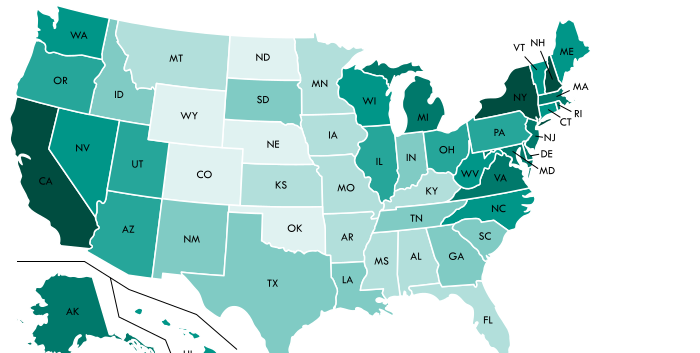
Most common states for computer systems managers
| Rank | State | Population | # of jobs | Employment/ 1000ppl |
|---|---|---|---|---|
| 1 | District of Columbia | 693,972 | 300 | 43% |
| 2 | Alaska | 739,795 | 188 | 25% |
| 3 | New Hampshire | 1,342,795 | 320 | 24% |
| 4 | Vermont | 623,657 | 147 | 24% |
| 5 | Rhode Island | 1,059,639 | 248 | 23% |
| 6 | Delaware | 961,939 | 203 | 21% |
| 7 | North Dakota | 755,393 | 156 | 21% |
| 8 | Wyoming | 579,315 | 124 | 21% |
| 9 | Washington | 7,405,743 | 1,488 | 20% |
| 10 | Oregon | 4,142,776 | 779 | 19% |
| 11 | Minnesota | 5,576,606 | 993 | 18% |
| 12 | Connecticut | 3,588,184 | 629 | 18% |
| 13 | New Mexico | 2,088,070 | 380 | 18% |
| 14 | South Dakota | 869,666 | 156 | 18% |
| 15 | Nebraska | 1,920,076 | 332 | 17% |
| 16 | Montana | 1,050,493 | 178 | 17% |
| 17 | Arizona | 7,016,270 | 1,102 | 16% |
| 18 | Pennsylvania | 12,805,537 | 1,924 | 15% |
| 19 | North Carolina | 10,273,419 | 1,536 | 15% |
| 20 | New Jersey | 9,005,644 | 1,330 | 15% |
Most common cities for computer systems managers
| Rank | City | # of jobs | Employment/ 1000ppl | Avg. salary |
|---|---|---|---|---|
| 1 | Rolling Meadows | 1 | 4% | $119,291 |
| 2 | Redondo Beach | 1 | 1% | $147,296 |
| 3 | Santa Clara | 1 | 1% | $156,077 |
Computer Systems Manager job outlook: Expert opinions
Our panel of computer systems manager experts
Tuskegee University

University of Pittsburgh at Johnstown
University of South Florida
Texas A&M University San Antonio

American University

SUNY Oswego

SUNY Potsdam

University of Nebraska at Omaha

Grand Valley State University
Tiffin University

Indiana University
University of Missouri

University of Illinois at Chicago
NCWIT
Loyola University Chicago
What will help Computer Systems Managers increase their earning potential?
Jason Nichols PhD: Build your experience base through internships and industry projects, and brag about these experiences when you interview. Collect professional certificates to compliment your degree. Security and cloud computing are excellent areas to pursue these in right now. AI and machine learning as well, of course. Build a structured skillset in problem solving and critical thinking, and demonstrate this skillset in your discussions with future employers. Map all of these efforts into a coherent story about yourself in your applications, and how they have shaped you to be a tech-savvy business problem solver, with a strong understanding of both the business and the technology. This foundation prepares you for so very many roles in our field, and businesses recognize and actively seek out this profile in their job candidates. Use the resources available to you. If you need additional time for more formal training, join a masters program. Join us for a masters program, actually. Our AI in Business masters program is launching this Fall, and is open for enrollment currently. Visit us here to learn more: https://wpcarey.asu.edu/masters-programs/ai-business
Dalya Fadlalla
Adjunct FacultyTuskegee University
Computer/Information Technology Administration And Management
What general advice would you give to a Computer Systems Manager?
Dalya Fadlalla: People who work as A_AN JOB_TITLE may enjoy their work because they know what is expected from them, as it is clear on JOB_TITLE. It also, helps them be unstressed due to the clear responsibility. They can have a great opportunity to learn new skills, which has a significant impact on their organization.
Some people may find the work is more stressful, challenging, and need long hours
As a Computer Information Systems graduate entering the job market, they can explore what people like and dislike about being a Computer Information Systems professional.
Many people like working in this field, as Technology advances very fast there is always something new to learn and discover. Others may think it is hard to keep up with new technologies.
Many people appreciate that their work has a significant impact on the world. For example, if they are developing new software.
Therefore, this will depend on the person, and how he sees working in this field. By understanding the advantages and disadvantages of the field, you can make you can decide if this is the right path for you.
What Computer Systems Manager skills would you recommend for someone trying to advance their career?
Dalya Fadlalla: Some companies and industries with JOB_TITLE positions are showing growth and progression. Computer Information Systems (CIS) is a field worth considering with the quick advance in technology and great profession to enter now.
This field offers many benefits including reasonable salaries, many great opportunities for advancement and development, and job security.
The demand for CIS graduates has increased, so CIS graduates should expect and
Believed that to be in high demand in many industries.
Computer Information Systems (CIS) is a career with great potential and a promising future.
What will help Computer Systems Managers increase their earning potential?
Dalya Fadlalla: JOB_TITLE for day-to-day activities will be different depending on the specific role and industry they are working in. When it comes to Computer Information Systems (CIS) graduates entering the job market, it will be useful to have a clear understanding of a job description, and daily activities with expectations of the job for someone who entered the field.
Daily basis activities will depend on their specific job title. Some of the common job titles in this field include IT or IT project manager, programs developer, computer administrator, and database administrator. There are common tasks for Computer Information Systems including managing projects, analyzing data, leading research, managing projects, creating presentations or reports, checking and maintaining computer networks, and collaborating with team members.
For someone entering this field, his day might include learning new skills, completing tasks assigned by a supervisor, working on small projects, collaborating with other team members, and managing and organizing large amounts of data.
Someone who entering the field needs to be open to learning and willing to take on new challenges to grow and develop their skills in the field. CIS offers a wide range of job opportunities with unique daily activities and responsibilities
Travis Stouffer
Assistant Professor of Information Systems, ChairUniversity of Pittsburgh at Johnstown
Department of Information Systems
What soft skills should all Computer Systems Managers possess?
Travis Stouffer: -Conflict Resolution
-Attention to Detail
-Active Listening
Ehsan Sheybani Ph.D.
ProfessorUniversity of South Florida
School of Information Systems and Management
What skills stand out on Computer Systems Manager resumes?
Ehsan Sheybani Ph.D.: Analytical and problem-solving skills, Strong technical skills, The ability to work well under pressure, attention to detail, teamwork skills, organization and time management, interpersonal and communication skills, management and leadership skills.
What soft skills should all Computer Systems Managers possess?
Ehsan Sheybani Ph.D.: Leadership, motivation, communication, conflict management, trust-building, decision-making, organization, and time management.
What hard/technical skills are most important for Computer Systems Managers?
Ehsan Sheybani Ph.D.: Negotiation, relevant technical skills, prioritization and goal setting, project planning, delegating, and budget management.
What skills will help Computer Systems Managers earn the most?
Ehsan Sheybani Ph.D.: Software development, technical sales leadership, mobile app development, business analysis, digital marketing, affiliate marketing, analytical reasoning, artificial intelligence, cloud computing, and blockchain.
Robert Vinaja Ph.D.
Assistant Professor of Computer Information SystemsTexas A&M University San Antonio
Computer Information Systems Department
What skills stand out on Computer Systems Manager resumes?
Robert Vinaja Ph.D.: The skills that stand out will depend on the job position you apply for. I do not think there is a set of universal skills that will stand out for any job. Instead, your resume skills must match the expected requirements for a specific job.
What soft skills should all Computer Systems Managers possess?
Robert Vinaja Ph.D.: -Ability to work as part of a team.
-Attention to detail.
-Problem-solving and analytical skills.
What hard/technical skills are most important for Computer Systems Managers?
Robert Vinaja Ph.D.: -Programming.
-Understand algorithms and data structures.
Anthony Baron
Teaching Assistant, Associate Software EngineerAmerican University
What skills stand out on Computer Systems Manager resumes?
Anthony Baron: For new graduates, the main skills that stand would definitely include which programming languages (Java, JavaScript, Python, etc.) have been used along with a depth of knowledge, which frameworks and libraries (React, Django, Flask, etc.) were used throughout projects and internships, and showing work experience. Most introductory and required courses will teach programming languages but do not always teach frameworks, which is why I would always recommend people to do personal projects and internships throughout college. Many positions at the entry-level are often very general. However, positions that are looking for specifics will look for certain skills and experience. For example, positions looking more towards web development would be more interested in whether a user used frameworks used to build websites. Showing leadership and trustworthiness is also a helpful skill to stand out via work experience and university clubs.
What hard/technical skills are most important for Computer Systems Managers?
Anthony Baron: The main technical/ hard skills, I would say, are mainly the same as in part 1. Another hard skill that will come through with experience in programming is learning how to Google, more specifically knowing exactly what to search to solve an issue in the code.
What skills will help Computer Systems Managers earn the most?
Anthony Baron: By earning, do you mean financially, career-wise, or most growth? Career-wise, it really depends on what the final goal is. For web developers, learning the programming languages and frameworks for web development would be the way to go. In general, any experience with programming and knowing a little about a lot will be helpful. Having top-level theory knowledge (some but not in-depth) is also very helpful. It will help you better understand what is happening under the hood and determine which methods are more efficient than others. Financially, it really depends on what skills are most in-demand today. Also, getting a Masters opens doors to more job opportunities, and in some companies, allows for a pay increase. However, this is not the case everywhere.
What general advice would you give to a Computer Systems Manager?
Mario Bkassiny Ph.D.: Young graduates should continuously seek every learning opportunity to enhance their professional skills. With the fast growth of engineering technology, it is important for engineers to remain up to date with the most recent innovations in their fields. The learning process does not stop at graduation, but instead, it extends beyond college to the workplace where engineers can gain expert knowledge in their fields.
What are the biggest trends we'll see in the Computer Systems Manager job market given the pandemic?
Christopher Lanz: I'm not sure any trend will be relevant long term. Short term, there will be increased competition among job applicants, since, as the economy contracts, there will obviously be fewer positions in toto. Thus applicants with more thorough training, or perhaps those with more or better certificates, will have an important advantage.
We have seen no decline in demand for trained computer scientists, who have always enjoyed a tremendous advantage in the job search (100% of our graduates go immediately into a job after graduating).
Deepak Khazanchi Ph.D.
Associate Dean for Academic Affairs, Community Engagement & Internationalization Officer, Professor of Information Systems & Quantitative Analysis, Director, Executive Master’s of Science in Information Technology (EMIT) Program, Executive Director, Center for Management of IT (CMIT), Fulbright Grantee (Specialist 2014; Core 2020-21)University of Nebraska at Omaha
College of Information Science & Technology
What technical skills for a Computer Systems Manager stand out to employers?
Deepak Khazanchi Ph.D.: Please refer to the prior response for purely technical skills; however, I believe that beyond "technical" skills, capabilities such as abstraction, computational thinking, problem solving, sensemaking, empathy, and multidisciplinarity of thinking will become important assets.
What's a good job out of college for Computer Systems Managers?
Deepak Khazanchi Ph.D.: I think the "best" and "interesting" jobs in my view will be those that leverage emerging technical skills such as AI/ML, data analytics, cybersecurity and medical informatics, with the nontechnical capabilities mentioned above.
What technical skills for a Computer Systems Manager stand out to employers?
Chirag Parikh Ph.D.: If you ask me, I consider valuable experience over good paycheck. Once you have gained that experience the paycheck will follow. As soon as you are out of college, the knowledge gained is very fresh and raring to go. If put into the right place can enhance your technical skills and you can do wonders.
As a Computer Engineering professor, I would say the job opportunities are tremendous for students out of college as they can venture into hardware field (technical support, hardware engineer, test engineer and much more) as well as software field (software engineer, software developer, software tester and much more). The possibilities are endless.
With COVID and employees working remotely there is still ample opportunity to enhance your technical and interpersonal skills as I believe remote working might stay for a while till things get back to normal.
What's a good job out of college for Computer Systems Managers?
Chirag Parikh Ph.D.: It is given that technical skills are required as you enter the job market. In the area of Computer Engineering, I feel that graduates should have a breadth of knowledge in most areas of computer engineering and a greater depth of knowledge in at least one area. Programming skills are of utmost importance, as you might not know every possible programming language or its syntax but the basic understanding of programming logic is necessary.
I personally value debugging skills as a must to have as having this makes you a well-rounded engineer no matter what area of engineering you belong to. Next in my list is technical writing and verbal communication skill. Most of the engineers are known to underperform in this skill. I value this skill, as employers would want their engineers to be able to create technical documents as well as present their design to other co-workers and sometimes to other stakeholders.
The last skill I feel that employers would like their employees to have would be to work in a multidisciplinary environment with co-workers from different branches of engineering and other backgrounds.
What type of skills will young Computer Systems Managers need?
George Miller: Many organizations realize graduates cannot learn everything in college about their major but want the graduate to have a solid foundation on their field of study. The organization wants to mold the graduate to their company environment with how they do things related to the field of study. Most companies want college graduates to have good communication skills (both oral and written), critical thinking skills and be able to work well in teams. These skills have been a staple for graduates since I can remember. This is why a college graduate takes many general education courses related to these skills and many of their major courses emphasize these skills.
Going back to the previous answer I believe graduates in all fields of study will need a better knowledge of technology and easier adaptability to changing technology. Again, an IS degree is already preparing students for this.
What skills stand out on Computer Systems Manager resumes?
Bipin Prabhakar: Skills by themselves on resumes do not provide enough information for the reviewer to assess a candidate. The resume has to showcase the actual capabilities rather than just listing skills. What can you actually do with the listed skill? With that said, deep skills in software development, data science and AI or the broad set of skills required to enable digital transformation will be in demand. Digital transformation requires skills in business analysis, business process and process design, technologies such as next generation ERP systems, AI and ML, cloud architectures and platforms and business analytics.
Are there any particularly good places in the United States for Computer Systems Managers to find work opportunities?
Bipin Prabhakar: There are three major sectors that hire technology graduates - the tech companies that tend to be in tech hubs and major cities, major corporations that are all over the country and consulting organizations that tend to have offices in the bigger cities with access to local clients or well-connected airports. Major employers tend to recruit nationally from the top programs across the country. The best time to find work is before graduation and the best place to find work is the campus recruitment process.
What skills stand out on Computer Systems Manager resumes?
Dale Musser Ph.D.: -Working on teams and collaboration - people skills matter a lot.
-Past accomplishments in delivering results while working with others
-Technical skills in target areas for job. The hottest areas right now: machine learning, large scale apps, and autonomous systems.
What are the biggest trends we'll see in the Computer Systems Manager job market given the pandemic?
Dale Musser Ph.D.: -Work at home for now. "You will have an office at the company after the pandemic."
-Transition of companies to new locations. I see some companies leaving the Bay Area for other locations. Reducing space in San Francisco by a number of companies shows that after the pandemic many employees won't be returning to the physical locations they used to work.
-Increased focus on automation and autonomous systems given the proximity issues.
What Computer Systems Manager skills would you recommend for someone trying to advance their career?
Matthew Liotine Ph.D.: If a student decides to take time off before moving on to a job or graduate school, they should use that time to develop skills in which you may not receive formal training while in college. For example, skills like leadership, problem-solving, teamwork, and communication are going to be more vital than ever in the new norm.
Are there any particularly good places in the United States for Computer Systems Managers to find work opportunities?
Adriane Bradberry: Technology increasingly permeates every aspect of society and provides the foundation for most modern innovation. Young graduates with computing skills will be able to apply to some of the most fastest-growing and highest-paying jobs over the next decade-jobs that are available in nearly every industry, including art, finance, healthcare, and entertainment. Students can establish and develop necessary skills by exploring computing programming apps, taking Computer Science or IT courses (online or at a local community college, if these classes are not offered at school), taking math classes, and joining after-school computing clubs. Graduates who develop these skills will contribute to meaningful work-developing innovative solutions that save lives, solve health problems, improve the environment, and keep us connected.
What type of skills will young Computer Systems Managers need?
Peter Dordal Ph.D.: I'm leaving off software developers, and answering about our Information Technology graduates.
IT students entering the business world will need to know how to get the maximum leverage out of business systems. In many cases, this will mean writing their own specialized queries to extract the precise business intelligence needed; general-purpose "canned" queries just won't cut it. They will need a broad understanding of what software can accomplish for the enterprise and how to deploy new software effectively; this applies to software used in the office as well as to software used in manufacturing and shipping. And they will need to understand how to lease storage and computing resources from the cloud to meet not only predictable, long-term demands but also sudden short-term business projects.
Students working in database administration and management will need to be able to manage much larger volumes of data than a few years ago. They will need to be familiar with the great variety of new databases in order to pick the best tool for the job.
Students working in network management will need to be able to ensure that everyone has the bandwidth and server access they need, as those demands expand to include extensive video, low-latency real-time connectivity, and the regular transfer of huge amounts of data.
Students in cybersecurity will need to be fully acquainted with all the recommended best practices. However, they will also have to be able to anticipate and guard against potential new vulnerabilities. "By the book" protection is no longer sufficient.
How do you envision technology impacting Computer Systems Managers in the next 5 years?
Peter Dordal Ph.D.: I think the biggest driver for change will be the continued explosive increase in the amount of data available. Ten years ago, it was enough to know customers' names, addresses, and past orders. Now there is a huge stream of information about what customers are looking at, what they are clicking on, what they're doing with your product, and what your customers' customers are doing. Analysis of this kind of information is becoming mainstream.