Explore jobs
Find specific jobs
Explore careers
Explore professions
Best companies
Explore companies
Job outlook for consultants/senior systems analyst in the United States
Consultant/senior systems analyst job growth summary. After extensive research, interviews, and analysis, Zippia's data science team found that:
The projected consultant/senior systems analyst job growth rate is 9% from 2018-2028.
About 56,000 new jobs for consultants/senior systems analyst are projected over the next decade.
Consultant/senior systems analyst salaries have increased 8% for consultants/senior systems analyst in the last 5 years.
There are over 97,807 consultants/senior systems analyst currently employed in the United States.
There are 166,101 active consultant/senior systems analyst job openings in the US.
The average consultant/senior systems analyst salary is $109,768.
Are consultant/senior systems analyst jobs in demand?
Consultant/senior systems analyst job and salary trends over time
Consultant/senior systems analyst jobs over time
Consultant/senior systems analyst job growth rate over time
| Year | # of jobs | % of population |
|---|---|---|
| 2021 | 97,807 | 0.03% |
| 2020 | 127,996 | 0.04% |
| 2019 | 75,137 | 0.02% |
| 2018 | 123,524 | 0.04% |
| 2017 | 122,261 | 0.04% |
Average consultant/senior systems analyst salary over time
Consultant/senior systems analyst salary by year
| Year | Avg. salary | Hourly rate | % Change |
|---|---|---|---|
| 2026 | $109,768 | $52.77 | +3.4% |
| 2025 | $106,151 | $51.03 | +2.3% |
| 2024 | $103,748 | $49.88 | +0.5% |
| 2023 | $103,198 | $49.61 | +1.2% |
| 2022 | $101,971 | $49.02 | +1.7% |
Consultant/senior systems analyst jobs by state
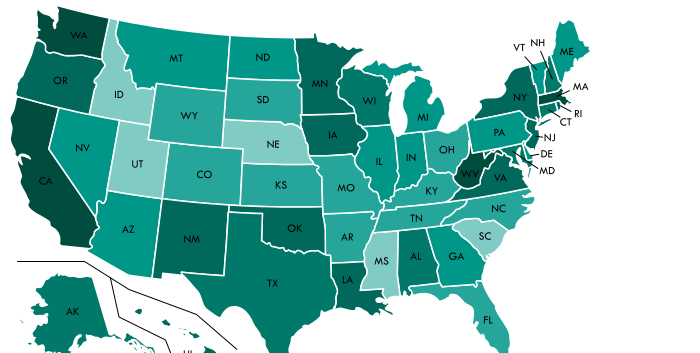
Most common states for consultants/senior systems analyst
| Rank | State | Population | # of jobs | Employment/ 1000ppl |
|---|---|---|---|---|
| 1 | District of Columbia | 693,972 | 625 | 90% |
| 2 | New Mexico | 2,088,070 | 680 | 33% |
| 3 | South Dakota | 869,666 | 290 | 33% |
| 4 | Delaware | 961,939 | 255 | 27% |
| 5 | New Hampshire | 1,342,795 | 354 | 26% |
| 6 | Alaska | 739,795 | 196 | 26% |
| 7 | Vermont | 623,657 | 164 | 26% |
| 8 | Minnesota | 5,576,606 | 1,416 | 25% |
| 9 | Rhode Island | 1,059,639 | 268 | 25% |
| 10 | North Dakota | 755,393 | 184 | 24% |
| 11 | West Virginia | 1,815,857 | 426 | 23% |
| 12 | Oregon | 4,142,776 | 896 | 22% |
| 13 | Connecticut | 3,588,184 | 788 | 22% |
| 14 | Washington | 7,405,743 | 1,583 | 21% |
| 15 | Arizona | 7,016,270 | 1,440 | 21% |
| 16 | South Carolina | 5,024,369 | 1,080 | 21% |
| 17 | Illinois | 12,802,023 | 2,621 | 20% |
| 18 | Massachusetts | 6,859,819 | 1,376 | 20% |
| 19 | Nebraska | 1,920,076 | 377 | 20% |
| 20 | Montana | 1,050,493 | 206 | 20% |
Consultant/Senior Systems Analyst job outlook: Expert opinions
Our panel of consultant/senior systems analyst experts
Western Kentucky University
Kent State University
Widener University
University of Wisconsin - Green Bay
Prairie View A & M University
SUNY College at Geneseo
Siena College
University of Maine
Western Kentucky University
University of Maryland - College Park
Mount Saint Mary's University
Washington and Lee University
Florida International University
What general advice would you give to a Consultant/Senior Systems Analyst?
Rebecca MacGowan: My general advice is to work backwards and start your career by thinking about what you want to achieve long term. When you think about your career in ten or twenty years, what position are you in? Once you have an idea of the type of position you would like to be in during the middle and/or late stage of your career, go on LinkedIn and look up individuals who currently hold that position and see what their career trajectory was. What positions provided them the stepping stones to achieve the career you currently aspire to? By working backwards, you can ensure that your initial position is setting you up for your long-term goals. Additionally, what you are likely to find when you look at the career paths of different folks is that there are often many paths leading to your ideal future position. Hopefully, this broadens your perspective regarding what position you need right now and how different positions can help set you up for your desired future career. Often, unless we are exceptionally fortunate, our first career after undergraduate isn’t going to be our ideal position, but with proper planning, it can be the first step towards our ideal position.
What Consultant/Senior Systems Analyst skills would you recommend for someone trying to advance their career?
Rebecca MacGowan: Business graduates encompass a broad set of majors, each of which has their own set of best practices and different applied tools that they use. I highly recommend students become familiar with the dominant trends in their fields including decision making processes (how do individuals in their field draw conclusions about what to do) and what software applications are the most prevalent (what they use for supply chain is going to be different from the applications they use for accounting, and so forth) so that they can ensure they are practicing their domain-specific aptitudes prior to graduation. They can do this via their college courses, outside learning opportunities, or via an internship with applied experience. Regardless of their specific major, all business students benefit from the development of their soft skills – rarely in a business environment will you work independently, the majority of the time you are going to be working in groups and teams, nested within departments, nested within organizations, nested within industries. As such, learning strong communication and conflict management skills, gaining an understanding of the strengths of your personal leadership style as well as an understanding of your weaknesses, and figuring out the best way to maintain your personal motivation and how to motivate others, are all skills that transcend time and are helpful across different positions and organizations. Additionally, as AI becomes more prominent in white-collar positions, the ability to interface with AI engines will continue to emerge as an important general skill to have.
What Consultant/Senior Systems Analyst skills would you recommend for someone trying to advance their career?
Ning Ye Ph.D.: Firstly, you need to research your salary benchmarks. Look up salary benchmarks for the role or industry you are entering into before joining the job market. Websites such as Payscale, Glassdoor and LinkedIn Salary can give valuable input concerning what others in equivalent positions earn. Such knowledge will help set realistic expectations and negotiate well. Select employers who invest in their employees' growth and development. Companies that have good mentoring programs, a way for advancement, and a positive culture tend to have better long-term salary prospects. Make a commitment to life-long learning and professional development. Keep abreast with new trends in your industry and keep upgrading your skills all along. Employers are more likely to invest in employees who demonstrate a commitment to their own growth and development. It is important to obtain certifications relevant to your field that can make you a more attractive candidate and justify higher salary demands. For instance, certifications in project management (PMP), data analysis (Google Data Analytics), or digital marketing (Google Analytics) can set you apart.
Prof. Mohammad Elahee Ph.D.
Perlroth Professor of Int’l. BusinessWhat Consultant/Senior Systems Analyst skills would you recommend for someone trying to advance their career?
Prof. Mohammad Elahee Ph.D.: A combination of both hard and soft skills will be needed to survive in this ‘dog eat dog world’. Hard skills that will be in high demand are familiarity with new AI- and machine-driven technologies and quantitative reasoning. Soft skills that employers will be looking for include emotional intelligence, communication and interpersonal skills and a “can do attitude”. Paradoxical though it may sound, AI would actually create more demand for people with emotional and social intelligence.
Dany Doueiri
ProfessorWhat general advice would you give to a Consultant/Senior Systems Analyst?
Dany Doueiri: Don't try to start your own business right after you graduate. Keep your dreams, passions, and aspirations alive but get experience from the field through companies, organizations, and institutions. Gain wisdom from those who have more experience than you and those who make mistakes, including your own shortcomings. Then, you can consider branching out. Finally, learning never stops at the end of your college journey. Be humble and keep on learning for life.
What Consultant/Senior Systems Analyst skills would you recommend for someone trying to advance their career?
Adam Roth: I recommend that students start by identifying a specific skill in demand within your field, such as data analysis or social media marketing, and focus on developing expertise in that area. Research salary ranges and living costs in particular areas where you’re interested in working to ensure your compensation aligns with the local market. Always negotiate a salary and consider other aspects of the offer, such as funds for continuing education, technology and more. Continuing to network and establish demand for your services is essential; attend industry events, join professional associations, and engage with professionals in your field. Never miss an opportunity to reach out to and check in with your professional contacts. Pursue additional learning opportunities and education, such as certifications or advanced degrees, to provide a competitive advantage and increase your earning potential over time.
What will help Consultants/Senior Systems Analyst increase their earning potential?
Adam Roth: In the next 3–5 years, the increasing presence of robots and artificial intelligence (AI) will drastically change the job market, leading to the replacement or displacement of many tasks that are currently performed by humans. This change highlights the growing need for individuals with degrees in the liberal arts. A liberal arts education emphasizes communication, critical thinking, problem-solving, analytical reasoning, creativity, emotional intelligence, and cultural awareness—human literacies, skills, and competencies that are difficult for a machine to replicate. As automation takes over many routine tasks, jobs requiring complex decision-making, creativity, and communication and interpersonal skills will become more important. Liberal arts graduates also excel in ethical decision-making and understanding societal issues, which are crucial in the responsible use and incorporation of AI.
What general advice would you give to a Consultant/Senior Systems Analyst?
Bradley Andrew Ph.D.: So-called soft skills are still in demand by employers, based on recent surveys, because a smaller percentage of graduates possess them. These include:
Showing up and on time;
Having a strong work ethic;
Critical thinking skills
Social skills, including the ability to get along well with people, motivate and encourage them, and leadership skills. Also be able to schmooze with clients over dinner or drinks, or just in your office. A personal touch and connection is something software can’t provide.
Creativity—Apple products, for example, appeal to many people because of their combination of form and function.
The ability to work AI in order to increase one’s productivity will become more important over the next 5 years.
What Consultant/Senior Systems Analyst skills would you recommend for someone trying to advance their career?
Bradley Andrew Ph.D.: I’m going to change the question based on the evidence gathered by labor economists. Overall, income rises most in a person’s 20s and 30s, stagnates in one’s 40s and actually falls from age 50 on. Moreover, people who are willing to change jobs more frequently have greater salary growth. If this is your goal, then spending your twenties and thirties working hard on your skills and credentials, being willing to move from one position to another and being geographically flexible will increase your lifetime income.
What will help Consultants/Senior Systems Analyst increase their earning potential?
Bradley Andrew Ph.D.: Once you have your first job, ask about or determine the 20% of your supervisor’s job that they hate and start doing that for them. They will love you for it and it will quickly get you recognition. You’ll also be well on your way to learning your boss’s job. Continue doing this as you progress in your career (Kudos to Theo Epstein, former GM for the Red Sox, for this recommendation)
No matter the task you’re given, do it to the absolute best of your abilities. In the professional world, you may often be given menial tasks or tasks that you don’t believe are part of your job description. Doing those tasks to the absolute best of your ability leads to increased trust, recognition and responsibility and will put you “above class.” If asked, the coffee you bring should be the best your boss has ever had. You never know who’s watching.
Don’t expect credit and don’t ask for credit when things go right; give the credit to others.
Xiaowen Chen Ph.D.
Assistant ProfessorWestern Kentucky University
Psychology
What Consultant/Senior Systems Analyst skills would you recommend for someone trying to advance their career?
Xiaowen Chen Ph.D.: Present your knowledge, skills, competencies, and experience by showing your research and applied projects so that employers will know what you have accomplished and the potential value you can bring to their organization.
What Consultant/Senior Systems Analyst skills would you recommend for someone trying to advance their career?
Dr. Vaneet Kaur: There are two sets of skills I will highly encourage graduates to proactively start building. Firstly, business graduates need to develop higher-order skills and capabilities like knowledge-based dynamic capabilities. These will help them to (a) constantly collect knowledge about emerging opportunities (and threats) in the industry, (b) mobilize themselves and their resources to bring identified opportunities into fruition, and (c) constantly renew their skills to effectively respond to the changes in the environment. Developing such knowledge-based dynamic capabilities will automatically prepare them for the different waves of skill set requirements that will keep arising in the job market. Secondly, it is no secret that we are living in the times of artificial intelligence and automation. So, in this day and age, it is extremely important that graduates learn to ride the wave of automation rather than being discouraged by it. Business graduates are set to contribute to the world with their business acumen and expertise, what they can do to complement it is to develop low-code, no-code skills. Such skills will help graduates to automate routine processes so that their time and energies can be strategically channelized towards those activities and processes that can add significant value to their organizations.
Tongyang Yang Ph.D.
Assistant Professor of Economics and Business AnalyticsWidener University
Business/Commerce
What general advice would you give to a Consultant/Senior Systems Analyst?
Tongyang Yang Ph.D.: There are many reasons that people like about being a business analyst, including reasons listed as follows: 1. Analytical Skills and Data Exploration: BAs often analyze data to understand trends and identify areas for improvement. Seeing a successful implementation and its positive impact can be very rewarding. 2. Problem-solving. BAs get to identify inefficiencies and propose solutions that can improve how a business operates. 3. Continuous learning. Business analysts may work on a range of projects and the field of business analysis may be constantly evolving, which required BAs to actively cultivate skills in new businesses. For example, the coming of the AI era requires BAs to master AI fundamentals and data fluency. 4. While some thrive on the problem-solving and communication aspects of a BA role, others may find them less appealing. Carefully consider your personality and preferences to see if this aligns with your career goals.
What will help Consultants/Senior Systems Analyst increase their earning potential?
Praneet Tiwari: Continue to be a learner! Business degrees give students the foundation they need to begin their careers but to continue to do well in their careers, they need to keep learning. Find opportunities to learn more to keep evolving whether it’s the use of free resources when available or if your organization funds additional degrees then use those opportunities too. The business world is constantly evolving so it’s important to stay current. Another important thing to focus on is networking. Often after we get our first jobs, we get complacent when it comes to networking but building a network is crucial. Connect with other professionals through LinkedIn, your university’s alumni associations, and events specific to your industry.
What will help Consultants/Senior Systems Analyst increase their earning potential?
Terésa Dowell-Vest Ph.D., M.F.A.: First, I would celebrate them getting to that point. Everything after is going to be challenging and, in some cases…in most cases, difficult to navigate, so boosting their confidence and morale are key to ensuring they see themselves as worthy of success. Second, network! For young people beginning their careers, it is vital to meet other people with similar passions and pursuits. Find your tribe and climb together. Finally, craft a plan. A dream is not a plan. You need to create a BUSINESS PLAN for your life. Establish what your goals are, pare them down to one or two SMART goals, determine who will likely be supporters of your goal, create a brand for yourself (social media, business cards, a personal motto) and determine the resources you’ll need to achieve your goal.
Jasmine Tang
SUNY College at Geneseo
Bilingual, Multilingual, And Multicultural Education
What Consultant/Senior Systems Analyst skills would you recommend for someone trying to advance their career?
Jasmine Tang: Be confident of their major/minor or the subject they like and do best of the field they like for themselves not for money or please their parents or fulfill the dream of others.
What will help Consultants/Senior Systems Analyst increase their earning potential?
Jasmine Tang: I always advise the students to apply any job that accept their degree or go for the one they really like.
What general advice would you give to a Consultant/Senior Systems Analyst?
Sunita Goel PhD: Great. Will send you the responses soon. Please let me know the latest deadline by which you need them.
What Consultant/Senior Systems Analyst skills would you recommend for someone trying to advance their career?
Dr. Ryan LaRochelle Ph.D.: Don't be afraid to negotiate. The labor market is incredibly tight at the moment, so employees have more leverage than they've had in decades. Your starting salary and benefits package will be the baseline for any negotiation moving forward, so use the leverage you have now to get the best package you can get. Also, think carefully about how different compensation and benefit packages interact with other factors in the state or region where you're looking to work.
What general advice would you give to a Consultant/Senior Systems Analyst?
Ron Ramsing Ph.D.: Relationships matter – continue to build your network by being a contributing member of a team while treating others well. Seek opportunities to actively learn and expand your knowledge and understanding of the industry. Mentors are important for providing guidance, feedback, and support. While it may take time, explore ways to connect with a mentor may it be formally or informally. Continue to hone your interpersonal skills through active listening, being conscientious, flexible, and willing to support and assist others. Be authentic!
What Consultant/Senior Systems Analyst skills would you recommend for someone trying to advance their career?
Dr. Rellie Derfler-Rozin: Though those skills have always been crucial for managers’ success, I think people’s skills will become even more important. Some more content-related areas/skills might be easier to navigate using technology, AI etc, but there will always be a need to manage people, and given the advanced technology there will be even more of a need to be sensitive to how people react to new technology, to make sure people use the technology in both effective and ethical manner. A lot of this will come from role modeling and showing ethical strong leadership.
What general advice would you give to a Consultant/Senior Systems Analyst?
Oliver Keys Jr: The power of mentorships and networking early in your career will be beneficial in the long run. Also, understanding that professional skills can be half the battle. Showing up on time, dressing appropriately, and communicating effectively can be challenging for some students. Internships and externships are great for students to get technical and professional experience.
Dr. Michelle Holloway
Professor and Doheny Program DirectorMount Saint Mary's University
International Business
What will help Consultants/Senior Systems Analyst increase their earning potential?
Dr. Michelle Holloway: Figure out what you are good at, then consider what you would enjoy doing professionally. Your strengths will tell you what job function to do (e.g., sales, accounting, procurement). Your interests will tell you what industry to work in (e.g., tech, entertainment, retail).
What Consultant/Senior Systems Analyst skills would you recommend for someone trying to advance their career?
Michelle Cowan Ph.D.: I’m not sure about this question since I haven’t really discussed this with any business analysts. I’ll pass this question on and see if I get a response. Otherwise, ask me about content strategy, UX, writing, and communication jobs, and I can speak more freely, since that’s what I did for 15 years before moving into academia.
What general advice would you give to a Consultant/Senior Systems Analyst?
Linnéa Chapman: The reality is that salaries for entry-level positions can be low -- and it can be tough to negotiate for more money when you're coming out of college. Graduates who are fortunate enough to receive several job offers may be able to choose the one with the highest pay, or use that offer to negotiate for a higher salary at a chosen firm. All graduates should remember that their starting salary is just that: where they are starting. If they work hard, develop valuable skills, and demonstrate the ability to do more than what is required, they’ll soon be able to earn promotions or opportunities at other firms. So, it is especially important for entry-level employees to bring a positive attitude and commitment to doing excellent work every single day. In my experience, companies recognize those shining stars and are quick to reward them with promotions (and higher pay). That said, the first few years out of college are sometimes difficult financially. New graduates might want to consider taking on freelance or part-time work in addition to their full-time jobs. For example, I have former students who do work in content creation on the weekends. This allows them to make extra money – and develop skills that could open new doors career-wise. While taking on an extra job is not for everyone, some find it a rewarding way to network and build up their resumes.