Explore jobs
Find specific jobs
Explore careers
Explore professions
Best companies
Explore companies
Job outlook for control operators in the United States
Control operator job growth summary. After extensive research, interviews, and analysis, Zippia's data science team found that:
The projected control operator job growth rate is -8% from 2018-2028.
About -83,800 new jobs for control operators are projected over the next decade.
Control operator salaries have increased 11% for control operators in the last 5 years.
There are over 16,741 control operators currently employed in the United States.
There are 64,435 active control operator job openings in the US.
The average control operator salary is $42,885.
Are control operator jobs in demand?
Control operator job and salary trends over time
Control operator jobs over time
Control operator job growth rate over time
| Year | # of jobs | % of population |
|---|---|---|
| 2021 | 16,741 | 0.00% |
| 2020 | 16,508 | 0.00% |
| 2019 | 16,886 | 0.01% |
| 2018 | 12,335 | 0.00% |
| 2017 | 12,032 | 0.00% |
Average control operator salary over time
Control operator salary by year
| Year | Avg. salary | Hourly rate | % Change |
|---|---|---|---|
| 2026 | $42,885 | $20.62 | +3.4% |
| 2025 | $41,476 | $19.94 | +1.4% |
| 2024 | $40,908 | $19.67 | +2.1% |
| 2023 | $40,050 | $19.25 | +3.6% |
| 2022 | $38,672 | $18.59 | +2.3% |
Control operator jobs by state
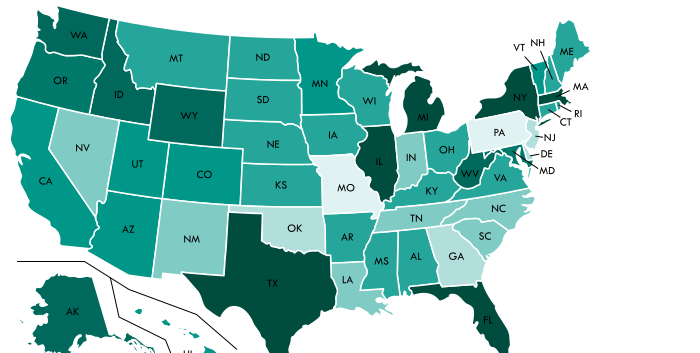
Most common states for control operators
| Rank | State | Population | # of jobs | Employment/ 1000ppl |
|---|---|---|---|---|
| 1 | District of Columbia | 693,972 | 199 | 29% |
| 2 | Massachusetts | 6,859,819 | 1,870 | 27% |
| 3 | Rhode Island | 1,059,639 | 190 | 18% |
| 4 | Alaska | 739,795 | 124 | 17% |
| 5 | New Jersey | 9,005,644 | 1,307 | 15% |
| 6 | New Hampshire | 1,342,795 | 184 | 14% |
| 7 | Hawaii | 1,427,538 | 142 | 10% |
| 8 | Georgia | 10,429,379 | 703 | 7% |
| 9 | Virginia | 8,470,020 | 581 | 7% |
| 10 | Maryland | 6,052,177 | 420 | 7% |
| 11 | Wisconsin | 5,795,483 | 400 | 7% |
| 12 | Minnesota | 5,576,606 | 376 | 7% |
| 13 | South Carolina | 5,024,369 | 332 | 7% |
| 14 | Iowa | 3,145,711 | 220 | 7% |
| 15 | Delaware | 961,939 | 72 | 7% |
| 16 | Wyoming | 579,315 | 40 | 7% |
| 17 | Indiana | 6,666,818 | 424 | 6% |
| 18 | Colorado | 5,607,154 | 350 | 6% |
| 19 | Utah | 3,101,833 | 200 | 6% |
| 20 | South Dakota | 869,666 | 52 | 6% |
Most common cities for control operators
| Rank | City | # of jobs | Employment/ 1000ppl | Avg. salary |
|---|---|---|---|---|
| 1 | Anderson | 1 | 4% | $37,491 |
| 2 | Franklin | 1 | 4% | $38,554 |
| 3 | Muncie | 2 | 3% | $38,696 |
| 4 | Decatur | 1 | 2% | $39,808 |
| 5 | Anaheim | 2 | 1% | $41,652 |
| 6 | Auburn | 1 | 1% | $44,133 |
| 7 | Columbia | 1 | 1% | $37,411 |
| 8 | Grand Rapids | 1 | 1% | $46,838 |
| 9 | Green Bay | 1 | 1% | $40,193 |
| 10 | Huntsville | 1 | 1% | $39,805 |
| 11 | Lakeland | 1 | 1% | $45,927 |
| 12 | Colorado Springs | 1 | 0% | $41,707 |
| 13 | Houston | 1 | 0% | $46,078 |
| 14 | Indianapolis | 1 | 0% | $38,622 |
Control Operator job outlook: Expert opinions
Our panel of control operator experts
Manhattan College
Fairfield University
University of Oregon
American University
Pacific Lutheran University
University of Nevada - Las Vegas

Bay Path University
What general advice would you give to a Control Operator?
Dr. Natalia Boliari PhD: First, learn everything about the company you just started working for - its historical path, management, the way it's dealt with crises, etc. Second, learn everything about the specific industry the company belongs to and see how the company has developed relative to the development of the industry domestically and internationally. Third, always be extremely alert to notice new opportunities and be prepared to take calculated risks. That is, actively look for opportunities to complete as many and diverse tasks as possible, and volunteer to complete any type of work regardless of whether it seems relevant to your assigned job or not. Opportunities to learn, grow, and improve and thus to maximize your income, will only come up if you are exposed to diverse situations.
What Control Operator skills would you recommend for someone trying to advance their career?
Dr. Natalia Boliari PhD: Be open minded. Finance is the broad definition of an industry which provides opportunities for careers in financial consultancy, financial analysis, stock brokerage, foreign investment, modeling, exchange rate forecasts, and many more. While most of those careers are attributed to the banking industry, you can find those and others in other sectors of the economy, such as insurance, technology, health care/medical, government, and so on. So, be open and look beyond the banking sector, examine the current and predicted trends in the economy to hunt for exciting career options.
What general advice would you give to a Control Operator?
John McDermott Ph.D.: To maximize your salary potential, keep learning, investing in your human capital, and expanding your capabilities. Learn as much as you can about your new position and industry, work with a variety of people at your firm, and seek opportunities outside your comfort zone. Your salary potential will increase as you are recognized as a capable and hard working colleague.
Z. Jay Wang
Department Head, Associate Professor of FinanceUniversity of Oregon
Finance And Financial Management Services
What will help Control Operators increase their earning potential?
Z. Jay Wang: Students who have a history of doing work in the field outside the classroom either through internships, industry projects, or school-sponsored clubs managing financial decisions are better poised to maximize starting salary potential. Starting early to secure internships with top companies will also position students well for higher earning potential. Most top banks and firms will post internships from April/May to August, and close by the end of September for the following summer. They are also rolling, so may fill the roles by as early as June of the sophomore year for the following summer after junior year. Finally, networking with industry and alumni professionals in the companies, firms, banks prior to applying for an internship or full-time position will have an impact. The candidate will learn more about the opportunity and company culture for their resume and potential interview, and most top companies in finance will have a referral program. If the candidate impresses the internal connection with excellent questions and strategic answers, they may get a referral that moves them up in the stacks of applicants.
Octavian Ionici PhD
Sr. Lecturer in FinanceAmerican University
Finance And Financial Management Services
What Control Operator skills would you recommend for someone trying to advance their career?
Octavian Ionici PhD: The finance profession is lucrative, rewarding and very competitive. Graduates should do their research about the organization they are interviewing with and be able to discuss how their skills can contribute to the business. They should also know if they would rather interact with people and clients or if they are drawn to intellectual pursuits such as analysis. Do they value power, prestige status, risk, or something else? Ultimately our core values, personal goals, interests, aptitudes, and personality will shape our career paths.
Being able to articulate what sparked their interest in the financial field and why they are interested in a chosen role will be an advantage during the hiring process. While still in college, students should join a professional association like the Financial Management Association to give them more access to that broad network, as well as access to career development resources that can set them apart from the crowd.
It's also critical to get an internship (paid or unpaid) in order to show some real-life experience. They can do this while they are still in college, during the summers, or even afterwards, to get a foot in the door.
Reading the WSJ and FT daily, and listening to Bloomberg, or other financial programs as a regular practice will help them to have fluency in the language of our profession. Because the finance sector is heavily regulated and changes occur due to changing economic and political conditions, they will need to stay updated with those changes. Financial media sources will help bring them that context to stay up to date on all of these moving parts.
What will help Control Operators increase their earning potential?
Dr. Kimberly Gaither: Maximize your salary potential by asking questions and learning as quickly as possible. Be a good communicator with those above and below you as well as your peers. Be dependable. Persons who show up early and work hard will be valued and rewarded.
Fang Lin
Assistant Professor of FinancePacific Lutheran University
Finance And Financial Management Services
What Control Operator skills would you recommend for someone trying to advance their career?
Fang Lin: Don't be afraid to negotiate your starting salary. Young journalists have a lot to offer newsrooms through social media skills and a willingness to adapt to new technologies such as artificial intelligence. Technology skills have value and should not be undersold. Also, young journalism students should not discount the value of their student media and internship experiences. Young journalists must use everything on their resumes to show how they bring value to their position and ask to be compensated fairly for the work they will contribute to the newsroom's success.
Dhruba Banjade
Assistant Professor in Finance & Department Chair of Business AnalysisWhat general advice would you give to a Control Operator?
Dhruba Banjade: i. The industry technology is changing fast. Specific skills will be more critical in the finance field in the next 3-5 years. Some of these are:
ii. Data analysis/ data mining skills. Knowledge of Excel, R, Python, data visualization, Tableau, RapidMiner, machine learning, and financial modeling skills are essential in finance and business.
iii. Skills and knowledge of artificial intelligence and machine learning will give more opportunities and help career development.
iv. Network security and cybersecurity are essential to protect financial transactions and digital data.
v. Knowledge of financial regulations and risk management will be in high demand in the next 3-5 years.
vi. Soft skills such as politeness, ability to work in a diverse group, good communication, learning attitude, etc, are also necessary.
vii. Many industry and business companies today focus on sustainable development and environmental, social, and governance activities. Knowledge of sustainability and ESG measures is also helpful.
viii. Broad knowledge of global financial markets, international finance, global economy, etc., will be valuable in the next 3-5 years.
John Clark Ph.D., CFA, CFP
Chair, Dept. of FinanceUniversity of Nevada - Las Vegas
Geological And Earth Sciences/Geosciences
What general advice would you give to a Control Operator?
John Clark Ph.D., CFA, CFP: Show you have experience. Doing an internship is a great way to increase your starting salary. I always advocate for doing applied research, this is research that you can show has implications for society - science for the sake of science is not good science! Obtaining an MS degree is also a good way to increase your salary, especially if your MS degree is relevant to your future job.
Heather Antanavica
Adjunct InstructorBay Path University
Accounting
Will there be an enduring impact of the coronavirus pandemic on Control Operators?
Heather Antanavica: The coronavirus will have a lasting impact on all of humanity, and everyone's jobs will be affected in one way or another. New graduates will have to navigate the working world in a very different way, for example; virtual interviewing, increased competition (many people will be re-entering the workforce after being laid-off during the spring of 2020), and being flexible with businesses that are adapting to a new way of operating. If you are not tech-savvy, work on that now. Companies will be looking for prospects with tech skills in industries where it wasn't much of a factor before the pandemic hit. Most importantly, develop a self-care routine that speaks to you. Meditation, yoga, exercise, grounding practices, and a healthy diet are great options for tending to your well-being so that you can get out there and start your new career with a healthy mind, body, and spirit!