Explore jobs
Find specific jobs
Explore careers
Explore professions
Best companies
Explore companies
Job outlook for creative services designers in the United States
Are creative services designer jobs in demand?
Creative services designer job and salary trends over time
Creative services designer jobs over time
Creative services designer job growth rate over time
| Year | # of jobs | % of population |
|---|---|---|
| 2021 | 826 | 0.00% |
| 2020 | 816 | 0.00% |
| 2019 | 874 | 0.00% |
| 2018 | 882 | 0.00% |
| 2017 | 879 | 0.00% |
Average creative services designer salary over time
Creative services designer salary by year
| Year | Avg. salary | Hourly rate | % Change |
|---|---|---|---|
| 2026 | $79,164 | $38.06 | +2.4% |
| 2025 | $77,280 | $37.15 | +3.5% |
| 2024 | $74,700 | $35.91 | +3.4% |
| 2023 | $72,223 | $34.72 | +2.2% |
| 2022 | $70,651 | $33.97 | +1.6% |
Creative services designer jobs by state
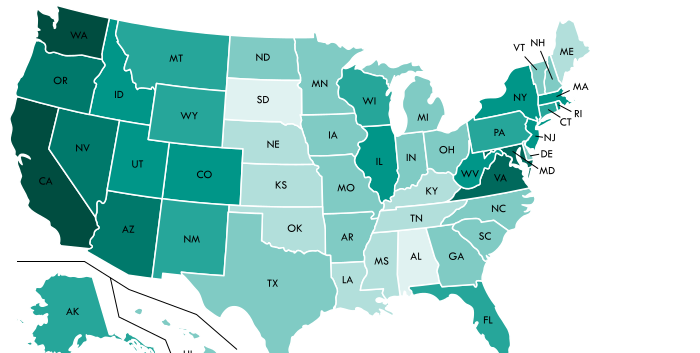
Most common states for creative services designers
| Rank | State | Population | # of jobs | Employment/ 1000ppl |
|---|---|---|---|---|
| 1 | District of Columbia | 693,972 | 359 | 52% |
| 2 | Minnesota | 5,576,606 | 1,307 | 23% |
| 3 | Oregon | 4,142,776 | 837 | 20% |
| 4 | Massachusetts | 6,859,819 | 1,270 | 19% |
| 5 | Iowa | 3,145,711 | 598 | 19% |
| 6 | Washington | 7,405,743 | 1,365 | 18% |
| 7 | Virginia | 8,470,020 | 1,368 | 16% |
| 8 | Utah | 3,101,833 | 464 | 15% |
| 9 | New Hampshire | 1,342,795 | 202 | 15% |
| 10 | Rhode Island | 1,059,639 | 164 | 15% |
| 11 | Colorado | 5,607,154 | 787 | 14% |
| 12 | Vermont | 623,657 | 88 | 14% |
| 13 | California | 39,536,653 | 4,971 | 13% |
| 14 | North Carolina | 10,273,419 | 1,293 | 13% |
| 15 | Nebraska | 1,920,076 | 259 | 13% |
| 16 | Delaware | 961,939 | 125 | 13% |
| 17 | South Dakota | 869,666 | 113 | 13% |
| 18 | New York | 19,849,399 | 2,317 | 12% |
| 19 | Illinois | 12,802,023 | 1,592 | 12% |
| 20 | Idaho | 1,716,943 | 204 | 12% |
Most common cities for creative services designers
| Rank | City | # of jobs | Employment/ 1000ppl | Avg. salary |
|---|---|---|---|---|
| 1 | Duluth | 1 | 3% | $72,040 |
| 2 | Leawood | 1 | 3% | $62,041 |
| 3 | San Carlos | 1 | 3% | $106,522 |
| 4 | Towson | 1 | 2% | $95,552 |
| 5 | Huntsville | 1 | 1% | $53,915 |
| 6 | Mountain View | 1 | 1% | $106,340 |
| 7 | Santa Monica | 1 | 1% | $98,058 |
| 8 | Stamford | 1 | 1% | $77,672 |
| 9 | Los Angeles | 2 | 0% | $97,995 |
| 10 | Baltimore | 1 | 0% | $95,536 |
| 11 | Chicago | 1 | 0% | $80,779 |
| 12 | New York | 1 | 0% | $83,852 |
| 13 | Sacramento | 1 | 0% | $105,884 |
| 14 | San Francisco | 1 | 0% | $106,676 |
Creative Services Designer job outlook: Expert opinions
Our panel of creative services designer experts
Arkansas State University
Merrimack College
University of Northern Iowa

Oklahoma State University Institute of Technology

Highline College
Marywood University

Tyler School of Art and Architecture, Temple University
Kansas City Art Institute
Siena College
Mansfield University of Pennsylvania
What will help Creative Services Designers increase their earning potential?
Nikki Arnell MFA: People like that being a graphic designer allows them to be creative for a living, with regular pay and benefits. However, the constant revisions and critiques on creative work can be challenging, and designers must learn to balance their artistic vision with client feedback and project objectives.
What general advice would you give to a Creative Services Designer?
Nancy Wynn: The foundational knowledge of Design is constant, but the technology changes at a fast-pace-one can love or hate that aspect. Additionally, some people love and hate aspects of working in the business environment. Since Design is interdisciplinary, it is best to approach the profession understanding that one needs to learn many things well, which requires continued learning and research; you need to embrace collaboration; and you need to learn how to articulate your ideas in writing and orally to small and large groups of people.
What will help Creative Services Designers increase their earning potential?
Nancy Wynn: There are many different ways to intersect the creative field of graphic design or Design. You can enter utilizing production skills centered on working with an Art Director-you produce their designs with various handwork and software platforms. If you enter as a junior graphic designer-you collaborate with an Art Director and brainstorm concepts / designs for projects. You may intersect working in the service industry where you help customers produce their designs. Day-to-day tasks can be specific if you work at a very large company, or more comprehensive if you work at a smaller agency. They can range from meetings with Art Directors or marketing people; collaboration with fellow designers or other team members based on the project components; brainstorming, research, and ideation for projects; learning new technology by producing designs and client presentations; meetings with focus groups or testing of projects; and finally debrief sessions on projects results.
Elizabeth Sutton
Department Head, Professor of Art HistoryUniversity of Northern Iowa
Department of Art
What hard/technical skills are most important for Creative Services Designers?
Elizabeth Sutton: We train our students in Adobe Creative Suite: InDesign, Photoshop, Illustrator.
What skills stand out on Creative Services Designer resumes?
Elizabeth Sutton: What really stands out is the quality of the student's portfolios and that they have client-based real-world experience.
What soft skills should all Creative Services Designers possess?
Elizabeth Sutton: There are many--the ability to collaborate and communicate effectively is absolutely necessary. The ability to ask for feedback and be able to take that feedback and incorporate it into a process is very important. Of course, meeting deadlines is also very important.
Mary Miller
InstructorOklahoma State University Institute of Technology
Graphic Design Faculty
What skills will help Creative Services Designers earn the most?
Mary Miller: The skills that will help you earn the most money throughout your career as a graphic designer are people skills and business skills. It's expected that you must have the design skills to be a long-time creative employee, but to rise to the top of the field, you have to be savvy with people and business decisions. If a designer works in the industry for several years and starts their own studio, they obviously need business knowledge to run and grow their business. Many designers who follow this career path move out of the creative work and concentrate on client relations and acquisition, managing their employees, and running their business. The owners of agencies and studios can earn large, six or seven-figure incomes. The designer who doesn't want to own their own business but would rather be a creative director and/or VP in a large agency will need great people skills. They will be responsible for developing their creative teams and managing people. As VPs and creative directors, they will have more administrative responsibility for the agency, but they don't have the full responsibility an owner does. These positions earn six-figure incomes.
In these creative positions, the portfolio is the most important thing to get the job. It's not as important to have advanced degrees as it might be for accountants, engineers, or other fields. Even job postings that say they require bachelor's degrees will enthusiastically hire someone with a portfolio that showcases the right skill set, regardless of their education. The creative department ultimately decides who they want to hire, not the HR folks who typically can't assess a creative portfolio, so degree requirements are generally not as important. HR people will screen resumes for certain words, which is not necessarily the most effective way to hire creative people. The portfolio is the best way to determine the candidate's ability. The post-pandemic economy has forced companies to change some of their hiring practices. There are so many open jobs that companies realize that they can't use some of the tired strategies they used before the pandemic. They are less concerned about degree requirements now as more Americans are questioning the expense of 4-year degrees and fewer people are willing to go into deep debt to buy one.
More Americans realize the value of industry-focused, technical degrees in higher education and seek less expensive ways to ensure career success. (ABC News did a recent series on this subject. It was broadcast on KRMG radio a couple of weeks ago. The series was all pandemic recovery, "how have we changed" type of reporting.) Associate of Applied Science degrees can fill the void for many. People are doing their homework and looking for programs with great track records and successful alumni that prove it. OSUIT's graphic design program has been around since 1946 when the school was started and has lots of examples of graduates who hold associate's of applied science graphic design degrees, and nothing more, who are successful agency and studio owners, VPs of Creative, Marketing Directors, Design Directors, Executive Creative Directors, Creative Directors, Associate Creative Directors, Sr. Art Directors, etc.
What skills will help Creative Services Designers earn the most?
Diana Boyd: -Originality/Creativity
-UX/UI design
-Branding
-Marketing and Advertising
-Illustration
What soft skills should all Creative Services Designers possess?
Diana Boyd: -Collaboration/Teamwork
-Interpersonal
-Reliability
-Ethical behavior
-Self-starter
Sue Jenkins
Associate ProfessorMarywood University
Art Department
What experience really stands out on Creative Services Designer resumes?
Sue Jenkins: Before saying what stands out most, there's one thing to avoid; those skill self-assessment bar graphs that take up too much real estate and don't provide the reader with valid, useful data. A better solution is to list skills and proficiency in years, such as Adobe Photoshop, three years.
Now, what stands out most on a resume is evidence of creative engagement beyond the classroom. Has the student been a member of any clubs? Won any awards? Have you participated in any solo or group exhibitions and completed any internships, pro bono, or freelance work? Have you worked on any side projects? Run an Etsy, Society6, or RedBubble account? Sold any commissioned work? Definitely include all these types of activities along with any tangible outcomes and achievements, like "Designed a series of digital documents that downsized paper waste and reduced the client's carbon footprint by 13%." Results-oriented statements provide a better sense of the designer's understanding of their role and their value to an organization.
What general advice would you give to a Creative Services Designer?
Abby Guido: We've all heard the buzz about networking, and there is so much buzz because it works. Make sure your LinkedIn profile is both up to date and active. Connect with all of your past professors, classmates, and anyone and everyone you meet in a professional setting. I often tell students to get into the habit of searching for any classroom guests, or guest lecturers, to connect, thank them for their time, and build their network. Share content. Write articles, or reshare those you find interesting.
Every job I have ever received in my career has been through someone else I know. I share this with students to help them see the value in relationships. I always remember the students that took the time to write a handwritten thank-you note. And I think of them when I get an email asking if I know any students are looking for work.
What general advice would you give to a Creative Services Designer?
Chris Chapin: My advice to all students and graduates is to be entrepreneurial. I define entrepreneurship as a skill set that helps us bring great design solutions to life and into the lives of those who need them. It is part business, part implementation strategy, and can manifest as a new business, as social entrepreneurship, or as intrapreneurship. In either case, it broadens career options for graduates and empowers them with the confidence and skillsets to take control of their careers.
What will help Creative Services Designers increase their earning potential?
Scott Foster: Make yourself indispensable. Instead of waiting for internal promotions or raises, individuals can increase their earnings by moving across their field. By augmenting their skill set and taking on new challenges in their current job, workers can benefit a lot from moving into a new job or even a new field. The best time to look for a new job is when you already have one.
Will there be an enduring impact of the coronavirus pandemic on Creative Services Designers?
Michelle Lockwood: Oh, yes! There will be an enduring impact of the coronavirus pandemic on graduates, and all of us. It has already changed so much about how we interact, do business, socialize, learn, love, and just plain live. There is no way that it could not impact the future of this field, or any area, in my opinion. I think the job market will look very different in the months and years to come. We will adapt, and there will be more opportunities for creativity, more problems to solve, and more chances to engage and inform. But those practicing will need to remain flexible, adapt gracefully to changing circumstances, and find pockets where they can solve problems, and use their unique skillset to illuminate, inform, and delight -- just as we have always done -- only differently.