Explore jobs
Find specific jobs
Explore careers
Explore professions
Best companies
Explore companies
Job outlook for culinary assistants in the United States
Culinary assistant job growth summary. After extensive research, interviews, and analysis, Zippia's data science team found that:
The projected culinary assistant job growth rate is 2% from 2018-2028.
About 17,700 new jobs for culinary assistants are projected over the next decade.
Culinary assistant salaries have increased 22% for culinary assistants in the last 5 years.
There are over 4,521 culinary assistants currently employed in the United States.
There are 56,153 active culinary assistant job openings in the US.
The average culinary assistant salary is $33,149.
Are culinary assistant jobs in demand?
Culinary assistant job and salary trends over time
Culinary assistant jobs over time
Culinary assistant job growth rate over time
| Year | # of jobs | % of population |
|---|---|---|
| 2021 | 4,521 | 0.00% |
| 2020 | 4,580 | 0.00% |
| 2019 | 4,985 | 0.00% |
| 2018 | 4,701 | 0.00% |
| 2017 | 4,806 | 0.00% |
Average culinary assistant salary over time
Culinary assistant salary by year
| Year | Avg. salary | Hourly rate | % Change |
|---|---|---|---|
| 2026 | $33,149 | $15.94 | +5.1% |
| 2025 | $31,534 | $15.16 | +4.5% |
| 2024 | $30,174 | $14.51 | +4.4% |
| 2023 | $28,902 | $13.90 | +6.0% |
| 2022 | $27,262 | $13.11 | +6.2% |
Culinary assistant jobs by state
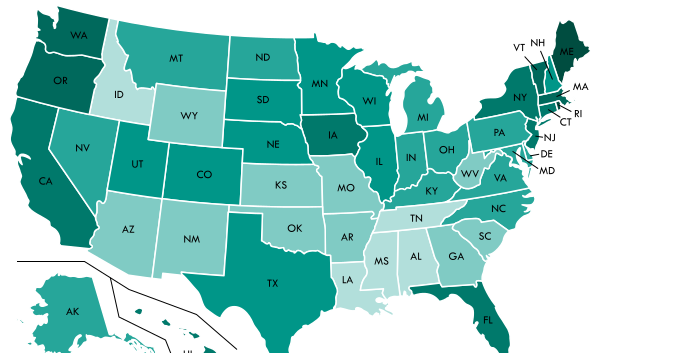
Most common states for culinary assistants
| Rank | State | Population | # of jobs | Employment/ 1000ppl |
|---|---|---|---|---|
| 1 | Minnesota | 5,576,606 | 919 | 16% |
| 2 | Indiana | 6,666,818 | 970 | 15% |
| 3 | Nebraska | 1,920,076 | 286 | 15% |
| 4 | New Hampshire | 1,342,795 | 201 | 15% |
| 5 | Georgia | 10,429,379 | 1,420 | 14% |
| 6 | Colorado | 5,607,154 | 797 | 14% |
| 7 | Iowa | 3,145,711 | 450 | 14% |
| 8 | North Dakota | 755,393 | 107 | 14% |
| 9 | Alaska | 739,795 | 106 | 14% |
| 10 | Florida | 20,984,400 | 2,740 | 13% |
| 11 | Illinois | 12,802,023 | 1,694 | 13% |
| 12 | Ohio | 11,658,609 | 1,564 | 13% |
| 13 | Arizona | 7,016,270 | 910 | 13% |
| 14 | Massachusetts | 6,859,819 | 864 | 13% |
| 15 | Missouri | 6,113,532 | 776 | 13% |
| 16 | South Carolina | 5,024,369 | 650 | 13% |
| 17 | Idaho | 1,716,943 | 219 | 13% |
| 18 | North Carolina | 10,273,419 | 1,222 | 12% |
| 19 | Kentucky | 4,454,189 | 515 | 12% |
| 20 | Utah | 3,101,833 | 370 | 12% |
Most common cities for culinary assistants
| Rank | City | # of jobs | Employment/ 1000ppl | Avg. salary |
|---|---|---|---|---|
| 1 | Chanhassen | 3 | 12% | $35,132 |
| 2 | Fallbrook | 2 | 7% | $38,163 |
| 3 | Edina | 3 | 6% | $35,144 |
| 4 | Roseville | 2 | 6% | $35,157 |
| 5 | Minnetonka | 2 | 4% | $35,135 |
| 6 | Burnsville | 2 | 3% | $35,145 |
| 7 | Fargo | 2 | 2% | $32,053 |
| 8 | Minneapolis | 4 | 1% | $35,151 |
| 9 | Orlando | 3 | 1% | $36,076 |
| 10 | Indianapolis | 3 | 0% | $31,772 |
| 11 | San Jose | 2 | 0% | $37,989 |
Culinary Assistant job outlook: Expert opinions
Our panel of culinary assistant experts
Spokane Community College
Edmonds Community College

Clark College

Clark College

PattiCakes Bakery and Stoby's Restaurant

University of New Mexico - Taos
Reynolds Community College
Robert Lombardi
Inland Northwest Culinary Academy instructorSpokane Community College
Culinary Arts
What are the biggest trends we'll see in the Culinary Assistant job market given the pandemic?
Robert Lombardi: Curb-side To Go, Food Trucks, Personal Catering, Family Farming, Farmers Markets. The meeting and convention market is expected to see an increase by 2022.
What are the biggest trends we'll see in the Culinary Assistant job market given the pandemic?
Stacey Schwartz: I believe restaurant workers will need more cross-training in order to be valuable in this job market. With reduced staff in restaurants, it's more important than ever to be versatile and diverse in skills. For example, someone who can cook, do pastries, and work front of the house would be a real asset. Being open to learning new skills having to do with the changing market such as home delivery and meal kits, as well as personal chef services.
What Culinary Assistant skills would you recommend for someone trying to advance their career?
Stacey Schwartz: If a student needs to take a gap year, a good way to spend it would be immersing themselves in culinary literature and information, familiarizing themselves with the basics, eating diverse foods, and exploring unique ingredients. This would be a wonderful way to start!
Aaron Guerra
Tenured Professor of Cuisine Management, Department HeadClark College
McClaskey Culinary Institute
What skills stand out on Culinary Assistant resumes?
Aaron Guerra: ServSafe 5 year certification as a student; basics of any quality student: good attendance, substantial grades, evidence of incorporating and demonstrating hard skills like plating and organization as well as soft skills like the ability to cost recipes correctly, produce accurate production sheet, and execute events; portfolios and management project binder that illustrate previous skills (Our students must provide a portfolio at the end of the program with their 120-hour externship paperwork and develop a small business plan/Restaurant management project that includes menu, full costing including q factor and budgeted yield percentage, profit and loss sheets, equipment depreciation, dining area and kitchen floor plans, business prospectus including demographics, marketing, and specified segmentation.
R. Earl Frederick
Tenured Professor of Cuisine ManagementClark College
McClaskey Culinary Institute
Will there be an enduring impact of the coronavirus pandemic on Culinary Assistants?
R. Earl Frederick: Yes, there will be an enduring impact of the coronavirus pandemic on graduates. I believe that our current students will be vastly equipped to deal with the hospitality industry changes. Before the pandemic happened, we were already teaching students how to be flexible (learning to do as many tasks as possible in your environment). We also encourage them to look "outside of the box" when it comes to careers in the hospitality industry. We emphasize to our students to look for a career rather than a job. Places like business dining facilities, senior living facilities, specialty markets, and casinos provide opportunities for career mobility and give their employees quality of life. It will be necessary for our graduates to look beyond restaurants to have a thriving hospitality industry career.
What general advice would you give to a Culinary Assistant?
Patti Stobaugh: Being humble and willing to learn will take you far in your career, not just in the beginning. If you have the desire to open your own food service business, go to work for a business that has a great reputation. That will give you the opportunity to learn so much.
Karla Nardi
Program CoordinatorUniversity of New Mexico - Taos
Department of Culinary Arts
What are the biggest trends we'll see in the Culinary Assistant job market given the pandemic?
Karla Nardi: Of course, the latest trends are to amp up the take out and delivery mode for restaurants in the current situation. Ordering on-line is great for both customers and restaurants. Restaurant operations that do not have a take out or delivery mode (or both ) will find it challenging to stay in business with the limited number of tables they are allowed. Take out containers, therefore, will become an important statement.
I think more thought will be put into boxes so that the food quality does not deteriorate. Dressing up the take out containers will serve as an advertising tool, as well. Outdoor dining has been incredibly helpful but will not help during the colder months. Paying more attention to outdoor seating areas, I believe, will continue even after the pandemic passes.
Another area that we could see an increase in demand is the field of Personal Chefs. As families struggle with rearranging their time, having a personal chef do the shopping, and cooking could become very attractive.
Will there be an increase or decrease in demand for Culinary Assistants in the next 5 years?
Karla Nardi: Even with the pandemic, we still have people calling us for students to work. The restaurant industry is evolving as we speak, and we, as educators, must keep one step ahead. The demand for graduates will increase, and students with specialization in different culinary fields will be in order.
Dave Quisenberry
Culinary Arts InstructorReynolds Community College
The Kitchens at Reynolds
Will there be an enduring impact of the coronavirus pandemic on Culinary Assistants?
Dave Quisenberry: Yes! I think the whole planet, as well as the hospitality industry, will have a lasting impact. As the industry struggles to cope and redefine itself, we are forced to embrace some fundamental principals. The reliance on building partnerships and networking is now more important than ever before. This will help those in the labor pool match skill sets with the need in industry.
COVID-19 has also been disruptive in the traditional foodservice model. No longer can we assume that viable business models are "dine-in" consumer-based primarily. As we practice more and more social distancing, we need to incorporate food outlets such as "to-go" and home meal replacement in existing models. These options will require specific operational guidelines and technical support to achieve success safely and efficiently. These trends have already started being addressed in educational content to better prepare graduates upon entry into the job market.
How do you envision technology impacting Culinary Assistants in the next 5 years?
Dave Quisenberry: As we deal with the impact of COVID-19 in our industry, we are being forced to rely on technology to communicate with each other, as well as our potential customers. Business models that have seen some success in maintaining market share have relied on new and existing web platforms to bring products and services to the market. The demand for knowledge in web design and virtual marketing will increasingly be a strong asset in any candidate's skill set.