Explore jobs
Find specific jobs
Explore careers
Explore professions
Best companies
Explore companies
Job outlook for data communications specialists in the United States
Are data communications specialist jobs in demand?
Data communications specialist job and salary trends over time
Data communications specialist jobs over time
Data communications specialist job growth rate over time
| Year | # of jobs | % of population |
|---|---|---|
| 2021 | 247 | 0.00% |
| 2020 | 249 | 0.00% |
| 2019 | 222 | 0.00% |
| 2018 | 2,062 | 0.00% |
| 2017 | 2,132 | 0.00% |
Average data communications specialist salary over time
Data communications specialist salary by year
| Year | Avg. salary | Hourly rate | % Change |
|---|---|---|---|
| 2026 | $71,632 | $34.44 | +3.4% |
| 2025 | $69,272 | $33.30 | +2.3% |
| 2024 | $67,703 | $32.55 | +4.2% |
| 2023 | $64,990 | $31.25 | +3.4% |
| 2022 | $62,853 | $30.22 | +1.0% |
Data communications specialist jobs by state
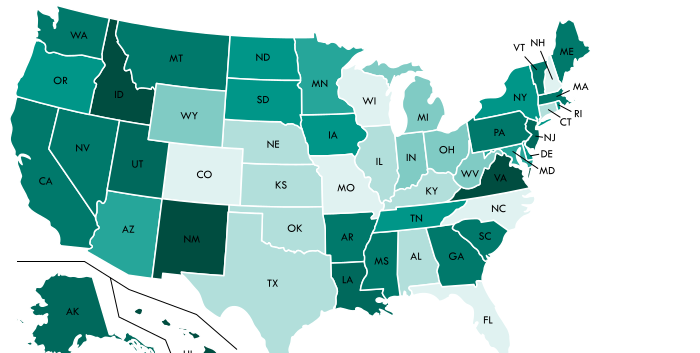
Most common states for data communications specialists
| Rank | State | Population | # of jobs | Employment/ 1000ppl |
|---|---|---|---|---|
| 1 | District of Columbia | 693,972 | 495 | 71% |
| 2 | Vermont | 623,657 | 221 | 35% |
| 3 | Alaska | 739,795 | 244 | 33% |
| 4 | Wyoming | 579,315 | 184 | 32% |
| 5 | Rhode Island | 1,059,639 | 289 | 27% |
| 6 | North Dakota | 755,393 | 202 | 27% |
| 7 | Maryland | 6,052,177 | 1,568 | 26% |
| 8 | New Hampshire | 1,342,795 | 330 | 25% |
| 9 | Utah | 3,101,833 | 730 | 24% |
| 10 | South Dakota | 869,666 | 203 | 23% |
| 11 | Colorado | 5,607,154 | 1,239 | 22% |
| 12 | Connecticut | 3,588,184 | 781 | 22% |
| 13 | Iowa | 3,145,711 | 694 | 22% |
| 14 | Nebraska | 1,920,076 | 417 | 22% |
| 15 | Montana | 1,050,493 | 236 | 22% |
| 16 | Delaware | 961,939 | 216 | 22% |
| 17 | Minnesota | 5,576,606 | 1,097 | 20% |
| 18 | Idaho | 1,716,943 | 343 | 20% |
| 19 | Illinois | 12,802,023 | 2,380 | 19% |
| 20 | Hawaii | 1,427,538 | 265 | 19% |
Most common cities for data communications specialists
| Rank | City | # of jobs | Employment/ 1000ppl | Avg. salary |
|---|---|---|---|---|
| 1 | Bowling Green | 1 | 2% | $62,681 |
Data Communications Specialist job outlook: Expert opinions
Our panel of data communications specialist experts
Grand Valley State University
Saint Mary's College
University of Kentucky
Bowie State University
Wartburg College
California State University - Long Beach
Point Loma Nazarene University
San Francisco State University
California State University - Dominguez Hills
University of Texas at Austin
Indiana University - Purdue University Indianapolis
University of Detroit Mercy
University of North Florida
Augsburg University
What general advice would you give to a Data Communications Specialist?
Matthew Turner Ph.D., M.B.A.: People like the flexibility and excitement that can come with being a communication specialist. You can often meet interesting and important people and travel to new places. You can get new challenges frequently so you don’t fall into a rut. One of the things that people dislike about being a communication specialist is that it can sometimes feel amorphous. They might wonder what are the most important things to learn, what skills, tools, software, etc. are most valuable and how will changing technology make that knowledge obsolete? It often involves retraining and evolving job responsibilities and positions.
What Data Communications Specialist skills would you recommend for someone trying to advance their career?
Andrew Wood Ph.D.: People entering the field should become increasingly familiar with technologies related to social media, artificial intelligence, and augmented reality, while demonstrating an interest in contemporary issues such as health care, climate change, environmental justice, community engagement, and similarly high-impact issues. It's one thing to possess a degree in communication studies; it's a much more important thing to translate the field's concepts and theories to the problems (and opportunities) that are transforming our planet.
What Data Communications Specialist skills would you recommend for someone trying to advance their career?
Dr. Alice Veksler Ph.D., BCPA: Practice your interpersonal skills and think about how what you have learned in your coursework translates to your chosen field of work. Teamwork, conflict resolution, social media savvy, and professionalism can make or break a career. Being able to articulate and demonstrate mastery of these skills with concrete examples during an interview can help land the job and then embodying the skillset of an excellent communicator will lead to professional success. Networking is also key so making sure that you do internships and engage with others in your chosen field helps with securing a job. Forging connections early in one's career can pay massive dividends down the road. We say that 'you get jobs by talking to people' and this maxim is especially true for a broad field like communication studies. Finally, I always encourage a healthy work-life balance to avoid burnout and maximize productivity.
What Data Communications Specialist skills would you recommend for someone trying to advance their career?
Dr. Mikhila Wildey PhD: I think the ability to engage and connect with people will be very important in the field as we shift more and more to a culture that is driven by AI. Although AI can be a useful tool, it likely won’t ever fully replace the value of human interaction and connection. In addition, employers often comment that they want to see employees with strong work ethic, and I think this will continue to be the case in 3-5 years. Having a strong work ethic can separate the people that move forward in their careers to those who remain stagnant.
What will help Data Communications Specialists increase their earning potential?
Dr. Mikhila Wildey PhD: My general advice for a graduate beginning their career in the field is to work hard, stay open-minded, and network! Most employees won’t stay in the same position for their entire career, and so I often tell graduates to not get too hung up on the first job needing to be the 'perfect' job for them. Often, the first job will be a place where they learn how to navigate the workplace, learn about their own strengths/weaknesses, and figure out what they like and don’t like. I encourage graduates to use this information to help them make decisions about the next steps in their career. And, if they are working hard and networking with people at their job, then opportunities will often times present themselves or be more available to them as they navigate their future career path.
What will help Data Communications Specialists increase their earning potential?
Dr. Veronica Hefner: I would recommend that a new graduate shows up and does the work to the best of their ability. So much of success is determined by reliability, competency, and effort. Aim to achieve a work/life balance that helps you stay mentally and physically healthy, but realize that means that when you're at work, you need to work. The most successful people are not always the most talented or the most educated, but they are the ones who exert the most effort and ambition. However, when you go home at the end of the day, leave work behind and focus on yourself. Finally, show respect to others. If you disagree with them, or just don't like them, you still need to show respect. Respect diverse people, ideas, perspectives, and consider the experiences you have with people and ideas that are different from your own as a privilege that helps you learn and grow.
Ying Lu Ph.D.
Associate ProfessorUniversity of Kentucky
Hospitality Administration/Management
What general advice would you give to a Data Communications Specialist?
Ying Lu Ph.D.: Communication skills. This is a service industry and requires strong communication skills to coordinate various departments and interact with diverse customers. A strong communication make you stand out in the team and make your job easier.
What Data Communications Specialist skills would you recommend for someone trying to advance their career?
Dr. Rochelle Daniel: My general advice to a graduate who transitions into that first professional job in the Communication field is similar to advice I give Communication students for navigating internship workspaces (Communications Internship Handbook: What HBCU Students Need to Know, 2022). Be intentional about learning the organizational or office culture, really listen to find out what is expected of you, be flexible and adaptable when there are changes in workflow, and don't be afraid to ask questions.
What will help Data Communications Specialists increase their earning potential?
Dr. Penni Pier: I wholeheartedly believe the same skills that have been important over the past 50. You need to be a good storyteller, a good writer, and a good researcher. Technology will change, the mediums will change, but the skills of being able to research, use your resources and tell a compelling story that touches the heart of your consumer or target audience remains constant.
What general advice would you give to a Data Communications Specialist?
Dr. Nick DiFrancesco: Communication- many grads lack even basic communication skills such as presenting, writing, or conversation; the industry is going to be seeking out not just the best and brightest, individuals who are personable, can relate and have rational discussions with others. The inability to engage in conversation and debate, or network with others is a serious issue among students, and these are skills that are absolutely vital to any professional.
What will help Data Communications Specialists increase their earning potential?
Dr. Nick DiFrancesco: Be reliable and willing to do different things. You don’t know where your best suited after graduation, but demonstrating that you can be counted on is not easily forgotten by most employers. Similarly, employees who decide to pigeon-hole themselves into a narrow set of tasks are rarely asked to do much beyond that, and can impede the progress in one’s career.
Dr. Nancy Meyer MA MA PhD
Lecturer in ClassicsCalifornia State University - Long Beach
Classics And Classical Languages, Literatures, And Linguistics
What general advice would you give to a Data Communications Specialist?
Dr. Nancy Meyer MA MA PhD: As a student, no matter what your degree was in, you got practical skills. Clearly articulate what those skills are! You may have to do some thinking, and maybe ask your professors what they see as important skills you learned. You may need research to find the right verbiage to clearly communicate what those skills are and why they matter. I am constantly trying to give that verbiage to my students, but I often feel like they aren’t quite getting it, but it’s on my syllabi. Think in terms of data and communication.
Margarita Pintado Burgos Ph.D.
Professor of SpanishPoint Loma Nazarene University
Romance Languages, Literatures, And Linguistics
What will help Data Communications Specialists increase their earning potential?
Margarita Pintado Burgos Ph.D.: A degree in Romance Languages, Literature and Linguistics equips you with plenty of tools to succeed in a variety of job opportunities. Thus, a general advice for recent graduates starting their careers, would be to remain open and to exploit as much as possible their skills, knowing that multilingualism, cross-cultural communication, reading and thinking critically, writing effectively, etc. are in high demand, especially considering the general decline of such skills in today's society.
What Data Communications Specialist skills would you recommend for someone trying to advance their career?
Dr. Geri Merrigan: Listening, empathy, and perspective-taking remain as important as ever, because change is the only certainty, and globalization connects us to people quite different from ourselves. That means skills for inclusive communication matter – analyzing an audience and crafting messages for diverse stakeholders. Finally, understanding the technology (especially AI) that is most consequential for your industry/sector, for Communication Studies majors, means understanding current events, reading about AI, and evaluating the credibility of what you read.
What will help Data Communications Specialists increase their earning potential?
Larry Hygh Jr., Ed.D.: Be open to all opportunities even if the opportunity is not something you have planned for your career trajectory. Networking is extremely crucial in the field of communications. Network, network, network, then network some more!
What will help Data Communications Specialists increase their earning potential?
John Daly: There are so many tasks depending upon your major in Communication. For example: Communication Studies: Sales, HR, Hospitality, General Management, PR; Crisis communication Radio, Television & Film: Production, Directing, Acting, Script-writing Journalism: Writing for news outlets, Editing Advertising: Copywriting, Creative advertising, Placement; Web design Speech and Hearing Sciences: Audiology, Stuttering, Stroke recovery, Language acquisition
Ms. Cheryl Paul
Assistant Director, Student Life MarketingIndiana University - Purdue University Indianapolis
Radio, Television, And Digital Communication
What will help Data Communications Specialists increase their earning potential?
Ms. Cheryl Paul: The role has become increasingly important in today’s digital age. With the proliferation of social media and online platforms, organizations need skilled communicators to navigate the complex landscape of public relations and brand management. Additionally, in times of crisis or rapid change, effective communication becomes even more crucial. As businesses recognize the importance of strategic communication in maintaining their reputation and engaging with their audience, the demand for skilled Communications Specialists continues to grow.
What Data Communications Specialist skills would you recommend for someone trying to advance their career?
Dr. William Gruen Ph.D.: Religious literacy, understanding diverse worldviews, beliefs, and practices. Engaging with difference and being empathetic to perspectives that are not your own.
What Data Communications Specialist skills would you recommend for someone trying to advance their career?
David Cassilo: There are so many ways to communicate with an audience through digital platforms. As such, being a communication specialist allows someone to showcase a lot of skills. Clear and effective communication is so vital for any organization. There are many opportunities to enter the field.
What will help Data Communications Specialists increase their earning potential?
David Cassilo: A communication specialist will see their role vary by organization, but at most places, this individual will help an organization maintain relationships with both the media and the public. Duties are extensive and can include creating press releases, running social media accounts, authoring written content and coordinating events. No day is likely the same for a communication specialist.
What will help Data Communications Specialists increase their earning potential?
Jason Nichols PhD: Build your experience base through internships and industry projects, and brag about these experiences when you interview. Collect professional certificates to compliment your degree. Security and cloud computing are excellent areas to pursue these in right now. AI and machine learning as well, of course. Build a structured skillset in problem solving and critical thinking, and demonstrate this skillset in your discussions with future employers. Map all of these efforts into a coherent story about yourself in your applications, and how they have shaped you to be a tech-savvy business problem solver, with a strong understanding of both the business and the technology. This foundation prepares you for so very many roles in our field, and businesses recognize and actively seek out this profile in their job candidates. Use the resources available to you. If you need additional time for more formal training, join a masters program. Join us for a masters program, actually. Our AI in Business masters program is launching this Fall, and is open for enrollment currently. Visit us here to learn more: https://wpcarey.asu.edu/masters-programs/ai-business
What Data Communications Specialist skills would you recommend for someone trying to advance their career?
Dr. Brandi Denison Ph.D.: I recommend that students seek out volunteer opportunities and get involved on campus in some capacity. Students who have demonstrated leadership through extracurricular activities, in addition to their excellent academic record, tend to have more opportunities after graduation. I also recommend that graduates network with a wide range of people while they are in school.
M. Elise Marubbio
Professor, American Indian, First Nations and Indigenous StudiesAugsburg University
Ethnic, Cultural Minority, Gender, And Group Studies
What will help Data Communications Specialists increase their earning potential?
M. Elise Marubbio: I would always suggest that students learn about and network in the area that they are interested in--do internships and interviews with organizational leaders they admire to show their interest and commitment to the field. I would also always remind them that their experiences matter and that skills such as communication, focus on detail, love of learning, commitment to bringing their best selves to the table are incredibly important soft skills that potential hiring folks really need and want. I would also challenge them to remember that the first job is a first step in a life-long learning and growing pathway, which means that the skills and knowledge they learn now will be added to and honed as they go along.