Explore jobs
Find specific jobs
Explore careers
Explore professions
Best companies
Explore companies
Job outlook for database analyst/developers in the United States
Database analyst/developer job growth summary. After extensive research, interviews, and analysis, Zippia's data science team found that:
The projected database analyst/developer job growth rate is 9% from 2018-2028.
About 10,500 new jobs for database analyst/developers are projected over the next decade.
Database analyst/developer salaries have increased 12% for database analyst/developers in the last 5 years.
There are over 45,373 database analyst/developers currently employed in the United States.
There are 101,919 active database analyst/developer job openings in the US.
The average database analyst/developer salary is $88,955.
Are database analyst/developer jobs in demand?
Database analyst/developer job and salary trends over time
Database analyst/developer jobs over time
Database analyst/developer job growth rate over time
| Year | # of jobs | % of population |
|---|---|---|
| 2021 | 45,373 | 0.01% |
| 2020 | 23,269 | 0.01% |
| 2019 | 16,234 | 0.00% |
| 2018 | 23,493 | 0.01% |
| 2017 | 23,052 | 0.01% |
Average database analyst/developer salary over time
Database analyst/developer salary by year
| Year | Avg. salary | Hourly rate | % Change |
|---|---|---|---|
| 2025 | $88,955 | $42.77 | +3.4% |
| 2024 | $86,024 | $41.36 | +2.3% |
| 2023 | $84,076 | $40.42 | +3.5% |
| 2022 | $81,229 | $39.05 | +2.4% |
| 2021 | $79,297 | $38.12 | +4.0% |
Database analyst/developer jobs by state
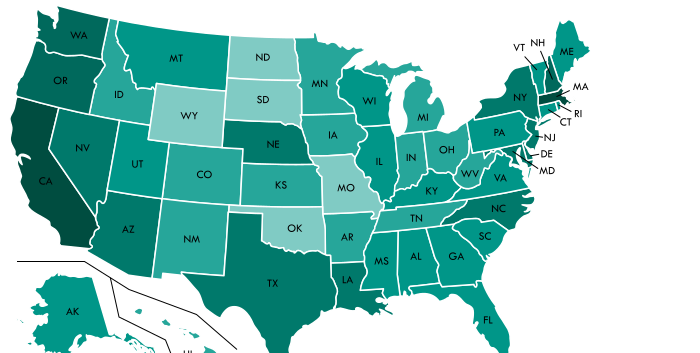
Most common states for database analyst/developers
| Rank | State | Population | # of jobs | Employment/ 1000ppl |
|---|---|---|---|---|
| 1 | District of Columbia | 693,972 | 545 | 79% |
| 2 | Virginia | 8,470,020 | 1,954 | 23% |
| 3 | Minnesota | 5,576,606 | 1,213 | 22% |
| 4 | Nebraska | 1,920,076 | 415 | 22% |
| 5 | North Dakota | 755,393 | 156 | 21% |
| 6 | Maryland | 6,052,177 | 1,197 | 20% |
| 7 | Colorado | 5,607,154 | 1,146 | 20% |
| 8 | Rhode Island | 1,059,639 | 215 | 20% |
| 9 | New Mexico | 2,088,070 | 393 | 19% |
| 10 | Washington | 7,405,743 | 1,354 | 18% |
| 11 | Massachusetts | 6,859,819 | 1,247 | 18% |
| 12 | Kansas | 2,913,123 | 529 | 18% |
| 13 | South Dakota | 869,666 | 158 | 18% |
| 14 | Vermont | 623,657 | 115 | 18% |
| 15 | Georgia | 10,429,379 | 1,814 | 17% |
| 16 | Alaska | 739,795 | 128 | 17% |
| 17 | Ohio | 11,658,609 | 1,883 | 16% |
| 18 | Utah | 3,101,833 | 510 | 16% |
| 19 | Iowa | 3,145,711 | 497 | 16% |
| 20 | Delaware | 961,939 | 158 | 16% |
Most common cities for database analyst/developers
| Rank | City | # of jobs | Employment/ 1000ppl | Avg. salary |
|---|---|---|---|---|
| 1 | Maryland Heights | 1 | 4% | $69,419 |
| 2 | Baltimore | 2 | 0% | $86,762 |
| 3 | Atlanta | 1 | 0% | $77,785 |
| 4 | Austin | 1 | 0% | $92,604 |
| 5 | New York | 1 | 0% | $90,567 |
Database Analyst/Developer job outlook: Expert opinions
Our panel of database analyst/developer experts
Kettering University
Minnesota State University - Mankato
University of Missouri - St Louis
University of Rhode Island
University of California, Irvine
Morgan State University
Nazareth College of Rochester
Lafayette College
University of Oregon
Old Dominion University
Florida International University
Central Connecticut State University
University of Wisconsin - Green Bay
Nova Southeastern University
Saint Peter's University
What Database Analyst/Developer skills would you recommend for someone trying to advance their career?
Yipeng Yang: Get to know clearly the job duties quickly. Make good connections with colleagues and listen to their advices.
What will help Database Analyst/Developers increase their earning potential?
Yipeng Yang: Enhance problem-solving ability. Keep learning and improving new skills in your field.
What general advice would you give to a Database Analyst/Developer?
Joseph Spivey: I’d start by becoming as knowledgeable as possible about the salaries of people in jobs you are interested in. Compare salaries for open positions; you may be able to use your knowledge as leverage to ask for more money. When you interview, ask not just about starting salary but about how raises and promotions are handled. I wish that I had learned some basic negotiation principles when I started my career. I’d recommend the book Getting to Yes: Negotiating Agreement Without Giving In.
What Database Analyst/Developer skills would you recommend for someone trying to advance their career?
Joseph Spivey: I think technology, especially artificial intelligence, provide increasingly important tools. Mathematics graduates will need to understand how to use technology in all kinds of new ways to improve their output and efficiency. Math graduates will need to be able to identify the best technological tools for a given task and critically interpret the output. As with most technological tools, people will be best served by using technology to augment, rather than replace, their efforts.
Dr. Osama Aljarrah
Assistant ProfessorKettering University
Manufacturing Engineering
What will help Database Analyst/Developers increase their earning potential?
Dr. Osama Aljarrah: Enhancing your qualifications through additional education can significantly boost your earning potential. This could mean obtaining an advanced degree or relevant certifications, especially in AI, supply chain, and manufacturing.
What will help Database Analyst/Developers increase their earning potential?
Louis Rocconi Ph.D.: The start of your career is not the end of your education journey. The evaluation, statistics, and methodology field is continually growing, so make professional development an essential part of your routine to keep you up-to-date on the latest research and trends. Be sure to connect with other professionals in the field. This network can serve as a valuable resource for brainstorming ideas and seeking advice throughout your career.
What will help Database Analyst/Developers increase their earning potential?
Kyle Nash Ph.D.: To maximize your salary potential, start by thoroughly researching the industry standards for your role and region to set realistic expectations. Highlight your unique skills and experiences during negotiations and be prepared to demonstrate your value to potential employers. Additionally, seeking certifications or advanced training in high-demand areas can give you a competitive edge. Networking and building professional relationships can also lead to higher-paying opportunities. Lastly, consider positions that offer growth potential, even if the starting salary is not the highest, as these roles often provide more substantial salary increases over time.
What Database Analyst/Developer skills would you recommend for someone trying to advance their career?
Ambrose Kidd III: Having a broad skill set and being prepared to learn on the job. The highest salaries will be for those that get their foot in the door and then demonstrate critical thinking and leadership skills.
What will help Database Analyst/Developers increase their earning potential?
Ambrose Kidd III: Be patient and explore widely. It sometimes takes a while to find the first job, but that will be a new opportunity to learn and demonstrate your ability.
Ms. Jacqueline Kelley Esq.
Adjunct ProfessorUniversity of Rhode Island
Public Administration
What will help Database Analyst/Developers increase their earning potential?
Ms. Jacqueline Kelley Esq.: Offer to learn different skills and continue to take courses to gain new knowledge and certifications.
What general advice would you give to a Database Analyst/Developer?
Dr. Jessie Borelli Ph.D.: Students trained in psychological science have many skills but tend to undervalue or underestimate their own worth. Our students are qualified to work in human services, business and marketing, research and development, the non-profit sector, and data science. To find the job that’s right for you, it’s important to identify what your long-term career goals are and to have a vision of how you want to achieve those goals. Some career fields may require advanced degrees but for other positions, a bachelor’s degree with applicable experience may be sufficient.
What Database Analyst/Developer skills would you recommend for someone trying to advance their career?
Dr. Jessie Borelli Ph.D.: The value of technical skills keeps increasing, and I can only imagine that these skills will continue to rise in value. One edge that psychological science students bring to the table is the ability to interpret data, as well as to understand the user experience that influences human behavior in digital spaces. For example, people with training in psychological science will be needed to consult on interpersonal interactions, promoting mental health in an increasing digital world and how to address issues of equity and inclusion in digital spaces.
Dr. Jacqueline Holland EdD, CFCS
Associate ProfessorMorgan State University
Family And Consumer Sciences/Human Sciences
What general advice would you give to a Database Analyst/Developer?
Dr. Jacqueline Holland EdD, CFCS: The general advice I would give to a graduate beginning their career in the field is to focus on continuous learning, networking, and staying up-to-date with industry trends.
Dr. Heather Lewis
Nazareth College of Rochester
Mathematics
What general advice would you give to a Database Analyst/Developer?
Dr. Heather Lewis: While some students do look for jobs directly related to mathematics, most of our students have found that their mathematics background is appealing to employers even outside of mathematics. With a background in math, you can do anything: this is so general that it can feel unhelpful, but in our experience it's surprisingly accurate. Math provides you with a skillset that is valuable in almost any career, and employers know this. Lean into problem solving and reasoning, look for something you find interesting, and see how those skills apply to that job. Math graduates tend to be very adaptable.
What will help Database Analyst/Developers increase their earning potential?
Dr. Heather Lewis: Many of our students double major - a popular pairing is Mathematics and Ethical Data Science - which gives them experience with both real-life data and practice with applying their problem-solving skills to a variety of situations.
What general advice would you give to a Database Analyst/Developer?
Dr. Amy Guisinger: Go into salary negotiations with knowledge. Research what other people are making with similar job titles and responsibilities. Many states require job postings to include starting salary and other forms of pay transparency. So even if you do not work in that state, you can benefit by knowing what others are making.
What will help Database Analyst/Developers increase their earning potential?
Dr. Amy Guisinger: I think it's important at the beginning of your career to learn as much as you can. At this stage, you often have a rare opportunity to interact with many people and departments (even if it is through low-level tasks like dropping off reports). Take advantage of those opportunities by reflecting on what particular people or departments do. Ask yourself what tasks and projects you find the most interesting in your company and find out who is working on those things. Seek out interactions with these people to understand the skills that make them successful. Also, don't be afraid to ask people for a lunch or coffee meeting to discuss their job and seek advice.
What general advice would you give to a Database Analyst/Developer?
Dr. Darek Nalle: AI and data analytics skills will be crucial for efficiency gains and competitive advantage.
What will help Database Analyst/Developers increase their earning potential?
Dr. Darek Nalle: Seek out a mentor. Join alumni associations and professional societies for networking. Volunteer in the local community.
What Database Analyst/Developer skills would you recommend for someone trying to advance their career?
Dr. Brittany Suggs Ph.D., MPH, LPC: Thank you both for extending the opportunity! Feel absolutely welcome to send the questions or related information my way for further review. Happy to contribute to this noteworthy endeavor!
Dr. Arun Upadhyay PhD
ProfessorFlorida International University
Finance And Financial Management Services
What will help Database Analyst/Developers increase their earning potential?
Dr. Arun Upadhyay PhD: I believe the world is becoming more data-centric and business decisions are going to be made based on the data analyses. Analytics is going to be integral to both business and economics-related jobs, enabling data-driven decision-making, market analysis, performance measurement, risk management, customer insights, resource optimization, forecasting, planning, and performance evaluation.
Dr. Alfredo Rosete PhD
Associate Professor of EconomicsCentral Connecticut State University
Economics
What general advice would you give to a Database Analyst/Developer?
Dr. Alfredo Rosete PhD: Critical thinking, strategizing using data insights, creating a strategy for data collection
What will help Database Analyst/Developers increase their earning potential?
Dr. Alfredo Rosete PhD: Pay attention to transferable skills that you can leverage for moving up in a company ladder or moving to similar jobs that pay more in different companies. Keep learning new skills that have a broad applicability.
Kristi Yowell
Coordinator & Senior Adjunct Lecturer, Graduate Human Resources Management ProgramWhat will help Database Analyst/Developers increase their earning potential?
Kristi Yowell: Data Analysis, Adaptability, Technical Skills.
What Database Analyst/Developer skills would you recommend for someone trying to advance their career?
John Clark Ph.D., CFA, CFP®: In the next 3-5 years, I think the finance industry will see a number of opportunities develop for tech savvy graduates. In many areas, incorporating data analytics and understanding how to handle big data will become an important skill. Banks and insurance companies will continue to develop tools for underwriting and credit analysis. Investment firms will begin to utilize the tools of big data to provide clients greater customization at lower costs. Corporations will desire these skills to provide better data for decision making and to help deliver better outcomes for their customers.
Fangjun Sang
Assistant Professor of AccountingUniversity of Wisconsin - Green Bay
Accounting And Related Services
What will help Database Analyst/Developers increase their earning potential?
Fangjun Sang: Realizing the gap between what they learned in class and what they use in practice, open-minded, learn from their mentors and senior colleagues, be professional.
What will help Database Analyst/Developers increase their earning potential?
Dr. Frank Mitropoulos Ph.D.: As we look toward the future of careers in Computer Applications, several skills stand out for their growing importance. These skills revolve around specific technologies that are expected to continue to grow and evolve. Technologies related to Cloud Computing, Artificial Intelligence (AI), Cybersecurity, and Data Science are quickly evolving and being applied across the technology sector. Cloud Computing: Given the widespread adoption of Cloud services, Cloud computing expertise is indispensable. Understanding how to leverage platforms like Azure, AWS, and Google Cloud is crucial to developing scalable, efficient solutions that meet business needs. Artificial Intelligence: AI and Machine Learning are transforming the world. Skills in these areas to solve real-world problems will be even more critical in the future. Cybersecurity: Digital threats are becoming more sophisticated. Safeguarding data, networks, and systems will require encryption, intrusion detection, development, and regulation skills. Data Science: Skills in Data Science will be increasingly sought after as businesses embrace data-driven decision-making. Extracting meaningful insights from extensive datasets and effectively communicating these findings will be essential. Soft skills: Finally, soft skills such as teamwork, problem-solving, and effective communication cannot be overlooked. Adapting, communicating, and leading will be essential for success.
Dr. Joshua Feinberg
Associate Professor of PsychologySaint Peter's University
Social Sciences
What Database Analyst/Developer skills would you recommend for someone trying to advance their career?
Dr. Joshua Feinberg: Make sure you emphasize the knowledge, skills, abilities, and other tools you have picked up with your psychology major and undergraduate education. Many students worry that they don't have the direct experience that some jobs/employers are looking for; it is important that students emphasize the aspects of their education that are transferable to their career interests.