Explore jobs
Find specific jobs
Explore careers
Explore professions
Best companies
Explore companies
Job outlook for database architects in the United States
Database architect job growth summary. After extensive research, interviews, and analysis, Zippia's data science team found that:
The projected database architect job growth rate is 9% from 2018-2028.
About 10,500 new jobs for database architects are projected over the next decade.
Database architect salaries have increased 12% for database architects in the last 5 years.
There are over 156,418 database architects currently employed in the United States.
There are 90,743 active database architect job openings in the US.
The average database architect salary is $93,654.
Are database architect jobs in demand?
Database architect job and salary trends over time
Database architect jobs over time
Database architect job growth rate over time
| Year | # of jobs | % of population |
|---|---|---|
| 2021 | 156,418 | 0.05% |
| 2020 | 65,521 | 0.02% |
| 2019 | 57,266 | 0.02% |
| 2018 | 56,223 | 0.02% |
| 2017 | 56,930 | 0.02% |
Average database architect salary over time
Database architect salary by year
| Year | Avg. salary | Hourly rate | % Change |
|---|---|---|---|
| 2026 | $93,654 | $45.03 | +3.4% |
| 2025 | $90,568 | $43.54 | +2.3% |
| 2024 | $88,518 | $42.56 | +3.5% |
| 2023 | $85,520 | $41.12 | +2.4% |
| 2022 | $83,486 | $40.14 | +4.0% |
Database architect jobs by state
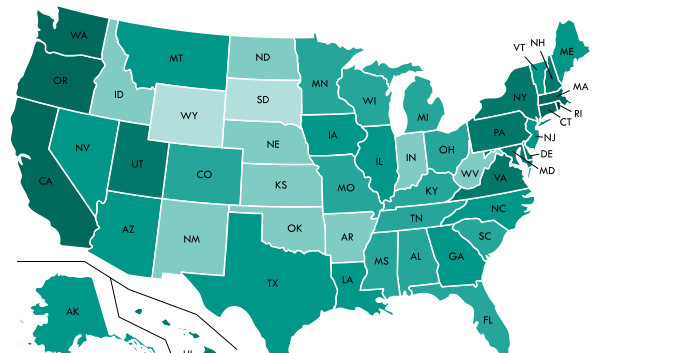
Most common states for database architects
| Rank | State | Population | # of jobs | Employment/ 1000ppl |
|---|---|---|---|---|
| 1 | District of Columbia | 693,972 | 574 | 83% |
| 2 | North Dakota | 755,393 | 159 | 21% |
| 3 | Virginia | 8,470,020 | 1,581 | 19% |
| 4 | Maryland | 6,052,177 | 1,180 | 19% |
| 5 | Rhode Island | 1,059,639 | 198 | 19% |
| 6 | Massachusetts | 6,859,819 | 1,106 | 16% |
| 7 | Vermont | 623,657 | 102 | 16% |
| 8 | New Jersey | 9,005,644 | 1,324 | 15% |
| 9 | Oregon | 4,142,776 | 610 | 15% |
| 10 | New Hampshire | 1,342,795 | 201 | 15% |
| 11 | Illinois | 12,802,023 | 1,828 | 14% |
| 12 | Minnesota | 5,576,606 | 781 | 14% |
| 13 | Colorado | 5,607,154 | 759 | 14% |
| 14 | Connecticut | 3,588,184 | 511 | 14% |
| 15 | Montana | 1,050,493 | 148 | 14% |
| 16 | Delaware | 961,939 | 134 | 14% |
| 17 | Georgia | 10,429,379 | 1,389 | 13% |
| 18 | North Carolina | 10,273,419 | 1,366 | 13% |
| 19 | Washington | 7,405,743 | 993 | 13% |
| 20 | Utah | 3,101,833 | 412 | 13% |
Most common cities for database architects
| Rank | City | # of jobs | Employment/ 1000ppl | Avg. salary |
|---|---|---|---|---|
| 1 | Annapolis | 2 | 5% | $91,419 |
| 2 | Frankfort | 1 | 4% | $79,714 |
| 3 | Bethesda | 2 | 3% | $91,138 |
| 4 | Dover | 1 | 3% | $91,624 |
| 5 | Lansing | 2 | 2% | $77,993 |
| 6 | Melbourne | 2 | 2% | $81,136 |
| 7 | Washington | 5 | 1% | $96,972 |
| 8 | Santa Ana | 2 | 1% | $94,729 |
| 9 | Dearborn | 1 | 1% | $78,615 |
| 10 | San Francisco | 2 | 0% | $106,852 |
| 11 | Arlington | 1 | 0% | $91,993 |
| 12 | Austin | 1 | 0% | $84,743 |
| 13 | Boston | 1 | 0% | $94,002 |
| 14 | Denver | 1 | 0% | $78,358 |
| 15 | Fort Worth | 1 | 0% | $84,258 |
Database Architect job outlook: Expert opinions
Our panel of database architect experts
Worcester Polytechnic Institute
Missouri University of Science and Technology
Massachusetts Institute of Technology
University of Florida
University of Nevada - Las Vegas
SUNY at Buffalo
University of Nevada - Las Vegas
University of Oregon

University Of Nevada, Las Vegas
University Of Nevada, Las Vegas

University of Idaho

University of New Mexico
Southern Illinois University Carbondale

The Catholic University of America

University of Wisconsin - Milwaukee

University at Buffalo – The State University of New York

Seminole State College of Florida

Rochester Institute of Technology
Dr. Steven Van Dessel Ph.D. Assoc. AIA
Associate Professor, Director Architectural Engineering ProgramWorcester Polytechnic Institute
Architectural Engineering
What general advice would you give to a Database Architect?
Dr. Steven Van Dessel Ph.D. Assoc. AIA: Employers always stress the importance of students knowing the fundamentals of engineering and the integration of engineering fundamentals with architectural design. Our program is quite unique in this respect as we are the only degree program in the country where students can earn an architectural engineering degree that is ABET accredited (they can get their PE) - and then also can gain their NAAB accredited architecture degree with one additional year (allowing them to also become architects). Knowledge of building information modeling is required, and I would think that AI at some point will also play a role when combined with advanced surveying technologies.
What Database Architect skills would you recommend for someone trying to advance their career?
Dr. Steven Van Dessel Ph.D. Assoc. AIA: We typically advise our student to pursue internship as soon as the summer after sophomore year so they can get experience in different sub-areas of architectural engineering that would allow them to get a better understanding of the careers they could pursue with their degree. This typically results in an offer for full employment early in senior year – at least for our students
What will help Database Architects increase their earning potential?
Dr. Steven Van Dessel Ph.D. Assoc. AIA: Starting salary is something they can/should consider – but it is often better for recent graduates to understand the growth potential with a particular employer/firm and understand what other benefits exist. We tell them to ask questions about the typical promotion steps within an organization, for example. Students that have taken the FE exam should highlight that – and ask questions in the interview about what mentoring there is within a firm to take the PE exam – it shows a positive level of professional attitude. Our students work for architects, engineering consultancy, contractors, etc. I think Bankrate listed AE as the most rewarding degree a few years ago – and one of the items listed was the diversity of office and fieldwork that makes employment enjoyable (i.e. not stuck in their office all week)
What general advice would you give to a Database Architect?
Rebecca Dolgas: 2. The ability to implement VR, AR, and AI capabilities. Clients are coming to expect photorealistic renderings and to be able to walk through their space virtually. Having the skill set to implement these tools will be crucial in keeping clients informed and pleased with your work.
What Database Architect skills would you recommend for someone trying to advance their career?
Rebecca Dolgas: 3. Be aware of your strengths and don't be afraid to negotiate. If you have multi-faceted skillsets make sure they are known. For example if you do well maintaining your own social media make a point that you would like to assist with marketing in a smaller firm. A great Marywood specific example is how closely interiors and architecture learn together. Being able to have a collaborative spirit and bring both disciplines together can be invaluable. If you can show your interdisciplinary skill set, it will make you more valuable and thus able to negotiate for a better salary.
What will help Database Architects increase their earning potential?
Rebecca Dolgas: 1. Pay attention to firm culture and benefits. You will be working long hours and closely with your team, you want to make sure these are people you could see yourself being comfortable around. In particular when it comes to mistakes. Most people take a little bit to adjust to their job. The first few months will be hard and you WILL mess up, that's okay just make sure that you are working for and with people who will help you to make corrections and continue to grow. Along the lines of growth, see what support systems they have for licensure. Testing is a time consuming and expensive process and many firms will help to cover these costs and the required time off, just be sure to ask.
Heath Pickerill PhD
Assistant Teaching ProfessorMissouri University of Science and Technology
Architectural Engineering
What general advice would you give to a Database Architect?
Heath Pickerill PhD: Explore various career choices within the field of architectural engineering during your time in school through internships and/or co-ops, which provide hands-on learning and insight into the countless career opportunities within the field.
What Database Architect skills would you recommend for someone trying to advance their career?
Heath Pickerill PhD: Being competent in CAD software, especially 3D modeling such as Revit, as well as demonstrating strong project management skills, which can be honed through leadership opportunities in professional organizations and design teams. Graduates should also understand the ethical implications and limitations of AI software in the production of written documents and basic design solutions.
What will help Database Architects increase their earning potential?
Heath Pickerill PhD: By boosting your resume through participation in professional organizations and design teams within the field, as well as diverse work experience with on-the-job training through internships and co-ops.
What general advice would you give to a Database Architect?
Paul Pettigrew AIA, NCARB, MIT M.Arch ʼ88: I think it’s a great time to be an architect. When numbers like close to 40% of the earth’s global carbon emissions are related to buildings being torn down, buildings being built, and operation of buildings, there’s no doubt that architects will be key players in future efforts to sustain the long term health of planet earth.
What Database Architect skills would you recommend for someone trying to advance their career?
Paul Pettigrew AIA, NCARB, MIT M.Arch ʼ88: Adaptability, the ability and desire to constantly learn new tools, techniques, business practices, and construction technologies/methodologies. The architecture profession has changed dramatically since the introduction of computers into practice, and all indications are that architectural practice will continue to change as computers, fabrication machines that talk to and work with computers, and technologies related to issues of sustainability, continue to adapt to the economics, business, practice, and significance of the architecture profession.
What will help Database Architects increase their earning potential?
Paul Pettigrew AIA, NCARB, MIT M.Arch ʼ88: Salary isn’t the whole story. Recent graduates need to take into account not only salary, but housing costs, and living expenses. The salary of a young architect will go farther in Chicago than it will in New York, Boston, or San Francisco. Cities with more extensive public transportation systems might offer recent graduates the option of not owning a car which could be a significant cost savings when you factor in car purchase cost, gas, parking, insurance, and maintenance.
What general advice would you give to a Database Architect?
Martin Gold FAIA: The most widespread complaint from people in the field is that it consumes ones attention, requires long hours, and relative to other professions, such as medicine, law, accounting, or engineering, the pay is lower on a per hour basis. On the other hand, architecture is more of an art than other professions and offers opportunities for creative people to have prosperous careers. The famous French architect Le Corbusier would say, architecture is a way of life.
What Database Architect skills would you recommend for someone trying to advance their career?
Martin Gold FAIA: The economy is historically dynamic and the field of architecture generally follows the economy so there are highs and lows. That said, there is always work in urban planning, historic preservation, adaptive reuse of buildings, and the need for new buildings. At the time of this writing, there is a trend to transform office buildings into residential uses as people work remotely much more often. This would be akin to the transformation of warehouse spaces into residential lofts in urban areas around the US in the 1990’s as manufacturing and shipping ports moved out of urban areas of the city. In the foreseeable future, there will always be a need for architects and associated professions to continue to improve on the constructed world in which we live.
What will help Database Architects increase their earning potential?
Martin Gold FAIA: Entering the field, architecture interns might find themselves in large firms working with project teams typically working with project architects, engineers, and clients to develop designs and translate them into drawings for permitting and construction. In some larger firms, there are expertise teams that work on specific building types such as housing, retail, warehouses, courthouses, supermarkets or restaurants. In smaller firms, they may be working directly with principal architects on projects. In both cases, interns would be attending client meetings, crafting drawings using one of the many computer drafting programs, and perhaps doing materials research and detailing the connections of various building systems. As interns gain experience, and perhaps secure their professional license, they move to become team leaders, partners, or perhaps start their own firms.
What general advice would you give to a Database Architect?
Grant Mosey Ph.D.: The path to salary maximization often seems to be a willingness to advocate on one's own behalf and be willing to move firms if necessary. Early career professionals may want to also think about where they are building their expertise. It is likely that architects who work on healthcare or multifamily housing are more likely to have abundant work in the future than those who work on places of religious worship or primary schools. The region in which one chooses to work and make connections can also be important. It never hurts to have a 'name brand' firm on one's resume early in one's career.
What Database Architect skills would you recommend for someone trying to advance their career?
Grant Mosey Ph.D.: I would advise architecture students to be as flexible as possible. While NAAB accredited schools award 6,000 to 7,000 professional degrees per year, NCARB states that fewer than 3,500 architects reach licensure each year. This suggests that many of those educated as architects are actually finding work in allied subjects. I know of many graduates who are set to become architects who end up becoming real estate professionals, construction professionals, policy-makers, academics, and more. Even for those dead set on architectural practice, these opportunities in adjacent fields can open doors to more design-focused practice.
What will help Database Architects increase their earning potential?
Grant Mosey Ph.D.: Familiarity with Building Information Modeling software like Revit is already all but a requirement to find professional work. Increasingly, firms are also looking for those who are capable of using visual programming like Grasshopper or Dynamo not only to generate forms but to optimize their workflow. In addition to those, professionals should familiarize themselves with modeling programs including SketchUp and Rhino and visualization platforms like VRay, Enscape, and Twin Motion. Soft skills like being personable and being able to present ideas extemporaneously will never go out of style.
What general advice would you give to a Database Architect?
Elaine Chow AIA, RA, NCARB: Adaptability will always be an important skill. There will be software improvements and changes that you need to stay aware of and technology that will benefit both the design and construction sides of the industry. Communication will remain an important part of the way we work together in teams.
What Database Architect skills would you recommend for someone trying to advance their career?
Elaine Chow AIA, RA, NCARB: Architecture licensure will help maximize salary potential, as well as pursuing other certifications such as LEED, CPHC, WELL, etc. Be your own advocate and request regular/annual reviews that allow you to highlight accomplishments and value you bring to your employer. If specialization appeals to you, there are opportunities to market yourself as an expert in a specific subject area.
What will help Database Architects increase their earning potential?
Elaine Chow AIA, RA, NCARB: Continue being a student throughout your career since learning never stops, especially in architecture where the knowledge is vast and first-hand experience is valuable. There are many facets to the architecture profession, when first graduating try to explore different roles to see what interests you and challenges you best.
What general advice would you give to a Database Architect?
Alfredo Fernandez-Gonzalez: It is important for recent graduates to recognize that Architecture is no longer limited to the physical realm, as transformative technologies are providing interesting career opportunities in the digital realm as well. This rapidly evolving context offers many opportunities and new directions for the discipline and remaining (or becoming!) current in new developments in computing power, digital visuals, manufacturing technologies, and robotics, are ways in which a recent graduate can secure a good paying job.
What Database Architect skills would you recommend for someone trying to advance their career?
Alfredo Fernandez-Gonzalez: Globally, there is significant demand for architects who are facile in the use of transformative technologies that support designers to generate and evaluate innovative ideas to provide solutions in a rapidly changing environment. Needless to say, being extremely competent in the many applications of Building Information Modeling (BIM), Extended Reality (XR), Generative Design, and Sustainability, will make new graduates effective at a time in which the profession and the world are rapidly transforming.
What will help Database Architects increase their earning potential?
Alfredo Fernandez-Gonzalez: In addition to mastering the skills that will become more important in the next 3-5 years, committing to work long hours and becoming credentialed in LEED, WELL, and/or other building performance standards is a way to quickly increase your worth for a firm. However, in the long run, working towards becoming a licensed architect is the best way to advance in the profession.
What general advice would you give to a Database Architect?
Dr. Alison Kwok PhD, RA, FAIA, LEED BD+C, CPHC: Diversify your experiences (and expectations); gain knowledge in a variety of different areas and certifications. Curate your portfolio to show a range of the kinds of work that you're able to offer. Get out of the comfort zone of doing only what you know "how to do" and challenge with incremental bits of knowledge.
What Database Architect skills would you recommend for someone trying to advance their career?
Dr. Alison Kwok PhD, RA, FAIA, LEED BD+C, CPHC: Because of the urgent need to address climate challenges in energy, materials, water, ecosystems, fire and so on, one person cannot do it all. Gone are the days of the "starchitect". What's most important is learning ways of collaboration, communicating, and team building; energy modeling at small and large holistic scales; life cycle accounting for materials.
What will help Database Architects increase their earning potential?
Dr. Alison Kwok PhD, RA, FAIA, LEED BD+C, CPHC: [tough question, in academia, we're prepare students to enter the profession with skills/knowledge, but really don't address the issue of how architects are paid when they start out in their careers. Perhaps first gather information such as cost of living data for the locations/cities of interest; find range of salaries for entry-level architects; talk with alums in the areas about benefits. To maximize salary potential, portfolio, cover letter, and range of experiences are key. As mentioned above, preparation to help firms to advance their mission, and be able to offer ways to help the firm get to important aspects beyond billable hours. Ask questions during the interview process about advancement and benefits.
Dak Kopec Ph.D.
Associate Professor, Coordinator, BA Interior Architecture and Design and Master of Design ProgramUniversity Of Nevada, Las Vegas
School of Architecture
What skills stand out on Database Architect resumes?
Dak Kopec Ph.D.: Having an area of expertise beyond the common skills that most graduates possess. Many firms are looking for those promotable employees, and these folks often speak with a high degree of intelligence about one or more aspects of design. I see that those with added skills in Health, Education, Sustainability, Technology, etc., often lead those departments in the firm, which becomes their mobility path to executive management. It's all about having something different or better than your competitors.
What hard/technical skills are most important for Database Architects?
Dak Kopec Ph.D.: Revit and CAD. Especially as these relate to performative design. What I mean by performative design are technologically feature-rich buildings to respond to atmospheric and environmental conditions that support human occupation and productivity.
Dak Kopec Ph.D.
Associate Professor, Coordinator, BA Interior Architecture and Design and Master of Design ProgramUniversity Of Nevada, Las Vegas
School of Architecture
What experience really stands out on Database Architect resumes?
Dak Kopec Ph.D.: Experience in the areas where one intends to practice. If someone wants to work in hospitality design, an employer will see what kind of experience they have. This is why selecting one's internship location is so important.
Many employers are also looking to see how well the Interior Designer can think outside the box and develop innovative design ideas.
An area of specialized knowledge that will complement the existing design team. Most firms are looking for future leaders.
What Database Architect skills would you recommend for someone trying to advance their career?
Dak Kopec Ph.D.: Design thinking. This can be done by looking for certificates or attending a series of seminars. The COVID-19 virus has opened up numerous opportunities to shape an Interior Designer's scope. Using Design Thinking as a means to solve problems will enhance a person's marketability.
Additionally, I would recommend learning about disease transmission and pathology. With a stronger foundation in these areas, the interior designer will be better equipped to address the infection control expectations that will likely be required of future Interior Designers.
What technology do you think will become more important and prevalent for Database Architects in the next 3-5 years?
Dak Kopec Ph.D.: COVID-19 has changed the playing field, and future skills will need to include creative ways to use materials and systems for enhanced infection control. This will consist of thinking differently about ventilation systems, space planning, and material specifications.
Randall Randall
Program Head Architecture, ProfessorUniversity of Idaho
Architecture Department
What skills stand out on Database Architect resumes?
Randall Randall: Diversity of creative work demonstrated in a portfolio.
What soft skills should all Database Architects possess?
Randall Randall: Communication skills (both disciplinary and interpersonal); strong work ethic; reliability.
What hard/technical skills are most important for Database Architects?
Randall Randall: Adept with hand-drawing, model making, CAD, and graphics software (photoshop, illustrator). Experience with some kind of hands-on-making/construction is a plus.
What skills will help Database Architects earn the most?
Randall Randall: Strength in all of the above, i.e., being the "whole package."
How have salaries changed over time for Database Architects?
Tamarah Begay: Salaries have changed a lot over the time I have spent in the Architectural Field. Minority women are now getting the recognition that they deserve in a field that has predominantly been ruled by non-minority males, and although it still is not equal, we have gained admission to higher compensation than we used to receive.
Anonymous Professor
How have salaries changed over time for Database Architects?
Anonymous Professor : With regard to money and employment compensation ... those who can be willing to try new things and move with the flow will do well ... very well. Those who cannot, it's McDonald's and minimum wage ...
A footnote: ... the people I contact do not care about who you are, what you are, or how you are. So things like pronouns, and victimization, and excuses, and hanging on to reasons for failure will not cut it in the workplace of the future ... learn ... grow ... and you will have success ...
Michael Brazley Ph.D.
Associate Professor of ArchitectureSouthern Illinois University Carbondale
School of Architecture
What are the biggest trends we'll see in the Database Architect job market given the pandemic?
Michael Brazley Ph.D.: Yes, there will be an enduring impact of the coronavirus pandemic on graduates. The first issue that comes to mind is lack of work for graduates because of lack of architectural commissions. The second point that comes to mind is that design itself will have changed because of covid-19. And third, more people will be working from home.
What Database Architect skills would you recommend for someone trying to advance their career?
Michael Brazley Ph.D.: Architectural Graduates will have to have very strong computer skills; not just in drawing but in writing also. Graduates will need to know the latest software, and in many cases, help to introduce the latest software to their new companies. Students are learning to make 3D digital videos and virtual reality models.
What general advice would you give to a Database Architect?
Michael Brazley Ph.D.: Work experience in an architect's office is best.
Robin Puttock
Interim Associate Dean for Undergraduate Studies, Visiting Assistant ProfessorThe Catholic University of America
School of Architecture and Planning
What are the biggest trends we'll see in the Database Architect job market given the pandemic?
Robin Puttock: I think we will continue to see more use of online platforms. I believe we will have an increase in firm participation this year in our annual School of Architecture and Planning career fair due to the online platform. In previous years, we invited representatives who were local and who could attend in person. There were also space limitations in our architecture building. Now that we are online, that opens up a world of possibilities, both for the hiring firms and for the students. In addition, the interviewing process can be quite efficient online, especially in the initial stages.
What Database Architect skills would you recommend for someone trying to advance their career?
Robin Puttock: My background is in sustainable civic architecture that supports wellbeing. Therefore, I would highly recommend earning certifications, if possible. I would recommend the LEED Green Associate and/or the WELL AP. In addition, NCARB's AXP hours can be quite flexible and can accommodate experience hours outside of the traditional architecture office.
If a student cannot find employment in an architecture firm working under a licensed architect, students have the option to earn AXP hours working for contractors, landscape architects, engineers, etc. As a bonus, they will receive a well-rounded internship experience. Finally, I would also recommend getting in touch with their local AIA chapters and plugging into continuing education opportunities and conferences. Knowledge and network connections gained in these outlets may prove quite useful in a future interview.
What general advice would you give to a Database Architect?
Robin Puttock: In addition to all of the above, I recommend students stay connected with their professors. Most of us have a vast network that we would love to invite you into. Often, an introduction is the pivotal component to a new opportunity. Relationships are key, especially when a recent graduate does not have significant professional experience. In addition, recent graduates should be sure to spend time on crafting their cover letters, their resumes, their work samples, and their portfolios. Make sure you are putting your best foot forward when an opportunity does arise.
What are the biggest trends we'll see in the Database Architect job market given the pandemic?
James Shields: In mid-to-late 2020, some 70% of architecture firms saw a decline in billings due to Covid-19 impacts. Some architecture firms were hit worse than others; firms that designed office buildings, hospitality projects and cultural buildings fared poorly, and in general have not been hiring. Health care organizations and the architecture firms that service them have also been hit, although most firms have helped hospitals evaluate or design alternative Covid-care facilities.
Firms that design housing projects remained more stable and have continued to at least interview some job candidates. There has also been an increase in demand for master planning services of all kinds, as communities and businesses want to be prepared for the end of the pandemic and a return to more normal economic activity with a plan for expansion in place. Firms that design Science & Technology buildings, like university lab, science and health care teaching buildings, have also seen their workload remain stable and be less affected by the pandemic as many US States have continued to fund such projects.
School design firms have also done well, as many local districts have been able to pass referendums for new projects during the crisis, keeping their architects busy. There has also been a surprisingly strong turn towards interest in sustainable energy and infrastructure systems during the pandemic.
What skills stand out on Database Architect resumes?
James Shields: Many interviews for architecture jobs remain online at the present time, so an ability to communicate via Zoom or Teams is vital. Looking professional on the small screen with an ability to show your work well are skills that can be practiced before an interview. Most architecture employees are currently working online from home, so knowledge of the essential digital architecture programs (like Revit, Bluebeam, Sketchup, et al) is currently very important. On resumes and in portfolios, any experience in the architecture sectors that have remained relatively stable (Housing, Master Planning, Science & Tech, Schools, sustainable infrastructure) should be emphasized. If you have no such experience, read up on current trends in these practice areas online and find some that interest you. Conveying such an interest can go a long way.
Are there any particularly good places in the United States for Database Architects to find work opportunities?
James Shields: Areas of the country that have been experiencing booming growth rates like North Carolina, Texas, and Colorado are expected to generate increased demand for architectural services as the pandemic is controlled. Look for cities whose growth rates top the US charts as you contemplate a location to settle after your time at the University, but don't be afraid to use the contacts you have already developed elsewhere as a rising economic tide raises all boats.
What are the biggest trends we'll see in the Database Architect job market given the pandemic?
Korydon Smith: To the above point, I anticipate growth in both the mainstream field of healthcare design (e.g., hospital design) and emergent fields at the intersection of architecture and health, such as renovating buildings to improve air quality, accommodate flexible functioning and spatial distancing, etc.
What skills stand out on Database Architect resumes?
Korydon Smith: Integrative thinking, a core competency in architecture, will become all the more important across sectors. Problem solving amidst complexity, resource constraints, and dynamic factors is what architects do; all businesses will need people that think this way.
Are there any particularly good places in the United States for Database Architects to find work opportunities?
Korydon Smith: Architectural work tends to be in population centers. Architectural practice has become globalized, where many firms work in multiple cities in the U.S. and abroad. Growth in mid- and large-sized cities in the U.S. will continue; likewise for Europe and Asia. Latin America and Africa are emergent markets.
Christy Graves
Professor/Program ManagerSeminole State College of Florida
School of Engineering, Design and Construction
What general advice would you give to a Database Architect?
Christy Graves: I would advise the graduate to learn from everyone they work with within the workplace environment. Even though a degree in architectural engineering technology is valuable, it's impossible to learn everything you need to know to be successful in the industry by taking classes in school and earning a degree. Do not be afraid to ask others for help when you aren't sure about the task you've been assigned to do. In addition, keep up with new technology. Remember, learning should be a lifetime pursuit. It shouldn't end with earning a degree.
What technology do you think will become more important and prevalent for Database Architects in the next 3-5 years?
Christy Graves: BIM (building information modeling) technology will continue to become more important in the architectural engineering technology profession.
What are the biggest trends we'll see in the Database Architect job market given the pandemic?
Christy Graves: From what I've seen, I believe job opportunities will continue to be available for architectural technology engineering graduates. While many industries have suffered from layoffs and unemployment during this pandemic, it seems that the built environment is still going strong. I think one of the biggest changes we may see is that once the pandemic is over, many employees are going to work remotely full-time, or the amount of time that was previously spent in the office environment will decrease.
What experience really stands out on Database Architect resumes?
Christy Graves: Software skills, such as AutoCAD and Revit.
What Database Architect skills would you recommend for someone trying to advance their career?
Christy Graves: I'd suggest trying to get part-time work to enhance the skills that were taught while going to school. Students should contact the career development center at their respective schools for part-time work opportunities.
Clyde Eiríkur Hull
Professor of Strategic ManagementRochester Institute of Technology
Saunders College of Business
What type of skills will young Database Architects need?
Clyde Eiríkur Hull: Graduates entering the workforce now and in the future will need to be comfortable in a digital workplace. Working digitally, whether in an established company or as a digital entrepreneur, was a growing trend before the pandemic, but it was pushing against a lot of inertia. That inertia has switched. Anything that works better, for the employer, digitally instead of in person is going to stay. Even if you aren't working remotely, you'll deal with many people who are. Graduates will need to be more capable of independent work, whether in virtual teams or on their own. But at the same time, interpersonal skills are going to become more important. People aren't interacting as much as they did, so their human skills are rusting. Anyone with polished interpersonal skills is going to stand out more.
Are there any particularly good places in the United States for Database Architects to find work opportunities?
Clyde Eiríkur Hull: I'm told that the best cities for architects are Atlanta, Chicago, and West Palm Beach (see archinect.com), but look for the construction booms. Given trends, I'd suggest that sustainable architecture, in particular, is due to take off in a major way.
How do you envision technology impacting Database Architects in the next 5 years?
Clyde Eiríkur Hull: Architecture is being hit with virtual reality and augmented reality. Anything you can design now can be built in virtual reality for modeling. But the trend toward digital work is going to impact architectural designs for a long time to come. How will future homes be designed when many residents plan to work from home? How will professional buildings be impacted? Those are questions that architects are answering right now.