Explore jobs
Find specific jobs
Explore careers
Explore professions
Best companies
Explore companies
Job outlook for database programmer/analysts in the United States
Database programmer/analyst job growth summary. After extensive research, interviews, and analysis, Zippia's data science team found that:
The projected database programmer/analyst job growth rate is 9% from 2018-2028.
About 10,500 new jobs for database programmer/analysts are projected over the next decade.
Database programmer/analyst salaries have increased 12% for database programmer/analysts in the last 5 years.
There are over 44,653 database programmer/analysts currently employed in the United States.
There are 43,462 active database programmer/analyst job openings in the US.
The average database programmer/analyst salary is $86,091.
Are database programmer/analyst jobs in demand?
Database programmer/analyst job and salary trends over time
Database programmer/analyst jobs over time
Database programmer/analyst job growth rate over time
| Year | # of jobs | % of population |
|---|---|---|
| 2021 | 44,653 | 0.01% |
| 2020 | 28,951 | 0.01% |
| 2019 | 26,530 | 0.01% |
| 2018 | 34,042 | 0.01% |
| 2017 | 34,187 | 0.01% |
Average database programmer/analyst salary over time
Database programmer/analyst salary by year
| Year | Avg. salary | Hourly rate | % Change |
|---|---|---|---|
| 2026 | $86,091 | $41.39 | +3.4% |
| 2025 | $83,255 | $40.03 | +2.3% |
| 2024 | $81,370 | $39.12 | +3.5% |
| 2023 | $78,614 | $37.80 | +2.4% |
| 2022 | $76,744 | $36.90 | +4.0% |
Database programmer/analyst jobs by state
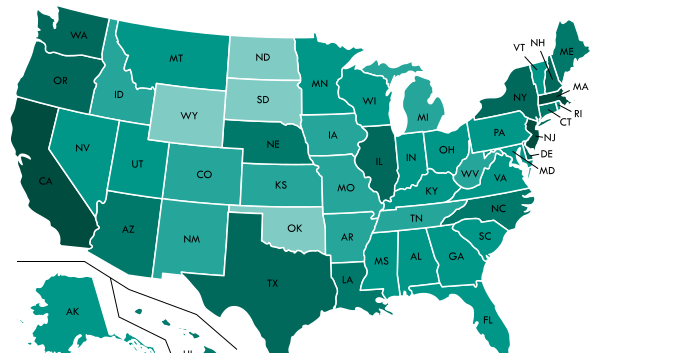
Most common states for database programmer/analysts
| Rank | State | Population | # of jobs | Employment/ 1000ppl |
|---|---|---|---|---|
| 1 | District of Columbia | 693,972 | 378 | 54% |
| 2 | Virginia | 8,470,020 | 1,214 | 14% |
| 3 | Massachusetts | 6,859,819 | 870 | 13% |
| 4 | Maryland | 6,052,177 | 789 | 13% |
| 5 | Alaska | 739,795 | 86 | 12% |
| 6 | Rhode Island | 1,059,639 | 119 | 11% |
| 7 | Delaware | 961,939 | 105 | 11% |
| 8 | Vermont | 623,657 | 67 | 11% |
| 9 | Utah | 3,101,833 | 304 | 10% |
| 10 | Minnesota | 5,576,606 | 497 | 9% |
| 11 | Oregon | 4,142,776 | 390 | 9% |
| 12 | New Hampshire | 1,342,795 | 124 | 9% |
| 13 | Montana | 1,050,493 | 90 | 9% |
| 14 | Illinois | 12,802,023 | 1,034 | 8% |
| 15 | North Carolina | 10,273,419 | 863 | 8% |
| 16 | New Jersey | 9,005,644 | 703 | 8% |
| 17 | Washington | 7,405,743 | 558 | 8% |
| 18 | Arizona | 7,016,270 | 531 | 8% |
| 19 | Colorado | 5,607,154 | 458 | 8% |
| 20 | Nebraska | 1,920,076 | 149 | 8% |
Most common cities for database programmer/analysts
| Rank | City | # of jobs | Employment/ 1000ppl | Avg. salary |
|---|---|---|---|---|
| 1 | Amherst | 1 | 3% | $95,634 |
| 2 | Schenectady | 1 | 2% | $86,677 |
| 3 | Norman | 1 | 1% | $67,082 |
| 4 | San Diego | 1 | 0% | $94,651 |
Database Programmer/Analyst job outlook: Expert opinions
Our panel of database programmer/analyst experts
Morgan State University
Old Dominion University
University of Indianapolis
New Mexico State University
Georgia Institute of Technology
University of Minnesota - Duluth

Colorado State University

Binghamton University

Furman University

University of Texas of the Permian Basin
Tim Scales
Director of Center for Entrepreneurship – Director Center for Economic Education and Senior Lecturer in Business and EconomicsWhat general advice would you give to a Database Programmer/Analyst?
Tim Scales: I would advise a graduate beginning their career in the field to focus on building a strong network, continuously learning and adapting to new technologies and trends, and seeking mentorship from experienced professionals in the industry.
Dr. Jacqueline Holland EdD, CFCS
Associate ProfessorMorgan State University
Family And Consumer Sciences/Human Sciences
What general advice would you give to a Database Programmer/Analyst?
Dr. Jacqueline Holland EdD, CFCS: The general advice I would give to a graduate beginning their career in the field is to focus on continuous learning, networking, and staying up-to-date with industry trends.
What Database Programmer/Analyst skills would you recommend for someone trying to advance their career?
Dr. Brittany Suggs Ph.D., MPH, LPC: Thank you both for extending the opportunity! Feel absolutely welcome to send the questions or related information my way for further review. Happy to contribute to this noteworthy endeavor!
What will help Database Programmer/Analysts increase their earning potential?
Abigail Richard Ph.D.: Students need to become lifelong learners. The fields of data analytics and computer science are constantly growing and changing. Students need to be adept at learning and teaching themselves new skills as technology evolves.
What Database Programmer/Analyst skills would you recommend for someone trying to advance their career?
Brett Zollinger Ph.D.: There will be so much data coming to us from various online sources (including much that is AI-generated) that knowing how to scrutinize it, mine it for quality gems, and then apply it will be highly valuable to organizations. Sociology graduates on the job will need solid footing in research methods, data literacy, and AI prompt engineering -- skills being taught in sociology curricula. The ability to make compelling cases for new or enhanced programmatic funding will be increasingly important, a reason that we require grant proposal writing in our core sociology curriculum. Also, sociology majors tend to be good at "reading the room" for the many social cues occurring in meetings, collaborative work, etc., and they also tend to be skilled in anticipating ways that organizational change affects other social actors - both internal and external to the organization. It's difficult to imagine that these abilities won't always be highly appreciated by employers for the foreseeable future.
Frank Ward
New Mexico State University
Agricultural Business And Management
What Database Programmer/Analyst skills would you recommend for someone trying to advance their career?
Frank Ward: Data driven quantitative skills used to inform management debates (attached article recently published by one of our NMSU teams (co-authors copied).
Communicating results of quantitative analysis of management choices to upper managemen
What general advice would you give to a Database Programmer/Analyst?
Dylan Brewer: Students with a bachelor's degree in economics from Georgia Tech often find employment opportunities in a variety of fields, including technology, consulting, banking, and policy/nonprofit organizations. In addition, lots of students go on to pursue graduate degrees. Here are some typical jobs that economics graduates from Georgia Tech might pursue:
Tech:
Data analyst roles at tech companies like Google, Amazon, Microsoft, etc.
Business analyst or product manager roles at tech firms
Economic analyst positions at tech companies, analyzing market trends and consumer behavior
Positions in financial technology companies, leveraging economic knowledge and data skills
Consulting:
Economic consultant roles at major consulting firms like McKinsey, BCG, Deloitte, etc.
Management consulting positions, providing data-driven business strategy advice
Consulting roles focused on economic analysis, forecasting, and risk assessment
Banking/Finance:
Roles in investment banking, such as financial analyst or associate positions
Positions in commercial banking, such as credit analyst or loan officer
Opportunities in corporate finance, financial analysis, and risk management departments
Roles in asset management firms, hedge funds, and other investment companies
Policy/Nonprofit:
Economic policy analyst positions at think tanks, research organizations, or government agencies
Roles in economic development organizations, analyzing policies and initiatives
Opportunities at nonprofit organizations focused on economic issues, such as poverty alleviation or microfinance
Positions in international organizations like the World Bank or IMF, working on economic development projects
Graduate studies:
Economics PhD and masters programs focused on research
Legal (JD) programs and other social sciences PhD programs
Data science masters programs
The quantitative and analytical skills gained through an economics degree, combined with Georgia Tech's strong reputation in STEM fields, make economics graduates attractive candidates for roles that involve data analysis, forecasting, and strategic decision-making across various industries.
Ahmed Maamoun Ph.D.
Assistant Professor of Marketing & 8X Recipient of the University of Minnesota’s Certificate for “Outstanding Teaching and Dedication to Helping Students Learn”University of Minnesota - Duluth
Marketing
What will help Database Programmer/Analysts increase their earning potential?
Ahmed Maamoun Ph.D.: The news from the job market is quite startling. A recent study from McKinsey & Company
estimates that nearly half of all U.S. jobs will be automated by 2030. Artificial Intelligence,
machine learning, and robots will make routine and conventional jobs obsolete. Most of what
students are learning will be irrelevant and dated by the time they graduate. This highlights the
need for emphasizing not just the academic abilities of graduates, but their soft and professional
skills as well. Graduates (regardless of their undergraduate major) who demonstrate a capacity to
think critically, communicate clearly, learn adaptively, make ethical decisions, work well with
others, and solve complex problems will stand a better chance of surviving in that ever-changing
job market. For example, in one survey, 93% of employers reported that "a candidate's
demonstrated capacity to think critically, communicate clearly, and solve complex problems is
more important than his or her undergraduate major."
How do you envision technology impacting Database Programmer/Analysts in the next 5 years?
Margaret Cheney: The pandemic is showing that remote work is a viable option, and mathematical work tends to be especially easy to do remotely. Employers are still hiring, even throughout the pandemic.
Xingye Qiao Ph.D.
Associate ProfessorBinghamton University
Department of Mathematical Sciences
What type of skills will young Database Programmer/Analysts need?
Xingye Qiao Ph.D.: Computing skills are becoming increasingly important, as statistics embraces the data science revolution. Students need to be able to program (using R or Python or some other language), take the data from the web, reshape it, manipulate it to allow easier downstream analysis, and be able to communicate the finding professionally.
All these are, of course, on top of statistical thinking. Competitive student candidates should not only be an order-taker. They should ask hard questions and think about the data problem in the context of the environment that generates the said data. This is related to knowledge of the domains, human contexts, and all kinds of ethical considerations.
Nathan Brown Ph.D.
Assistant Professor of FrenchFurman University
Department of Classics
What Database Programmer/Analyst skills would you recommend for someone trying to advance their career?
Nathan Brown Ph.D.: Your CV and degree only go so far. You need to craft a compelling narrative to explain to a potential employer what value you bring. That story is not readily obvious from a transcript or a resume. You must be able to tell your story.
Paul Feit
Professor and ChairUniversity of Texas of the Permian Basin
Department of Math and Physics
Are there any particularly good places in the United States for Database Programmer/Analysts to find work opportunities?
Paul Feit: A bachelor's or minor in Mathematics is sort-of a 'vanilla' degree. It is a boost in many careers; it tells potential employers that the graduate is ready for the quantitative needs in any position. Just about every position has some quantitative need. A minor in Mathematics alerts employers that the candidate brings computational finesse to whatever his/her major.
Jobs for higher degrees are in academic institutions and companies big enough to need analysis of their proprietary data. Computer companies appreciate mathematical credentials, but may expect these to be in addition to a computer science background.