Explore jobs
Find specific jobs
Explore careers
Explore professions
Best companies
Explore companies
Job outlook for decision analysts in the United States
Are decision analyst jobs in demand?
Decision analyst job and salary trends over time
Decision analyst jobs over time
Decision analyst job growth rate over time
| Year | # of jobs | % of population |
|---|---|---|
| 2021 | 246 | 0.00% |
| 2020 | 240 | 0.00% |
| 2019 | 248 | 0.00% |
| 2018 | 260 | 0.00% |
| 2017 | 264 | 0.00% |
Average decision analyst salary over time
Decision analyst salary by year
| Year | Avg. salary | Hourly rate | % Change |
|---|---|---|---|
| 2026 | $79,900 | $38.41 | +1.6% |
| 2025 | $78,611 | $37.79 | +1.7% |
| 2024 | $77,295 | $37.16 | +2.5% |
| 2023 | $75,441 | $36.27 | +2.8% |
| 2022 | $73,411 | $35.29 | +0.7% |
Decision analyst jobs by state
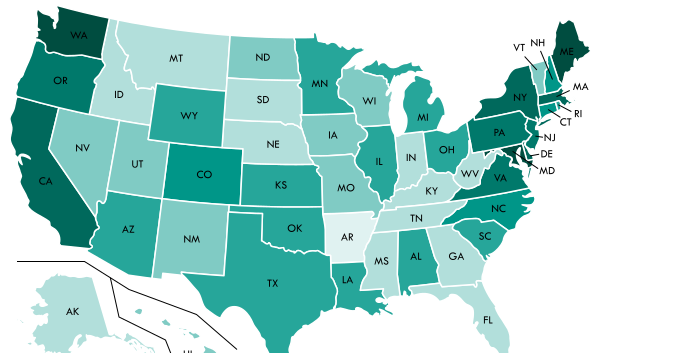
Most common states for decision analysts
| Rank | State | Population | # of jobs | Employment/ 1000ppl |
|---|---|---|---|---|
| 1 | District of Columbia | 693,972 | 146 | 21% |
| 2 | Virginia | 8,470,020 | 529 | 6% |
| 3 | Colorado | 5,607,154 | 287 | 5% |
| 4 | Delaware | 961,939 | 47 | 5% |
| 5 | Maryland | 6,052,177 | 267 | 4% |
| 6 | Massachusetts | 6,859,819 | 263 | 4% |
| 7 | Illinois | 12,802,023 | 356 | 3% |
| 8 | Georgia | 10,429,379 | 268 | 3% |
| 9 | Arizona | 7,016,270 | 233 | 3% |
| 10 | Connecticut | 3,588,184 | 92 | 3% |
| 11 | Utah | 3,101,833 | 88 | 3% |
| 12 | Hawaii | 1,427,538 | 48 | 3% |
| 13 | Rhode Island | 1,059,639 | 28 | 3% |
| 14 | Alaska | 739,795 | 24 | 3% |
| 15 | California | 39,536,653 | 884 | 2% |
| 16 | New York | 19,849,399 | 459 | 2% |
| 17 | Pennsylvania | 12,805,537 | 225 | 2% |
| 18 | New Jersey | 9,005,644 | 194 | 2% |
| 19 | Washington | 7,405,743 | 130 | 2% |
| 20 | Oregon | 4,142,776 | 76 | 2% |
Most common cities for decision analysts
| Rank | City | # of jobs | Employment/ 1000ppl | Avg. salary |
|---|---|---|---|---|
| 1 | Annapolis | 1 | 3% | $100,239 |
| 2 | Plano | 5 | 2% | $74,462 |
| 3 | Charlotte | 5 | 1% | $79,632 |
| 4 | Colorado Springs | 3 | 1% | $79,115 |
| 5 | Tampa | 3 | 1% | $61,600 |
| 6 | Chesapeake | 2 | 1% | $90,015 |
| 7 | Peoria | 2 | 1% | $77,691 |
| 8 | Avondale | 1 | 1% | $77,619 |
| 9 | San Antonio | 7 | 0% | $76,419 |
| 10 | Phoenix | 5 | 0% | $77,581 |
| 11 | Boston | 3 | 0% | $94,458 |
| 12 | Atlanta | 1 | 0% | $60,588 |
Decision Analyst job outlook: Expert opinions
Our panel of decision analyst experts
University of North Dakota
Widener University
Siena College
Carthage College
California State University - Bakersfield
University of Texas at Austin
University of Missouri - Columbia
Mercer University
University of Southern Maine
North Dakota State University
Framingham State University
Indiana University Kokomo
What Decision Analyst skills would you recommend for someone trying to advance their career?
Dr. Swagata Banerjee PhD: Digital literacy: As technology continues to evolve, proficiency in digital tools and platforms will become increasingly essential. Adaptability: The ability to quickly learn new skills and adapt to changing circumstances will be crucial in a rapidly evolving industry landscape. Data literacy: Understanding and analyzing data will become more important for making informed decisions and optimizing strategies. Interdisciplinary skills: The ability to work across different disciplines and collaborate effectively with diverse teams will be highly valued. Emotional intelligence: Soft skills such as empathy, communication, and teamwork will continue to be in demand as workplaces become more interconnected and dynamic.
What general advice would you give to a Decision Analyst?
Ning Ye Ph.D.: First of all, the ability to understand and interpret data will be key as businesses increasingly use data analytics for decision-making. One area where there will be huge demand is in data analytics, business intelligence, and data visualization. Secondly, I think the ability to adapt fast and bounce back after a failure is going to be more crucial than ever. This encompasses; embracing new ideas, learning from past mistakes, having a positive attitude when faced with adversities. Emotional intelligence (EQ) together with leadership abilities are also important for any employee. This involves knowing how to control your feelings, being able to share others' pain, and leading different teams in a globalized changing world.
What will help Decision Analysts increase their earning potential?
Adam Roth: In the next 3–5 years, the increasing presence of robots and artificial intelligence (AI) will drastically change the job market, leading to the replacement or displacement of many tasks that are currently performed by humans. This change highlights the growing need for individuals with degrees in the liberal arts. A liberal arts education emphasizes communication, critical thinking, problem-solving, analytical reasoning, creativity, emotional intelligence, and cultural awareness—human literacies, skills, and competencies that are difficult for a machine to replicate. As automation takes over many routine tasks, jobs requiring complex decision-making, creativity, and communication and interpersonal skills will become more important. Liberal arts graduates also excel in ethical decision-making and understanding societal issues, which are crucial in the responsible use and incorporation of AI.
Yvette Koepke
Associate Dean for Academic SuccessUniversity of North Dakota
Ethnic, Cultural Minority, Gender, And Group Studies
What Decision Analyst skills would you recommend for someone trying to advance their career?
Yvette Koepke: Salary: Preparation is key. Prepare by taking advantage of opportunities and experiences through projects, jobs, internships, organizations, or volunteering. Prepare by doing homework about the field and the position, and research showing the value of diversity. And prepare by practicing how best to make the case for what you can contribute.
Tongyang Yang Ph.D.
Assistant Professor of Economics and Business AnalyticsWidener University
Business/Commerce
What Decision Analyst skills would you recommend for someone trying to advance their career?
Tongyang Yang Ph.D.: The rise of AI has brought many opportunities for the professions like business analysts in terms of AI integration. Businesses will need analysts who can bridge the gap between AI and human needs and focus on more strategic areas like identifying ethical considerations of AI implementation, developing plans to mitigate AI bias, and designing human-AI collaboration workflows. For people who are interested in entering this profession, I would suggest adapting your skillset to include AI understanding, data storytelling, and strategic thinking to be well-positioned in the future.
What general advice would you give to a Decision Analyst?
Sunita Goel PhD: Great. Will send you the responses soon. Please let me know the latest deadline by which you need them.
What Decision Analyst skills would you recommend for someone trying to advance their career?
Sunita Goel PhD: Great. Will send you the responses soon. Please let me know the latest deadline by which you need them.
What will help Decision Analysts increase their earning potential?
Sunita Goel PhD: Great. Will send you the responses soon. Please let me know the latest deadline by which you need them.
What Decision Analyst skills would you recommend for someone trying to advance their career?
Prof. Kim Jovanovich P.E.: Attached please see the responses to your interview questions. I hope this sheds some light on the questions you asked!
What Decision Analyst skills would you recommend for someone trying to advance their career?
Mr. Joseph Tenuta MBA: Any major can benefit from the ability to analyze, read, and interpret data. From a software standpoint, learn Excel. For everyone, learn how to write a business email and email etiquette. It also pays to be attentive, be on time, and respectful. It helps to be a nice person too.
Dr. John Tarjan
Chair, Management/MarketingCalifornia State University - Bakersfield
Business Administration, Management And Operations
What general advice would you give to a Decision Analyst?
Dr. John Tarjan: Before interviewing and/or starting a new job, do your homework. Learn everything you can about the company—its market, competitive strategy, culture and history. If possible, talk with people who work there or others who know the company well to get an idea what it takes to be successful there. Be respectful of the culture and traditions. Dress, speak and act as appropriate and expected. While every organization should reexamine itself occasionally, one should first demonstrate a longstanding commitment to the organization before expecting to be listened to about potential changes. Show up when expected, treat other employees, customers and suppliers with respect. While the forgoing may seem unnecessary to some to even mention, unfortunately, many, if not most employers would disagree.
What will help Decision Analysts increase their earning potential?
Joseph Taylor: The role of a Business Analyst can vary greatly from company to company, and even from department to department, so it is very important to look at the details of a particular position that you are applying for. One common factor from all Business Analyst is that they are generally expected to make sense of data, and to be effective communicators that can apply insights to real-world problems.
What Decision Analyst skills would you recommend for someone trying to advance their career?
John Paglia: While technical skills such as Excel proficiency and financial statement analysis will always be needed, strong communication and interpersonal skills, coupled with a strong sense of self and understanding the organization - including its mission, goals and objectives - will be required to demonstrate maturity, commitment, flexibility, alignment and a willingness to learn and adapt. This will be critical as more AI applications emerge on the scene and redefine traditional job functions.
What Decision Analyst skills would you recommend for someone trying to advance their career?
Dr. Jae Eun Jeong: 1) Data Interpretation skills. 2) Deep understanding of human behavior.
What Decision Analyst skills would you recommend for someone trying to advance their career?
Ilyas Iyoob PhD: In the coming years, integrating operations research with AI will be crucial. For example, while AI might predict customer behaviors, operations research can optimize logistical responses to those behaviors (which puts the “action” in “actionable insights”), creating a powerful synergy. Skills in real-time decision making will also become invaluable as businesses increasingly rely on dynamic systems that require immediate responses, like dynamic pricing or real-time delivery routing. Moreover, as the discourse around technology shifts towards ethics and sustainability, being able to apply operations research to ensure algorithms are both profitable and considerate of broader impacts will be a significant advantage.
Dr. Harvey James Jr., PhD
Professor of Agricultural and Applied EconomicsUniversity of Missouri - Columbia
Agricultural Business And Management
What will help Decision Analysts increase their earning potential?
Dr. Harvey James Jr., PhD: Soft skills – that is, skills relating to how we work with others – will always be critical, even as technology advances. People need to know how to contribute within teams, how to share ideas, how to disagree without being disagreeable, and how to take correction or criticism professionally. Critical thinking and analytical skills are also important. You often cannot accept information that comes to you at face value. So knowing how to evaluate, analyze, and utilize information is critical. To this end, understanding the strengths and weaknesses of generative AI will become increasingly important in the coming years. Generative AI is still in its infancy, but it will not go away. Knowing how to develop effective prompts and how to evaluate responses provided is a skill that takes time and experience to develop.
What general advice would you give to a Decision Analyst?
Benjamin Greulich Ph.D.: I have attached my responses to those three questions. Let me know if you are looking for something a little bit different and I would be happy to reanswer/update anything!
What will help Decision Analysts increase their earning potential?
Dan Jenkins Ph.D.: Graduates should leverage their interdisciplinary skills to adapt to diverse roles. Emphasize your ability to integrate knowledge from various fields, and continuously seek professional development opportunities. Networking and mentorship are vital for career growth. Our programs, such as the BA in Leadership and Organizational Studies and the MA in Leadership Studies, emphasize critical thinking, ethical decision-making, and effective communication.
What Decision Analyst skills would you recommend for someone trying to advance their career?
Adrian Garcia: Expand your network and build your reputation. Nurture relationships with former classmates, current students, faculty, and industry insiders. The more people know and trust you, the better off you’ll be. Making good impressions and making yourself indispensable will open doors.
What will help Decision Analysts increase their earning potential?
Adrian Garcia: Soft skills—the ones that can be easily transferred from one task to another. Also, soft skills will not face obsolescence to the same extent as hard skills. Bottom line: no one will put in the effort to train you up or keep you around them if you’re not likable or pleasant.
What general advice would you give to a Decision Analyst?
Erastus Ndinguri: A couple of ways to maximize your salary potential are;
Through first salary negotiation - By understanding the job market of your field, knowing what you can offer and preparing well for your salary negotiation you can positively maximize your first salary potential. This can affect your future earnings especially if you rise up the corporate ladder in the same organization.
Not settling, but continuing to learn- Learn a new skill that will help in building your resume. Network with colleagues in your organization and learn from them. Continuous learning and self-improvement create opportunities for higher earnings.
Embrace mentorships- Having a good seasoned colleague/mentor can open opportunities for higher earning. A mentor can help you prepare for a salary negotiation and also steer you to the right projects that lead to career advancements hence a higher salary.
What general advice would you give to a Decision Analyst?
Ghadah Alshuwaiyer PhD, CHES®: I advise recent graduates to seek professional development opportunities under the guidance of an experienced mentor to help them achieve their desired career goals. Building a robust professional network and seeking interdisciplinary collaborations are also important.