Explore jobs
Find specific jobs
Explore careers
Explore professions
Best companies
Explore companies
Job outlook for designer/artists in the United States
Designer/artist job growth summary. After extensive research, interviews, and analysis, Zippia's data science team found that:
The projected designer/artist job growth rate is 3% from 2018-2028.
About 6,800 new jobs for designer/artists are projected over the next decade.
Designer/artist salaries have increased 12% for designer/artists in the last 5 years.
There are over 12,888 designer/artists currently employed in the United States.
There are 48,360 active designer/artist job openings in the US.
The average designer/artist salary is $51,173.
Are designer/artist jobs in demand?
Designer/artist job and salary trends over time
Designer/artist jobs over time
Designer/artist job growth rate over time
| Year | # of jobs | % of population |
|---|---|---|
| 2021 | 12,888 | 0.00% |
| 2020 | 12,724 | 0.00% |
| 2019 | 13,639 | 0.00% |
| 2018 | 13,758 | 0.00% |
| 2017 | 13,718 | 0.00% |
Average designer/artist salary over time
Designer/artist salary by year
| Year | Avg. salary | Hourly rate | % Change |
|---|---|---|---|
| 2025 | $51,173 | $24.60 | +2.4% |
| 2024 | $49,955 | $24.02 | +3.5% |
| 2023 | $48,287 | $23.22 | +3.4% |
| 2022 | $46,686 | $22.45 | +2.2% |
| 2021 | $45,670 | $21.96 | +1.6% |
Designer/artist jobs by state
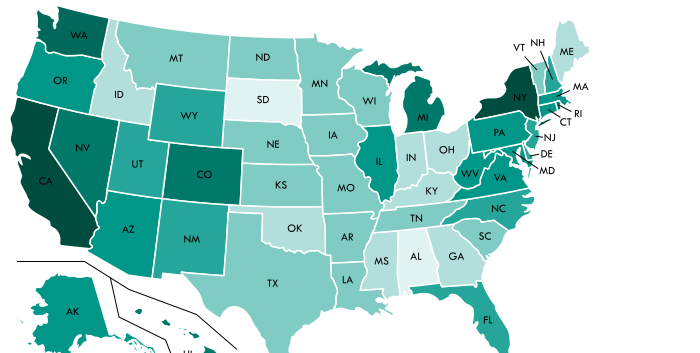
Most common states for designer/artists
| Rank | State | Population | # of jobs | Employment/ 1000ppl |
|---|---|---|---|---|
| 1 | District of Columbia | 693,972 | 227 | 33% |
| 2 | Washington | 7,405,743 | 913 | 12% |
| 3 | Oregon | 4,142,776 | 463 | 11% |
| 4 | Massachusetts | 6,859,819 | 703 | 10% |
| 5 | New Hampshire | 1,342,795 | 131 | 10% |
| 6 | California | 39,536,653 | 3,525 | 9% |
| 7 | Virginia | 8,470,020 | 727 | 9% |
| 8 | Utah | 3,101,833 | 272 | 9% |
| 9 | Georgia | 10,429,379 | 802 | 8% |
| 10 | Rhode Island | 1,059,639 | 86 | 8% |
| 11 | Vermont | 623,657 | 51 | 8% |
| 12 | Colorado | 5,607,154 | 404 | 7% |
| 13 | Minnesota | 5,576,606 | 399 | 7% |
| 14 | Wisconsin | 5,795,483 | 398 | 7% |
| 15 | Connecticut | 3,588,184 | 234 | 7% |
| 16 | Delaware | 961,939 | 71 | 7% |
| 17 | Wyoming | 579,315 | 38 | 7% |
| 18 | New York | 19,849,399 | 1,281 | 6% |
| 19 | Illinois | 12,802,023 | 759 | 6% |
| 20 | Maryland | 6,052,177 | 390 | 6% |
Most common cities for designer/artists
| Rank | City | # of jobs | Employment/ 1000ppl | Avg. salary |
|---|---|---|---|---|
| 1 | Fort Myers | 1 | 1% | $46,476 |
| 2 | Vancouver | 1 | 1% | $60,119 |
| 3 | Los Angeles | 1 | 0% | $60,447 |
Designer/Artist job outlook: Expert opinions
Our panel of designer/artist experts
Michigan State University
Florida Gulf Coast University
Xavier University
Arcadia University
University of Missouri - Kansas City
Memphis College of Art
Pennsylvania College of Technology
University of Akron
Muhlenberg College
Kean University
What general advice would you give to a Designer/Artist?
Tiffany Prater: As we emerge from the pandemic, it's crucial to hone your communication skills, particularly in areas such as presenting your design ideas, collaborating with team members, and effectively communicating with clients. This will not only build your confidence but also help you communicate your thought processes and informed design solutions, be open to correction and criticism, and gather experience while working with senior graphic designers, creative directors, and clients.
What Designer/Artist skills would you recommend for someone trying to advance their career?
Tiffany Prater: Never stop learning because life never stops teaching. This quote by Kirill Korshikov rings true for new designers, who must know the latest trends and tools to be uniquely creative, improve their skills, and land a better design job. Knowledge and inspiration can come from anywhere and everywhere in our daily lives.
What will help Designer/Artists increase their earning potential?
Tiffany Prater: There are several ways to maximize your salary potential. If you have the time to pick up a few night classes on top of your job, take courses in either Art Direction, Copywriting, Photography, UX/UI design, Social, or Strategic planning. If you'd like to take a break from the private sector, getting a Master of Fine Arts degree is even better as it can lead to higher design jobs and teaching positions.
What general advice would you give to a Designer/Artist?
Beth Secor: Keep your eyes and ears open for job opportunities, find a job at an arts non-profit, and never quit making art. Actively engage in the profession, as it can lead to unexpected opportunities.
What Designer/Artist skills would you recommend for someone trying to advance their career?
Beth Secor: For studio artists, it is important to steer away from AI, as AI-produced artworks are devoid of real emotion or soul. A skill that is very important is having the ability to put yourself out there, promote your work on social media platforms or in exhibitions, and have a gallery representing your work.
What will help Designer/Artists increase their earning potential?
Beth Secor: Many of the students I went to undergraduate and graduate school, including myself had aspirations of becoming famous artists, but it is best to develop other skills that are art-related that can help you make a living in the meantime. Internships with local arts non-profits organizations, museums, and/or galleries are a great place to start, and while working with them, it is a great opportunity to build networks with others in the arts community.
What general advice would you give to a Designer/Artist?
Michalis Andronikou PhD: Be open-minded and creative. You may need to combine a few different skills to find your own professional path.
What Designer/Artist skills would you recommend for someone trying to advance their career?
Michalis Andronikou PhD: You may be able to combine different jobs that support and promote one another. If you are a performing artist and a teacher, your students could be a supportive audience and they can learn a lot from your performances.
What will help Designer/Artists increase their earning potential?
Michalis Andronikou PhD: It’s difficult to predict what skills will become more important in the field in the next 3-5 years, but creative people and people with a will to improve their skills will find a way to prevail and lead.
What general advice would you give to a Designer/Artist?
Wanda Sullivan MFA: In addition to full time practicing artists, our studio art graduates work in a variety of jobs. We have alumni in art administration positions, a tenured professor at Auburn, elementary and high school art teachers, an education director at the Center for Craft and even a curator at the Field Museum in Chicago. The common thread that they all have in common is a strong foundation in creative problem solving. Art is fundamental to the human condition. We are born wired to create. In a sense, art gives flavor to life through color, form, line, texture and shapes. Art is communication, a non-verbal language that connects us across backgrounds, cultures and generations, it is what makes us human.
What Designer/Artist skills would you recommend for someone trying to advance their career?
Wanda Sullivan MFA: Making art or working in an art related field is one of the most rewarding ways to earn a living. It is a privilege to contribute to the tradition of culture in one's community, region and country. People shape the creative fiber of communities, they do not happen on their own. The most common frustration creatives face is lack of funding in the arts and lack of understanding. These obstacles can be overcome and should not deter young people from studying art. Art was here before we were all born and will be here after we all leave, it gives life flavor and it will never go out of style.
What will help Designer/Artists increase their earning potential?
Wanda Sullivan MFA: Absolutely! Individuals who are trained in visual fields are creative problem solvers. Every profession values creativity and all forms of art are always and will always be in demand.
What general advice would you give to a Designer/Artist?
Assistant Professor Trish Gianakis: A fine artist's day-to-day activities are basically focused on creating art. There are other tasks as well, such as marketing, networking, collaborating with other artists, research and teaching workshops or classes. At a beginner level when someone is entering the field of fine art, typical activities focus on building their skill and a specific style to stand out. While developing their portfolio, going to art shows and getting into the art community to meet other artists and gallery owners to establish themselves in the artistic community. Many artists work multiple jobs in order to sustain their income while they figure out the specific style to make themselves stand out.
What Designer/Artist skills would you recommend for someone trying to advance their career?
Assistant Professor Trish Gianakis: I like to say we are in the beginning of the digital Renaissance. Digital art is finally accepted as an art form. This career can be a dynamic and rewarding career if you have a passion for creativity, expression, and want to make a cultural impact by meaningful contribution to society.
What will help Designer/Artists increase their earning potential?
Assistant Professor Trish Gianakis: The politics of being a fine artist can be tricky to navigate. There are some basic unsaid rules an artist must follow in order to become successful to reap the rewards. Learning these unsaid rules can be frustrating for artists which is one of the things artists dislike. While others once they understand the rules thrive.
What general advice would you give to a Designer/Artist?
Teresa Dunn: In general artists make because they are driven by internal impulse to create. I would not describe that as like or dislike, but as being compelled to make something from nothing or transform something into something else completely new. There are many layers to why a person chooses to be an artist including the personal satisfaction of making something beautiful, compelling, incredible, shocking, or even disturbing. There is also the pleasure of providing joy to others, being provocative or evocative—the reaction of an audience is exciting. Downsides to the profession are learning to cope with failure—not everything an artist makes is worth keeping or is well received; rejection—an artist does not always get the exhibitions, sales, awards, and opportunities they would like or are worthy of receiving; the bureaucracy—dealing with things like taxes, paperwork, and organization of schedules are the necessary but less glamorous aspects of being an artist.
What Designer/Artist skills would you recommend for someone trying to advance their career?
Teresa Dunn: Entering the profession in practical terms is complicated as being an artist can be challenging on many levels, leaving many artists to balance their creative practice with other work such as education, arts administration, or jobs unrelated to the arts. I would rephrase the question: why is it critical to be an artist today? Artists have the capacity to see and to distill the world around us in sensitive and rich ways that invite viewers to understand themselves or others, view the past/present/future in unexpected ways, and identify topics of vital importance that audiences may not have considered without the perceptiveness of an artist through their artwork. Communities, cultures, civilizations are rich because of the dedication of artists and other creatives to make artwork that helps one find meaning, validates the self, makes the unknown known, reveals purpose, provides hope, challenges the status quo, and asks us to grow as individuals and as collectives.
What will help Designer/Artists increase their earning potential?
Teresa Dunn: For many artists a typical daily scenario and often the main priority is to be in the studio making their artwork. However, for those whose work is primarily performative or social practice, the studio might not be the most important place for creative discovery. In addition, artists have such varied practices and unique demands that there is not a simple way to answer this question. It can be a combination of many activities such as being in the studio making artwork, preparing materials to create their work, reading, doing research, traveling to see artwork in galleries and museums, attending exhibitions or residencies, working with assistants, networking, applying for shows, engaging with community, teaching, etc.
Steve Hughart II
Laboratory Coordinator I/ Adjunct ProfessorFlorida Gulf Coast University
Fine And Studio Arts
What general advice would you give to a Designer/Artist?
Steve Hughart II: Advice I would give to a graduate beginning their career in Art would be to enter as many shows and exhibitions as possible. Not just in Florida either, expand your focus to regional and national exhibitions as well. Gain as much exposure as you can and make a lot of work to show off. To put it simply, the more you make the better you will get. People will always appreciate a well-crafted handmade item before and artificially made one.
What Designer/Artist skills would you recommend for someone trying to advance their career?
Steve Hughart II: If you want to maximize your salary potential, I always say you need to have a lot of tools in your toolbox. Take your foundation courses seriously and learn as much as you can from the faculty and staff here at FGCU. Ask questions, devote time outside of class to work, time management and understanding how long it will take to complete tasks is very important. Another important aspect is social networking. Meet as many people as you can in the field you are interested in. A lot of times finding the best position isn’t based on what you know, but who you know.
What will help Designer/Artists increase their earning potential?
Steve Hughart II: The most important skills that I would suggest would be to learn and understand the Adobe Creative Cloud Applications such as Photoshop and Illustrator for example. These platforms will benefit you immensely in the art field in a ton of different ways. All artists will use these applications in one form or another. That being said, I would also encourage everyone to do as much work as possible with your hands. Learn to use power tools, pick up a piece of paper and pencil instead of the iPad, use a real camera instead of your phone. With AI growing so fast digital media work will all be AI generated, so focusing on improving your editing skills and creating with your hands will be where the jobs are.
What general advice would you give to a Designer/Artist?
Professor Kelly Phelps M.F.A.: Fine Artist work! We have professions like any other. Many fine artist have art as his or her primary gig. Some have use art as their secondary job. Fine Artist try to work in his or her craft on a daily basis. Artist work in the studio, work on self -promotion, fix equipment, seek opportunities, exhibit, network/collaborate with other artist.
What Designer/Artist skills would you recommend for someone trying to advance their career?
Professor Kelly Phelps M.F.A.: Fine Arts is a great profession because creativity is needed everywhere. Artist/Designers are the makers of everything! There is an opportunity where art can be found in nearly any career.
What will help Designer/Artists increase their earning potential?
Professor Kelly Phelps M.F.A.: The biggest dislike about being about being a Fine Artist is the societal stigma …What are you going to do with that career? Having to constantly explain and validate what fine artist do is exhausting. Artist make or design everything. From the clothes on our backs to the toilet you set on we (artist /designers) have designed or created everything. Art has so many practical applications outside of visually creative things displayed in a gallery or museum.
What general advice would you give to a Designer/Artist?
Christian Patchell: There is a ton of opportunity and burgeoning markets opening up every day. We discuss this in my classes. The landscape of the arts changes at a faster pace than ever, but change doesn’t happen in a vacuum. With each new evolution there comes new opportunities. For example, many of my students find themselves interested in UX/UI. This is an area with a lot of opportunity for a new Designer but only if there is a passion for the Market. Even though this is a field first identified in the early 90s, I’d say that in the last decade or so it really has hit the Design World hard. This doesn’t mean that designing for print has to take a back seat. Print is more popular than ever in terms of designing and creating objects (books, packaging, etc.) that many of us refer to as art objects, interactive objects, or objects of influence. Telling a good story through the design of an object is pushing Graphic Design into wonderful areas and is really starting to connect with audiences on entirely new levels. Don’t let the articles listing the “Top 10 Majors at Universities” or the “25 Most Popular Jobs” fool you, Art and Design are more relevant and more important than ever before.
What Designer/Artist skills would you recommend for someone trying to advance their career?
Christian Patchell: A Graphic Designer will do a number of things every day. Often, there may be a beginning of the week meeting, this could be a team meeting or a one-on-one with the Art Director, Art Manager, or Senior Designer. So many of my students are finding remote employment, that makes these meetings (via Zoom or Skype) even more important. Also, there is now an added importance to Designers being good communicators, not just to other creative individuals but to additional areas outside of Design, such as Marketing, Sales, etc. Designers need to be able to speak to and/or hear input from various areas as they move through designing for a brief. Usually these meetings will sum up the week behind and the week ahead. A good Director will also be able to see where a team member might need assistance to finish something or is awaiting approval. When I worked in the Greeting Card industry these meetings not only mapped out the weeks’ worth of card design but also determined the larger picture such as planning a line of cards or an ad campaign. As a Designer, it was useful to see the smaller picture and the bigger picture as we moved forward as a team. A day to day an entry level Designer may be asked to assist in many areas with different skill sets for each. They could be proofing copy, laying out text, correcting bad links on a site or app. as well as designing an entire project from the ground up. It all depends on their area of expertise or the market in which they find themselves. My advice to those starting in Graphic Design is to “have many legs under the table of their career,” meaning: it’s a good idea to know a lot about multiple aspects of the Design Market. This is especially helpful for someone starting out, as it keeps many avenues open on the journey ahead as well as allowing for changes in the market or technology that may redirect one’s trajectory.
What will help Designer/Artists increase their earning potential?
Christian Patchell: Oddly, what most people like and dislike are the same thing. Designers many times stand at a starting point, the line where technology and art merge into something beautiful and engaging. We are early adopters, curious where the digital and traditional merge into something new or different. Making something “new” and “different” over and over again can be a difficult climb. But if you are someone with a wealth of ideas and likes to solve problems creatively, the challenge of Graphic Design may be right for you. The other side of that coin is technology. A Graphic Designer needs to stay current on emerging technologies while maintaining an eye on trends and changes in the culture. While in school it is quite easy to stay up to date on programs that are the industry standards (Adobe Publishing Suite, Figma, etc.) it can be more difficult to do this once you have graduated. As a teaching professional I try to keep my skill set current on an annual basis (sometimes shorter) so I can be of service to my students and relevant in my field. As a Graphic Designer if you do your job right, no one may really see it. However, if you do it wrong in even the slightest way, everyone might see it. At the end of the day though there is nothing quite like seeing your design out in the wild. Whether part of a team or as an individual, a Graphic Designer is given an opportunity to share their work, their art, with an extremely large audience and instigate change while creating something personal and telling a good story. That feeling of accomplishment, for me at least, outweighs any cons there might be in this creative field.
Carla Noack
Associate Professor of Theatre, ActingUniversity of Missouri - Kansas City
Drama/Theatre Arts And Stagecraft
What general advice would you give to a Designer/Artist?
Carla Noack: My advice is to be patient and generous with one’s self and others. A career in this field is built over time through nurturing relationships, staying curious, being kind, taking creative risks, and being willing to forgive and be forgiven. Any job “counts” in this field when viewed through an artistic lens. It’s about staying interested in the human condition, finding ways to express your perspective, and encouraging others to do the same.
What Designer/Artist skills would you recommend for someone trying to advance their career?
Carla Noack: Be a good collaborator: always show up and on time; treat everyone as a potential scene partner; embrace surprises and challenges; connect with audience members; find “day jobs” between production work that are flexible and engaging; nurture a desire to learn everything about everything.
What will help Designer/Artists increase their earning potential?
Carla Noack: The world needs humans who know how to solve problems creatively and joyfully; who can express themselves clearly and tell stories effectively; who are willing to connect to others in real space and time through vulnerability and empathy; who have skills in listening—helping others feel heard and valued; and who can inspire all of us to envision new ways of working, learning and living together.
What general advice would you give to a Designer/Artist?
Lucas Charles: As graphic design graduates embark on their careers, nurturing curiosity, continuous upskilling, networking, and collaboration are pivotal. Embracing curiosity sparks innovation, while ongoing learning ensures relevance in a fast-paced industry. Building connections fosters opportunities, and collaboration cultivates dynamic work environments.
What Designer/Artist skills would you recommend for someone trying to advance their career?
Lucas Charles: To maximize their salary potential, graphic design graduates should focus on key strategies. Building a diverse portfolio showcases skills, while cultivating a professional network opens doors to higher-paying opportunities. Continuous upskilling ensures competitiveness, and confident negotiation of fair compensation based on expertise enhances earning potential.
What will help Designer/Artists increase their earning potential?
Lucas Charles: In the ever-changing field of graphic design, adaptability, digital fluency, and understanding user experience are becoming more crucial. Embracing new and emerging technologies, prioritizing empathy, and fostering a mindset of lifelong learning are paramount for success.
What general advice would you give to a Designer/Artist?
Kathryn Anderson: Some of the day-to-day duties of a graphic designer entail some basic skills such as the following: listen attentively; engage in and interpret research (visual, text-driven, data-based, etc.); problem-solve; process and critique creative ideas; use technology in an ethical and appropriate manner; prepare digital and other work/files for printing and/or the web; and revamp concepts as per the client’s wishes.
What Designer/Artist skills would you recommend for someone trying to advance their career?
Kathryn Anderson: A Graphic Designer’s work-life is rather sedentary and repetitive. However, any astute employer will encourage a bit of exercise and play throughout the course of the day to keep their team focused and happy. Other downsides might be: fast deadlines or short turn-arounds, insufficient communication from a client, and mandatory overtime hours. Mostly, the benefits out-weight the negatives. In today’s virtual world, more designers can and do work remotely or in hybrid environments—which is a plus for those who have child-care or other familial responsibilities.
What will help Designer/Artists increase their earning potential?
Kathryn Anderson: With the advent of AI, graphic designers must be valued for their technical and critical thinking skills. Graphic Designers of today provide more than just what the client wants or envisions, but rather a uniquely hyper-focused solution that can stand the test of time because of the insightful research and intense amount of processing and editing that is embedded in the design.
What general advice would you give to a Designer/Artist?
Professor Kate Jordahl: It is an excellent time to begin in the visual and performing arts because we have such a need for creativity and our approaches to the problems of the world, the challenges of our society, and the ever-changing fabric of business. Whether you work directly in making things and performing or you are a supervisor who organizes other people's creative tasks, this is a very rewarding area with a balance of using all of your skills to create and make projects successful
What Designer/Artist skills would you recommend for someone trying to advance their career?
Professor Kate Jordahl: Visual and performing arts professionals will do a variety of jobs and tasks. Part of the point of working in this area is both the creativity and the flexibility that a career a creative career can offer you. Many visual and performing arts professionals will work for themselves, so really, they are small business owners needing to negotiate, organize, and then create their artwork or perform their skill. Generally, creative professionals will find that they will spend approximately 30% of their time in their chosen area of creativity and about 70% of their time in the business of organization, negotiation, and client relations. These specialties need people who are self-starters, who really enjoy working collaboratively, and who can work independently to make deadlines and realize projects. For most visual and performing arts professionals, the last decade has been a time of great change, and being flexible is probably one of the most important things you can bring to the table.
What will help Designer/Artists increase their earning potential?
Professor Kate Jordahl: People like that they can be flexible in the performing arts and that there is a myriad of ways to work and thrive in this area. People dislike that the pay is sometimes less than for other professions and that the hours can be very long. Being a visual and performing arts professional means working when the work needs to be done, and it can mean long days, but the rewards are worth it.
What general advice would you give to a Designer/Artist?
Jeffrey Fracé: An artist at the beginning of their career, unless they are lucky enough to have a trust fund, has the unique challenge of effectively managing at least two businesses at once. Most of you will begin as a freelancer, and earn most of your money not from your art. To minimize the time it takes to earn a living with your art, keep your cost of living low, and try not to wear yourself out at your day job. Create day-to-day stability, but put your energy — your best self — into your art. Keep meeting people, keep practicing, and keep creating and producing original work. The more you diversify your skills — scripted and improvised, stage and camera, artistic and commercial, learning and teaching — the better chance you’ll have achieving a balance of satisfying work and satisfying income.
What Designer/Artist skills would you recommend for someone trying to advance their career?
Jeffrey Fracé: More and more, the actor, director, or designer who is also a creator has a better chance of succeeding in the field. This means creating new work in any medium — original live performance, writing and shooting your own movie (low-budget or no-budget is absolutely legit), or creating online content, for example. This also means creating opportunities for yourself instead of waiting for them to arrive — “put yourself out there” is a cliché, but more necessary than ever. To have the best chances for success with your original work, you will also need to be a producer and marketer. The next most important skill is interdisciplinary collaboration. Learn how you work with other people and practice to get better at it. Hone your listening skills, and develop interest in other disciplines and how they intersect with yours. Practice bravery and flexibility in how you approach new projects and collaborative partnerships.
What will help Designer/Artists increase their earning potential?
Jeffrey Fracé: I recommend that before you graduate, you think about where you want to live and make a plan to move there. Consider factors such where are the artists doing the kind of work you are interested in doing, whom do you already know there, and are there opportunities to earn a living as you break into the field. Meet as many people as you can in your chosen place — whomever you want to work with, get to know their work better and reach out to them. Meanwhile, keep active by continuing to train yourself, because in theater or film/TV, it’s very common for there to be gaps between projects as you are starting out. Keep your cost of living low, and try not to wear yourself out at your day job. Do something every day that reminds you that you are an artist, whether it’s rehearsing your monologues, working on a scene with a friend, taking classes, writing, composing or playing music, whatever helps you feel creative.
What general advice would you give to a Designer/Artist?
David Flynn: Everything that you see has been touched by a designer. The field is expanding with technology, but basic communication design principals remain paramount. It doesn’t matter if it’s a newspaper ad or a social post, you must have a professional that knows how to communicate a message, move the viewer's eye, and make the point. Designers work in every company and in every industry, worldwide.
What Designer/Artist skills would you recommend for someone trying to advance their career?
David Flynn: They like that it can be very lucrative, so rewarding when you see your work in the world, nothing like it really. Downside is that “creativity on demand” is difficult to sustain and you have to purpose to take care of your creative soul.
What will help Designer/Artists increase their earning potential?
David Flynn: We spend our day creating items that need to communicate a message clearly and quickly to a person or public. Information, directions, product benefits, packaging, events, advertising, anything and everything is designed to inform.
What general advice would you give to a Designer/Artist?
Emily Potts: The day-to-day work is difficult to define because it depends heavily on the path an individual chooses, driven by their own goals, talents, and dreams. Fine artists are equipped with portfolios that demonstrate technical skill and can translate that into a wide range of employment opportunities. These include commercial art, non-profit work, art management, teaching, animation, skilled crafts like jewelry making and steel fabrication, and even developing proposals and grant writing for public and site-specific commissions. Fine arts are truly expansive in nature.
What Designer/Artist skills would you recommend for someone trying to advance their career?
Emily Potts: The opportunity to exercise creativity is incredibly fulfilling. Art enriches communities and reflects thoughts and feelings that will always hold value for society. Storytelling is inherently woven into art, and the ability to communicate with others in a nuanced and empathetic way is more important now more than ever.
What will help Designer/Artists increase their earning potential?
Emily Potts: Fine art requires strong discipline, constant creative thinking, problem-solving, and communication skills. While the breadth of the field might initially overwhelm some, the stereotype that there are no jobs in the arts is simply untrue. Artists need to find their niche and develop the skills and portfolio to back it up. A fine arts degree is not an ending point, but a springboard. By professionally presenting their creative work, artists can propel themselves into jobs they are passionate about and truly believe in.
What general advice would you give to a Designer/Artist?
Dr. Denise Anderson: When mentoring students in developing their final portfolios and preparing them for professional practice I ask them “What makes you stand out above the line” or simply put, what separates you from all the other designers looking for a job. This could be prestigious internships, knowing motion or 3D rendering skills and then I tell them to promote their strengths. For example, my student Myesha Bennett spent four years in the Navy to pay for college. What she learned along the way shaped her as the designer she is today and these lessons made her stand above the line.
What Designer/Artist skills would you recommend for someone trying to advance their career?
Dr. Denise Anderson: The skills graphic designers will need is learn artificial intelligence software AND how to masterfully use it. The masses will tinker with the new technology but designers need to harness the power of it and use their learned skills of ideation, art direction, and image manipulation skills (Photoshop). What they also need to develop is their storytelling skills which will help them with art directing and creating AI images.
What will help Designer/Artists increase their earning potential?
Dr. Denise Anderson: Similar to question 1, leverage what you have done prior to entering the field. It takes my students 6-8 weeks to complete their resumes and personal because the image and content needs to be authentic. Perception is a lot in our field and I train students to feel confident about themselves. Portfolios get students an interview but they need to communicate their value to get hired.
What general advice would you give to a Designer/Artist?
Carol Pelletier: I think most people love the creative space of being in the studio working on the next project, exhibiting their work and having it viewed by other artists and the greater public. The greatest frustration for most artists is work-life balance, like any other field.
What Designer/Artist skills would you recommend for someone trying to advance their career?
Carol Pelletier: The Studio Arts is a great place for those individuals who want to enter creative fields while fostering the spirit of entrepreneurship, while Art Therapy utilizes the arts for healing.
What will help Designer/Artists increase their earning potential?
Carol Pelletier: Many of our students go on to become practicing artists, exhibiting nationally and internationally. Here are a few names for you. Danielle Fretwell, recently had her first solo show in London at the Alice Amati Gallery. Kat Giordano, another studio art major recently graduated with the MFA in Painting from Goldsmiths University of London and is preparing for shows at the Stapleford Granary in Cambridgeshire and at Lampo in London. Kevin Ivester, another studio art major, owns and operates one of the top Contemporary Art Galleries in Austin Texas called Ivester Contemporary. Holly Nichols is an artist, illustrator and author with over 3 million followers on Instagram. Our other majors in the Fine Arts include Art Therapy and those students become practicing Art Therapists after pursuing the Master's degree in Art Therapy or Expressive Arts Therapies. Brittany Quinn owns her own LLC called Green Lotus Art Therapy in Berlin Connecticut where she and other practitioners she hires provide art therapy and counseling services to individuals.
What general advice would you give to a Designer/Artist?
Hartmut Austen: Go abroad for a while and travel. Build or become part of a community. Foster relationships with people that have an interest in your wellbeing and success. Maintain relationships with other artists and people in other professional fields. Attend professional development opportunities and consider continuing education towards an M.F.A. program.
What Designer/Artist skills would you recommend for someone trying to advance their career?
Hartmut Austen: Apprenticeships in an artist's studio or workshop, embrace physical labor. Develop soft skills such as connecting with others, having a healthy sense of self, and curiosity.
What will help Designer/Artists increase their earning potential?
Hartmut Austen: Attend graduate school or broaden your education. Declutter your life and studio. Make your art and yourself visible in the context you want to be seen. Build relationships, focus on your strengths, learn from others in the discipline, and maintain integrity.
What general advice would you give to a Designer/Artist?
Ananda Keator: 3D printing accessories, digital renderings, and (hopefully) revival of almost lost arts.
What Designer/Artist skills would you recommend for someone trying to advance their career?
Ananda Keator: Don't work for free, know your worth and fight for it. Also make sure there is 'life' in your 'work/life balance'. Figure out what success means to you, and it will look different for everyone. You don't have to move to NYC, you don't have to win lots of awards, etc., if that's not what makes you happy.
What will help Designer/Artists increase their earning potential?
Ananda Keator: Be multifaceted, don't try to specialize just yet. And see #1