Explore jobs
Find specific jobs
Explore careers
Explore professions
Best companies
Explore companies
Job outlook for development research analysts in the United States
Are development research analyst jobs in demand?
Development research analyst job and salary trends over time
Development research analyst jobs over time
Development research analyst job growth rate over time
| Year | # of jobs | % of population |
|---|---|---|
| 2021 | 492 | 0.00% |
| 2020 | 467 | 0.00% |
| 2019 | 459 | 0.00% |
| 2018 | 431 | 0.00% |
| 2017 | 403 | 0.00% |
Average development research analyst salary over time
Development research analyst salary by year
| Year | Avg. salary | Hourly rate | % Change |
|---|---|---|---|
| 2025 | $70,829 | $34.05 | +3.2% |
| 2024 | $68,655 | $33.01 | +1.1% |
| 2023 | $67,934 | $32.66 | --0.2% |
| 2022 | $68,052 | $32.72 | +1.1% |
| 2021 | $67,331 | $32.37 | +0.7% |
Development research analyst jobs by state
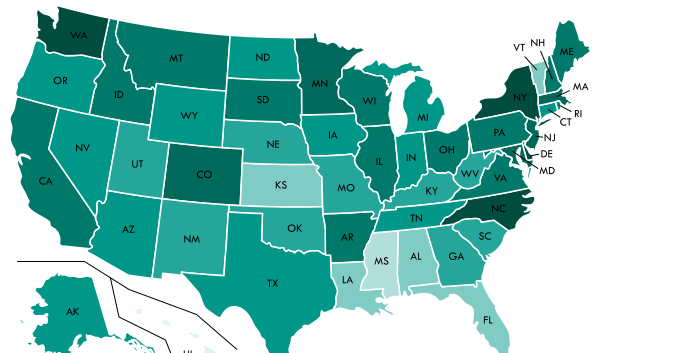
Most common states for development research analysts
| Rank | State | Population | # of jobs | Employment/ 1000ppl |
|---|---|---|---|---|
| 1 | District of Columbia | 693,972 | 336 | 48% |
| 2 | Minnesota | 5,576,606 | 1,747 | 31% |
| 3 | South Dakota | 869,666 | 248 | 29% |
| 4 | Montana | 1,050,493 | 290 | 28% |
| 5 | North Dakota | 755,393 | 205 | 27% |
| 6 | Nebraska | 1,920,076 | 492 | 26% |
| 7 | Alaska | 739,795 | 181 | 24% |
| 8 | Pennsylvania | 12,805,537 | 2,957 | 23% |
| 9 | New Mexico | 2,088,070 | 450 | 22% |
| 10 | Georgia | 10,429,379 | 2,165 | 21% |
| 11 | Arizona | 7,016,270 | 1,480 | 21% |
| 12 | Missouri | 6,113,532 | 1,266 | 21% |
| 13 | Vermont | 623,657 | 128 | 21% |
| 14 | Kansas | 2,913,123 | 570 | 20% |
| 15 | Rhode Island | 1,059,639 | 212 | 20% |
| 16 | Tennessee | 6,715,984 | 1,250 | 19% |
| 17 | Indiana | 6,666,818 | 1,242 | 19% |
| 18 | Delaware | 961,939 | 180 | 19% |
| 19 | Ohio | 11,658,609 | 2,049 | 18% |
| 20 | Wisconsin | 5,795,483 | 1,044 | 18% |
Most common cities for development research analysts
| Rank | City | # of jobs | Employment/ 1000ppl | Avg. salary |
|---|---|---|---|---|
| 1 | Livermore | 1 | 1% | $78,478 |
| 2 | Albuquerque | 2 | 0% | $62,076 |
| 3 | Denver | 1 | 0% | $79,980 |
| 4 | Indianapolis | 1 | 0% | $63,922 |
| 5 | Jacksonville | 1 | 0% | $51,972 |
Development Research Analyst job outlook: Expert opinions
Our panel of development research analyst experts
College of New Jersey, The
North Dakota State University
University of Nebraska - Omaha
Middlebury College
Lafayette College
Furman University
University of Cincinnati
Pepperdine University

University of California, Irvine

Elizabethtown College

Creighton University

Rutgers, The State University of New Jersey-Newark

East Tennessee State University

Utah State University

Humboldt State University

University of Akron
Chrissy Daeschner OTD, MS, OTR/L
Capstone CoordinatorWhat general advice would you give to a Development Research Analyst?
Chrissy Daeschner OTD, MS, OTR/L: By saying "Yes". Most companies have standard salaries or small scale for adjusting salary. Per Diem jobs, research interventionist, additional weekend on call, adjunct jobs, and other opportunities gives you the ability to increase salary and opportunities.
What Development Research Analyst skills would you recommend for someone trying to advance their career?
Chrissy Daeschner OTD, MS, OTR/L: Research skills will be extremely important as the use of evidence-based research in practice and value-based services are imperative. Leadership and entrepreneurship skills will also be important as we promote programming and services in community-based settings.
What will help Development Research Analysts increase their earning potential?
Chrissy Daeschner OTD, MS, OTR/L: I would suggest they keep an open mind and don't be fearful of the unknown, embrace it. I think there is a lot of stress of a getting a certain job or style of job, but taking different opportunities increases your connections and experiences.
What general advice would you give to a Development Research Analyst?
Dr. Piper Williams PhD: Students who major in AAS bring additional expertise and qualifications to any application - so a clear articulation of these could help to maximize salary potential. They will have: skills that will enable them to contribute to innovation in the workplace, a demonstrated capacity to think critically, communicate clearly, and solve complex problems, demonstrate ethical judgment and integrity; intercultural skills; and the capacity for continued new learning, critical thinking, complex problem-solving, written and oral communication, and applied knowledge in real-world settings.
What Development Research Analyst skills would you recommend for someone trying to advance their career?
Dr. Piper Williams PhD: I would advise a graduate to reflect on what they've learned about the contributions, experiences, history and present reality of people of African descent in the New World. In addition, thinking about the skills they developed related to the major in African American Studies, including but not limited to: Research and Analysis, Writing, Public Speaking, Project Development and Completion, Ethical Reasoning, Listening, Teamwork and Collaboration, Perspective-Taking, Awareness of Context and what they call 'Cultural Competence. Use this education, to make the case that in addition to all the skills you can bring, the education offered by AAS will allow you to distinguish yourself as a candidate who can meet the needs the current moment demands. Black Americans encounter implicit racism in all walks of life: medicine and healthcare, law, politics and gov't, business and industry, performing arts and entertainment, sports, education, news media and social, community and humanitarian services. With this degree, you can enter almost any field and be more equitable to everyone you meet. (And by the way, in the list above, there are a number of people with a degree in African American Studies.)
What will help Development Research Analysts increase their earning potential?
Dr. Piper Williams PhD: As the chair of African American Studies (AAS) at TCNJ, I know that an AAS major combines the strengths of the traditional liberal arts major with the community engagement, cultural, and social awareness that is at the heart of the African American scholarly tradition. Students graduating with a degree in African American Studies will have the intellectual and practical tools to pursue any number of careers requiring analytical ability, cultural competence, and creative problem-solving skills.
What general advice would you give to a Development Research Analyst?
Christina Weber PhD: There are a number of skills that will be important. Soft skills such as creativity, adaptability, collaboration, emotional intelligence, and persuasion. In addition, there is a growing need for folks who have high cultural competence, especially with understanding the experiences of diverse groups. Finally, there is a need for folks to have skills in social science research—understanding how to develop research projects, conduct surveys, focus groups, as well as experience with programs such as GIS, SPSS, and r-studio.
What Development Research Analyst skills would you recommend for someone trying to advance their career?
Christina Weber PhD: As stated above, I think that having the skills listed above with help a lot with this. I also think that doing research on the field they are entering, so they know the typical salary can help folks with negotiating their salary.
What will help Development Research Analysts increase their earning potential?
Christina Weber PhD: My advice to students is to use the Career Center for support—practice interviewing, have several people read their resume. I also suggest people get on LinkedIn and start to develop their professional networks. Finally, I think folks should understand that careers happen over time and that your first job will likely not be your only job and that many people have winding career trajectories. It’s important to stay open and adaptable to the job market. Also, do not sell your skills short. You have a lot to add to the professional landscape.
What general advice would you give to a Development Research Analyst?
John Lyden: Research skills (ability to find and interpret information), oral and written communication skills (ability to present information clearly), data analysis and interpretation, language interpretation and translation. Computer facility will be highly valued. Employers will include those in higher education, government, non-profits, research institutes, and museums.
What Development Research Analyst skills would you recommend for someone trying to advance their career?
John Lyden: You should realize that your degree can lead to many careers, and that you can even change your career direction easily. Your degree has given you important skills in communication, critical thinking, analysis, and problem solving. Employers will see that you are good at adapting to new tasks and learning new skills that go well beyond the content you have studied.
What will help Development Research Analysts increase their earning potential?
John Lyden: Convey to potential employers the range of skills you possess and the ways you have used them. If you had an internship, describe the skills you used and explain how they can apply to various jobs. Emphasize and demonstrate your communication and research skills. Give examples from the courses you took and explain the connections between them that have allowed you to utilize higher order thinking of analysis and synthesis. Your degree in Religion can also be combined with a complementary minor or double major and may lead you to graduate school in almost any field you choose to pursue.
What general advice would you give to a Development Research Analyst?
Jeffrey Knopf: Some of the most important skills are traditional skills. Good communication skills are still number one. The ability to write well and communicate clearly will always help you. Qualitative research skills also remain important. The ability to learn from history or understand other cultures will always be valuable. Beyond this, I am seeing increasing demand for a variety of hard practical skills, such as data analytics or imagery analysis. Finally, in a world where the problems of misinformation and disinformation keep getting worse, critical thinking skills and the ability to discern what is true and what is fake will only increase in importance.
What Development Research Analyst skills would you recommend for someone trying to advance their career?
Jeffrey Knopf: Getting your foot in the door is still the most important first step. For example, if you can get a government job, even if it's not your preferred position, it becomes easier to learn about other openings and to move lateral to something better. Doing a good job also helps. If you prove your worth to employers, they will want to keep you and promote you, or your bosses may want to bring you with them if they move elsewhere. Finally, it is good to have specific skills or training you can highlight. These might include being fluent in other languages or having data analytics skills, among others.
What will help Development Research Analysts increase their earning potential?
Jeffrey Knopf: It's a good idea to be open to different possibilities. If a graduate is willing to say yes to an opportunity, even if it is not ideally what they were looking for, this can open the door to better opportunities down the road. Relationships with other people are also very important. The better you can get along with and work with other people, the more those people will become part of your network and maybe able to help you later on.
What general advice would you give to a Development Research Analyst?
Brett Hendrickson PhD, MDiv (he/him): Remember that employers in many sectors want and need people with the skill set that Religious Studies teaches you. With a Religious Studies major, you have high levels of cultural competence and cultural empathy. Your critical thinking skills are matched by your ability to communicate your ideas in both oral and written formats. When it comes to problem-solving, you are highly skilled in studying and understanding the historical, political, and ethical contexts that guide people's decision making. You are an expert researcher, able to read and digest large amounts of text in a short amount of time.
What Development Research Analyst skills would you recommend for someone trying to advance their career?
Brett Hendrickson PhD, MDiv (he/him): Religious Studies majors who wish to maximize their salary potential should be bold in articulating the digital research tools that they learned as part of their education. Religious Studies graduates know how to use and assess historical and cultural data from multiple online data sources. They should also emphasize their excellent interpersonal skills and that they are well-versed in interacting with diverse people on highly sensitive topics.
What will help Development Research Analysts increase their earning potential?
Brett Hendrickson PhD, MDiv (he/him): The skills that will be even more important in the near and long-term future are culturally-competent communication, problem-solving and critical thinking, and information literacy.
What general advice would you give to a Development Research Analyst?
Lori Bruce MA, MBE, HEC-C: Multidisciplinary partnership is critical, since bioethicists can be “gatekeepers;” their policies may influence which members of the public receive certain health services, and which do not receive them. Knowledge, applied cautiously! It’s important to have a nuanced understanding of many bioethics principles and theories, and apply them with caution, so that the most relevant values are influencing your work.
What Development Research Analyst skills would you recommend for someone trying to advance their career?
Lori Bruce MA, MBE, HEC-C: If you only have a Bachelor’s degree in bioethics, your best bet is probably to get a position within research ethics. These positions are in academic institutions or private industry, and you can move up in management. You could work in Human Research Subject Protection, or for an Institutional Animal Care and Use Committees. All these positions mean you would review research studies and suggest modifications to ensure they are in line with federal standards. This is important work to safeguard trust in medicine!
What will help Development Research Analysts increase their earning potential?
Lori Bruce MA, MBE, HEC-C: Multidisciplinary partnership is critical, since bioethicists can be “gatekeepers;” their policies may influence which members of the public receive certain health services, and which do not receive them.
Knowledge, applied cautiously! It’s important to have a nuanced understanding of many bioethics principles and theories, and apply them with caution, so that the most relevant values are influencing your work.
What general advice would you give to a Development Research Analyst?
Dr. Claire Gilliland PhD: The skills we prioritize in sociology (generating research questions, thinking critically, examining social systems, analyzing multiple types of data) are all skills that are well-suited to multiple different careers, but it may require some translation to match the priorities of a particular field.
What Development Research Analyst skills would you recommend for someone trying to advance their career?
Dr. Claire Gilliland PhD: I've only worked in academia, so I don't have a good sense about salary potential or where the field is heading. Someone in career services would know more about what job ads are looking for in current graduates.
What will help Development Research Analysts increase their earning potential?
Dr. Claire Gilliland PhD: my general advice is for students to be thoughtful and strategic about how they sell the skills they've gained in sociology to potential employers. The skills we prioritize in sociology (generating research questions, thinking critically, examining social systems, analyzing multiple types of data) are all skills that are well-suited to multiple different careers, but it may require some translation to match the priorities of a particular field. For example, students would describe a class paper where they searched for and read about empirical research as a "literature review," a term that mostly applies to academic work. However, the skills required for a literature review are gathering, analyzing, and synthesizing information from a range of sources, which is a skill many employers would want in a future employee.
What general advice would you give to a Development Research Analyst?
Dr. Jennifer Caplan PhD: Technology advances so quickly these days that staying on top of advances will be really important. Luckily, any religion major has spent a ton of time thinking about the way society advances and develops, so you're well-positioned to be an early adopter of new software and tech platforms.
What Development Research Analyst skills would you recommend for someone trying to advance their career?
Dr. Jennifer Caplan PhD: The great thing about a religion major, of course, is that there IS no one field you're funneled into! Religion majors succeed highly in EVERY field, because you get such well-rounded training. So the best way to maximize your salary potential is to harness the skills you have gained, and to tap into the innate curiosity and interest in the world to throw yourself into your new career and ensure you shine. Religion majors know how to see the big picture of the world around them and how to really analyze the documents or tasks in front of them. Those are talents that are perfect to help you rise to the top!
What will help Development Research Analysts increase their earning potential?
Dr. Jennifer Caplan PhD: My biggest advice would be to use the skills you have spent 4 years developing to your best advantage! The transition from being a senior who knows a lot to a new member of a field can be rough, so just remember that you have killer reading comprehension, excellent writing skills, and an ability to synthesize information that far outstrips colleagues who came through less interdisciplinary majors, so use those to learn quickly and nail your new workload!
What general advice would you give to a Development Research Analyst?
Anna Penner: Other than getting a job teaching sociology, there really aren't jobs that will be advertised as looking for a sociologist. But sociology gives you tools to be able to work in nearly whatever industry you want to be in. Don't limit yourself to a "sociology" job and don't sell yourself short because you don't have a major the job may be aimed at. Because many people don't have a clear understanding of what sociology is, you will likely need to explain how your degree has positioned you to be uniquely qualified to do the job you're applying for. You have a lot of skills that employers want and need; look over job descriptions and find ways that you can meet and exceed the expectations for those jobs and make sure to call attention to them in job applications and interviews.
What Development Research Analyst skills would you recommend for someone trying to advance their career?
Anna Penner: Market yourself strategically. Think about what you learned by getting a sociology degree--the ability to do original research and analyze data, the ability to understand how institutions shape society and individuals, the ability to think critically about problems you see in the world around you. Make sure to highlight the assets that you bring to the table as a possible outsider to the industry you are applying for. Also be aware that you may need to spend some time making less than you'd like, but know what you're worth, and after some time proving yourself at your organization make sure you're properly compensated for what you add to the team.
What will help Development Research Analysts increase their earning potential?
Anna Penner: Methodological skills are important. Knowing how to construct a good survey or conduct an interview to get rich data is critical. But I think just as important as being able to analyze qualitative or statistical data, is finding ways to communicate results in clear and compelling ways so that stakeholders know what action to take is equally important. Some of the gaps we are seeing between science and the general public today could be ameliorated by someone explaining findings in concise and applicable ways that show why we should care about this information. You could be the bridge from expertise to the general public.
Martha Taylor
Professor and Chair of ClassicsWhat general advice would you give to a Development Research Analyst?
Martha Taylor: As AI takes over, there will still be a need for people who can read and interpret texts---perhaps even a greater need. Burnish and be able to demonstrate your critical reading and critical analysis skills. Also, take every opportunity to develop your skills in digital Humanities. Classical languages graduates are problem solvers and very good at pattern identification. They have strong research skills. All of these will remain very important.
What Development Research Analyst skills would you recommend for someone trying to advance their career?
Martha Taylor: Stay abreast of new trends. Read broadly and be widely curious. Keep up with advances in English literature (since so much of interpretation of Classical texts follows similar lines).
Giovanna Percontino
Communication Career Coach, M.Ed.What general advice would you give to a Development Research Analyst?
Giovanna Percontino: Research the industries that really speak to your values and philosophies. Look for the companies you want to work for not necessarily the role. Align your skills with the roles you are interested make sure you are a good fit. Ask questions to those who are in the industry or jobs you would love to be. These are just conversations with successful people.
What Development Research Analyst skills would you recommend for someone trying to advance their career?
Giovanna Percontino: The soft skills are really important now: Communication, Adaptability, Reliability, Leadership, Writing, Rigor
What will help Development Research Analysts increase their earning potential?
Giovanna Percontino: Take a salary negotiation workshop at U Career Success. Research the current trends and salaries.
David Feldman Ph.D.
Professor of Urban Planning and Public Policy and Political Science, Director, Water UCI, Director, MPP ProgramUniversity of California, Irvine
Urban Planning and Public Policy
What skills stand out on Development Research Analyst resumes?
David Feldman Ph.D.: Succinct writing, critical thinking, strong quantitative analytical skills.
David Brown
Professor of HistoryElizabethtown College
History Department
What soft skills should all Development Research Analysts possess?
David Brown: It's critical to be able to work as a team. Empathy, understanding, a bit of diplomacy, and integrity - aside from the obvious need of technical competency - are highly valued. As always, motivation is terribly important and this can be conjoined with flexibility. If energy and attitude remain positive this will rub off on others and create an attractive dynamic that draws people in. Finally, the ability to make a decision and follow through with it is perhaps too little appreciated.
What will help Development Research Analysts increase their earning potential?
David Brown: Salaries have generally kept up with inflation, though with the decline of funding in the Humanities disciplines, the number of jobs has not been robust. There is a wide variance in compensation within a highly stratified university system that includes adjuncts, lecturers, visiting faculty and full-time faculty in the ranks of assistant, associate, and full professor. There is an increasing interest in pubic history - in museums, archives, and historical societies - that provide opportunities for those seeking opportunities outside of the academy.
Richard Witmer Ph.D.
Distinguished Professor of Government and PoliticsCreighton University
Department of Political Science
What certifications/licenses/courses can have the biggest impact for Development Research Analysts?
Richard Witmer Ph.D.: With the move to online a few key ones are adaptability, a willingness to continue to learn, teamwork, and reliability.
Dr. Rachel Emas Ph.D.
Assistant Teaching Professor, MPA Program DirectorRutgers, The State University of New Jersey-Newark
School of Public Affairs and Administration
What certifications/licenses/courses can have the biggest impact for Development Research Analysts?
Dr. Rachel Emas Ph.D.: The courses or certifications that have the greatest impact on a person's public service job prospects are highly dependent on that person's career goals. Some of the courses that are helpful for nearly all public servants include topics like grant writing, administrative ethics, leadership of organizations, equity and diversity, and evidence-based decision making.
What certifications/licenses/courses can have the biggest impact for Development Research Analysts?
Paul Trogen Ph.D.: Some surveys suggest that as many as half of local government jobs may be filled by business graduates. One should take courses similar to what those business students study. One of our graduate students surveyed local governments, and found the skills most in demand included accounting, human resource management, budgeting, public relations, and risk management. The ability to use spreadsheets and communicate clearly with tables and graphs helps. Quantitative skills like linear programming, PERT/CPM, inventory models, and queuing theory will make you an indispensable problem solver. Some high demand niches that are unique to the public sector include geographic information systems (GIS), city planning, and economic development. Hard skills will increase your chances of landing an interview.
Dr. John Stevens
Professor of StatisticsUtah State University
Department of Mathematics and Statistics
What are the biggest trends we'll see in the Development Research Analyst job market given the pandemic?
Dr. John Stevens: At the beginning of the pandemic in March 2020, I saw an almost immediate drop in hiring statisticians and data scientists -- not for lack of need, but more for lack of certainty on the part of the employers. I think a lot of companies had to pause to wait and see what the pandemic would bring. While the pandemic has lasted longer than most of us first thought it would, fortunately the hiring freezes didn't last as long. By September/October 2020 I started to see job openings more frequently, and while I can't say for certain that things are back to 'normal', it looks like a lot of companies have figured out their new path forward and are back to filling needed positions. Many of these positions now include greater flexibility in location and hours, but I've also noticed that the salaries are sometimes less than they would have been a year ago. At the same time, many positions are reopening with salaries as high as before. There does seem to be more salary variability now, and I don't know how long this will last.
What soft skills should all Development Research Analysts possess?
Dr. Anne Paulet Ph.D.: In terms of soft skills, those probably won't change much, they will simply be practiced differently. Being flexible is important since jobs may switch between home and office and since one may be dealing with someone else working from home and the challenges that can present-what cat owner hasn't had their cat walk in front of the camera or step on the wrong computer key? The ability to work in groups will continue to have importance as well as the ability to manage your own time and meet deadlines. At the same time, the nature of computer camera interaction means that people will have to learn to "read" others differently than they would in an in-person environment. Many recent articles have talked about how it is harder to read facial cues or detect emotional responses on the computer. Again, those presently taking synchronous classes have the opportunity to practice these skills--providing students turn on their cameras rather than relying only on audio. If the past year has demonstrated anything, it is that people need to be more culturally aware and sensitive and also be able to work with people of diverse backgrounds. History classes are a great way for students to better understand what others have gone through and how that might impact interaction today. Additionally, history classes-as well as college in general-should provide students with the skills to help create the kind of changes in institutions and companies that need to be made to make them more inclusive. Perhaps the greatest skill college students have is the ability to learn. I never intended to teach online, yet here I am doing just that. It required learning new ways to approach teaching, reconsideration of the ways students learned in the new environment, and figuring out new online programs to make all this happen. I was forced to do this as a result of the pandemic but most students will find that this sort of adjustment-whether foreseen or not-will be a regular part of their career path. The ability to learn these new skills, to apply new methods and to approach issues in new and innovative ways will help them stand out when it comes to looking for a job.
What's a day at work look like for a Development Research Analyst?
Dr. Anne Paulet Ph.D.: I am sorry but I don't think I have the ability to describe a day of work. Too much of that rests on the field the grad goes into. Many jobs will likely involve more online time but that does not apply evenly across fields. Some companies or institutions may reconsider the way they configure or use indoor and outdoor space, but that again is dependent on varying factors. The best advice is be flexible, innovative, friendly and willing to learn.
What are the biggest trends we'll see in the Development Research Analyst job market given the pandemic?
Dr. Anne Paulet Ph.D.: I believe that a number of companies will keep some of their employees working from home or at least be more flexible about it. This obviously gives an advantage to anyone with computer skills, which most college students should have these days. Additionally, graduates will have to be both articulate in written correspondence-including emails-as that will become an increasing part of work and will also have to be comfortable and professional in front of a computer camera. For students who will be graduating soon and are presently taking online classes which involve discussion-as many history classes do-this is a great time to practice those on camera communication skills before hitting the job market. Students should also be practicing their group work skills. Increasingly companies tend to use groups of people with differing skills to achieve their project goals. The ability to work well with a group can be hard to master and anyone with experience successfully doing so-say in a class assignment-would have an advantage. At the same time, with the increased likelihood of working from home, those seeking employment will also want to demonstrate their ability to manage their time, be self-motivated, stay organized and meet deadlines with very limited supervision. The ability to do well in your classes while juggling other issues during the pandemic can be a good example of this ability. Moreover, the mix of synchronous and asynchronous classes many students are taking will provide a really good opportunity to establish a system for managing the workflow and meeting deadlines even before entering the job market. While some sectors of the economy will take longer to recover-restaurants for instance-areas where history students might shine, such as museum work, should rebound relatively well. Additionally, museums, along with other institutions, will be seeking to increase their online presence so any ability to envision interactive and engaging ways for these institutions to reach a broader audience would be a sought after quality. Finally, there will be a growing number of jobs that may not even exist now-jobs that foster environmental awareness or sustainability, jobs that seek to bring people together across distances and dividing lines whether racial, ethnic, gender-based, political or religious, and jobs that use technology in new and innovative ways. I know that I have had to rethink the way I teach and the methods I use (as well as learn some new computer programs) to better meet the needs of teaching online. As companies continue to increase their online presence, students will need these skills as well.
What are the biggest trends we'll see in the Development Research Analyst job market given the pandemic?
Dr. Bill Lyons: Work that can be done remotely has been undisrupted while other work has been struggling to survive. In education, the argument about advancing online education is over: online education is here to stay.
What certifications/licenses/courses can have the biggest impact for Development Research Analysts?
Dr. Bill Lyons: Conflict Management/Transformation skills. Quantitative analysis skills. Writing skills. Creativity and imagination skills developed in the arts.