Explore jobs
Find specific jobs
Explore careers
Explore professions
Best companies
Explore companies
Job outlook for directors of search engine optimization in the United States
Are director of search engine optimization jobs in demand?
Director of search engine optimization job and salary trends over time
Director of search engine optimization jobs over time
Director of search engine optimization job growth rate over time
| Year | # of jobs | % of population |
|---|---|---|
| 2021 | 211 | 0.00% |
| 2020 | 205 | 0.00% |
| 2019 | 200 | 0.00% |
| 2018 | 182 | 0.00% |
| 2017 | 166 | 0.00% |
Average director of search engine optimization salary over time
Director of search engine optimization salary by year
| Year | Avg. salary | Hourly rate | % Change |
|---|---|---|---|
| 2026 | $103,538 | $49.78 | +3.9% |
| 2025 | $99,663 | $47.91 | +1.9% |
| 2024 | $97,799 | $47.02 | +1.6% |
| 2023 | $96,299 | $46.30 | +0.8% |
| 2022 | $95,534 | $45.93 | +1.9% |
Director of search engine optimization jobs by state
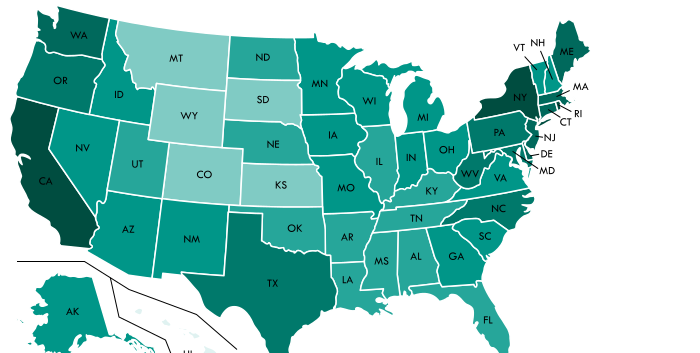
Most common states for directors of search engine optimization
| Rank | State | Population | # of jobs | Employment/ 1000ppl |
|---|---|---|---|---|
| 1 | District of Columbia | 693,972 | 179 | 26% |
| 2 | Iowa | 3,145,711 | 555 | 18% |
| 3 | Arkansas | 3,004,279 | 505 | 17% |
| 4 | Oklahoma | 3,930,864 | 460 | 12% |
| 5 | Massachusetts | 6,859,819 | 732 | 11% |
| 6 | Alabama | 4,874,747 | 518 | 11% |
| 7 | Louisiana | 4,684,333 | 510 | 11% |
| 8 | Mississippi | 2,984,100 | 311 | 10% |
| 9 | Rhode Island | 1,059,639 | 91 | 9% |
| 10 | Oregon | 4,142,776 | 327 | 8% |
| 11 | Vermont | 623,657 | 48 | 8% |
| 12 | New Jersey | 9,005,644 | 608 | 7% |
| 13 | Montana | 1,050,493 | 74 | 7% |
| 14 | California | 39,536,653 | 2,252 | 6% |
| 15 | New York | 19,849,399 | 1,157 | 6% |
| 16 | Illinois | 12,802,023 | 791 | 6% |
| 17 | Utah | 3,101,833 | 195 | 6% |
| 18 | Connecticut | 3,588,184 | 184 | 5% |
| 19 | New Hampshire | 1,342,795 | 71 | 5% |
| 20 | Delaware | 961,939 | 46 | 5% |
Most common cities for directors of search engine optimization
| Rank | City | # of jobs | Employment/ 1000ppl | Avg. salary |
|---|---|---|---|---|
| 1 | Framingham | 1 | 1% | $118,278 |
| 2 | Atlanta | 2 | 0% | $94,597 |
| 3 | Miami | 1 | 0% | $79,410 |
| 4 | New York | 1 | 0% | $128,209 |
| 5 | San Francisco | 1 | 0% | $130,372 |
Director Of Search Engine Optimization job outlook: Expert opinions
Our panel of director of search engine optimization experts
Tusculum University
Old Dominion University

James Madison University
What will help Directors Of Search Engine Optimization increase their earning potential?
Joshua Ray Ph.D.: For several years my conversations with employers concerning graduate preparation have centered around problem-solving skills and attitude. Employers desperately need employees how can identify, define, analyze, and solve business issues in real-time and who have the demeanor to work well with people inside and outside the organization. These skills also serve entrepreneurial minded individuals. More specific skills in technology, analytics, and leadership have been, and continue to be, highly sought after.
What will help Directors Of Search Engine Optimization increase their earning potential?
Jay Walker Ph.D.: I believe answer to number two is a good response to number three. There is an increasing importance in the ability to work with and understand data. Economics offers a framework to view the world, but through the lens of understanding data.
What will help Directors Of Search Engine Optimization increase their earning potential?
Richard Tate: Sales is transitioning from a "problem solving" focus to a "teaching" focus. Great sales professionals today are able to teach their clients something that the client didn't know about their product, service, competition, market, business environment, etc. Through technology and "ask Google," most professional buyers can research and gain 60-80% of the knowledge that they need to make a buying decision.
That leaves only a 20% to 40% space for a salesperson to have an impact, and that space must be filled with new ideas and new knowledge that will assist the buyer in making an informed decision. Much of business-to-business sales today is very technical and expensive. Wrong technology decisions carry far greater risk to a company today. The wrong application can quickly turn any competitive advantage over to a competitor and with today's "sticky" technologies, you may never get that customer back.
Being an expert in your field and having the boldness to challenge your buyer's thoughts and show them a different way, is how salespeople can best increase their earning potential.