Explore jobs
Find specific jobs
Explore careers
Explore professions
Best companies
Explore companies
Job outlook for ecommerce project managers in the United States
Are ecommerce project manager jobs in demand?
Ecommerce project manager job and salary trends over time
Ecommerce project manager jobs over time
Ecommerce project manager job growth rate over time
| Year | # of jobs | % of population |
|---|---|---|
| 2021 | 508 | 0.00% |
| 2020 | 493 | 0.00% |
| 2019 | 481 | 0.00% |
| 2018 | 439 | 0.00% |
| 2017 | 399 | 0.00% |
Average ecommerce project manager salary over time
Ecommerce project manager salary by year
| Year | Avg. salary | Hourly rate | % Change |
|---|---|---|---|
| 2025 | $107,946 | $51.90 | +3.9% |
| 2024 | $103,907 | $49.96 | +1.9% |
| 2023 | $101,963 | $49.02 | +1.6% |
| 2022 | $100,399 | $48.27 | +0.8% |
| 2021 | $99,602 | $47.89 | +1.9% |
Ecommerce project manager jobs by state
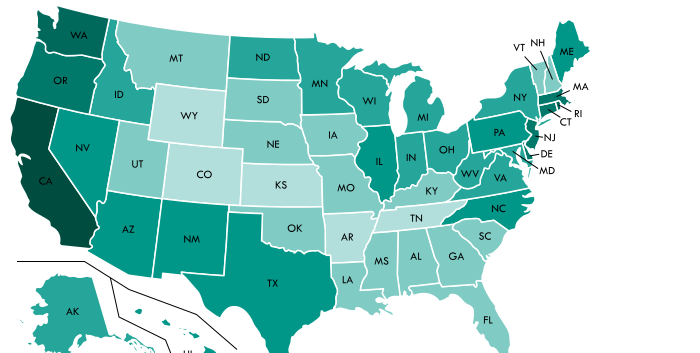
Most common states for ecommerce project managers
| Rank | State | Population | # of jobs | Employment/ 1000ppl |
|---|---|---|---|---|
| 1 | District of Columbia | 693,972 | 784 | 113% |
| 2 | Massachusetts | 6,859,819 | 2,554 | 37% |
| 3 | Washington | 7,405,743 | 2,487 | 34% |
| 4 | Vermont | 623,657 | 181 | 29% |
| 5 | Minnesota | 5,576,606 | 1,560 | 28% |
| 6 | Oregon | 4,142,776 | 1,142 | 28% |
| 7 | Virginia | 8,470,020 | 2,298 | 27% |
| 8 | New Hampshire | 1,342,795 | 360 | 27% |
| 9 | Utah | 3,101,833 | 768 | 25% |
| 10 | Maryland | 6,052,177 | 1,435 | 24% |
| 11 | Rhode Island | 1,059,639 | 252 | 24% |
| 12 | North Dakota | 755,393 | 179 | 24% |
| 13 | Delaware | 961,939 | 223 | 23% |
| 14 | California | 39,536,653 | 8,667 | 22% |
| 15 | New Jersey | 9,005,644 | 1,989 | 22% |
| 16 | Illinois | 12,802,023 | 2,628 | 21% |
| 17 | Nebraska | 1,920,076 | 411 | 21% |
| 18 | Montana | 1,050,493 | 218 | 21% |
| 19 | North Carolina | 10,273,419 | 2,023 | 20% |
| 20 | Wisconsin | 5,795,483 | 1,139 | 20% |
Most common cities for ecommerce project managers
| Rank | City | # of jobs | Employment/ 1000ppl | Avg. salary |
|---|---|---|---|---|
| 1 | Burbank | 1 | 1% | $127,493 |
| 2 | Newport Beach | 1 | 1% | $124,600 |
| 3 | Chicago | 1 | 0% | $103,742 |
Ecommerce Project Manager job outlook: Expert opinions
Our panel of ecommerce project manager experts
Ohio State University
Heidelberg University

Kansas State University

University of Kansas

Binghamton University
University of Colorado Colorado Springs
Indiana Wesleyan University

New York Institute of Technology

Colby-Sawyer College
Dr. Laura Deeter PhD
Professor of Practice: Horticulture and Crop ScienceOhio State University
Applied Horticulture And Horticultural Business Services
What general advice would you give to an Ecommerce Project Manager?
Dr. Laura Deeter PhD: Be open to learning and trying something outside of your comfort zone.
Be willing to work hard and don't expect to be project manager right out of school. Hard work will get you there fast enough.
Dr. Trish Berg
Associate Professor of Management, Heidelberg University, Tiffin, OhioHeidelberg University
Business Administration, Management And Operations
What Ecommerce Project Manager skills would you recommend for someone trying to advance their career?
Dr. Trish Berg: Daily, project managers create plans, create work schedules, build, and motivate teams, assign, and track work from start to finish, set project setting scopes and budgets, create workflow plans, and define what key performance indicators (KPIs) are which is how they can measure project success. Project managers must be both people focused, and task focused. Successful project managers understand what Sinek calls the power of the why in order to successfully motivate teams towards success.
What will help Ecommerce Project Managers increase their earning potential?
Dr. Trish Berg: One career field that is in high demand and growing is project management. With the complexity and flexibility needed in today's fast-paced culture, many organizations in diverse industries rely on project managers to complete jobs and organize teams to meet the needs of customers.
Daily, project managers create plans, create work schedules, build, and motivate teams, assign, and track work from start to finish, set project setting scopes and budgets, create workflow plans, and define what key performance indicators (KPIs) are which is how they can measure project success.
Project managers must be both people focused, and task focused. Successful project managers understand what Sinek calls the power of the why in order to successfully motivate teams towards success.
What will help Ecommerce Project Managers increase their earning potential?
Brett Horton Ph.D.: - Willingness to take on increased responsibility
- Willingness to move locations
- Willingness to work in different departments to learn and grow with the organization
What soft skills should all Ecommerce Project Managers possess?
Milena Stanislavova Ph.D.: Working and collaborating in groups, presenting to different audiences, writing technical reports, grant applications and researching new topics are all essential soft skills. Much of today's world relies on data, so collecting, summarizing, organizing and presenting data is also an important soft skill that is becoming quite fundamental.
Denise Lorenzetti
Director of Binghamton University's Fleishman Center for Career and Professional DevelopmentBinghamton University
Fleishman Center for Career and Professional Development
What are the biggest trends we'll see in the Ecommerce Project Manager job market given the pandemic?
Denise Lorenzetti: It is likely to see a continuation of remote job opportunities even after the pandemic is resolved. Many positions that have been successfully moved to remote options may in fact stay remote, depending on the employer.
The pandemic has increased the number of jobs available in specific industries and decreased the amount in others.
Industries and fields that have and will likely continue to grow include:
Supply chain/logistics and positions related to production, distribution, and selling of goods such as e-commerce
Technology and industries that help support businesses such as software, developers, artificial intelligence.
Healthcare
Biotechnology
The service industries were affected by the pandemic, making these positions harder to come by. This would include entertainment, travel, lodging, and full-service restaurants among others.
Mark Paquette
Principal Program CoordinatorUniversity of Colorado Colorado Springs
College of Business
What are the biggest trends we'll see in the Ecommerce Project Manager job market given the pandemic?
Mark Paquette: The pandemic has caused employers to assess their work capabilities and shift positions to virtual environments. As a result, I think the trends we will see are:
-An increase and shift to permanent or long-term work-from-home opportunities. Many companies are recognizing that the shift to working remotely may actually improve morale, efficiency, quality, and job satisfaction among staff. Additionally, companies are seeing financial savings with reduced need in utilities, ancillary, and auxiliary services. As a result, I believe employers will be looking at their structures and making decisions to increase remote work opportunities, which also allows the employers to access a broader talent pool outside of their regional areas.
-A demand in flexible work arrangements from employees and candidates. As companies see the benefits of remote work, so do the employees and those searching for work. Individuals are seeing benefits of commuting less, having greater flexibility with time, and the ability to have more independence. I would suspect we will see individuals asking for more flexible arrangements, including the option to work from home at least part of the time. Prior to COVID, candidates were already asking for options that allowed for, at least in part, some remote work arrangements, and with COVID, this will likely be magnified.
-Contract workers may experience more opportunities. As businesses grapple with the impacts of COVID, many are also seeing the need to have more control of time-sensitive changes that impact their business. When lockdowns and limitations are imposed on the number of people allowed in spaces, the need to have a workforce that can pivot quickly is becoming more essential. I think this will lead to more contract, or contingent, type work rather than full-time employment as it allows the employer greater flexibility.
-Expanded benefits may also be a trend, especially around mental health support services. The pandemic has forced many people to feel isolated, not in control, and questioning their value. To combat this, I anticipate employers will focus on promoting their health and wellness programs as benefits, and helping job seekers see the value in a company that has a well-rounded benefits package versus just a standard health plan or limited paid time off.
-Social distancing may be the norm for some time. As the vaccine rollout is underway, there are many months ahead of us for true results, and even then, questions linger on how many people may choose not to be vaccinated, or how many new strains there will be for which the vaccine may or may not work. This will impact business operations, and companies (and governments) may impose requirements for job seekers such as wearing personal protective equipment during the interview and onboarding process or as a standard operating practice throughout the year.
-Virtual interviewing is likely a big trend over 2021, whereby companies will focus on phone and video interviewing rather than in-person opportunities. Many individuals may onboard virtually as well. Virtual interviewing was on the rise prior to COVID, but the need was magnified. As a result candidates may also need to be adaptable to using various types of platforms and more products are coming to market, and existing products are enhancing their service options.
Are there any particularly good places in the United States for Ecommerce Project Managers to find work opportunities?
Joseph Snider: There are many opportunities in the South right now. With major tech companies moving to Texas, that is now going to be a hot spot.
Elisa Chan
Assistant Professor of MarketingNew York Institute of Technology
School of Management
Are there any particularly good places in the United States for Ecommerce Project Managers to find work opportunities?
Elisa Chan: Companies, big or small, will be looking for talents in e-commerce and digital marketing. But I think that there could be more demand from small/medium-sized companies looking for help in these areas.
What are the biggest trends we'll see in the Ecommerce Project Manager job market given the pandemic?
Elisa Chan: The market has seen exponential growth in e-commerce and digital marketing during the pandemic. This trend will continue as more companies continue to transition some, if not most, of their businesses and customer engagement online. I believe that we will see high demand for talents in performance (sales/lead-oriented) and brand (content/engagement-oriented) marketing, especially those who have a good understanding of both.
Jennifer Tockman
Director of Career Development and BOLD Women's Leadership NetworkColby-Sawyer College
What type of skills will young Ecommerce Project Managers need?
Jennifer Tockman: Flexibility, ability to adapt to whatever style work style, and the environment we are using given the world around us, working as a team (even if remote), can be a self-learner, especially in a private fashion. Excellent communication skills are also essential for success.