Explore jobs
Find specific jobs
Explore careers
Explore professions
Best companies
Explore companies
Job outlook for economic development coordinators in the United States
Are economic development coordinator jobs in demand?
Economic development coordinator job and salary trends over time
Economic development coordinator jobs over time
Economic development coordinator job growth rate over time
| Year | # of jobs | % of population |
|---|---|---|
| 2021 | 211 | 0.00% |
| 2020 | 200 | 0.00% |
| 2019 | 196 | 0.00% |
| 2018 | 183 | 0.00% |
| 2017 | 176 | 0.00% |
Average economic development coordinator salary over time
Economic development coordinator salary by year
| Year | Avg. salary | Hourly rate | % Change |
|---|---|---|---|
| 2025 | $61,044 | $29.35 | +2.4% |
| 2024 | $59,593 | $28.65 | +0.6% |
| 2023 | $59,262 | $28.49 | +0.8% |
| 2022 | $58,766 | $28.25 | +2.3% |
| 2021 | $57,461 | $27.63 | +1.4% |
Economic development coordinator jobs by state
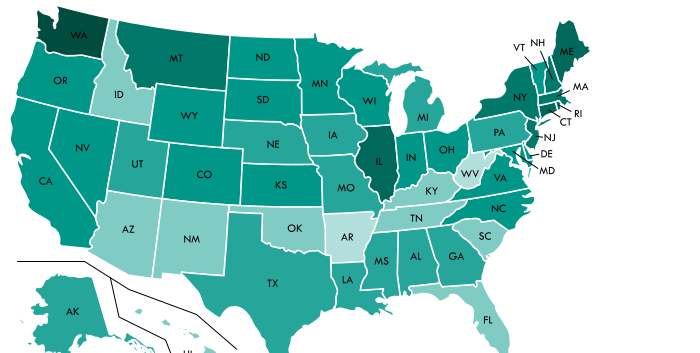
Most common states for economic development coordinators
| Rank | State | Population | # of jobs | Employment/ 1000ppl |
|---|---|---|---|---|
| 1 | North Dakota | 755,393 | 254 | 34% |
| 2 | Kansas | 2,913,123 | 812 | 28% |
| 3 | South Dakota | 869,666 | 242 | 28% |
| 4 | New Mexico | 2,088,070 | 571 | 27% |
| 5 | Arkansas | 3,004,279 | 729 | 24% |
| 6 | Wyoming | 579,315 | 122 | 21% |
| 7 | Montana | 1,050,493 | 206 | 20% |
| 8 | Minnesota | 5,576,606 | 1,024 | 18% |
| 9 | Alabama | 4,874,747 | 866 | 18% |
| 10 | Delaware | 961,939 | 170 | 18% |
| 11 | Alaska | 739,795 | 131 | 18% |
| 12 | Oklahoma | 3,930,864 | 653 | 17% |
| 13 | Nebraska | 1,920,076 | 289 | 15% |
| 14 | Idaho | 1,716,943 | 215 | 13% |
| 15 | Pennsylvania | 12,805,537 | 1,529 | 12% |
| 16 | Georgia | 10,429,379 | 1,299 | 12% |
| 17 | Arizona | 7,016,270 | 864 | 12% |
| 18 | Wisconsin | 5,795,483 | 674 | 12% |
| 19 | Indiana | 6,666,818 | 726 | 11% |
| 20 | District of Columbia | 693,972 | 74 | 11% |
Most common cities for economic development coordinators
| Rank | City | # of jobs | Employment/ 1000ppl | Avg. salary |
|---|---|---|---|---|
| 1 | Seattle | 1 | 0% | $94,154 |
Economic Development Coordinator job outlook: Expert opinions
Our panel of economic development coordinator experts

University of Nebraska - Omaha
Ohio University
Clemson University
The University of Tennessee - Knoxville
West Virginia State University

University of Houston-Downtown

American University

The University of Texas at Arlington

Baker University
University of Redlands
University of Nevada - Las Vegas
What general advice would you give to an Economic Development Coordinator?
Chad Miller Ph.D.: The study of economics and the practice of economic development are different. Economic developers need to understand how a local economy operates and basic macro/micro economics, but business and finance are more important skills than understanding economics. Economic developers typically work for local or state government organizations, chambers of commerce, or regional public-private partnerships marketing to attract business investment, retain and expand existing industry, or conduct small and entrepreneurial development programs in order create quality jobs, wealth, increase the tax base, and improve quality of life of a community. Economic developers need to be a 'jack of all trades' as they need to understand marketing, real estate development, public financing, business decision making, politics, as well as, other academic areas. Since so much different expertise is required, the ability to network is essential in order to utilize specific expertise needed to make the business investment happen.
What Economic Development Coordinator skills would you recommend for someone trying to advance their career?
Chad Miller Ph.D.: For those entering the field having GIS mapping skills and graphic design/data visualization skills are great assets to get your foot in the door. Typically, salaries and opportunities increase dramatically with 2-3 years of economic development experience.
What will help Economic Development Coordinators increase their earning potential?
Chad Miller Ph.D.: The practice of economic development is becoming more data-driven so understanding labor market and other data platforms (e.g., JobsEQ, EMSI/Lightcast, IMPLAN, ESRI Community Analyst, Placer.AI, etc.) is becoming more important.
What are the biggest trends we'll see in the Economic Development Coordinator job market given the pandemic?
Dr. Dustin White Ph.D.: I think that the biggest trend that we should expect to see in the job market (both during the pandemic and after) is an acknowledgement that remote work can be effective in many kinds of jobs. This should lead to increased flexibility in location for job seekers. Previously, most companies were very reluctant to hire remote workers. The pandemic should have changed that opinion for many firms. If companies are reluctant to accept remote work and can't give a good reason why, they are likely to lose a competitive edge to more flexible workplaces.
Brian Collins Ph.D.
Associate Professor, Chair & Drs. Ram and Sushila Gawande Chair in Indian Religion and PhilosophyOhio University
College of Arts and Sciences
What skills stand out on Economic Development Coordinator resumes?
Brian Collins Ph.D.: Intercultural competency, critical thinking, and oral and written communications are the skills that will most stand out on the resumes of graduates of religious studies programs.
What soft skills should all Economic Development Coordinators possess?
Brian Collins Ph.D.: Intercultural competency and critical thinking are absolutely essential to dealing with our increasingly diverse and fragmented society.
What hard/technical skills are most important for Economic Development Coordinators?
Brian Collins Ph.D.: Communicating your ideas clearly and concisely is a vital skill that we try to develop in religious studies programs.
What skills will help Economic Development Coordinators earn the most?
Brian Collins Ph.D.: The ability to deal with change, the only constant in life, is the product of a humanities education and is also what puts people in the running for promotion within an organization or allows them to get hired into new and often largely undefined positions that require someone who can navigate the shifting sands.
What are the biggest trends we'll see in the Economic Development Coordinator job market given the pandemic?
Curtis Simon: I think it is hard to gauge the impact of the pandemic. We know that downturns in economic activity have a negative impact on cohorts entering the labor market, and historically, that negative impact persists in the form of depressed earnings for many years. So that's a guess.
What experience really stands out on Economic Development Coordinator resumes?
Dr. Marianne Wanamaker Ph.D.: Any hands-on experience is a huge advantage in today's labor market. I always encourage my students to take as many project-based courses as they can. It gives you something tangible to talk about in an internship or job interview. Writing experience is also really helpful.
Dr. Mark Wilson
Associate Professor of EconomicsWest Virginia State University
Economics Department
What skills stand out on Economic Development Coordinator resumes?
Dr. Mark Wilson: Job skills that stand out: two skills that every job seeker should now cultivate are: proficiency with spreadsheets and proficiency with online conferencing (e.g., Zoom, Skype). Most graduates have low skills in spreadsheets and will be trying to learn these skills on-the-fly. Proficient spreadsheet users are able to take their skills to the next level. As for teleconferencing, we are just scratching the surface of what COVID has taught us about online meetings. Newbies in the job market should be skilled enough in teleconferencing that they can share screens, do hosting, and know etiquette of conference calling.
What type of skills will young Economic Development Coordinators need?
Rob Austin McKee Ph.D.: Some of the most significant workplace issues are the uncertainty regarding when the pandemic will end, and the degree to which our shift away from the traditional workplace model (i.e., in-person versus remote work) is permanent. This predicament is similar to the idea of punctuated equilibrium; we are enduring a great upheaval, but we will achieve a new status quo at some point. To the extent that employers shift to a more remote workforce, graduates will need to learn how to be productive in their home environments while maintaining a clear division between work and other aspects of their lives.
In other words, it will be necessary for them to defend proper work-life balance. Doing so may be challenging because remote workers will likely have to contend with increasingly popular employer-required productivity and performance tracking software that may incentivize them to work more or focus on employer-prescribed metrics that are imperfectly aligned with their work tasks. So, workers need to master the autonomy resulting from such physical separation from their managers while simultaneously learning how to navigate the productivity and surveillance systems that intend to substitute those aspects of traditional management.
What experience really stands out on Economic Development Coordinator resumes?
Rob Austin McKee Ph.D.: We have established that internships are scarce, and the job market is dismal. In this environment, applicants must demonstrate that they were not complacent while they were unemployed or underemployed. They can rise above the applicant pool and impress potential employers by showing that they used any time spent unemployed or underemployed building or refining the knowledge, skills, and abilities of value to prospective hiring firms.
Beyond the resume, applicants should master the virtual interview process and realize that some underappreciated factors may influence their success. Good lighting, a clean and quiet environment, and a stable internet connection are all important. Any student taking virtual classes knows how easy it is to lose focus or become distracted by their phones, pets, family members, etc. Realize that any person(s) remotely interviewing them may have the same distractions present, especially if they are conducting the interview from home. So, interviewees must be able to provide an engaging interview. So, practice!
Are there any particularly good places in the United States for Economic Development Coordinators to find work opportunities?
Evan Kraft Ph.D.: If so, I would say that the US Government definitely will need young people. This includes the Treasury Department, Commerce, Agriculture, and even State. The Federal Reserve and its twelve Federal Reserve Banks are excellent employers, offering Research Assistant positions for econ grads. State and local governments also hire plenty of economists.
In the private sector, financial institutions such as banks, insurance companies and investment companies need young people who understand the basics of how the economy works and the financial system. Many of my students have gotten jobs in this sector.
What are the biggest trends we'll see in the Economic Development Coordinator job market given the pandemic?
Evan Kraft Ph.D.: In the next few months, I am afraid that we will not see a lot of good economic news. If anything, we can expect more restrictions on people's movements and on business activities that require people to be in close proximity to each other. We probably will not see a lot of good news until the later spring/early summer, when larger numbers of people will have received the vaccines, and better weather allows for more outdoor activity.
Overall, unemployment insurance claims rose last week to 853,000, the highest level since October. To give you an idea of how big that is, in a good economy 200 to 250,000 would be a normal number. And this number represents an increase from recent numbers.
However, there are some companies expanding at the moment. AU grads may be well-equipped to cope with jobs that involve working remotely, using analytical and computer skills. Those parts of the economy that can operate online are chugging on, in some cases growing, while those parts of the economy that operate in-person are having difficulties.
What skills stand out on Economic Development Coordinator resumes?
Evan Kraft Ph.D.: In general, employers are usually looking for people who can take initiative and responsibility. Specific skills such as computer programming, knowledge of useful software are great, but a job candidate's ability to express themselves, their confidence and ability to communicate, and their interpersonal skills are still very important. The AU degree and specific knowledge students gathered at AU can be a big plus, along with these other qualities.
What skills stand out on Economic Development Coordinator resumes?
Michael Ward: Doing well in coursework is great, but what sells a job candidate is the initiative in an activity that shows that you have synthesized and applied what you have learned across multiple courses. This is a big ask but, there are plenty of ways to do this. You can join an extra-curricular club, but better is providing the leadership to enhance the club experience. You can take a part-time job, but better is founding a small entrepreneurial business that fills an unmet need. You can write term papers for classes, but better is helping draft and implement action plans for, say, a non-profit. If you have an interest in a hobby, a sport, or an industry, show that you have developed it into an expertise. All resumes include coursework, but activities that demonstrate initiative will stand out.
Narbeli Galindo
Mealman Chair in Business Leadership and Innovation/ Associate Professor of Business and EconomicsBaker University
Business and Economics
Will there be an increase or decrease in demand for Economic Development Coordinators in the next 5 years?
Narbeli Galindo: It is my prediction that in the next few years some of the companies, in the industries I have mentioned above, will have high demand for graduates, who are creative, eager to learn and ready to be train, so they can start to make a difference. As the economy improves and the virus is under control, more companies in industries that were affected, will start looking to hire graduates, who have innovative ideas, so they can help those companies overcome the recent economic downturn.
Johannes Moenius Ph.D.
William R. and S. Sue Johnson Endowed Chair of Spatial Economic Analysis and Regional Planning and Director of the Institute for Spatial Economic Analysis (ISEA) at the University of Redlands School of BusinessUniversity of Redlands
School of Business
What type of skills will young Economic Development Coordinators need?
Johannes Moenius Ph.D.: Everyone talks about STEM, soft skills, high levels of expertise, and management. Our own analysis shows that this is likely not going to be correct across the board. Street math (i.e., addition, subtracting, etc.) is already done by calculators everywhere. Not all jobs require higher levels of math. Our research has especially shown that there is substantial regional variation in skill requirements, so there is no one size fits all. However, there are some sets of skills that ranked first in our research almost across the board, specifically, fundamental skills like reading comprehension and writing. Combined with communication skills and entrepreneurial attitudes, these are workforce skills and traits that will be almost universal.
What are the biggest trends we'll see in the Economic Development Coordinator job market given the pandemic?
C. Jeffrey Waddoups Ph.D.:
The absolute collapse in demand for workers in the hospitality sector, in other sectors where in-person services are provided, and the accompanying economic hardships these workers face.
Also, the change to remote work will permanently alter the way many of us do our jobs.
What skills stand out on Economic Development Coordinator resumes?
C. Jeffrey Waddoups Ph.D.: Workers must be able to communicate clearly and professionally, and in an era of remote work, this suggests that writing skills are particularly important. Economics graduates are often expected to be good with data and numbers. The pandemic has not changed this.
Are there any particularly good places in the United States for Economic Development Coordinators to find work opportunities?
C. Jeffrey Waddoups Ph.D.: The demand for graduates in economics will remain as long as employers need intelligent analytical workers with good communication skills. There is no place in particular where such skills are needed more than any other site.