Explore jobs
Find specific jobs
Explore careers
Explore professions
Best companies
Explore companies
Job outlook for editorial interns in the United States
Editorial internship job growth summary. After extensive research, interviews, and analysis, Zippia's data science team found that:
The projected editorial internship job growth rate is -5% from 2018-2028.
About -5,500 new jobs for editorial interns are projected over the next decade.
Editorial internship salaries have increased 11% for editorial interns in the last 5 years.
There are over 14,100 editorial interns currently employed in the United States.
There are 51,667 active editorial internship job openings in the US.
The average editorial internship salary is $32,356.
Are editorial internship jobs in demand?
Editorial internship job and salary trends over time
Editorial internship jobs over time
Editorial internship job growth rate over time
| Year | # of jobs | % of population |
|---|---|---|
| 2021 | 14,100 | 0.00% |
| 2020 | 14,521 | 0.00% |
| 2019 | 15,525 | 0.00% |
| 2018 | 16,068 | 0.00% |
| 2017 | 16,540 | 0.01% |
Average editorial internship salary over time
Editorial internship salary by year
| Year | Avg. salary | Hourly rate | % Change |
|---|---|---|---|
| 2026 | $32,356 | $15.56 | +3.3% |
| 2025 | $31,320 | $15.06 | +3.2% |
| 2024 | $30,355 | $14.59 | +1.2% |
| 2023 | $29,993 | $14.42 | +2.7% |
| 2022 | $29,197 | $14.04 | +2.1% |
Editorial internship jobs by state
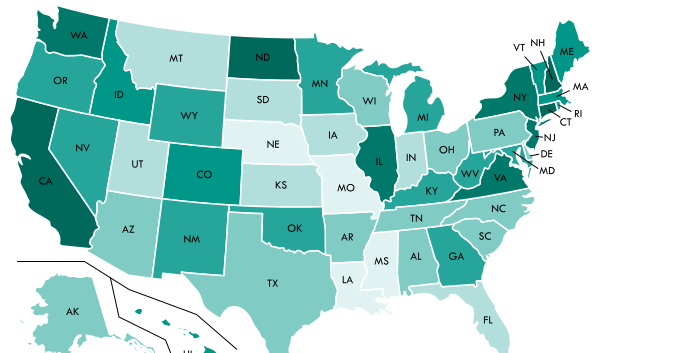
Most common states for editorial interns
| Rank | State | Population | # of jobs | Employment/ 1000ppl |
|---|---|---|---|---|
| 1 | District of Columbia | 693,972 | 51 | 7% |
| 2 | New York | 19,849,399 | 356 | 2% |
| 3 | Vermont | 623,657 | 12 | 2% |
| 4 | Wyoming | 579,315 | 9 | 2% |
| 5 | California | 39,536,653 | 232 | 1% |
| 6 | Virginia | 8,470,020 | 85 | 1% |
| 7 | Massachusetts | 6,859,819 | 71 | 1% |
| 8 | Illinois | 12,802,023 | 66 | 1% |
| 9 | New Jersey | 9,005,644 | 57 | 1% |
| 10 | Oregon | 4,142,776 | 53 | 1% |
| 11 | Washington | 7,405,743 | 40 | 1% |
| 12 | Connecticut | 3,588,184 | 30 | 1% |
| 13 | Arkansas | 3,004,279 | 20 | 1% |
| 14 | Idaho | 1,716,943 | 18 | 1% |
| 15 | New Hampshire | 1,342,795 | 16 | 1% |
| 16 | New Mexico | 2,088,070 | 14 | 1% |
| 17 | Hawaii | 1,427,538 | 11 | 1% |
| 18 | Rhode Island | 1,059,639 | 11 | 1% |
| 19 | Maine | 1,335,907 | 9 | 1% |
| 20 | North Dakota | 755,393 | 7 | 1% |
Most common cities for editorial interns
| Rank | City | # of jobs | Employment/ 1000ppl | Avg. salary |
|---|---|---|---|---|
| 1 | Tallahassee | 1 | 1% | $24,125 |
| 2 | Atlanta | 2 | 0% | $29,599 |
| 3 | Chicago | 2 | 0% | $36,587 |
| 4 | Sacramento | 2 | 0% | $42,283 |
Editorial Internship job outlook: Expert opinions
Our panel of editorial internship experts
University of Baltimore
Ohio Wesleyan University
Furman University

California State University, Fresno

Kansas State University
The University of Kentucky
American Society of Magazine Editors

California University of Pennsylvania
University of Minnesota
What Editorial Internship skills would you recommend for someone trying to advance their career?
Gabriel Aguilar PhD: In my field, generative AI will become the most important research area. Scholars and students are both excited and concerned about the possibilities of AI, and there is much research to do. I would recommend two recent special issues on generative AI from the journals Computers & Composition and the Journal of Business and Technical Communication (JBTC). The research there is great.
What will help Editorial Interns increase their earning potential?
Betsy Boyd: Read what you want to write; stay engaged with the marketplace in which you want to work and make change. Make connections with new mentors by emailing writers and editors (and other professionals) you admire. Not everyone will respond, but some will respond. It's natural to want to help the next generation! Continue to ask for feedback on your own writing from peers and mentors. Stay in touch with your professors. Seek out jobs that interest you; persevere (rejections happen). Work on your craft always. Take pride in it. Set manageable goals. Check in with your goals every week or month. Create a routine. Aim to write most days. Form a peer group for regular feedback/idea sharing.
What general advice would you give to an Editorial Internship?
Anna Mae Duane: The idea that English majors are not in demand is a myth—don’t harm your own chances by buying into it! There are numerous studies—and countless employer testimonies—that indicate how valuable your skills as an English major are. English majors consistently find work in a variety of fields, and perhaps even more important, alumni of English departments report that they find their jobs and lives rewarding. According to the National Association of Colleges and Employers, 'what sets two equally qualified job candidates apart can be as simple as who has the better communication skills.' You are, in many ways, ahead of the game in comparison to others in your cohort. I’d also urge English majors to think broadly about their career options. Yes, fields like journalism, publishing and advertising all rely on the skills developed in English departments. But other employers, particularly in tech companies, have realized how valuable English majors can be to their organization. As a recent report in Fortune indicates, top executives in AI at IBM and elsewhere realize that having expertise in the Humanities is an essential component for success in their field.
What general advice would you give to an Editorial Internship?
Sarah Graves Ph.D.: Many wrongly assume that a degree in English is a dead end. But that's only because the career potential isn't as immediately obvious as something like, say, a degree in computer science or accounting. The truth is that English majors can do almost anything. Of course, they can become teachers or enter writing-related fields, such as journalism, editing, or publishing. But tons of CEOs are English majors, as are those in business-related fields, such as marketing, brand strategy, and social media management. Even most tech companies hire English majors. That's because computer science majors might be experts in coding, but English majors excel at humanizing the end product, like making chatbots sound more human. In fact, the areas where English majors excel are those most in-demand by employers: communication, creativity, critical thinking, and empathy.
Professor Margaret Oakes
Professor of EnglishFurman University
English Language And Literature
What Editorial Internship skills would you recommend for someone trying to advance their career?
Professor Margaret Oakes: The ability to read carefully and analytically. This is a skill that has declined in the past couple of decades as people obtain more information visually - but a visual presentation cannot carry the amount of detail that written language can, and carelessness in the use of language causes a world of problems in every area of human life (law, medicine, politics, etc.).
What general advice would you give to an Editorial Internship?
Catherine Wilbur: The best way to maximize salary earnings is to complete the highest level of education in your chosen field. The average salary for someone with a bachelor's degree in English is around $59,124 per year, while someone with a master's degree in English can expect to earn around $69,732 per year.
What Editorial Internship skills would you recommend for someone trying to advance their career?
Catherine Wilbur: Even with the advancement of AI, among the most essential competencies are the ability to think critically and solve problems, to effectively both orally and in writing, to assess and analyze information, and to exercise curiosity and imagination. One recent study showed that college graduates spend, on average, 44% of their time writing, including letters, memos, short reports, instructional materials, and professional articles and essays. Additionally, even as people use generative AI to draft documents, they still need to be edited and proofread by a person to ensure that they are accurate and contain no biased information.
Betsy Hays
ChairCalifornia State University, Fresno
Department of Media, Communications and Journalism
What general advice would you give to an Editorial Internship?
Betsy Hays: Do informational interviews to build your network. Ask folks about their career path, the scope of their jobs, their biggest successes, advice they have for someone just starting out, etc. And then ask if they have ideas for other people that would be good to talk to. And then keep going! Also, be obsessed with thank you notes.
What are the biggest trends we'll see in the Editorial Internship job market given the pandemic?
Betsy Hays: Having the ability to successfully work remotely will be more important than ever, as will being able to effectively communicate in virtual spaces. And, post-pandemic, being able to do things in a hybrid fashion - part in person and part online - will also make job candidates much more marketable.
What Editorial Internship skills would you recommend for someone trying to advance their career?
Betsy Hays: Study the successes and failures of others so you can learn best practices based on real life. And practice being a content creator. Write, take photos, create graphics, produce videos - practice sharing information and telling stories in a myriad of ways. And when you have some good stuff, share it publicly (blog, YouTube channel, social media, podcast, etc.) to learn what people respond to. And monitor trends. There are also a number of free or low-cost certifications that you can obtain as well. And one more - volunteer for a cause you believe in to make the world a better place while learning new skills.
Will there be an enduring impact of the coronavirus pandemic on Editorial Interns?
Naomi Wood Ph.D.: Yes. There can't help but be one - just as there was an impact on graduates during the 2008 financial crisis. Graduates will be forced to improvise, be entrepreneurial, and be creative.
What I will add about English and other humanities majors is that they are particularly well-suited to deal with this level of chaos and uncertainty because they have always known they're going to have to explore and grow. There is no one path to follow - and our graduates vindicate our confidence that they can find their way!
What type of skills will young Editorial Interns need?
Naomi Wood Ph.D.: Communication skills, both oral and written; ability to work in a team; leadership experience; ability to problem-solve and invent. A growth mindset and readiness to keep learning.
What experience really stands out on Editorial Internship resumes?
Naomi Wood Ph.D.: Research shows that studying abroad, doing internships, participating in and leading student groups, and other forms of community engagement can make a big difference in whether your resume stands out. But it also helps if you can tell compelling stories about those experiences - what they have allowed you to learn about yourself, your place in the world, and what you have to contribute.
Jeff Rice Ph.D.
Professor, ChairThe University of Kentucky
Department of Writing, Rhetoric, and Digital Studies
What are the biggest trends we'll see in the Editorial Internship job market given the pandemic?
Jeff Rice Ph.D.: If there is one thing people are doing in the pandemic, it is reading. They are reading, of course, writing: COVID and health news, critiques of the administration's handling of COVID, predictions for the future (life after COVID), and more. There is no shortage of analysis, updates, news, and so on. During a pandemic, people want information. This is the same for the recent election or any event,moment, or issue that attracts considerable attention.
In addition, people are reading long-form essays about sports, about global events, about current events. People are home and on their computers, and they are reading all day long. Content providers need people to create the content, do the research, edit the copy, engage in design, and handle the social media accounts. This is a time for companies and organizations to be hiring more writers.
What skills stand out on Editorial Internship resumes?
Jeff Rice Ph.D.: Research skills. Written and digital communication skills. Knowledge of digital tools - whether Adobe products, podcasting software, and such - but also how to use the tools to reach audiences, create sticky content, develop brands, send information, persuade, and inform. It's one thing to know how to create a movie or poster or infographic or report or Instagram post; it's another thing to have the rhetorical and writing skills to properly use that tool to create information for a specific audience.
What general advice would you give to an Editorial Internship?
Sidney Holt: The biggest challenge facing editorial hopefuls is uncertainty. Magazines and websites were already experiencing unprecedented challenges as the consumption of media changed and publishers shifted from advertising-supported to reader-supported business models. The pandemic only accelerated those trends. For new graduates, that means fewer opportunities to work for established brands (and where those opportunities do exist, it means working remotely, at least for the foreseeable future, which in turn means fewer opportunities to enjoy the kind of one-on-one training that furthered the careers of previous generations of writers and editors).
That's the downside. The upside is that the skills and energy young journalists can bring to a media organization are especially valuable during a period of extraordinary change. But you have to be prepared to be resilient. Not only is "the gold watch after 50 years" gone; you have expect you won't be in any job very long, at least in the early years of your career.
What type of skills will young Editorial Interns need?
Dr. Christina Fisanick: College graduates in 2021 and beyond, need all of the skills that English programs have to offer: critical thinking, effective communication, creativity, and flexibility. New hires need to be able to adapt to workplace changes quickly and with aplomb, which requires critical thinking and problem solving and the ability to communicate those solutions to a diverse audience clearly and effectively. Those skills are refined and practiced regularly in English programs.
What general advice would you give to an Editorial Internship?
Thomas Reynolds: I think there will be a lasting impact of this pandemic on graduates. The nature of the field is that others in the industry (scientists, engineers, for ex.) often take on tech writing and communication tasks in tight economic conditions, or even just as a matter of a particular culture in a particular business. However, the field of technical communication has been predicted to have a strong future (see Bureau of Labor Statistics, which predicts growth in jobs in this field).
Technical writing and communication require that students are comfortable with technology and communication and that they adapt to changing situations. I think there are also opportunities for savvy graduates who can offer certain skills and experiences that are unique to the changing situation. This field has a long history of resilience for its graduates seeking jobs in tough circumstances.