Explore jobs
Find specific jobs
Explore careers
Explore professions
Best companies
Explore companies
Job outlook for educational associates in the United States
Educational associate job growth summary. After extensive research, interviews, and analysis, Zippia's data science team found that:
The projected educational associate job growth rate is 4% from 2018-2028.
About 55,400 new jobs for educational associates are projected over the next decade.
Educational associate salaries have increased 14% for educational associates in the last 5 years.
There are over 26,651 educational associates currently employed in the United States.
There are 44,953 active educational associate job openings in the US.
The average educational associate salary is $42,278.
Are educational associate jobs in demand?
Educational associate job and salary trends over time
Educational associate jobs over time
Educational associate job growth rate over time
| Year | # of jobs | % of population |
|---|---|---|
| 2021 | 26,651 | 0.01% |
| 2020 | 28,750 | 0.01% |
| 2019 | 30,233 | 0.01% |
| 2018 | 27,120 | 0.01% |
| 2017 | 26,473 | 0.01% |
Average educational associate salary over time
Educational associate salary by year
| Year | Avg. salary | Hourly rate | % Change |
|---|---|---|---|
| 2026 | $42,278 | $20.33 | +3.5% |
| 2025 | $40,831 | $19.63 | +3.4% |
| 2024 | $39,480 | $18.98 | +2.7% |
| 2023 | $38,440 | $18.48 | +3.3% |
| 2022 | $37,196 | $17.88 | +2.0% |
Educational associate jobs by state
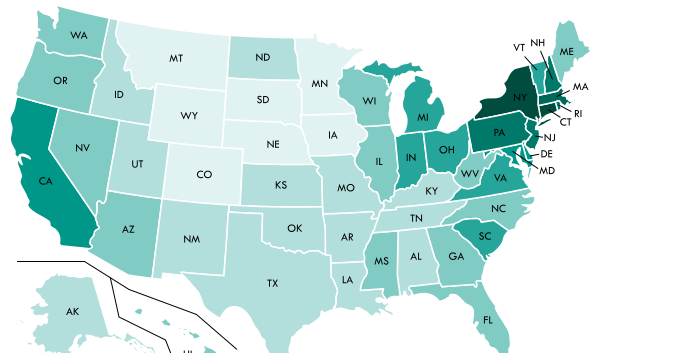
Most common states for educational associates
| Rank | State | Population | # of jobs | Employment/ 1000ppl |
|---|---|---|---|---|
| 1 | Maine | 1,335,907 | 30 | 2% |
| 2 | District of Columbia | 693,972 | 12 | 2% |
| 3 | California | 39,536,653 | 230 | 1% |
| 4 | Texas | 28,304,596 | 155 | 1% |
| 5 | Illinois | 12,802,023 | 84 | 1% |
| 6 | Pennsylvania | 12,805,537 | 71 | 1% |
| 7 | New Jersey | 9,005,644 | 70 | 1% |
| 8 | Virginia | 8,470,020 | 53 | 1% |
| 9 | Georgia | 10,429,379 | 53 | 1% |
| 10 | Michigan | 9,962,311 | 50 | 1% |
| 11 | Massachusetts | 6,859,819 | 46 | 1% |
| 12 | Maryland | 6,052,177 | 44 | 1% |
| 13 | Arizona | 7,016,270 | 44 | 1% |
| 14 | South Carolina | 5,024,369 | 39 | 1% |
| 15 | Louisiana | 4,684,333 | 38 | 1% |
| 16 | Oregon | 4,142,776 | 27 | 1% |
| 17 | Connecticut | 3,588,184 | 23 | 1% |
| 18 | New Hampshire | 1,342,795 | 10 | 1% |
| 19 | Alaska | 739,795 | 9 | 1% |
| 20 | North Dakota | 755,393 | 6 | 1% |
Most common cities for educational associates
| Rank | City | # of jobs | Employment/ 1000ppl | Avg. salary |
|---|---|---|---|---|
| 1 | Pflugerville | 2 | 3% | $35,143 |
| 2 | Hallandale Beach | 1 | 3% | $38,350 |
| 3 | Troy | 2 | 2% | $45,714 |
| 4 | Orlando | 4 | 1% | $38,775 |
| 5 | Carlsbad | 1 | 1% | $44,578 |
| 6 | Fort Lauderdale | 1 | 1% | $38,415 |
| 7 | Miami Gardens | 1 | 1% | $38,335 |
| 8 | Boston | 2 | 0% | $53,558 |
| 9 | Chicago | 2 | 0% | $39,166 |
| 10 | Miami | 2 | 0% | $38,271 |
| 11 | New York | 2 | 0% | $61,007 |
| 12 | Austin | 1 | 0% | $35,192 |
| 13 | Denver | 1 | 0% | $32,616 |
| 14 | Jacksonville | 1 | 0% | $38,127 |
| 15 | Los Angeles | 1 | 0% | $45,610 |
Educational Associate job outlook: Expert opinions
Our panel of educational associate experts
Towson University
Longwood University

Saint Xavier University

Bethel University

Springfield College
Berry College

Missouri State University

Boston College

Nicholls State University
Chatham University
What will help Educational Associates increase their earning potential?
David Wizer: In nonprofit, public education field there’s not a great deal of negotiating opportunities. For students in the instructional design field there are ways to feature projects completed, skills they have, and a strong resume that highlights professional skills and experiences.
Meg Gardner Ph.D.
Senior Lecturer and Director of Teacher PreparationWhat will help Educational Associates increase their earning potential?
Meg Gardner Ph.D.: First and foremost, make sure that the district where you plan to teach is a right fit for you. Gather a sense of the culture of the school by asking interview committee members about their own experiences at the district. Prior to accepting a position, conduct some research on the district; for instance, investigate the mission statement and the curricular opportunities available. Be ready with questions for committee members that help you understand the ethos of the school and look for compatibility among your own beliefs about teaching and learning. Once in the classroom, take advantage of early mentoring programs and seek out advice for respected colleagues more informally. Stay up to date with innovative practices through social media outlets and teacher training opportunities offered through your district. Lastly, make time in your busy schedule for activities that you find fulfilling to maintain a healthy and balanced outlook.
Dr. Audrey Church Ph.D.
Chair, Department of Education and Counseling; Professor of School LibrarianshipLongwood University
Education
What will help Educational Associates increase their earning potential?
Dr. Audrey Church Ph.D.: For those entering their first teaching position, I would give the following advice:
--Be sure that you are familiar with the policies of your school and school district. You want to be well-informed and knowledgeable so that you know what is expected of you as a teaching professional.
--Start immediately to build relationships with others on your team-your grade level team, your department team, etc.
--Become active in the professional association of your field, starting perhaps at the state level, for example, with the state affiliate of the National Council of Teachers of English or the Council for Exceptional Children or the American Association of School Librarians.
Laura Laskowski-Ferrell
Assistant Professorial Lecturer and Program CoordinatorSaint Xavier University
Education Department
What experience really stands out on Educational Associate resumes?
Laura Laskowski-Ferrell: Any experience that job seekers have to pertain to the management of children is key. Examples include camp counseling, tutoring, etc. For new teachers, coursework designed around topics such as assessment and classroom management is important. Any extra-curricular is good to list well, as this could lead to the management of a club or activity depending on the school's need. For experienced practitioners, speak to the classroom experience and tell the story of your career. What grade levels have you taught? What professional development opportunities stand out? Oftentimes, educational administrators are looking for a specific set of qualifications, include any endorsements or certifications you hold for the state in which you plan to practice.
Jessica Tangen Daniels Ph.D.
Associate Provost - Innovation and Partnerships, Program Director/Professor, Ed.D. Leadership in Higher EducationBethel University
Education Leadership
What skills will help Educational Associates earn the most?
Jessica Tangen Daniels Ph.D.: For educational leaders, I'm not convinced discrete skills equate to salary. Working hard and working well with others, with a disposition of humility and curiosity, is really powerful. Perhaps the combination of soft and hard skills gained through diverse experiences, positions, and institutional contexts results in the highest earning potential.
Dr. Linda Davis-Delano
Director, Educator Preparation & Licensure, Professor, Physical EducationSpringfield College
Educator Preparation
What are the biggest trends we'll see in the Educational Associate job market given the pandemic?
Dr. Linda Davis-Delano: Many more job openings as teachers retire early.
What skills stand out on Educational Associate resumes?
Dr. Linda Davis-Delano: Ability to teach remotely and use a variety of pedagogical techniques including the use of a variety of technological platforms (e.g., YouTube, Zoom, Microsoft Teams, Nearpod, Kahoot, Brainpop, TedEd).
Are there any particularly good places in the United States for Educational Associates to find work opportunities?
Dr. Linda Davis-Delano: Graduates will be successful securing teaching positions all across the country.
What are the biggest trends we'll see in the Educational Associate job market given the pandemic?
Dr. Frances Roe: One of the biggest current trends in education is that the pandemic has prompted many teachers to retire or to leave the teaching profession. This exodus from the profession means that there will be more jobs available for our graduates. Locally, administrators from different districts have asked me if the Teacher Education Department knows of any recent graduates who do not have teaching jobs. They are ready to hire our recent graduates right now! The certification area did not matter. They need certified teachers now!
A trend is one that continues from pre-pandemic days. That trend is the need for math and science teachers for middle and high schools. Foreign language and special education teachers are also remain in demand.
What skills stand out on Educational Associate resumes?
Dr. Frances Roe: In my opinion, student teachers must include language at the top of their resume that aligns with the language listed in the advertisement for the teaching position. The HR Department of most school districts receive the resumes first. The personnel in HR sorts the resumes according to their needs, so graduates should state near the top of their resumes skills that align with the school district's needs. Also, they should highlight that they have had experience teaching virtually. All of our graduates have had some experience in this area. Virtual teaching is likely a trend that will be with us for a while.
Are there any particularly good places in the United States for Educational Associates to find work opportunities?
Dr. Frances Roe: Urban and large suburban areas are typically excellent places to our graduates to find teaching jobs. Large districts such as Hamilton County in Chattanooga, Cobb, and Gwinnet Counties in Georgia, as well as our local school districts are regulars at our Teacher Recruitment Fairs. The districts are holding their own district teacher recruitment fairs earlier and earlier in hopes of hiring our graduates. It is not usual for districts of various sizes to either email or call me asking for help finding certified teachers in the areas I identified earlier.
What are the biggest trends we'll see in the Educational Associate job market given the pandemic?
Dr. Ximena Uribe-Zarain: Even though the pandemic has had an enormous impact on the social, economic, and emotional fabric of our society, jobs in our field have not been greatly affected by it. Graduates from the field of educational assessment, program evaluation, and research in education will find plenty of opportunities even in harsh times like these. The trends in the job market continue to be in industry in the area of psychometrics, program evaluation firms, and higher education.
What the pandemic has changed is the way we conduct business. The pandemic has made more evident and even widened systemic inequalities. As researchers, we need to pay close attention to our own cultural responsiveness and be mindful of the disparities in terms of health, racial justice, and technological access. We need to be intentional in our designs, analyses, and the dissemination of results; ultimately thinking on the way our work contributes to a more inclusive and equitable society.
What skills stand out on Educational Associate resumes?
Dr. Ximena Uribe-Zarain: Graduates of programs in the realm of educational assessment, program evaluation, and research in education tend to excel at critically evaluating social issues, and at using sophisticated methodologies to solve such issues. They are prepared to understand psychometric theory and to implement program evaluation. All of these are good skills to highlight. However, we cannot forget that graduates are more often than not avid users of technologies capable of navigating complex research and statistical software. I believe that highlighting technological skills (quantitative and qualitative analysis software, programming, use of VPN, etc.) is a good bet, especially now that working from home is so prevalent. Also, it is important to mention that being a good communicator could be the deciding factor, especially as we are communicating clearly and professionally more and more often using different media.
Tim Klein
MSW, True North LeadBoston College
Lynch School Of Education and Human Development
What are the biggest trends we'll see in the Educational Associate job market given the pandemic?
Tim Klein: In response to economic disruption brought on by the economy, many companies will shift their priorities from growth to efficiency. This will accelerate investment and innovation in machine learning, automation and artificial intelligence.
What skills stand out on Educational Associate resumes?
Tim Klein: This market shift will influence the skills that employers are looking for. Specifically, this will put a premium on universal human skills-skills that cannot be replaced by technology. Companies will be looking for three types of workers who possess different universal human skills-they will want innovators who are creative, critical thinkers adept at navigating uncertainty. They will want facilitators, who are skilled communicators and expert relationship builders. They will want executors-people who are incredibly responsible, accountable and trustworthy. The good news is that interdisciplinary studies provides ample opportunity for students to become innovators, facilitators and executors. Because these skills are not domain specific, students with an interdisciplinary background could really excel in a variety of fields, from healthcare, to tech, to education. Recent college graduate ability to successfully enter the workforce will depend on their ability to "self-credential"-that is, effectively tell the story of how they developed universal human skills through their college education, and show how those skills will transfer to success in the workforce.
Karen Cheramie
Interdisciplinary Studies Program CoordinatorNicholls State University
English, Modern Languages & Cultural Studies Department
What are the biggest trends we'll see in the Educational Associate job market given the pandemic?
Karen Cheramie: Remote work is changing the workplace we once knew. People seeking jobs are at a disadvantage with employers cutting back hiring. Short-term job market looks bleak.
What skills stand out on Educational Associate resumes?
Karen Cheramie: Make sure your future employers know the impact you can make in the job. Check on your transferable skills. Be flexible and adaptable.
Are there any particularly good places in the United States for Educational Associates to find work opportunities?
Karen Cheramie: Nicholls' IDST alumni have always had an endless number of careers to choose from. Positions in Business, Education, Political Science, Law Enforcement, Banking, Human Resources, Social Service, and so much more are within their reach.
Christie Lewis
Assistant Professor of Education, Field CoordinatorChatham University
Education Department
Will there be an enduring impact of the coronavirus pandemic on Educational Associates?
Christie Lewis: I believe that there will be an impact on pre-service teachers that graduate during the coronavirus pandemic. Graduates are going to need a stronger network of support than they typically receive. School districts may want to consider providing monthly seminars to help new teachers adapt during their first few years of service. Going along with this, new teachers and current graduates need increased amounts of mentoring so that they can connect with well-experienced and successful teachers. Graduates of teacher preparation programs will need intensive support from someone that they can look up to and trust.
Finally, I believe it would help if schools provide outlets for nonevaluative feedback sessions based on classroom observations, and also time to co-plan with experienced colleagues in the grade level and/or content level. We also should remember that pre-service teachers graduated during unprecedented times and many learned to teach in a virtual environment as the pandemic progressed, just like many experienced teachers had to learn. This being said, many graduates lost the opportunity for traditional on-ground teaching, but graduates were resilient, preserved, and adapted. Teachers and students did the same. This is something that all graduates and everyone else should be proud of.
What type of skills will young Educational Associates need?
Christie Lewis: Young graduates entering the teaching force need to have many skills. Graduates should be culturally competent educators, know how to build a community of learners, know how to build relationships with families and students, know how to manage a classroom, be able to adapt, problem-solve, and think creatively. In addition, graduates need to be able to plan well to meet the needs of all learners, know how to use and analyze various student data and have the skillset to challenge students to learn so that all students can be successful in the classroom. Graduates also need to know how to use technology tools, and many graduates should have had the opportunity to learn this during student teaching. Finally, new teachers need to understand social and emotional development and how the pandemic, protests, and other current events in our world and how things happening in the student's own lives can impact learning and behavior.
What experience really stands out on Educational Associate resumes?
Christie Lewis: I believe that graduates that go above and beyond the "check the box" really stand out. What I mean by this is that graduates who have been involved in the school and that became part of the school community really stand out. Perhaps a graduate volunteered to help with events at the school, started a tutoring club, and/or participated and did other things than teach in the classroom stands out. In addition, I think that volunteering in the community and also participating in teacher professional development really stands out. These things show that a graduate is excited and passionate.
What are the biggest trends we'll see in the Educational Associate job market given the pandemic?
Danné Davis: -I see a few trends. One trend is SEL--Socioemotional Learning. Anyone who works with school-age youth, from this point forward, must provide meaningful social and emotional support to learners. In the same way that hunger impedes learning; heartache, stress, and trauma complicate learning. If student success is the desired outcome, moving forward, teachers must address and attend to students' emotional needs throughout the learning cycle. Teacher education programs will need to position all teacher candidates to be responsive to the immediate SE needs and learners' related matters.
-Another trend is the ability to implement meaningful remote learning and assessment. Many education professionals are hobbling along in their instructional delivery. Much of the stumbling is because teachers and school districts are trying to retrofit in-person methods with online processes and digital tools. There will likely be increased demand for researchers and evaluators of all education facets during the COVID-19 pandemic.
-Sir Ken Robinson urges education stakeholders to consider the role of creativity in reform-consider this a third trend. An example of instructional innovation is learning pods-small in-person learning groups, usually but not always, led by an experienced educator. I acknowledge the inherent inequity in learning pods, but I am fascinated by the speed at which families who may have shunned homeschooling in the past have moved with warp speed to create these new learning models. Only time will determine the gains, but future teachers will need to be creative thinkers and doers.
-A fourth trend is consulting learners. Unlike many of their teachers, 21st-century school children have grown up with tech tools and gaming devices. Like, Sir Robinson I too value the input of learners-see Files.
-Lastly, feminist political scientists and outdoor recreational specialists may also be trending.