Explore jobs
Find specific jobs
Explore careers
Explore professions
Best companies
Explore companies
Job outlook for electrical engineering directors in the United States
Are electrical engineering director jobs in demand?
Electrical engineering director job and salary trends over time
Electrical engineering director jobs over time
Electrical engineering director job growth rate over time
| Year | # of jobs | % of population |
|---|---|---|
| 2021 | 228 | 0.00% |
| 2020 | 238 | 0.00% |
| 2019 | 236 | 0.00% |
| 2018 | 229 | 0.00% |
| 2017 | 219 | 0.00% |
Average electrical engineering director salary over time
Electrical engineering director salary by year
| Year | Avg. salary | Hourly rate | % Change |
|---|---|---|---|
| 2026 | $139,603 | $67.12 | +3.2% |
| 2025 | $135,215 | $65.01 | +2.9% |
| 2024 | $131,415 | $63.18 | +2.2% |
| 2023 | $128,577 | $61.82 | +2.2% |
| 2022 | $125,785 | $60.47 | +1.5% |
Electrical engineering director jobs by state
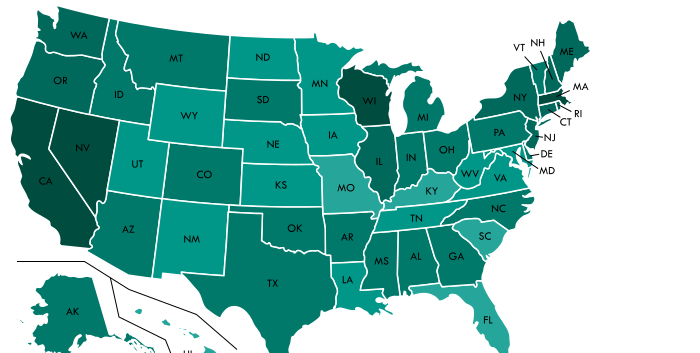
Most common states for electrical engineering directors
| Rank | State | Population | # of jobs | Employment/ 1000ppl |
|---|---|---|---|---|
| 1 | District of Columbia | 693,972 | 257 | 37% |
| 2 | Iowa | 3,145,711 | 993 | 32% |
| 3 | Arkansas | 3,004,279 | 757 | 25% |
| 4 | Massachusetts | 6,859,819 | 1,486 | 22% |
| 5 | Alabama | 4,874,747 | 1,071 | 22% |
| 6 | Utah | 3,101,833 | 606 | 20% |
| 7 | Wyoming | 579,315 | 115 | 20% |
| 8 | Delaware | 961,939 | 186 | 19% |
| 9 | North Dakota | 755,393 | 146 | 19% |
| 10 | Virginia | 8,470,020 | 1,529 | 18% |
| 11 | Colorado | 5,607,154 | 995 | 18% |
| 12 | Oregon | 4,142,776 | 754 | 18% |
| 13 | Oklahoma | 3,930,864 | 697 | 18% |
| 14 | New Hampshire | 1,342,795 | 243 | 18% |
| 15 | Rhode Island | 1,059,639 | 193 | 18% |
| 16 | Washington | 7,405,743 | 1,239 | 17% |
| 17 | Mississippi | 2,984,100 | 518 | 17% |
| 18 | Alaska | 739,795 | 123 | 17% |
| 19 | Louisiana | 4,684,333 | 770 | 16% |
| 20 | Maine | 1,335,907 | 201 | 15% |
Most common cities for electrical engineering directors
| Rank | City | # of jobs | Employment/ 1000ppl | Avg. salary |
|---|---|---|---|---|
| 1 | Windsor | 1 | 3% | $154,347 |
| 2 | Waltham | 1 | 2% | $156,985 |
| 3 | Redwood City | 1 | 1% | $177,823 |
| 4 | Anaheim | 1 | 0% | $166,473 |
| 5 | Irvine | 1 | 0% | $165,890 |
| 6 | Sacramento | 1 | 0% | $178,297 |
| 7 | San Diego | 1 | 0% | $162,884 |
| 8 | San Jose | 1 | 0% | $177,222 |
Electrical Engineering Director job outlook: Expert opinions
Our panel of electrical engineering director experts
Gonzaga University
Stevens Institute of Technology
California State University - Fresno
University of Alabama at Birmingham
Pennsylvania State University - Abington
San Diego State University
University of Utah

University of Maryland - College Park

San Jose State University
Chapman University

Clemson University
York College of Pennsylvania

Kettering University

Union College

University of Utah
California State University - Sacramento
University of Pittsburgh

Old Dominion University

University of Central Florida
What general advice would you give to an Electrical Engineering Director?
Craig Johnson Ph.D., P.E.: To begin your career in our field, please know that there are some shared values, some behavior constraints, and some awesome possible career paths for you to explore! Our program is accredited through ABET, which means that you can acquire your Professional Engineering licensure. Along with licensure are ethics compliance and legal behavior. You must put safety as a first constraint in all work. Create great technical solutions to real problems that may affect us all. Politics and company policies evolve, and we must evolve with them. New finance realities dictate that you will be more active in both seeking new jobs and changing jobs to promote your careers. You are at the center of many crossroads of technical activity that present options for your path forward.
What Electrical Engineering Director skills would you recommend for someone trying to advance their career?
Craig Johnson Ph.D., P.E.: Network with your peers and have job opportunities in sight at all times. Keep up your virtual profiles and be the engineer everyone wants to have around. Each job selection is your choice, but networking and being proactive in seeking opportunities is crucial to maximizing your salary potential.
What will help Electrical Engineering Directors increase their earning potential?
Craig Johnson Ph.D., P.E.: Master basic science and engineering concepts, as well as application of 'soft skills' such as written and verbal communication. Acquire skills and knowledge areas in electromechanical devices, especially in areas of energy and heat transfer, reflecting current issues related to climate change and power management.
What Electrical Engineering Director skills would you recommend for someone trying to advance their career?
Steven Schennum Ph.D. P.E.: The most important skill is the ability to learn new things, and especially to unlearn things you “know” after evidence demonstrates that these things are not true. Learn how to analyze information. Your intuition, simulations, and results should all be in alignment. If they are not, then dig deeper. Learn the terminology and jargon specific to your company and your projects. Spend time reading. Don’t be afraid to ask questions. Don’t be intimidated by new software.
What will help Electrical Engineering Directors increase their earning potential?
Steven Schennum Ph.D. P.E.: Put a good resume together and follow suggestions of people who are experts at preparing resumes. Before you have an interview, practice interviewing. Participate in a mock interview and listen to feedback. Maximize salary potential by documenting your accomplishments, your work, and your results. Keep a journal. If you have good documentation, you can more easily make a case for promotion when the time comes.
What Electrical Engineering Director skills would you recommend for someone trying to advance their career?
Min Song: Communication skills and innovative thinking skills. As emerging technologies continue to be complex and multidisciplinary, it’s important to be able to communicate with professionals in diverse disciplines. Taking robotics, for example, the electrical engineer must be able to work with mechanical and biomechanical engineers, computer engineers, software engineers, artificial intelligence experts, cognitive scientists, system engineers, etc. A person will be able to generate innovative ideas only if the person has a complete and comprehensive understanding of the entire system and can work well with other individuals with a range of expertise.
What general advice would you give to an Electrical Engineering Director?
Aaron Stillmaker Ph.D.: I highly encourage students starting to look for jobs to get their resume polished both by talking with a trusted professor and taking advantage of career centers at their university. I always suggest that students highlight fascinating projects on their resumes that highlight their knowledge base without having to list skills, and they need to be ready to talk intelligibly about those projects. I would make sure to prepare for interviews by brushing up on design course material that are taught in the courses most closely pertaining to the specialty they are interviewing for. I also suggest they contact professors they have a good relationship with to ask them to reach out to their contacts in the field, as many professors have connections in the industry and are happy to help their good students attain good jobs.
What Electrical Engineering Director skills would you recommend for someone trying to advance their career?
Aaron Stillmaker Ph.D.: I think that in the next 3-5 years electrical engineering jobs will start to require more programming, especially scripting languages like Python, and artificial intelligence. Machine learning is becoming prevalent in many fields, and likely most prevalent in electrical and computer engineering. A baseline understanding of the theory of machine learning is something that all electrical and computer engineers should have when entering the job market.
What will help Electrical Engineering Directors increase their earning potential?
Aaron Stillmaker Ph.D.: To maximize your salary I always tell my students to make sure to research what the average entry engineer in that specialty and location makes, which is easy both by researching online and talking with colleagues. Make sure to apply to many positions at the same time and ideally get interviews around the same time. Ideally if you get multiple companies that want to hire them, they can use the job offers to compete with each other. I also always tell students to ideally not say a desired number first, and no matter what the hiring manager offers them they should ask for more. If the number is below average, they have a strong hand to ask for more, but even with a good offer, I always suggest students ask for 10% more than what was offered. The worst thing they can say is no, and hold firm on the offer, so they have nothing to lose.
What Electrical Engineering Director skills would you recommend for someone trying to advance their career?
Arie Nakhmani: Electrical Engineering has always (from its inception) been a good profession to enter, but now it is better than ever. Now everything is becoming Electrical Engineering, and the world cannot survive without it even for a few days. Electrical Engineering is the most necessary profession for the survival of modern society.
What Electrical Engineering Director skills would you recommend for someone trying to advance their career?
Yi Yang PhD: In the next 3-5 years, I believe management skills will become increasingly important. Engineers who can bridge the gap between technical complexity and business strategy, driving innovation and growth in their organizations will be very valuable.
What will help Electrical Engineering Directors increase their earning potential?
Dr. Arif Engin: Electrical engineers solve problems by skillfully applying mathematics and science. Electrical engineering classes are challenging at college, and electrical engineers must embrace lifelong learning to remain at the top of their skills. In the end, seeing the results of their work in a finished product is a rewarding experience.
Florian Solzbacher
Department Chair, Professor, Elect & Computer EngineeringUniversity of Utah
Electrical and Computer Engineering Department
What skills stand out on Electrical Engineering Director resumes?
Florian Solzbacher: Examples of having applied the knowledge gained in their studies to practical examples of solving engineering problems that require the combination of skills and at least some understanding of system engineering aspects are important signals that graduating engineers are ready to be productive in a real-world setting are always important. Obviously, participating in projects that address current "hot topic" problems, e.g., in robotics, AI/machine learning, power systems, biomedical applications, or that resonate with specific problems an employer is currently working on, will raise a student's profile.
Supplemental skills, such as Entrepreneurial or business training, can enhance and differentiate a student's resume. This shows that an engineer is not solely focused on the core technical engineering skills but does have an understanding of the driving forces and their interaction in a real-world business setting, that are not only part of the design requirements for a product (e.g., design to cost), but also often drive the selection of technical solution paths, after all, every development and product has to make business sense. Imagine two young engineers proposing a solution to their manager for a new product: one maybe even over-exceeds the technical requirements, but the development and/or manufacturing and servicing effort and cost is significantly higher than a colleagues solution that may only just about reach the requirements, or maybe even compromise on some specifications, but that is far cheaper to develop, make and service and that may allow entering a far larger market- chances are very high that the business may decide to go for the "inferior" solution from a technical point of view, that is, however, the better product. This supplemental skill set is a significant competitive advantage to have as an engineer.
Donald Yeung
Professor and Associate Chair for Undergraduate Education, Affiliate Professor, Computer Science DepartmentUniversity of Maryland - College Park
Department of Electrical and Computer Engineering
What hard/technical skills are most important for Electrical Engineering Directors?
Donald Yeung: In terms of hard technical skills, I believe the courses students take along with their GPA in these courses is one level of demonstration. (As I mentioned above, employers know about our program probably down to specific courses, and so if someone gets an A+ in some notoriously challenging course, that's probably known and appreciated). Some employers will give technical interviews and require students to solve problems on their feet. But I think most employers will judge this based on a student's transcript.
What skills will help Electrical Engineering Directors earn the most?
Donald Yeung: Finally, in terms of compensation, I believe the Computer Engineering degree in our department garners the highest average starting salary across the entire UMD campus. The Electrical Engineering degree is not far behind. I don't know if specific skills within ECE garner more pay. But I can say that these days, Data Science (i.e., Machine Learning and Artificial Intelligence) is the fastest-growing field, probably bar none. The US Bureau of Labor Statistics, I think, puts the growth in this field at around 30% from now until 2026. I would expect the starting salaries in these jobs to be the very highest. So, perhaps having a background in Data Science and Machine Learning might get you a higher-paying job. But I also think it's dangerous for students to look at such statistics to guide what courses they take today (elective courses, that is). What's hot today may not be tomorrow. A career is 40 years, not the next 5 or 10 years.
Yasser Dessouky
Professor and ChairSan Jose State University
Industrial and Systems Engineering
What skills stand out on Electrical Engineering Director resumes?
Yasser Dessouky: Besides being very comfortable with various professional social-media platforms, the new engineering students must embrace developing their skills in artificial intelligence and data science techniques. Besides being an excellent team member, today's remote world requires engineers to have independent problem-solving skills for a career to thrive.
What skills stand out on Electrical Engineering Director resumes?
Tom Springer Ph.D.: -Classroom or work-related experience with electrical circuit design and electrical schematic analysis
-Exposure to control system design and theory, communications systems principles
-Lab experience with power/analog electronics testing or test methodology
-Understanding of digital design using hardware verification languages: System Verilog
-Experience leading engineering projects
What soft skills should all Electrical Engineering Directors possess?
Tom Springer Ph.D.: -Good communication skills
-Ability to exercise critical thinking and innovative problem solving
-Able to work under supervision and mentoring
-Works well in a team-oriented environment
What skills will help Electrical Engineering Directors earn the most?
Tom Springer Ph.D.: Skill sets that span domain disciplines are very much in demand. Such as a computer architect or electrical engineer with a strong background in software development
Dr. John Ballato
J. E. Sirrine Endowed Chair and ProfessorClemson University
Department of Materials Science and Engineering
What skills stand out on Electrical Engineering Director resumes?
Dr. John Ballato: The phrase "well rounded" may be getting old, but it's still true. We like to see graduates who didn't just go to class but worked in a laboratory or did a co-op/internship and had various extra-curricular activities, both personal and professional. Remember that materials science and engineering are leveraging computer science more and more, whether through atomistic or microstructural modeling or newer technologies such as machine learning (ML) and artificial intelligence (AI). So having some familiarity with those and how they complement experimental/hands-on studies are helpful.
Another point about skills that stand out is a simple one - do your homework. There are few things more irritating than receiving a resume or email asking for a job, and the student clearly didn't care enough to look up what we do. The resume is a copy and paste and isn't personalized to the specific position, Group, or company. That stands out like a sore thumb.
What skills will help Electrical Engineering Directors earn the most?
Dr. John Ballato: Here, too, the answer depends on the field, job position (and location), and organization. MSE graduates generally are well compensated compared to other engineering fields. The most important thing is that you wake up every morning and are excited about the work you're doing. There's no substitute for enjoying your work, regardless of how much you are paid.
Tristan Ericson Ph.D.
Associate ProfessorYork College of Pennsylvania
Civil and Mechanical Engineering
What are the biggest trends we'll see in the Electrical Engineering Director job market given the pandemic?
Tristan Ericson Ph.D.: Engineering jobs will still be available. Some companies are struggling in the pandemic, but some are thriving. Our students are still able to find co-ops, and our graduates are still finding jobs. The market has slowed a bit, but not as much as I expected. Rather, we see a shift in job availability as the need for different technologies changes. Most of our summer 2020 graduating seniors found jobs. It took more time for some of them to secure employment than typical, but their ultimate success rate was higher than I would have anticipated in such an uncertain time. Going forward, I think the need for engineering jobs will gradually increase to levels higher than pre-pandemic. Consider the Biden administration's ambitious infrastructure goals. These alone will place increased demand on engineering, but they are also a broader indicator of society's increased need for innovation and product development. The push for vehicle electrification will provide many new job opportunities in that staple industry.
What technical skills for an Electrical Engineering Director stand out to employers?
Patrick Atkinson: Broadly speaking, employers are looking for employees who can jump in, take on a project and move things forward. Since engineers are data-driven, knowing how to read and interpret findings from a variety of sources is key. This can be very challenging if the data conflicts between sources or the data is unclear. Whether the data is from a mathematical model, a physical test laboratory, or from the field, learning how to synthesize the findings and balance the strengths/weaknesses of a given data source are key. At the end of the day, every project needs a way forward and it is the engineer's job to optimize a design to meet the objectives for the product.
Ronald Bucinell Ph.D.
Associate Professor of Mechanical Engineering, Fellow of the American Society of Mechanical EngineersUnion College
Department of Mechanical Engineering
Will there be an enduring impact of the coronavirus pandemic on Electrical Engineering Directors?
Ronald Bucinell Ph.D.: The pandemic has forced all colleges and universities to offer courses online. Some schools have been offering online courses for decades. These schools have invested in infrastructure and their faculty have developed pedagogical techniques that are compatible with an online course format. The rest of us were thrown into the fire with less than adequate tools and training, so I believe the quality of the courses have suffered. This is especially acute in engineering where students need to master the theory and develop a physical intuition for the phenomenon they are studying. The development of physical intuition comes from labs and design projects, both of which are not compatible with an online format. In the short term, I do believe our graduates will suffer, because they will have to find ways outside their education to make up for the physical laboratory and design experiences that were taken out of the curriculum to accommodate the online format. Because of an emphasis on continuing education in engineering, I do think they will catch up.
What are the biggest trends we'll see in the Electrical Engineering Director job market given the pandemic?
Bruce Gale Ph.D.: As automation, information sharing, and software continue to become more important in response to the pandemic, engineers with programming skills will become ever more valuable. As a corollary, there is significant interest in increasing automation in factories, which will lead to additional opportunities in systems engineering for complex tools.
What are the biggest trends we'll see in the Electrical Engineering Director job market given the pandemic?
Steven Fernandez: No sure, with respect to mechanical engineering there is so many variables as to what new trends ME grads can experience. One of the greatest challenges Mechanical Engineering students face is the broadness of the field of study they have chosen. Surprisingly, many ME grads find themselves at a bit of a loss as to what carrier path to choose when they finally get their degree. As a mechanical engineer you can be designing anything from a supersonic missile, to a food processing line, in multiple functions. Mechanical engineers can be project engineers, design engineers, operation engineers, or manufacturing engineers with all options in just one industrial field. Each industrial field is affected differently by the pandemic. Take Space X, Google, Amazon, and Raytheon which are all industries ME's work in. These company seem to be doing the same if not better during the pandemic. How about the bicycle industry? With more families at home looking for activities there is a backlog of bicycles as the manufacturers cannot keep up with the orders. Try and order a NordicTrack treadmill, or a concept-2 rowing machine and you will be put on a waiting list due to the shortage of supply. Mechanical engineers work in all these industries. On the flip side look at some industries tied to travel and vacation. Yes, Boeing took a hit because of their 737 planes being grounded, but also because of the massive decrease in flight travel. So, all that said, I would say the pandemic trend for now would follow the course as such; industries which are negatively affected due to the loss of public activities will continue to struggle or have slow growth, while other industries where the mass public has been redirected will flourish and grow.
What experience really stands out on Electrical Engineering Director resumes?
Matthew Barry Ph.D.: What really stands out on a resume to me is anything related to hands-on experience. I honestly prefer students and potential employees that have hands-on experience and ok grade point averages (GPAs) compared to students with high GPAs and no hands-on experience. And this hands-on experience does not have to come from internships or co-ops, but could be the result of participating in clubs, or being part of a Makerspace, either as a mentor, or a user.
Will there be an enduring impact of the coronavirus pandemic on Electrical Engineering Directors?
Michel Audette Ph.D.: My take on this is what I've seen with my wife's work in industry, which suggests that the industrial landscape is going to be increasingly equipped for, and open to, remote work. I think that the implication for graduates is that they may need to be flexible about working within a geographically distributed team. If company deciders feel that someone is worth employing because of a unique skill set, then they would typically be more willing to hire that person even if unable to make it to work regularly, if that is feasible given the nature of the work; some work, such as hardware testing or industrial production, may not lend itself to remote contributions.
Nonetheless, for those areas that accommodate geographically distributed activity, such as software development, graduates can expect to interact with team members all over the US, possibly all over the world, if someone is deemed unique enough to hire despite living abroad. This places a high premium on the ability and willingness to work in a heterogeneous team, where not only will members look different, but also have myriad accents in their English, which will also impose a certain adaptability and tolerance to team members.
A related impact could also be that global hiring will make it easier for multi-national companies to hire a portion of their talent in countries where wages are lower and motivate US-based engineers to seek out graduate degrees in order to increase their competitiveness and employability at US salaries.
Maria Jacob
ProfessorUniversity of Central Florida
Department of ECE
What experience really stands out on Electrical Engineering Director resumes?
Maria Jacob: Well, this is a too general question to answer. It totally depends on which job you are applying. Is the graduate going to the industry or research? Is the job for testing, designing, coding? What will stand out will depend on this.
However, if I really have to choose one, I always thought that one of the most important things you can learn is to work in a multidisciplinary group. Then, if before graduation a student can have an internship either in the industry or in research that will definitely stand out.