Explore jobs
Find specific jobs
Explore careers
Explore professions
Best companies
Explore companies
Job outlook for electrical system specialists in the United States
Are electrical system specialist jobs in demand?
Electrical system specialist job and salary trends over time
Electrical system specialist jobs over time
Electrical system specialist job growth rate over time
| Year | # of jobs | % of population |
|---|---|---|
| 2021 | 434 | 0.00% |
| 2020 | 491 | 0.00% |
| 2019 | 499 | 0.00% |
| 2018 | 433 | 0.00% |
| 2017 | 427 | 0.00% |
Average electrical system specialist salary over time
Electrical system specialist salary by year
| Year | Avg. salary | Hourly rate | % Change |
|---|---|---|---|
| 2026 | $81,108 | $38.99 | +3.3% |
| 2025 | $78,550 | $37.76 | +2.4% |
| 2024 | $76,684 | $36.87 | +2.4% |
| 2023 | $74,903 | $36.01 | +3.1% |
| 2022 | $72,643 | $34.92 | +3.8% |
Electrical system specialist jobs by state
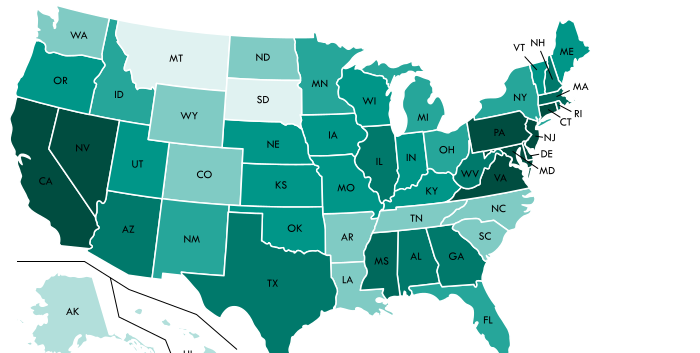
Most common states for electrical system specialists
| Rank | State | Population | # of jobs | Employment/ 1000ppl |
|---|---|---|---|---|
| 1 | District of Columbia | 693,972 | 204 | 29% |
| 2 | Virginia | 8,470,020 | 1,269 | 15% |
| 3 | Massachusetts | 6,859,819 | 1,028 | 15% |
| 4 | Maryland | 6,052,177 | 935 | 15% |
| 5 | Iowa | 3,145,711 | 455 | 14% |
| 6 | Wyoming | 579,315 | 74 | 13% |
| 7 | Colorado | 5,607,154 | 668 | 12% |
| 8 | Utah | 3,101,833 | 363 | 12% |
| 9 | New Hampshire | 1,342,795 | 157 | 12% |
| 10 | Delaware | 961,939 | 111 | 12% |
| 11 | North Dakota | 755,393 | 90 | 12% |
| 12 | Arizona | 7,016,270 | 800 | 11% |
| 13 | Alabama | 4,874,747 | 515 | 11% |
| 14 | Nebraska | 1,920,076 | 202 | 11% |
| 15 | Alaska | 739,795 | 80 | 11% |
| 16 | Minnesota | 5,576,606 | 576 | 10% |
| 17 | Kansas | 2,913,123 | 286 | 10% |
| 18 | Vermont | 623,657 | 60 | 10% |
| 19 | Georgia | 10,429,379 | 913 | 9% |
| 20 | Wisconsin | 5,795,483 | 536 | 9% |
Most common cities for electrical system specialists
| Rank | City | # of jobs | Employment/ 1000ppl | Avg. salary |
|---|---|---|---|---|
| 1 | Marlborough | 1 | 3% | $83,912 |
| 2 | Savage | 1 | 3% | $70,030 |
| 3 | Minneapolis | 1 | 0% | $69,975 |
| 4 | Sacramento | 1 | 0% | $91,221 |
Electrical System Specialist job outlook: Expert opinions
Our panel of electrical system specialist experts
University of Kansas

Rowan University

The Ohio State University at Lima
North Carolina Central University
Western Illinois University

American Public University System

Forsyth County, Georgia

Rollins College
What technology do you think will become more important and prevalent for Electrical System Specialists in the next 3-5 years?
Cari Ann Kreienhop: I posed this question to our alumni in the field and received the response that GIS (ESRI) and Smart City technologies like Advanced Meter Reading (Xylem/Sensus is a big brand name in the water sector, for example) are the most likely evolving platforms and uses they will encounter. Additionally, it's essential to keep abreast of thematic trends related to technology: an awareness of cybersecurity threats, best practices, and defensive tactics. Understanding the language, concepts, and strategies to manage better, and support IT, and protect the organization is critical.
Beyond specific technology, leaning into logical analysis and data-gathering skills are critical to bringing a well-rounded perspective into an organization. Mastering Excel and R are great for hitting the ground running in an organization, but being versatile and savvy with data analytics will be an asset to any organization.
Dr. Kate Seltzer Ph.D.
Assistant ProfessorRowan University
Department of Language, Literacy and Sociocultural education
How would you rate the starting salaries for Electrical System Specialists, as well as the prospects for salary advancement?
Dr. Kate Seltzer Ph.D.: Educators are not paid nearly enough. However, working in a state with strong teachers' unions helps to ensure a starting salary that recent graduates can live off of and growth opportunities, albeit modest, over their careers.
Are there any particularly good places in the United States for Electrical System Specialists to find work opportunities?
Leah Herner-Patnode: Usually, urban areas of bigger cities and southern states, such as North Carolina, have many openings. Maine, Florida, California, Hawaii, Washington, and Texas are the most open positions.
Elisha Blankson
Program Director NCCU, Assistant ProfessorNorth Carolina Central University
Communication Disorders Department
What type of skills will young Electrical System Specialists need?
Elisha Blankson: Graduates will need a skill set about the field in which they received training and additional skills useful to the job market. For example, with the changing demographics in the United States, extra skills in information technology and foreign languages will be a plus when entering the job market.
Dr. Richard Filipink Ph.D.
ProfessorWestern Illinois University
History Department
What technology do you think will become more important and prevalent for Electrical System Specialists in the next 3-5 years?
Dr. Richard Filipink Ph.D.: Everyone will need hardware to run the meetings software and the bandwidth to maintain it. An increase in laptop/desktop preference for home use, as your phone won't be enough to conduct much of your work function.
Dr. Elizabeth Keavney Ph.D.
Associate ProfessorAmerican Public University System
Public Administration Department
What type of skills will young Electrical System Specialists need?
Dr. Elizabeth Keavney Ph.D.: The ability to examine all sides of an issue, to include long-term consequences and short-term consequences and unintended consequences and intended outcomes is vital. A focus on goals and objectives, instead of depending on an emotional response, will help lead to the best solutions. Public servants should be adaptable and able to work with people from various cultures. They need to have an understanding of how to work with and motivate individuals and groups. Those who can stay engaged and exercise good judgment will fare best in fluid and changing times.
How do you envision technology impacting Electrical System Specialists in the next 5 years?
Dr. Elizabeth Keavney Ph.D.: COVID-19 has increased the number of people who are working at home. This means a solid basic knowledge of telecommuting, and the ability to work unsupervised will be necessary. The ability to use remote security protocols, the cloud, and various software platforms will be required.
Are there any particularly good places in the United States for Electrical System Specialists to find work opportunities?
Donna Kukarola: This one, not so sure of, the southeast continues to see options as well as mid-western states.
Will there be an enduring impact of the coronavirus pandemic on Electrical System Specialists?
Donna Kukarola: The procurement field is an opportunity; each day will have its own set of challenges and opportunities. Obtaining the right item/service at the right time, at the right price, is not all that procurement does. They are strategic members, sourcing, timing, keeping up with trends, laws, best practices, and advising that the resource desired is already available!
This year, entering the workforce will be different for many interviews to be held electronically - even, perhaps, teleworking when they get the job. Training is a bit more of a challenge then, and it can be hard to get a real feel of the "attitude." Keeping an open mind and being flexible is a must; during this pandemic, we have all had to learn how to do our jobs differently and navigate our careers.
What experience really stands out on Electrical System Specialist resumes?
Claire Strom Ph.D.: I don't read resumes, but I would argue that a graduate needs to narrate their college experiences effectively and talk about them in terms of skills gained.