Explore jobs
Find specific jobs
Explore careers
Explore professions
Best companies
Explore companies
Job outlook for elementary school registrars in the United States
Are elementary school registrar jobs in demand?
Elementary school registrar job and salary trends over time
Elementary school registrar jobs over time
Elementary school registrar job growth rate over time
| Year | # of jobs | % of population |
|---|---|---|
| 2021 | 1,334 | 0.00% |
| 2020 | 1,370 | 0.00% |
| 2019 | 1,436 | 0.00% |
| 2018 | 1,416 | 0.00% |
| 2017 | 1,414 | 0.00% |
Average elementary school registrar salary over time
Elementary school registrar salary by year
| Year | Avg. salary | Hourly rate | % Change |
|---|---|---|---|
| 2025 | $30,686 | $14.75 | +2.1% |
| 2024 | $30,047 | $14.45 | +2.5% |
| 2023 | $29,322 | $14.10 | +1.9% |
| 2022 | $28,783 | $13.84 | +2.4% |
| 2021 | $28,098 | $13.51 | +1.7% |
Elementary school registrar jobs by state
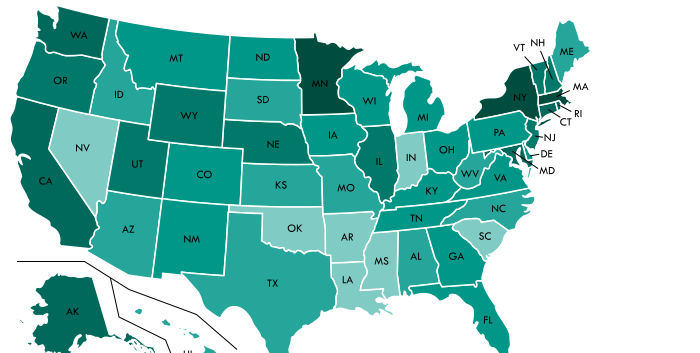
Most common states for elementary school registrars
| Rank | State | Population | # of jobs | Employment/ 1000ppl |
|---|---|---|---|---|
| 1 | New Hampshire | 1,342,795 | 128 | 10% |
| 2 | Montana | 1,050,493 | 90 | 9% |
| 3 | Connecticut | 3,588,184 | 284 | 8% |
| 4 | District of Columbia | 693,972 | 53 | 8% |
| 5 | Illinois | 12,802,023 | 863 | 7% |
| 6 | Minnesota | 5,576,606 | 385 | 7% |
| 7 | Oregon | 4,142,776 | 275 | 7% |
| 8 | Rhode Island | 1,059,639 | 72 | 7% |
| 9 | Alaska | 739,795 | 49 | 7% |
| 10 | Colorado | 5,607,154 | 309 | 6% |
| 11 | Delaware | 961,939 | 62 | 6% |
| 12 | Wyoming | 579,315 | 32 | 6% |
| 13 | New Jersey | 9,005,644 | 441 | 5% |
| 14 | Arizona | 7,016,270 | 319 | 5% |
| 15 | Missouri | 6,113,532 | 309 | 5% |
| 16 | Kansas | 2,913,123 | 143 | 5% |
| 17 | New Mexico | 2,088,070 | 111 | 5% |
| 18 | Vermont | 623,657 | 31 | 5% |
| 19 | Maryland | 6,052,177 | 268 | 4% |
| 20 | Massachusetts | 6,859,819 | 265 | 4% |
Most common cities for elementary school registrars
| Rank | City | # of jobs | Employment/ 1000ppl | Avg. salary |
|---|---|---|---|---|
| 1 | Plainfield | 2 | 4% | $29,928 |
| 2 | Spanaway | 1 | 4% | $32,701 |
| 3 | Lewiston | 1 | 3% | $24,869 |
| 4 | Charlottesville | 1 | 2% | $26,728 |
| 5 | Boston | 1 | 0% | $36,413 |
| 6 | Durham | 1 | 0% | $25,751 |
Elementary School Registrar job outlook: Expert opinions
Our panel of elementary school registrar experts
Texas Christian University
University of Arkansas, Fayetteville

University of Guam
San Francisco State University

Seattle Pacific University

Minnesota State University, Mankato
University of Tennessee-Knoxville

Marshall University

University of Mary Washington
What general advice would you give to an Elementary School Registrar?
Jonathan Higgins Ed.D.: Get involved in your school. Many club sponsor, team lead, coaching positions come with a supplement. Other teachers will work after-school tutoring programs, tutor privately, or work summer school. Additionally, many districts pay more for advanced degrees. The amount may only be $2,500 or so per year, but if you spend $10,000 on a Masters degree, it is likely you will pay it back in four or five years and then be making more money. Unfortunately, the only other way to maximize salary is to move into a more administrative role. It is sad when we see good teachers leaving the classroom to pursue administration solely for economic reasons. In addition, it is sad for administration when we see not so great people also move into those roles because they want to be paid more as well.
What general advice would you give to an Elementary School Registrar?
Jo Jimerson Ph.D.: In teaching, this is sometimes not really possible, as many districts use salary scales that are tied to years of experience. That said, ask whether prior experience (clinical teaching, long term substituting, related work) can be used to start you at a higher “step” on the experience ladder. In some positions, districts use salary ranges, so come ready to talk about your prior experience that could warrant starting you nearer the midpoint of the range where possible.
What Elementary School Registrar skills would you recommend for someone trying to advance their career?
Dr. Vicki Collet: In addition to pay increases for experience, additional education helps you climb the salary ladder. Be intentional so that your ongoing education counts not just for license renewal, but also for an additional endorsement or degree.
Matthew Limtiaco
Assistant Professor of Elementary EducationUniversity of Guam
School of Education
What skills stand out on Elementary School Registrar resumes?
Matthew Limtiaco: An appreciation for the diversity in any given classroom is critical, along with the skills and commitment toward meeting the needs of students who come from a myriad of family backgrounds, social settings, belief systems, economic statuses', and histories of access and familiarity with our education system.
Each student brings with them a completely different set of skills, interests, fears, and struggles. Our capacity for empathy, honesty, and resourcefulness directly translates to student and classroom experience. Teachers reach students when they have the tools to connect with each student, show them that they are caring adults, and help each student realize their potential through measurable development in content areas as well as soft skills.
This is true online or in face-to-face settings. Online classrooms teachers are maximizing the reduced window of interaction with students by streamlining the delivery and assessment of content. No doubt, this priority is influenced by a culture of results-oriented teaching based on narrow measures. This compromise is made with a cost. Efforts toward social-emotional support should be increased in online classes, while content expectations should be relaxed during perhaps the most stressful time our young ones and their families have faced in their lives. Any absence of empathy and soft skill development in online settings is a product of decades-old priorities placed on high-stakes tests based on national standards.
Teachers entering the field should have a strong understanding of the need for social-emotional support and an ability to meet the needs of diverse students.
Stephanie Sisk-Hilton Ph.D.
ProfessorSan Francisco State University
Department of Elementary Education
What's a good job out of college for Elementary School Registrars?
Stephanie Sisk-Hilton Ph.D.: The good news for recent graduates of teacher training programs is that the job market looks very strong in almost every area of education. In California, we have had a strong job market for teachers for several years due to our aging educator workforce. The pandemic and the challenges of teaching over the past year, coupled with strong returns for retirement funds, appears to be accelerating the wave of retirements. While it will be particularly challenging to be a new teacher in the coming years, new teachers will likely have abundant job opportunities to select from. Teaching is not the highest earning career path, and there is much work to be done to ensure fair wages commiserate with the level of education and skill required for educators, but it is a stable and highly rewarding job, which may be particularly appealing during these uncertain times.
Christopher Hanson
Assistant Professor of Music, Director of Music Education and Orchestral ActivitiesSeattle Pacific University
Music Department
What general advice would you give to an Elementary School Registrar?
Christopher Hanson: Keep asking questions and look for opportunities to engage in teaching and learning wherever you can. Connect with peers and future colleagues. Do not just wait. Now is the time to create and sustain dialog on educational change. Although there are endless numbers of variables to how, when, what, and with whom we learn, our genuine curiosity and sincere desire to engage others in the educative process is our greatest hope to see education in a better place than it was before the pandemic.
We must heed the call of innovation and encourage a transition from our current state of triage and survival. You, as a recent graduate, are the future of what education will be. Ask yourself, what will the world look like that you will help create? Is this a world that you and others can learn in? What more can you do to secure the possibilities and promise of education for all? These are the questions that will fuel change and secure growth through the inevitable vicissitudes of education.
Aaron Hoy Ph.D.
Assistant Professor of SociologyMinnesota State University, Mankato
Sociology Department
What type of skills will young Elementary School Registrars need?
Aaron Hoy Ph.D.: It is good news for our society and for sociology majors that employers have already put an increased emphasis on hiring and retaining employees who have a solid understanding of issues of diversity and inclusion. This emphasis will likely continue for the foreseeable future, which is a good opportunity for sociology majors who are comfortable working in diverse environments and really understand and appreciate human diversity in terms of race, ethnicity, socioeconomic status, sex, gender identity or expression, and sexuality, among others. In fact, right now, diversity-related skills are those that recent sociology graduates say they are most likely to use and benefit from in the workplace, according to a 2015 report from the American Sociological Association.
I would also encourage sociology majors to prioritize rigorous methodological training to the extent that they can within their specific program. There are already many, many jobs available for college graduates with research skills, including in the private sector, and these are likely to grow in the coming years. However, sociology majors sometimes overlook these jobs or opt not to apply for them. As an advisor myself, I suspect that this is often because students do not feel confident in their research skills or because they assume that, say, a psychology or an economics major would be a better fit. But these are good-paying jobs with above-average levels of employee satisfaction, and sociology majors should not take themselves out of the running for them.
Although it may be scary or uncomfortable for some students, taking an extra research design or statistics class might be a good idea. And of course, writing up research results and presenting them in clear, logical ways is a key part of the research process, so as always, students should make a very concerted effort to improve their written and verbal communication skills as best they can. That may mean taking an extra composition or public speaking class if necessary.
Lisa King Ph.D.
Associate ProfessorUniversity of Tennessee-Knoxville
Department of English
What general advice would you give to an Elementary School Registrar?
Lisa King Ph.D.: I'd also remind graduates that careers are rarely set from the get-go, and not to be discouraged; a career can grow from unexpected opportunities and connections and sometimes it just takes time - or outlasting a pandemic. Careers in English and the humanities are just as important as others, even if media narratives frequently devalue them. Take advantage of the flexibility of your degree and training, build on it, and know the value of your skills. If we have learned anything from this pandemic it's that communication is crucial, and this is part of what you've been trained to do. The world needs you.
How do you envision technology impacting Elementary School Registrars in the next 5 years?
Teresa Eagle: Imagine a school system faced with a highly contagious virus fifty years ago. The technology of 2020 has made it possible to continue teaching and learning, in a time when physical proximity is a serious concern. The alternatives are clearly not perfect, but virtual learning is better than it would have been even ten years ago. Now parents, politicians, and educators are demanding improved access to virtual education.
The longer the pandemic disrupts in-person schools, the louder the demand for improved learning formats will be. Technology, with all the associated elements, is already stepping up to meet these demands, though not as quickly as we might like. With even better technology, the results of the pandemic may well be increased opportunities for students and teachers, with improved connections and nearly unlimited possibilities for education, better tailored to meet the individual needs of students.
Janine Davis Ph.D.
Associate ProfessorUniversity of Mary Washington
College of Education
Will there be an enduring impact of the coronavirus pandemic on Elementary School Registrars?
Janine Davis Ph.D.: For our teacher education graduates, the impact of the pandemic will most likely work in their favor when it comes to finding jobs-the pandemic has led to many retirements, which will mean that we will need even more teachers to fill those empty positions. At the same time, the advent of increased virtual learning means that it will no longer be an option that teachers know and use technology, including teaching online and using learning management and data analysis systems-those skills will almost certainly be a non-negotiable for future teaching positions. Finally, I think that this event has highlighted the importance of working as part of a team of teachers and other school leaders.