Explore jobs
Find specific jobs
Explore careers
Explore professions
Best companies
Explore companies
Job outlook for emergency management coordinators in the United States
Are emergency management coordinator jobs in demand?
Emergency management coordinator job and salary trends over time
Emergency management coordinator jobs over time
Emergency management coordinator job growth rate over time
| Year | # of jobs | % of population |
|---|---|---|
| 2021 | 1,583 | 0.00% |
| 2020 | 1,566 | 0.00% |
| 2019 | 1,543 | 0.00% |
| 2018 | 1,465 | 0.00% |
| 2017 | 1,466 | 0.00% |
Average emergency management coordinator salary over time
Emergency management coordinator salary by year
| Year | Avg. salary | Hourly rate | % Change |
|---|---|---|---|
| 2026 | $61,574 | $29.60 | +2.2% |
| 2025 | $60,233 | $28.96 | +0.2% |
| 2024 | $60,096 | $28.89 | +2.3% |
| 2023 | $58,755 | $28.25 | +3.2% |
| 2022 | $56,930 | $27.37 | +4.7% |
Emergency management coordinator jobs by state
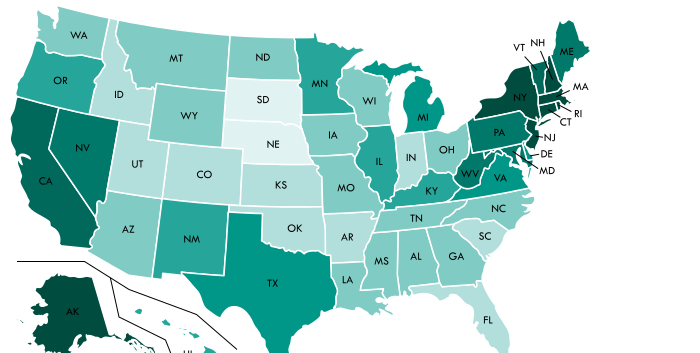
Most common states for emergency management coordinators
| Rank | State | Population | # of jobs | Employment/ 1000ppl |
|---|---|---|---|---|
| 1 | North Dakota | 755,393 | 267 | 35% |
| 2 | Delaware | 961,939 | 331 | 34% |
| 3 | Nebraska | 1,920,076 | 623 | 32% |
| 4 | Idaho | 1,716,943 | 548 | 32% |
| 5 | Iowa | 3,145,711 | 974 | 31% |
| 6 | Kansas | 2,913,123 | 815 | 28% |
| 7 | New Mexico | 2,088,070 | 564 | 27% |
| 8 | South Dakota | 869,666 | 233 | 27% |
| 9 | Arkansas | 3,004,279 | 757 | 25% |
| 10 | Vermont | 623,657 | 123 | 20% |
| 11 | Virginia | 8,470,020 | 1,610 | 19% |
| 12 | Massachusetts | 6,859,819 | 1,287 | 19% |
| 13 | Alabama | 4,874,747 | 929 | 19% |
| 14 | Oklahoma | 3,930,864 | 701 | 18% |
| 15 | Alaska | 739,795 | 131 | 18% |
| 16 | Oregon | 4,142,776 | 692 | 17% |
| 17 | New Hampshire | 1,342,795 | 226 | 17% |
| 18 | Rhode Island | 1,059,639 | 167 | 16% |
| 19 | Illinois | 12,802,023 | 1,763 | 14% |
| 20 | Maine | 1,335,907 | 188 | 14% |
Most common cities for emergency management coordinators
| Rank | City | # of jobs | Employment/ 1000ppl | Avg. salary |
|---|---|---|---|---|
| 1 | Columbus | 1 | 2% | $53,270 |
| 2 | Coral Gables | 1 | 2% | $53,380 |
| 3 | Fort Smith | 1 | 1% | $55,367 |
| 4 | Vancouver | 1 | 1% | $59,868 |
| 5 | Boston | 1 | 0% | $81,698 |
| 6 | Chicago | 1 | 0% | $62,694 |
| 7 | Gilbert | 1 | 0% | $59,538 |
| 8 | Los Angeles | 1 | 0% | $77,637 |
| 9 | New Orleans | 1 | 0% | $60,517 |
| 10 | Oakland | 1 | 0% | $83,466 |
Emergency Management Coordinator job outlook: Expert opinions
Our panel of emergency management coordinator experts
University of North Texas
Connecticut College
Heidelberg University

Austin Community College

Wichita State University
What general advice would you give to an Emergency Management Coordinator?
Laura Siebeneck Ph.D.: Acquiring a solid academic foundation in emergency management and developing strong analytical, written, communication, and problem-solving skills is important for success in this field. And more and more, I am noticing that employers are looking for individuals that work well in a team-setting and possess project management skills. The hazards and disasters emergency managers encounter are becoming increasingly complex and being able to collaborate and think creatively to solve these problems is important.
What Emergency Management Coordinator skills would you recommend for someone trying to advance their career?
Laura Siebeneck Ph.D.: I often tell my students to be lifelong learners. I encourage them to keep reading, to keep seeking out new skillsets and remain current with new and emerging technologies. I also encourage them to seek out the various training opportunities and credentials offered within the profession. Whether a student finds employment in the public, private, or non-profit sector, there are always opportunities to expand their knowledge and skillset while in their emergency management roles.
What will help Emergency Management Coordinators increase their earning potential?
Laura Siebeneck Ph.D.: Before entering the field, I strongly encourage students to seek out internship opportunities. Many of the entry-level positions in this field require experience, and internships are a great way to gain that experience, get access to training opportunities, and to build one’s professional network. I have seen many student internship experiences lead to full-time employment. Additionally, joining professional organizations, such as the International Association of Emergency Managers, seeking out volunteer opportunities, and attending emergency management conferences, are also great ways to meet others in the field.
What are the biggest trends we'll see in the Emergency Management Coordinator job market given the pandemic?
Julia Kushigian Ph.D.: The exciting trends for students graduating in Hispanic Studies and for those already in the job market are the potential benefits of a remote learning anticipated years ago through pedagogical tools designed by those in language, literature and culture. The interactive formulas, ability to engage participants and broaden the definition of language learning to include cultural studies of a variety of professional fields were already in the works and Covid was the impetus to move even faster. We know from a variety of studies, including a major report by the American Council of Teachers of Foreign Languages, for example, that 9 out of 10 U.S. employers rely on employees with language skills other than English. Spanish being in high demand is the most sought after language. Of course, beyond the more obvious benefits of being bilingual ("Why Bilinguals are Smarter" NYT 2012) are the less obvious of being adept at solving certain mental problems, thriving in ambiguity, flexibility with unknowns and the potential to stave off dementia later in life.
Paige Atterholt
Adjunct ProfessorHeidelberg University
Will there be an enduring impact of the coronavirus pandemic on Emergency Management Coordinators?
Paige Atterholt: I think now, being in year 2 of the pandemic, I think if anything there will be more jobs for graduates. Just looking through the jobs online, there are many opportunities for graduates to get a job. I think the older community retired when things got bad, which opened the door for the younger generation.
Will there be an enduring impact of the coronavirus pandemic on Emergency Management Coordinators?
Stuart Greenfield Ph.D.: According to the National Student Clearinghouse estimates for Fall 2018-Fall 2020, Nscresearchcenter, enrollment inf post-secondary institutions declined by 703.9K. Of this decline, 621.4K (88.3%) were attributed to Public 2-year institutions.
What soft skills should all Emergency Management Coordinators possess?
Stuart Greenfield Ph.D.: Given the changing demographics that the country has experienced, the entire education continuum must change. According to the Brookings Institution, Brookings, the non-Hispanic White population in the under 18 cohort since 2000 has declined.
As you'll note from the occupations that are projected to increase the greatest, most require face-to-face contact, so that soft-skills will be necessary. I would also expect that critical thinking skills will be needed as more responsibility will be required of front-line workers.
Sonja Armbruster
Health Sciences EducatorWichita State University
Department of Public Health Sciences
Will there be an enduring impact of the coronavirus pandemic on Emergency Management Coordinators?
Sonja Armbruster: Absolutely. For most of my 20-year career in public health, my colleagues and I have been frustrated by the fact that most people have no idea what public health is. At least now, most people have some understanding of some aspects of the field of public health. Particularly, people see that policy development, assessing community needs, community engagement and addressing equity are all core responsibilities of this field. After 9/11/2001 and the anthrax events, new preparedness dollars flowed into public health, and over times those funding streams slowly eroded again. Over the next few years, it is reasonable to expect increased funding to support public health. This article from The Nation's Health would be a good resource to learn more: www.thenationshealth.org