Explore jobs
Find specific jobs
Explore careers
Explore professions
Best companies
Explore companies
Job outlook for employment recruiters in the United States
Are employment recruiter jobs in demand?
Employment recruiter job and salary trends over time
Employment recruiter jobs over time
Employment recruiter job growth rate over time
| Year | # of jobs | % of population |
|---|---|---|
| 2021 | 1,674 | 0.00% |
| 2020 | 1,464 | 0.00% |
| 2019 | 1,431 | 0.00% |
| 2018 | 1,342 | 0.00% |
| 2017 | 1,252 | 0.00% |
Average employment recruiter salary over time
Employment recruiter salary by year
| Year | Avg. salary | Hourly rate | % Change |
|---|---|---|---|
| 2026 | $50,951 | $24.50 | +2.5% |
| 2025 | $49,691 | $23.89 | +1.7% |
| 2024 | $48,857 | $23.49 | +0.9% |
| 2023 | $48,431 | $23.28 | +2.0% |
| 2022 | $47,492 | $22.83 | +1.4% |
Employment recruiter jobs by state
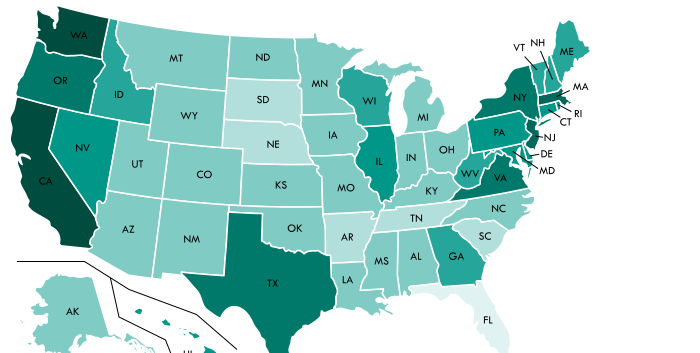
Most common states for employment recruiters
| Rank | State | Population | # of jobs | Employment/ 1000ppl |
|---|---|---|---|---|
| 1 | District of Columbia | 693,972 | 121 | 17% |
| 2 | Massachusetts | 6,859,819 | 422 | 6% |
| 3 | Oregon | 4,142,776 | 257 | 6% |
| 4 | New Hampshire | 1,342,795 | 81 | 6% |
| 5 | Alaska | 739,795 | 44 | 6% |
| 6 | Vermont | 623,657 | 35 | 6% |
| 7 | Washington | 7,405,743 | 361 | 5% |
| 8 | Colorado | 5,607,154 | 261 | 5% |
| 9 | Nebraska | 1,920,076 | 91 | 5% |
| 10 | Rhode Island | 1,059,639 | 56 | 5% |
| 11 | Delaware | 961,939 | 52 | 5% |
| 12 | Montana | 1,050,493 | 50 | 5% |
| 13 | North Dakota | 755,393 | 38 | 5% |
| 14 | Wyoming | 579,315 | 28 | 5% |
| 15 | Illinois | 12,802,023 | 469 | 4% |
| 16 | Virginia | 8,470,020 | 346 | 4% |
| 17 | Arizona | 7,016,270 | 263 | 4% |
| 18 | Connecticut | 3,588,184 | 126 | 4% |
| 19 | Iowa | 3,145,711 | 111 | 4% |
| 20 | Idaho | 1,716,943 | 69 | 4% |
Most common cities for employment recruiters
| Rank | City | # of jobs | Employment/ 1000ppl | Avg. salary |
|---|---|---|---|---|
| 1 | Silver Spring | 1 | 1% | $52,900 |
| 2 | Phoenix | 1 | 0% | $46,132 |
Employment Recruiter job outlook: Expert opinions
Our panel of employment recruiter experts
University of Scranton
Coastal Carolina University
Manhattan College

Neumann University

Land O Lakes

Grand Valley State University

University of Idaho
Superior Restaurant Group

University of New Hampshire

Drexel University
Muhlenberg College

LIU-Brooklyn

The Pennsylvania State University

Emmaus Homes

East Tennessee State University

DePaul University

Macalester College

SHRM
HRCI
What general advice would you give to an Employment Recruiter?
Sara Moore MBA: In the next 3-5 years, employers will gravitate towards candidates with three vital skills: communication, problem-solving, and collaborative teamwork. Communication skills are essential as professionals navigate complex interactions with diverse stakeholders, effectively express ideas, and cultivate meaningful connections. Additionally, problem-solving and critical thinking abilities will be in high demand as the field faces new challenges and explores innovative solutions. As the landscape of human development continues to evolve, collaborative teamwork will grow in importance, reflecting the trend towards interdisciplinary and diverse approaches. Professionals who excel in these three skills will be well-equipped to manage emerging issues, propel positive change, and make meaningful contributions to society.
What will help Employment Recruiters increase their earning potential?
Dr. Paul Datti PhD, CRC, HS-BCP: Graduates of The University of Scranton’s Counseling and Human Services program, as well as other similar educational programs, tend to have significant success upon graduation. At Scranton, typically about half to two-thirds of our graduates go on to graduate school, mainly in professional counseling or social work, but some also go on to programs in public administration, applied behavior analysis, child life care, and even law school. The remainder tend to soon get jobs in the field, in positions such as behavioral health technician, community health assistant, rehabilitation aide, child advocate, psychiatric or mental health technician, social work assistant, and more. According to OnetOnline and the Bureau of Labor Statistics, jobs in this area are expected to exponentially grow over the years and are considered “bright outlook” occupations.
What will help Employment Recruiters increase their earning potential?
Leann Mischel PhD: The soft skills will always be important. Communication, teamwork, and leadership skills should always be honed. In addition to those, it is important to keep up with technology and AI. It is no surprise that both of these are changing at lightning speed. Graduates need to keep in mind that these will make their jobs easier, not take their jobs from them. Utilize them to increase the quality and quantity of your performance and increase your efficiency.
Pamela Chasek
Professor of Political Science, Manhattan CollegeManhattan College
International Relations And National Security Studies
What general advice would you give to an Employment Recruiter?
Pamela Chasek: I think it is important to understand economics, speak another major language in addition to English, and have good computer skills. It is also important. But strong interpersonal skills should not be underestimated.
What Employment Recruiter skills would you recommend for someone trying to advance their career?
Pamela Chasek: The more skills you have the better off you will be. Negotiate your salary package -- don't just accept what they offer you. However, if they refuse to budge, you may want to negotiate consideration of a raise after a 3-month probationary period.
What will help Employment Recruiters increase their earning potential?
Pamela Chasek: I think it is important to understand economics, speak another major language in addition to English, and have good computer skills. It is also important. But strong interpersonal skills should not be underestimated.
Robert Till Ph.D.
Professor EmeritusNeumann University
Management Department
What hard/technical skills are most important for Employment Recruiters?
Robert Till Ph.D.: Employers expect that you will be proficient in Microsoft office, plus exposure to other HR-related software is important. Another hard skill that is highlighted frequently is familiarity with the employment law: HR professionals must be aware of EEO laws, ERISA, FMLA, Fair pay, and healthcare regulations. Finally, a few graduates highlighted the importance of basic financial skills, such as budgeting, forecasting, and basic statistics.
What skills will help Employment Recruiters earn the most?
Robert Till Ph.D.: When considering what areas of HR offer the greatest compensation, you need to think about supply and demand. Typically, if you have quantitative or computer skills, your value increases. A simple search of HR jobs suggests that Compensation and Benefits is an area that does pay well.
The graduates felt their CIS course and their HR Courses were helpful to their success, but they would have liked exposure to HR software currently being used in the field and greater exposure to forms typically used in HR departments.
Philomena Morrissey Satre
Director of Diversity Equity & Inclusion and External Strategic PartnershipsLand O Lakes
What soft skills should all Employment Recruiters possess?
Philomena Morrissey Satre: Inquisitive, ability to operate within ambiguity, strong customer service aptitude, strong cultural competency skills, agility, and adaptability to change.
What hard/technical skills are most important for Employment Recruiters?
Philomena Morrissey Satre: Ability to learn and work with HR Systems like payrolls systems: HRIS and Learning and Development Platforms. Can work effectively with data, understanding and applying knowledge, juggling multiple priorities, and problem-solving.
Dan Wiljanen Ph.D.
Affiliate of Practice Professor, SHRM Student Chapter AdviserGrand Valley State University
Seidman College of Business
What soft skills should all Employment Recruiters possess?
Dan Wiljanen Ph.D.: Soft Skills
-Active Listening - Giving full attention to what other people are saying, taking time to understand the points being made, asking questions as appropriate, and not interrupting at inappropriate times.
-Critical Thinking - Using logic and reasoning to identify the strengths and weaknesses of alternative solutions, conclusions, or approaches to problems.
-Service Orientation - Actively looking for ways to help people.
-Social Perceptiveness - Being aware of others' reactions and understanding why they react as they do.
-Judgment and Decision Making - Considering the relative costs and benefits of potential actions to choose the most appropriate one.
-Complex Problem Solving - Identifying complex problems and reviewing related information to develop and evaluate options and implement solutions.
-Coordination - Adjusting actions concerning others' actions.
-Time Management - Managing one's own time and the time of others.
-Competencies - Blend of skills, abilities, and knowledge
-Integrity - Job requires being honest and ethical.
-Cooperation - Job requires being pleasant with others on the job and displaying a good-natured, cooperative attitude.
-Attention to Detail - Job requires being careful about detail and thorough in completing work tasks.
-Dependability - Job requires being reliable, responsible, and dependable, and fulfilling obligations.
-Adaptability/Flexibility - Job requires being open to change (positive or negative) and considerable variety in the workplace.
-Stress Tolerance - Job requires accepting criticism and dealing calmly and effectively with high-stress situations.
-Concern for Others - Job requires being sensitive to others' needs and feelings and understanding and helpful on the job.
-Social Orientation - Job requires preferring to work with others rather than alone and being personally connected with others on the job.
-Analytical Thinking - The job requires analyzing information and using logic to address work-related issues and problems.
Initiative - Job requires a willingness to take on responsibilities and challenges.
-Persistence - Job requires persistence in the face of obstacles.
What hard/technical skills are most important for Employment Recruiters?
Dan Wiljanen Ph.D.: Knowledge of the HR Discipline
-Personnel and Human Resources - Knowledge of principles and procedures for personnel recruitment, selection, training, compensation and benefits, labor relations and negotiation, and personnel information systems.
-Administration and Management - Knowledge of business and management principles involved in strategic planning, resource allocation, human resources modeling, leadership technique, production methods, and coordination of people and resources.
-Law and Government - Knowledge of laws, government regulations, and executive orders.
-Education and Training - Knowledge of principles and methods for training design, implementation, and evaluation.
Technology Skills
-Enterprise resource planning ERP software
-Human resources software - Human Resource Information Systems (HRIS)
-Office suite software
-Project management software
-Web page creation and editing software
-Word processing software
Daniel Eveleth Ph.D.
Professor of Management and Human ResourcesUniversity of Idaho
Department of Business
What skills stand out on Employment Recruiter resumes?
Daniel Eveleth Ph.D.: Given this emphasis on the candidate, employee, and manager experiences, what skills are needed:
-Empathy skill - able to look at "our processes" through the eyes of the candidate, employee, manager. It is their journey, not our process.
-Relationship building - given the demand for talent, we often need to play the long game; rather than posting a job announcement and praying for applications to "process," we may need to develop connections with passive job seekers, for example, who may not be ready to apply; we need to think about how we reject candidates so that they pass on positive word of mouth to others and possibly reply/apply when a better fit appears. We may need to develop our relationships with hiring managers to help them make quicker hiring decisions, help them avoid biases when interviewing, learn more from them about their talent needs and preferences.
-Ability and willingness to search for talent. There are excellent job seekers who don't know your organization exists or that you have a culture, positions, etc., that would be a good fit. This is particularly critical for helping a company meet its DEI goals.
-Interpersonal communication skills:
-Job candidates prefer recruiters who are both warm/approachable and knowledgeable about the jobs and the company.
-Hiring managers and other business partners often have varying degrees of experience with recruiting, selection, onboarding, development practices and have unique needs and often unique personalities, work styles, etc. Communication with them is critical and sometimes includes having challenging conversations.
-Tools-oriented skills:
-Data analysis skills
-Journey/Experience mapping
-Data visualization (e.g., Tableau)
-Knowledge of applicant tracking systems
-Success using social media to engage followers (e.g., managed a fraternity's social media sites to engage alumni)
-Familiarity with managing conversations via remote technology.
-Interest in the company/industry.
What are the biggest trends we'll see in the Employment Recruiter job market given the pandemic?
Brandi Sechrist: The trend we are currently seeing due to the pandemic is lack of applicant flow. I would encourage those coming into the restaurant business to think outside of the box on attracting candidates.
Jonathan Nash Ph.D.
Assistant Professor of AccountingUniversity of New Hampshire
Paul College of Business and Economics
What are the biggest trends we'll see in the Employment Recruiter job market given the pandemic?
Jonathan Nash Ph.D.: In most years accounting firms have a visible presence on campus. They host networking sessions, resume reviews, and other events promoting professional development. Because of the pandemic firms now offer virtual sessions to help students gain insight into this profession and firm culture. Similarly, interviews, internships, and leadership training events have all moved online.
Despite these changes, employment opportunities have remained strong. Firms need accounting information to make decisions irrespective of macro-level economic conditions. As a result, demand for accounting majors is fairly inelastic (in the press accounting is often referred to as a "recession proof" majorwww.cnbc.com. Initial data suggests our placement rate for this year will be in the mid-90's, consistent with prior years, and salaries remain high (median starting salary of approximately $60,000) relative to most other majors.
Dr. Salvatore Falletta
Human Resource Development – Program DirectorDrexel University
Policy, Organization, and Leadership
Will there be an enduring impact of the coronavirus pandemic on Employment Recruiters?
Dr. Salvatore Falletta: The once-in-a-100-years pandemic namely, COVID-19, has been sweeping across our nation and the world. Uncertainty is at an all-time high, as we experience complete disruption of our daily activities and become more homebound. As a result, the way in which we work has changed rapidly. Working remotely has exponentially increased and technology is being leveraged like never before. Remote work will be the new normal for many organizations and industries including the HR profession, which in turn, will provide recent graduates and top talent with greater opportunities irrespective of geographical location and where they physically reside.
Ryan Smolko
Associate Director, Career CenterMuhlenberg College
The Career Center at Muhlenberg College
What technical skills for an Employment Recruiter stand out to employers?
Ryan Smolko: Technical skills vary by industry and the technical skills needed today are not those that will be needed five or even one year from now. Adaptability is key to staying relevant in their career both now and in the future. O*Net is a great resource for students to see technical skills commonly used in their jobs of interest.
The technical skills everyone should be continually working on are Excel/Tableau and Canva/PowerPoint. Working with large amounts of data is almost universal in today's economy regardless of industry or position. You can also have the best data in the world but if you can't present it in a dynamic way it won't be seen which is why being well versed in presentation and design tools can be a big advantage.
What's a good job out of college for Employment Recruiters?
Ryan Smolko: A good job out of college is one that integrates a students skillset with their larger value system. Students can see every job available with a click of a button so employers are doing a lot around showing their culture, mission and social responsibility in very genuine ways.
What are the biggest trends we'll see in the Employment Recruiter job market given the pandemic?
Ryan Smolko: Overnight, employers have had to innovate the way in which they do their work. Even when it is safe for employees to return to their offices, a level of flexibility will almost certainly be a staple going forward. Productivity is measured by work done- not hours at a desk. Those employers who remain rigid will find retaining top talent challenging. Along those lines employees will have the ability to live almost anywhere while still building a successful career.
Will there be an enduring impact of the coronavirus pandemic on Employment Recruiters?
Herbert Sherman Ph.D.: The coronavirus has changed the way in which people work as well as the type of work that people will be performing by accelerating the use of technology to facilitate more employees working in a virtual setting and therein reducing the need for traditional office space or even shared workspace. Graduates with a degree in human resource management will need to not only be comfortable working remotely in a non-office environment but need to truly find a balance between work demands (which are now 24/7) and the ability to lose oneself within the comforts of one's home surroundings. Work-life balance will not only be of the utmost import for employees but for HR professionals as well.
Secondly, HR graduates, even if working in a traditional office setting, will be expected to be well versed in the use of HR analytics and HRIS packages (i.e. UKG Pro, TriNet, BambooHR, UKG Ready, Workday Human Capital Management, Ceridian Dayforce, Oracle Cloud HCM, ADP Workforce Now, Oracle PeopleSoft HCM, Paychex Flex, and Zenefits) which integrate HR functions including job analysis and job design, recruitment and selection of employees, training and development, performance management, compensation and benefits, and employee retention. HR graduates should also be quite comfortable using computer hardware and software that facilitate virtual meetings and conferences - in person job interviews may become the thing of the past and replaced with Zoom, Google Hangouts, Cisco Webex Meetings and even Skype or WhatsApp.
What are the biggest trends we'll see in the Employment Recruiter job market given the pandemic?
Elaine Farndale Ph.D.: As we move into a period of economic recovery following the pandemic, I would expect to see a gradual opening up of positions across the job market, but no major recovery for the next couple of years. As most businesses start to regroup and win back their customers, there will likely be cautious steps forward. STEM jobs are most likely to be in high demand as these are areas in which the future economy will grow, but also areas in which the supply of suitable talent is limited. HR graduates will have an influential role to play if they can demonstrate skills in helping organizations transition through a complex restructuring of jobs and activities.
What skills stand out on Employment Recruiter resumes?
Elaine Farndale Ph.D.: An ability to be flexible and adaptable has to be a number one priority for most positions, particularly HR. This might be related to geographic flexibility, i.e., being willing to go where skills are needed, or flexibility of working hours or place of work (in an office or working from home). We have learned a lot about the advantages (e.g., reduced office space, meeting, and travel costs) and disadvantages (e.g., losing connections with co-workers, more complex people management, and productivity challenges) of remote working so businesses will be trying to continue to keep the advantages while removing the disadvantages once people can work on-site as well as remotely. HR professionals who can advise businesses through this balancing act will be invaluable.
Are there any particularly good places in the United States for Employment Recruiters to find work opportunities?
Elaine Farndale Ph.D.: The answer will lie in which states can recover from the pandemic the quickest, which is still very much unknown.
What skills stand out on Employment Recruiter resumes?
Tonya Courtois: To be most attractive to us a resume should be more than just a list of a person's work history and the skills they acquired while they occupied each role. A resume that will stand out to us, is a resume that tells us how a candidate problem-solved during their tenure at each job. We are also looking for candidates who closely align with our core value system. A one size fits all resume is not a best practice. Candidates should do their homework and clearly and specifically identify past behaviors that demonstrate they share our values. Resumes should be full of well-written examples of how they added value.
What are the biggest trends we'll see in the Employment Recruiter job market given the pandemic?
Tonya Courtois: Covid 19 has forced many to rethink and reevaluate the status quo. Remote work has always been a topic of consideration for many but the pandemic pushed it into high gear for both employers and potential employees. More employers are going to be looking for individuals who are open to remote work. This brings its own set of new considerations. As an employer you are looking for individuals who are able to manage themselves and their time. Are they tech-savvy, adaptable, innovative, organized and self-aware? How will we manage accountability and production? For potential employees, they want to know how they will learn the role, how personal will it feel, will there be any disconnect, and how to balance work and home life.
Recruiters will have to think outside of the box to hire and onboard individuals. However, it doesn't stop there. Recruiters now have to be more accommodating, educated on the culture of the organization, and find that personal touch that allows the candidate to feel connected to the mission of the organization. They have to paint that picture of the company as a whole. They will have to be the expert, the coach, the teacher, the face of the organization.
Are there any particularly good places in the United States for Employment Recruiters to find work opportunities?
Tonya Courtois: Our industry provides support staff to adults who have developmental disabilities. Our entry-level employees are called Direct Support Professionals (DSPS). We, like many others in our industry, are experiencing a significant staffing crisis. This crisis has gained national attention. To close the gap we continue to encourage our state legislatures to standardize rates and pay rates that will allow us to outpace minimum wage and be competitive with other high-volume employers. My recommendation to students and recent graduates is to research mission-driven, caregiving roles in their area, specifically those for individuals with disabilities. Learn about disabilities and understand the need. Reach out to a couple of different organizations in your area and connect with them to learn more about their mission. Find a good fit and pick up some part-time hours while finishing school. At Emmaus we are very intentional in creating career paths for individuals who have a mission heart and want to do work that matters. It's not just a job but a defined career path!
What general advice would you give to an Employment Recruiter?
Dr. James Lampley: Be willing to go where the jobs are. Many of our graduates are "place-bound". Their family obligations or spouses make it difficult to relocate.
What Employment Recruiter skills would you recommend for someone trying to advance their career?
Dr. James Lampley: I would encourage a graduate or graduate student to use the gap year experience to learn a new marketable skill or to work with under-served groups. Learn how to do something that not a lot of people can do.
What are the biggest trends we'll see in the Employment Recruiter job market given the pandemic?
Dr. James Lampley: Online delivery. Before the pandemic, we were already seeing a trend to more online programs. After we return to "normal" we will see online courses and online programs expand exponentially.
What Employment Recruiter skills would you recommend for someone trying to advance their career?
Dr. Martha Martinez- Firestone Ph.D.: I think a gap year is great to transform passions into expertise. Cultivate knowledge and networks in areas where you would eventually like to get a job. Research the industry that interests you, attend industry events, make zoom connections, and get the skills that people are talking about. If possible, volunteer in those industries to enhance your knowledge, contacts, and resume.
What experience really stands out on Employment Recruiter resumes?
Erik Larson: While it might seem a bit of a stretch to find a silver lining to this situation, I hope that students and employers recognize that the experiences of students navigating higher education in the pandemic will distinguish this group from their predecessors. In addition to their demonstrated ability to adapt to circumstances changing rapidly, I have been impressed by students' responsibility, care, and awareness in the current environment.
What are the biggest trends we'll see in the Employment Recruiter job market given the pandemic?
Regan Gross: There has been, and will continue to be, a shift in the way we do work. Employers are realizing that they can minimize overhead and leverage technology by adopting remote workforces. There will still be some employers who are resistant to this change and will continue to do things the traditional way. E-commerce jobs, such as those in online retail, will continue to increase, while jobs that require in-person social interaction, such as in the restaurant industry, will continue to evolve into contactless alternatives, reducing the number of positions available for employment. While hospitality and restaurants have been among the hardest hit, for many, still being able to dine-out and stay away from home, is important to their mental health.
Job interviews will continue to be virtual as much as feasible. Job seekers will be well advised to brush up on their on-camera interviewing skills, including dressing appropriately as with in-person job interviews, avoiding any background noise and being cognizant of the appearance of their on-camera surroundings/background. Practice virtual interviews with friends and family if possible.
Are there any particularly good places in the United States for Employment Recruiters to find work opportunities?
Dr. Amy Dufrane: Attractive locations for graduates to work are larger cities with manufacturing and service-driven economies using shared resources and supply chains with technological and virtual service delivery. However, as more companies have relaxed their remote work policies, where someone lives is becoming less and less important. What is becoming more important to graduates are the certifications and learning experiences that will differentiate them from others seeking employment.
How do you envision technology impacting Employment Recruiters in the next 5 years?
Dr. Amy Dufrane: Technology will continue to have a major impact on HR over the next five years. There will be increased use of automation displacement versus augmenting workers. Additionally, there will be an expansion of the use of digital tools, combined with data analytics and data literacy. Gaining industry certifications similar to HRCI's suite of credentials will be pivotal to remain agile and relevant in the ever-changing work landscape.