Explore jobs
Find specific jobs
Explore careers
Explore professions
Best companies
Explore companies
Job outlook for engineering support specialists in the United States
Are engineering support specialist jobs in demand?
Engineering support specialist job and salary trends over time
Engineering support specialist jobs over time
Engineering support specialist job growth rate over time
| Year | # of jobs | % of population |
|---|---|---|
| 2021 | 345 | 0.00% |
| 2020 | 394 | 0.00% |
| 2019 | 511 | 0.00% |
| 2018 | 251 | 0.00% |
| 2017 | 244 | 0.00% |
Average engineering support specialist salary over time
Engineering support specialist salary by year
| Year | Avg. salary | Hourly rate | % Change |
|---|---|---|---|
| 2025 | $70,461 | $33.88 | +3.4% |
| 2024 | $68,139 | $32.76 | +2.3% |
| 2023 | $66,596 | $32.02 | +1.5% |
| 2022 | $65,590 | $31.53 | +1.7% |
| 2021 | $64,519 | $31.02 | +1.6% |
Engineering support specialist jobs by state
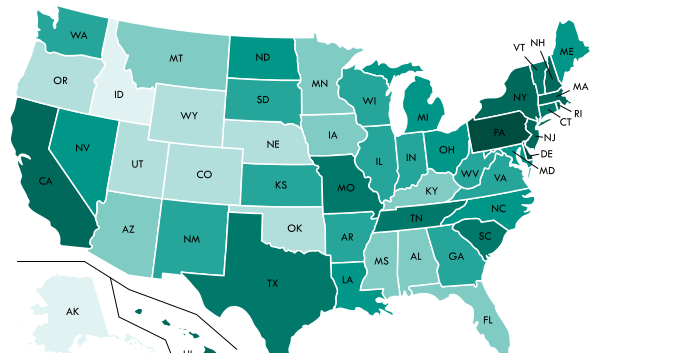
Most common states for engineering support specialists
| Rank | State | Population | # of jobs | Employment/ 1000ppl |
|---|---|---|---|---|
| 1 | District of Columbia | 693,972 | 513 | 74% |
| 2 | South Dakota | 869,666 | 331 | 38% |
| 3 | North Dakota | 755,393 | 261 | 35% |
| 4 | Washington | 7,405,743 | 2,349 | 32% |
| 5 | Massachusetts | 6,859,819 | 2,097 | 31% |
| 6 | Delaware | 961,939 | 298 | 31% |
| 7 | Utah | 3,101,833 | 943 | 30% |
| 8 | Alaska | 739,795 | 223 | 30% |
| 9 | Wyoming | 579,315 | 174 | 30% |
| 10 | Oregon | 4,142,776 | 1,219 | 29% |
| 11 | Kansas | 2,913,123 | 832 | 29% |
| 12 | Virginia | 8,470,020 | 2,405 | 28% |
| 13 | New Hampshire | 1,342,795 | 377 | 28% |
| 14 | Rhode Island | 1,059,639 | 295 | 28% |
| 15 | New Mexico | 2,088,070 | 562 | 27% |
| 16 | Maine | 1,335,907 | 355 | 27% |
| 17 | Montana | 1,050,493 | 286 | 27% |
| 18 | Nebraska | 1,920,076 | 503 | 26% |
| 19 | Maryland | 6,052,177 | 1,516 | 25% |
| 20 | Colorado | 5,607,154 | 1,408 | 25% |
Most common cities for engineering support specialists
| Rank | City | # of jobs | Employment/ 1000ppl | Avg. salary |
|---|---|---|---|---|
| 1 | Columbus | 4 | 9% | $65,603 |
| 2 | Scottsdale | 5 | 2% | $60,464 |
| 3 | Clearwater | 2 | 2% | $61,487 |
| 4 | Kokomo | 1 | 2% | $66,302 |
| 5 | Tempe | 2 | 1% | $60,578 |
| 6 | Grand Prairie | 1 | 1% | $73,367 |
| 7 | Muncie | 1 | 1% | $66,621 |
| 8 | Olathe | 1 | 1% | $67,876 |
| 9 | Overland Park | 1 | 1% | $67,941 |
| 10 | Saint Joseph | 1 | 1% | $75,619 |
| 11 | Birmingham | 1 | 0% | $60,761 |
| 12 | Fremont | 1 | 0% | $85,699 |
| 13 | Glendale | 1 | 0% | $60,532 |
| 14 | Oakland | 1 | 0% | $85,693 |
| 15 | Pittsburgh | 1 | 0% | $83,462 |
| 16 | San Jose | 1 | 0% | $85,803 |
Engineering Support Specialist job outlook: Expert opinions
Our panel of engineering support specialist experts
Texas A&M University San Antonio
Thomas Jefferson University and Philadelphia University

Grand Valley State University
Tiffin University

Whitworth University
SUNY College
What will help Engineering Support Specialists increase their earning potential?
Jason Nichols PhD: Build your experience base through internships and industry projects, and brag about these experiences when you interview. Collect professional certificates to compliment your degree. Security and cloud computing are excellent areas to pursue these in right now. AI and machine learning as well, of course. Build a structured skillset in problem solving and critical thinking, and demonstrate this skillset in your discussions with future employers. Map all of these efforts into a coherent story about yourself in your applications, and how they have shaped you to be a tech-savvy business problem solver, with a strong understanding of both the business and the technology. This foundation prepares you for so very many roles in our field, and businesses recognize and actively seek out this profile in their job candidates. Use the resources available to you. If you need additional time for more formal training, join a masters program. Join us for a masters program, actually. Our AI in Business masters program is launching this Fall, and is open for enrollment currently. Visit us here to learn more: https://wpcarey.asu.edu/masters-programs/ai-business
Robert Vinaja Ph.D.
Assistant Professor of Computer Information SystemsTexas A&M University San Antonio
Computer Information Systems Department
What soft skills should all Engineering Support Specialists possess?
Robert Vinaja Ph.D.: -Ability to work as part of a team.
-Attention to detail.
-Problem-solving and analytical skills.
Brian George Ph.D.
Associate ProfessorThomas Jefferson University and Philadelphia University
Industrial Engineering
What skills will help Engineering Support Specialists earn the most?
Brian George Ph.D.: Skills that companies desire are the ability to complete work on time, the ability to work with others, professionalism, a strong work ethic, leadership, and communication skills.
What skills stand out on Engineering Support Specialist resumes?
Brian George Ph.D.: For those with engineering degrees, there are usually courses that are the same across most engineering programs, and graduates will have the ability to address math, science, and engineering problems. What can stand out are courses like product development, problem-solving, data analysis classes, internships, co-ops, and summer jobs where students can apply the theory they learned in the classroom to real-world situations.
What hard/technical skills are most important for Engineering Support Specialists?
Brian George Ph.D.: Hard/technical skills needed for a position may be dependent upon the position itself. It is hard to say exactly what hard/technical skills are the most important without knowing the exact job description, but knowing how to find information to solve problems can be as important as knowing how to do the required work. Knowledge of engineering will be important for our graduates, but sometimes having experience or knowledge in other fields can be just as valuable, as is the ability to read technical papers and patents and understand them.
What soft skills should all Engineering Support Specialists possess?
Brian George Ph.D.: As far as soft skills, the ability to communicate verbally and via writing, work together with people from different backgrounds, and brainstorm and critical thinking are all important soft skills, such as networking.
What technical skills for an Engineering Support Specialist stand out to employers?
Chirag Parikh Ph.D.: If you ask me, I consider valuable experience over good paycheck. Once you have gained that experience the paycheck will follow. As soon as you are out of college, the knowledge gained is very fresh and raring to go. If put into the right place can enhance your technical skills and you can do wonders.
As a Computer Engineering professor, I would say the job opportunities are tremendous for students out of college as they can venture into hardware field (technical support, hardware engineer, test engineer and much more) as well as software field (software engineer, software developer, software tester and much more). The possibilities are endless.
With COVID and employees working remotely there is still ample opportunity to enhance your technical and interpersonal skills as I believe remote working might stay for a while till things get back to normal.
What type of skills will young Engineering Support Specialists need?
George Miller: Many organizations realize graduates cannot learn everything in college about their major but want the graduate to have a solid foundation on their field of study. The organization wants to mold the graduate to their company environment with how they do things related to the field of study. Most companies want college graduates to have good communication skills (both oral and written), critical thinking skills and be able to work well in teams. These skills have been a staple for graduates since I can remember. This is why a college graduate takes many general education courses related to these skills and many of their major courses emphasize these skills.
Going back to the previous answer I believe graduates in all fields of study will need a better knowledge of technology and easier adaptability to changing technology. Again, an IS degree is already preparing students for this.
What are the biggest trends we'll see in the Engineering Support Specialist job market given the pandemic?
Kamesh Sankaran Ph.D.: Though the trend in remote work is widely expected to continue even after the pandemic, there are some associated trends that are overlooked:
a) An increase in delivery (packages to the home office, etc.) to support remote workers, and
b) Embedded systems and IoT technologies at the worksites.
What skills stand out on Engineering Support Specialist resumes?
Kamesh Sankaran Ph.D.: Interdisciplinary problem solving in engineering
Are there any particularly good places in the United States for Engineering Support Specialists to find work opportunities?
Kamesh Sankaran Ph.D.: Low-cost places for startups that are close to existing hubs
What are the biggest trends we'll see in the Engineering Support Specialist job market given the pandemic?
Klaus Dölle: During the Pandemic implementation, home office workspaces are very popular. Companies have to reduce their workforce population in their office space, especially, if they have large open space offices. Online meetings are very common now using Skype, Microsoft Teams, Zoom, Google Meet, etc., depending on the company's policy or internal regulation.
Due to on-line meetings, large companies, save two-digit million numbers in travel cost. This will have an impact on future travel and meetings. Home office space will save future office space costs. Home office space is already implemented for some sales force prior to COVID (Why pay for office space if the sales rep travels 80% of his time?) I assume companies will most likely reduce some office space and save costs that way, by having to rent less office space. Fewer business trips in the future, more on-line meetings. This will have an impact on airline travel. I remember when I was working and 9/11 happened, the same was done by companies on a much smaller scale. Internet technology was not that advanced yet and too costly; after a while, it went back to a normal operation.