Explore jobs
Find specific jobs
Explore careers
Explore professions
Best companies
Explore companies
Job outlook for enterprise data architects in the United States
Enterprise data architect job growth summary. After extensive research, interviews, and analysis, Zippia's data science team found that:
The projected enterprise data architect job growth rate is 5% from 2018-2028.
About 8,400 new jobs for enterprise data architects are projected over the next decade.
Enterprise data architect salaries have increased 10% for enterprise data architects in the last 5 years.
There are over 14,721 enterprise data architects currently employed in the United States.
There are 151,018 active enterprise data architect job openings in the US.
The average enterprise data architect salary is $127,432.
Are enterprise data architect jobs in demand?
Enterprise data architect job and salary trends over time
Enterprise data architect jobs over time
Enterprise data architect job growth rate over time
| Year | # of jobs | % of population |
|---|---|---|
| 2021 | 14,721 | 0.00% |
| 2020 | 24,145 | 0.01% |
| 2019 | 24,598 | 0.01% |
| 2018 | 11,918 | 0.00% |
| 2017 | 11,666 | 0.00% |
Average enterprise data architect salary over time
Enterprise data architect salary by year
| Year | Avg. salary | Hourly rate | % Change |
|---|---|---|---|
| 2026 | $127,432 | $61.27 | +3.4% |
| 2025 | $123,234 | $59.25 | +2.3% |
| 2024 | $120,444 | $57.91 | +2.0% |
| 2023 | $118,095 | $56.78 | +2.3% |
| 2022 | $115,427 | $55.49 | +1.5% |
Enterprise data architect jobs by state
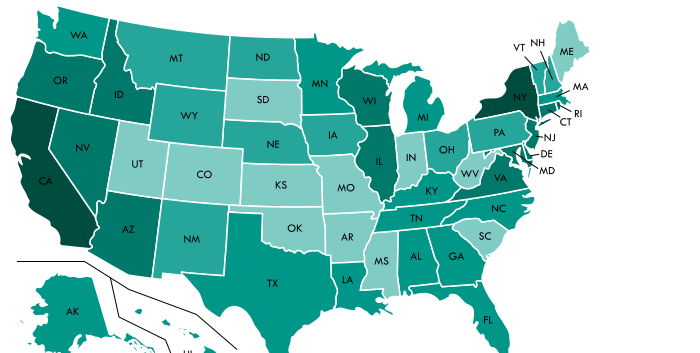
Most common states for enterprise data architects
| Rank | State | Population | # of jobs | Employment/ 1000ppl |
|---|---|---|---|---|
| 1 | District of Columbia | 693,972 | 696 | 100% |
| 2 | Massachusetts | 6,859,819 | 2,417 | 35% |
| 3 | Vermont | 623,657 | 190 | 30% |
| 4 | North Dakota | 755,393 | 216 | 29% |
| 5 | Utah | 3,101,833 | 843 | 27% |
| 6 | Maryland | 6,052,177 | 1,510 | 25% |
| 7 | Connecticut | 3,588,184 | 895 | 25% |
| 8 | Wyoming | 579,315 | 147 | 25% |
| 9 | Illinois | 12,802,023 | 3,123 | 24% |
| 10 | Colorado | 5,607,154 | 1,328 | 24% |
| 11 | New Hampshire | 1,342,795 | 316 | 24% |
| 12 | Minnesota | 5,576,606 | 1,301 | 23% |
| 13 | Georgia | 10,429,379 | 2,287 | 22% |
| 14 | Montana | 1,050,493 | 218 | 21% |
| 15 | Alaska | 739,795 | 157 | 21% |
| 16 | Idaho | 1,716,943 | 344 | 20% |
| 17 | North Carolina | 10,273,419 | 1,955 | 19% |
| 18 | New Jersey | 9,005,644 | 1,748 | 19% |
| 19 | Oregon | 4,142,776 | 772 | 19% |
| 20 | Rhode Island | 1,059,639 | 199 | 19% |
Most common cities for enterprise data architects
| Rank | City | # of jobs | Employment/ 1000ppl | Avg. salary |
|---|---|---|---|---|
| 1 | Burlington | 1 | 4% | $117,170 |
| 2 | Annapolis | 1 | 3% | $122,698 |
| 3 | Dover | 1 | 3% | $120,817 |
| 4 | Hartford | 2 | 2% | $127,363 |
| 5 | Alpharetta | 1 | 2% | $111,626 |
| 6 | Glenview | 1 | 2% | $128,045 |
| 7 | Boston | 4 | 1% | $117,382 |
| 8 | Atlanta | 3 | 1% | $111,512 |
| 9 | Little Rock | 2 | 1% | $98,381 |
| 10 | Tallahassee | 2 | 1% | $118,004 |
| 11 | Tampa | 2 | 1% | $120,601 |
| 12 | Framingham | 1 | 1% | $117,373 |
| 13 | Baton Rouge | 1 | 0% | $117,602 |
| 14 | Colorado Springs | 1 | 0% | $101,442 |
| 15 | Des Moines | 1 | 0% | $103,796 |
Enterprise Data Architect job outlook: Expert opinions
Our panel of enterprise data architect experts
Worcester Polytechnic Institute
Missouri University of Science and Technology
Massachusetts Institute of Technology
University of Florida
University of Nevada - Las Vegas
SUNY at Buffalo
University of Nevada - Las Vegas

University Of Nevada, Las Vegas

University of New Mexico
Arizona State University

Wartburg College

University of Wisconsin - Milwaukee

Seminole State College of Florida

Rochester Institute of Technology
College of Charleston
Dr. Steven Van Dessel Ph.D. Assoc. AIA
Associate Professor, Director Architectural Engineering ProgramWorcester Polytechnic Institute
Architectural Engineering
What general advice would you give to an Enterprise Data Architect?
Dr. Steven Van Dessel Ph.D. Assoc. AIA: Employers always stress the importance of students knowing the fundamentals of engineering and the integration of engineering fundamentals with architectural design. Our program is quite unique in this respect as we are the only degree program in the country where students can earn an architectural engineering degree that is ABET accredited (they can get their PE) - and then also can gain their NAAB accredited architecture degree with one additional year (allowing them to also become architects). Knowledge of building information modeling is required, and I would think that AI at some point will also play a role when combined with advanced surveying technologies.
What general advice would you give to an Enterprise Data Architect?
Rebecca Dolgas: 2. The ability to implement VR, AR, and AI capabilities. Clients are coming to expect photorealistic renderings and to be able to walk through their space virtually. Having the skill set to implement these tools will be crucial in keeping clients informed and pleased with your work.
What Enterprise Data Architect skills would you recommend for someone trying to advance their career?
Rebecca Dolgas: 3. Be aware of your strengths and don't be afraid to negotiate. If you have multi-faceted skillsets make sure they are known. For example if you do well maintaining your own social media make a point that you would like to assist with marketing in a smaller firm. A great Marywood specific example is how closely interiors and architecture learn together. Being able to have a collaborative spirit and bring both disciplines together can be invaluable. If you can show your interdisciplinary skill set, it will make you more valuable and thus able to negotiate for a better salary.
Heath Pickerill PhD
Assistant Teaching ProfessorMissouri University of Science and Technology
Architectural Engineering
What will help Enterprise Data Architects increase their earning potential?
Heath Pickerill PhD: By boosting your resume through participation in professional organizations and design teams within the field, as well as diverse work experience with on-the-job training through internships and co-ops.
What general advice would you give to an Enterprise Data Architect?
Paul Pettigrew AIA, NCARB, MIT M.Arch ʼ88: I think it’s a great time to be an architect. When numbers like close to 40% of the earth’s global carbon emissions are related to buildings being torn down, buildings being built, and operation of buildings, there’s no doubt that architects will be key players in future efforts to sustain the long term health of planet earth.
What Enterprise Data Architect skills would you recommend for someone trying to advance their career?
Paul Pettigrew AIA, NCARB, MIT M.Arch ʼ88: Adaptability, the ability and desire to constantly learn new tools, techniques, business practices, and construction technologies/methodologies. The architecture profession has changed dramatically since the introduction of computers into practice, and all indications are that architectural practice will continue to change as computers, fabrication machines that talk to and work with computers, and technologies related to issues of sustainability, continue to adapt to the economics, business, practice, and significance of the architecture profession.
What will help Enterprise Data Architects increase their earning potential?
Paul Pettigrew AIA, NCARB, MIT M.Arch ʼ88: Salary isn’t the whole story. Recent graduates need to take into account not only salary, but housing costs, and living expenses. The salary of a young architect will go farther in Chicago than it will in New York, Boston, or San Francisco. Cities with more extensive public transportation systems might offer recent graduates the option of not owning a car which could be a significant cost savings when you factor in car purchase cost, gas, parking, insurance, and maintenance.
What general advice would you give to an Enterprise Data Architect?
Martin Gold FAIA: The most widespread complaint from people in the field is that it consumes ones attention, requires long hours, and relative to other professions, such as medicine, law, accounting, or engineering, the pay is lower on a per hour basis. On the other hand, architecture is more of an art than other professions and offers opportunities for creative people to have prosperous careers. The famous French architect Le Corbusier would say, architecture is a way of life.
What general advice would you give to an Enterprise Data Architect?
Grant Mosey Ph.D.: The path to salary maximization often seems to be a willingness to advocate on one's own behalf and be willing to move firms if necessary. Early career professionals may want to also think about where they are building their expertise. It is likely that architects who work on healthcare or multifamily housing are more likely to have abundant work in the future than those who work on places of religious worship or primary schools. The region in which one chooses to work and make connections can also be important. It never hurts to have a 'name brand' firm on one's resume early in one's career.
What Enterprise Data Architect skills would you recommend for someone trying to advance their career?
Grant Mosey Ph.D.: I would advise architecture students to be as flexible as possible. While NAAB accredited schools award 6,000 to 7,000 professional degrees per year, NCARB states that fewer than 3,500 architects reach licensure each year. This suggests that many of those educated as architects are actually finding work in allied subjects. I know of many graduates who are set to become architects who end up becoming real estate professionals, construction professionals, policy-makers, academics, and more. Even for those dead set on architectural practice, these opportunities in adjacent fields can open doors to more design-focused practice.
What will help Enterprise Data Architects increase their earning potential?
Grant Mosey Ph.D.: Familiarity with Building Information Modeling software like Revit is already all but a requirement to find professional work. Increasingly, firms are also looking for those who are capable of using visual programming like Grasshopper or Dynamo not only to generate forms but to optimize their workflow. In addition to those, professionals should familiarize themselves with modeling programs including SketchUp and Rhino and visualization platforms like VRay, Enscape, and Twin Motion. Soft skills like being personable and being able to present ideas extemporaneously will never go out of style.
What general advice would you give to an Enterprise Data Architect?
Elaine Chow AIA, RA, NCARB: Adaptability will always be an important skill. There will be software improvements and changes that you need to stay aware of and technology that will benefit both the design and construction sides of the industry. Communication will remain an important part of the way we work together in teams.
What Enterprise Data Architect skills would you recommend for someone trying to advance their career?
Elaine Chow AIA, RA, NCARB: Architecture licensure will help maximize salary potential, as well as pursuing other certifications such as LEED, CPHC, WELL, etc. Be your own advocate and request regular/annual reviews that allow you to highlight accomplishments and value you bring to your employer. If specialization appeals to you, there are opportunities to market yourself as an expert in a specific subject area.
What general advice would you give to an Enterprise Data Architect?
Alfredo Fernandez-Gonzalez: It is important for recent graduates to recognize that Architecture is no longer limited to the physical realm, as transformative technologies are providing interesting career opportunities in the digital realm as well. This rapidly evolving context offers many opportunities and new directions for the discipline and remaining (or becoming!) current in new developments in computing power, digital visuals, manufacturing technologies, and robotics, are ways in which a recent graduate can secure a good paying job.
Dak Kopec Ph.D.
Associate Professor, Coordinator, BA Interior Architecture and Design and Master of Design ProgramUniversity Of Nevada, Las Vegas
School of Architecture
What soft skills should all Enterprise Data Architects possess?
Dak Kopec Ph.D.: Flexibility in thinking and the ability to understand other people's perspectives. Basically, to get along as a team while keeping the negativity to a minimum.
What hard/technical skills are most important for Enterprise Data Architects?
Dak Kopec Ph.D.: Revit and CAD. Especially as these relate to performative design. What I mean by performative design are technologically feature-rich buildings to respond to atmospheric and environmental conditions that support human occupation and productivity.
What are the biggest trends we'll see in the Enterprise Data Architect job market given the pandemic?
Tamarah Begay: One of the largest trends in the job market given the pandemic is the usage of different online and virtual platforms for interviews and meetings. Not only are these platforms being used to communicate ideas and design but to connect and link professionals to job seekers. This has allowed the industry to have shifted to predominantly working remotely. There has also been a rise and increase in anti-microbial materials, space planning, and incorporating a cleaner HVAC and air quality system into buildings. This can include using hard surface floors and furniture without fabrics to allow for ease of cleaning and to help reduce the spread of germs and incorporating specialty air filters or lights. The industry has also seen an increase in wanting to incorporate outdoor spaces within designs.
What certifications/licenses/courses can have the biggest impact for Enterprise Data Architects?
Tamarah Begay: Certifications and licenses that can be locally, nationally, and universally applicable are most impactful for a future job prospect to have. Being a licensed Architect and having or being LEED certified is of great impact for job prospects on all levels. Staying up to date on continuing education courses and staying knowledgeable about new products or methods should be a habitual update to one's personal knowledge bank. Bringing versatility and diversity to the work place in any form, whether it is through licenses or courses, is beneficial and can have a great impact.
How have salaries changed over time for Enterprise Data Architects?
Marc Neveu Ph.D.: I was first hired into an architecture office over 25 years ago, so I can say with some confidence, that salaries have gone up! Many offices, however, are very different than when I graduated. Not all, but many are much more integrated with other disciplines. There is an incredible group of firms in the valley, like Construction Zone, who do both design and construction. Others, like Ryan Companies, are integrated from Development through Facilities Management. By owning more of the entire process, rather than just the design, firms are able to generate more revenue. As a student graduating today, I would be better position to have an architecture degree plus an additional credential - in construction management, real estate development, or even sustainability. In this way, you can leverage your position in an office to be more valuable.
Anonymous Professor
How have salaries changed over time for Enterprise Data Architects?
Anonymous Professor : With regard to money and employment compensation ... those who can be willing to try new things and move with the flow will do well ... very well. Those who cannot, it's McDonald's and minimum wage ...
A footnote: ... the people I contact do not care about who you are, what you are, or how you are. So things like pronouns, and victimization, and excuses, and hanging on to reasons for failure will not cut it in the workplace of the future ... learn ... grow ... and you will have success ...
What certifications/licenses/courses can have the biggest impact for Enterprise Data Architects?
Anonymous Professor : With regard to student graduates with the license issue and their potential, it's all about and their ability to think ... my contacts tell me that they want people who can look outside the box ... and be flexible to change ... and make no mistake about it ... the future is all about a willingness to change and be flexible to change. Professional license requirements is a think of the past ... it's all about what you can do now.
Will there be an enduring impact of the coronavirus pandemic on Enterprise Data Architects?
Brian Birgen Ph.D.: These students will be better prepared for online collaboration. Many companies are learning what aspects of the job require in-person presence and which can be completed remotely. Recent graduates will have experience working collaboratively at a distance, which will become an increasingly important skill.
What are the biggest trends we'll see in the Enterprise Data Architect job market given the pandemic?
James Shields: In mid-to-late 2020, some 70% of architecture firms saw a decline in billings due to Covid-19 impacts. Some architecture firms were hit worse than others; firms that designed office buildings, hospitality projects and cultural buildings fared poorly, and in general have not been hiring. Health care organizations and the architecture firms that service them have also been hit, although most firms have helped hospitals evaluate or design alternative Covid-care facilities.
Firms that design housing projects remained more stable and have continued to at least interview some job candidates. There has also been an increase in demand for master planning services of all kinds, as communities and businesses want to be prepared for the end of the pandemic and a return to more normal economic activity with a plan for expansion in place. Firms that design Science & Technology buildings, like university lab, science and health care teaching buildings, have also seen their workload remain stable and be less affected by the pandemic as many US States have continued to fund such projects.
School design firms have also done well, as many local districts have been able to pass referendums for new projects during the crisis, keeping their architects busy. There has also been a surprisingly strong turn towards interest in sustainable energy and infrastructure systems during the pandemic.
What skills stand out on Enterprise Data Architect resumes?
James Shields: Many interviews for architecture jobs remain online at the present time, so an ability to communicate via Zoom or Teams is vital. Looking professional on the small screen with an ability to show your work well are skills that can be practiced before an interview. Most architecture employees are currently working online from home, so knowledge of the essential digital architecture programs (like Revit, Bluebeam, Sketchup, et al) is currently very important. On resumes and in portfolios, any experience in the architecture sectors that have remained relatively stable (Housing, Master Planning, Science & Tech, Schools, sustainable infrastructure) should be emphasized. If you have no such experience, read up on current trends in these practice areas online and find some that interest you. Conveying such an interest can go a long way.
Christy Graves
Professor/Program ManagerSeminole State College of Florida
School of Engineering, Design and Construction
What technology do you think will become more important and prevalent for Enterprise Data Architects in the next 3-5 years?
Christy Graves: BIM (building information modeling) technology will continue to become more important in the architectural engineering technology profession.
Clyde Eiríkur Hull
Professor of Strategic ManagementRochester Institute of Technology
Saunders College of Business
What type of skills will young Enterprise Data Architects need?
Clyde Eiríkur Hull: Graduates entering the workforce now and in the future will need to be comfortable in a digital workplace. Working digitally, whether in an established company or as a digital entrepreneur, was a growing trend before the pandemic, but it was pushing against a lot of inertia. That inertia has switched. Anything that works better, for the employer, digitally instead of in person is going to stay. Even if you aren't working remotely, you'll deal with many people who are. Graduates will need to be more capable of independent work, whether in virtual teams or on their own. But at the same time, interpersonal skills are going to become more important. People aren't interacting as much as they did, so their human skills are rusting. Anyone with polished interpersonal skills is going to stand out more.
How do you envision technology impacting Enterprise Data Architects in the next 5 years?
Clyde Eiríkur Hull: Architecture is being hit with virtual reality and augmented reality. Anything you can design now can be built in virtual reality for modeling. But the trend toward digital work is going to impact architectural designs for a long time to come. How will future homes be designed when many residents plan to work from home? How will professional buildings be impacted? Those are questions that architects are answering right now.
What technology do you think will become more important and prevalent for Enterprise Data Architects in the next 3-5 years?
Dr. Barry Stiefel Ph.D.: No one (except for maybe Steve Jobs) foresaw the Smartphone Revolution. Yet, by 2010 the world had changed. Five years from now (2025), there could be another new technology that we have not even imagined previously.
My suggestion is to try to be aware, as much as possible, of the latest and upcoming tech but focus on a specific set (or two) of hardware and software that most interests you. When I was younger, I tried staying on top of it all but quickly found that so much was coming out so fast that soon I spent all my time just trying to be on top of it all and unable to do much else. Technology has become so vast and diversified that to be good at something, you may not be able to do it all.
Professional and social networking can create professional communities where people who specialize in one set or two of technology or skills can share and exchange knowledge and expertise with colleagues and friends that complement each other. This is a strategy that I recommend.