Explore jobs
Find specific jobs
Explore careers
Explore professions
Best companies
Explore companies
Job outlook for environmental compliance managers in the United States
Environmental compliance manager job growth summary. After extensive research, interviews, and analysis, Zippia's data science team found that:
The projected environmental compliance manager job growth rate is 6% from 2018-2028.
About 4,600 new jobs for environmental compliance managers are projected over the next decade.
Environmental compliance manager salaries have increased 7% for environmental compliance managers in the last 5 years.
There are over 9,296 environmental compliance managers currently employed in the United States.
There are 35,731 active environmental compliance manager job openings in the US.
The average environmental compliance manager salary is $68,648.
Are environmental compliance manager jobs in demand?
Environmental compliance manager job and salary trends over time
Environmental compliance manager jobs over time
Environmental compliance manager job growth rate over time
| Year | # of jobs | % of population |
|---|---|---|
| 2021 | 9,296 | 0.00% |
| 2020 | 9,907 | 0.00% |
| 2019 | 9,868 | 0.00% |
| 2018 | 9,501 | 0.00% |
| 2017 | 9,214 | 0.00% |
Average environmental compliance manager salary over time
Environmental compliance manager salary by year
| Year | Avg. salary | Hourly rate | % Change |
|---|---|---|---|
| 2026 | $68,648 | $33.00 | +3.0% |
| 2025 | $66,669 | $32.05 | +0.3% |
| 2024 | $66,486 | $31.96 | +1.5% |
| 2023 | $65,530 | $31.50 | +2.0% |
| 2022 | $64,246 | $30.89 | +1.4% |
Environmental compliance manager jobs by state
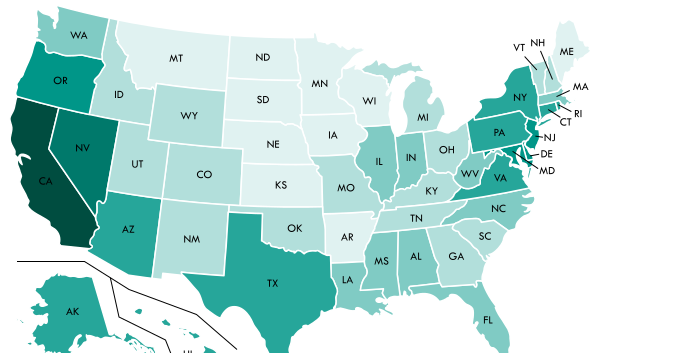
Most common states for environmental compliance managers
| Rank | State | Population | # of jobs | Employment/ 1000ppl |
|---|---|---|---|---|
| 1 | District of Columbia | 693,972 | 166 | 24% |
| 2 | North Dakota | 755,393 | 97 | 13% |
| 3 | Alaska | 739,795 | 89 | 12% |
| 4 | Massachusetts | 6,859,819 | 627 | 9% |
| 5 | Maine | 1,335,907 | 117 | 9% |
| 6 | Virginia | 8,470,020 | 619 | 7% |
| 7 | Washington | 7,405,743 | 509 | 7% |
| 8 | Minnesota | 5,576,606 | 373 | 7% |
| 9 | Connecticut | 3,588,184 | 242 | 7% |
| 10 | Iowa | 3,145,711 | 207 | 7% |
| 11 | Nebraska | 1,920,076 | 141 | 7% |
| 12 | Rhode Island | 1,059,639 | 76 | 7% |
| 13 | Maryland | 6,052,177 | 358 | 6% |
| 14 | New Hampshire | 1,342,795 | 77 | 6% |
| 15 | Montana | 1,050,493 | 64 | 6% |
| 16 | Delaware | 961,939 | 59 | 6% |
| 17 | Vermont | 623,657 | 35 | 6% |
| 18 | Wyoming | 579,315 | 32 | 6% |
| 19 | California | 39,536,653 | 1,983 | 5% |
| 20 | New Jersey | 9,005,644 | 491 | 5% |
Most common cities for environmental compliance managers
| Rank | City | # of jobs | Employment/ 1000ppl | Avg. salary |
|---|---|---|---|---|
| 1 | Danvers | 1 | 4% | $61,365 |
| 2 | Frankfort | 1 | 4% | $54,542 |
| 3 | Annapolis | 1 | 3% | $78,050 |
| 4 | Dover | 1 | 3% | $74,689 |
| 5 | Eden Prairie | 1 | 2% | $49,723 |
| 6 | Elgin | 1 | 1% | $59,074 |
| 7 | Hartford | 1 | 1% | $67,476 |
| 8 | Indianapolis | 2 | 0% | $58,829 |
| 9 | Los Angeles | 2 | 0% | $102,373 |
| 10 | Atlanta | 1 | 0% | $50,514 |
| 11 | Baton Rouge | 1 | 0% | $65,966 |
| 12 | Birmingham | 1 | 0% | $60,562 |
| 13 | Boston | 1 | 0% | $64,284 |
| 14 | Denver | 1 | 0% | $54,413 |
| 15 | Des Moines | 1 | 0% | $44,164 |
| 16 | Detroit | 1 | 0% | $57,453 |
Environmental Compliance Manager job outlook: Expert opinions
Our panel of environmental compliance manager experts
University of Rhode Island
Bellarmine University
Lawrence University
University of New Hampshire
Utah State University
Gonzaga University

Elon University

Kennesaw State University
Bard College

Denison University
Simona Trandafir
Associate Professor & Undergraduate Program DirectorUniversity of Rhode Island
Environmental/Natural Resources Management And Policy
What Environmental Compliance Manager skills would you recommend for someone trying to advance their career?
Simona Trandafir: In the next few years, there may be a growing emphasis on skills related to data analysis and modeling due to the increasing availability of environmental data. Proficiency in tools for spatial analysis and environmental simulation software will be highly desirable. Additionally, skills in sustainability reporting and green finance will become more prevalent as businesses and governments will focus more on sustainable practices and investments. Also, effective communication skills, particularly in translating complex ecological and economic data to various stakeholders, will remain desirable.
What Environmental Compliance Manager skills would you recommend for someone trying to advance their career?
Scott Rowland: Have an idea of what starting salaries are in your area. Don't over-sell yourself. Be realistic about what skills you have and about how long you are willing to commit to the company.
What general advice would you give to an Environmental Compliance Manager?
Martha Carlson Mazur PhD: Be a contributing member of the communities you occupy. Forming authentic relationships builds the network that will lead to opportunities for advancement.
What Environmental Compliance Manager skills would you recommend for someone trying to advance their career?
Martha Carlson Mazur PhD: The art of paying attention is the top emerging skill that students need to acquire before entering the workforce in Environmental Science. We have so many distractions vying for our attention in today’s high-tech world that we need to be mindful of where we choose to direct our thoughts to optimize our productivity. Likewise, paying attention to changes in the environment is of utmost importance in the work that we do, and paying attention to our own needs will keep us going in the hard but rewarding work of changing the world.
What will help Environmental Compliance Managers increase their earning potential?
Martha Carlson Mazur PhD: Be clear to yourself on what you value and how you want to use your unique skills and knowledge to change your piece of the world. Then, connect with people to find shared values and build relationships to enact your vision while being open to opportunities you might not have considered.
What general advice would you give to an Environmental Compliance Manager?
Marcia Bjornerud: Be open to taking short-term jobs for a few years to get a sense of the range of career opportunities in environmental sciences and which match your skills and temperament best. Think creatively about how your interdisciplinary training in environmental sciences can be applied even in fields that are not obviously 'environmental' - e.g. city/regional government, transportation, healthcare, etc. All human activities are embedded within and dependent on the natural environment. Also, the habit of 'systems thinking' that is central to environmental science can be applied to complex human systems.
What Environmental Compliance Manager skills would you recommend for someone trying to advance their career?
Dr. James Malley Jr: Some of this is market driven by the type of employer (public versus private), the location of the job (major metropolitan area versus a more rural or smaller city), etc. In the foreseeable future due to Environmental Engineering becoming popular around 1970 there are many people approaching retirement age (“the silver tsunami”) so jobs will likely be plentiful which will help. So, to maximize starting salaries you will want to do your homework and study the different employers, regions, etc. to see what salary ranges are realistic. Then pursue the opportunities that have the higher starting salaries if that is your priority (clearly an Environmental Engineer working for a major industry such as gas and oil will have a higher starting salary offer than one working for municipal governments) and also carefully interview the firms when they invite you to interview to find out how they handle things like overtime, bonuses, salary review frequency, etc.
What Environmental Compliance Manager skills would you recommend for someone trying to advance their career?
Daniella Hirschfeld PhD: Humanity today faces tremendous environmental challenges - chemicals in our water and air are causing major health problems, climate change is leading to increased disaster events, and biodiversity loss is at an all time high. Being an environmental designer allows people to address these challenges head on. It also gives people a chance to make other people's lives more livable, healthier, and happier.
Dr. Greg Gordon Professor/Chair
Professor/ChairGonzaga University
Natural Resources Conservation And Research
What will help Environmental Compliance Managers increase their earning potential?
Dr. Greg Gordon Professor/Chair: We find that graphical information systems (GIS) skills are in high demand. Soft skills such as ability to work as a team, develop work plans, collaborate and communicate with diverse stakeholders, communicate technical and scientific information, are, and will be very important in the near and long term future.
What general advice would you give to an Environmental Compliance Manager?
Aaron Haines Ph.D., Certified Wildlife Biologist ®: Having more technical skill sets can help you get entry level positions that can lead to higher pay positions. These include the ability to extract DNA from biological samples and understand the process of DNA sequencing, be familiar with geographical information systems (GIS) software such as ArcPro, ArcGIS, QGIS, be familiar with programming language such as Phyton and R statical programming, and government policies that impact your field of study.
Be a member of a professional organization and attend their conferences. This will allow you the opportunity to learn from others, network, and meet potential future employers.
Will Pluer Ph.D.
Assistant Professor of EngineeringElon University
Physics & Engineering Department
What soft skills should all Environmental Compliance Managers possess?
Will Pluer Ph.D.: Within the job, time management is probably the most important. An employer will be impressed if you're finishing work before your deadlines. To get the job in the first place, professionalism is very important. Submit a clean and attractive resume with your application and then show up to an interview dressed for the job.
Dr. Dan Ferreira Ph.D.
Associate Professor of Environmental ScienceKennesaw State University
Ecology, Evolution, and Organismal Biology
What Environmental Compliance Manager skills would you recommend for someone trying to advance their career?
Dr. Dan Ferreira Ph.D.: I think the best advice I can offer recent graduates is to be as flexible as possible. Being willing to relocate, for example, vastly expands the number of potential jobs they can apply to. Applying for positions that might not be exactly where they want to go, but might give them the experience or skills they need to get to their desired career after a year or two also will help open more doors. So if you can't find your ideal job right away, consider that internship or volunteer opportunity that will make you more marketable in the future.
What soft skills should all Environmental Compliance Managers possess?
Dr. Eban Goodstein: Networking.
What hard/technical skills are most important for Environmental Compliance Managers?
Dr. Eban Goodstein: Solid natural science background, esp ecology, and biogeochemical cycles.
What general advice would you give to an Environmental Compliance Manager?
Dr. Doug Spieles Ph.D.: Cast a wide net. You may have an ideal position and geographic location in mind, but very few people land that dream job immediately. A willingness to pursue various positions and locations can increase your odds of finding an entry-level job. This can help you build skills and networks that will put you in a healthier place for achieving your ultimate goal.