Explore jobs
Find specific jobs
Explore careers
Explore professions
Best companies
Explore companies
Job outlook for family consultants in the United States
Are family consultant jobs in demand?
Family consultant job and salary trends over time
Family consultant jobs over time
Family consultant job growth rate over time
| Year | # of jobs | % of population |
|---|---|---|
| 2021 | 2,794 | 0.00% |
| 2020 | 2,696 | 0.00% |
| 2019 | 2,693 | 0.00% |
| 2018 | 2,631 | 0.00% |
| 2017 | 2,517 | 0.00% |
Average family consultant salary over time
Family consultant salary by year
| Year | Avg. salary | Hourly rate | % Change |
|---|---|---|---|
| 2025 | $35,172 | $16.91 | +2.2% |
| 2024 | $34,417 | $16.55 | +2.4% |
| 2023 | $33,604 | $16.16 | +4.3% |
| 2022 | $32,231 | $15.50 | +2.6% |
| 2021 | $31,410 | $15.10 | +2.1% |
Family consultant jobs by state
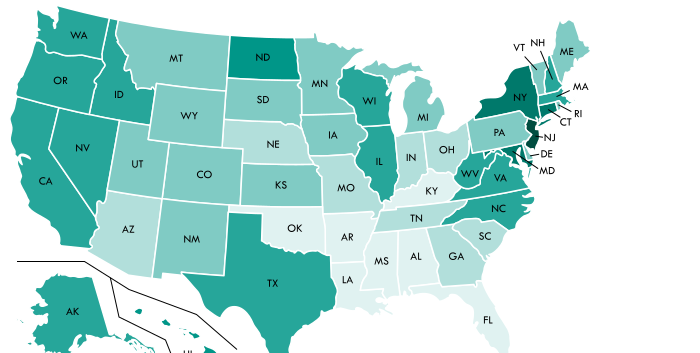
Most common states for family consultants
| Rank | State | Population | # of jobs | Employment/ 1000ppl |
|---|---|---|---|---|
| 1 | South Dakota | 869,666 | 179 | 21% |
| 2 | Alabama | 4,874,747 | 594 | 12% |
| 3 | Oklahoma | 3,930,864 | 486 | 12% |
| 4 | Mississippi | 2,984,100 | 291 | 10% |
| 5 | District of Columbia | 693,972 | 63 | 9% |
| 6 | Maine | 1,335,907 | 95 | 7% |
| 7 | Vermont | 623,657 | 45 | 7% |
| 8 | New Hampshire | 1,342,795 | 74 | 6% |
| 9 | Massachusetts | 6,859,819 | 369 | 5% |
| 10 | Washington | 7,405,743 | 368 | 5% |
| 11 | Maryland | 6,052,177 | 302 | 5% |
| 12 | Oregon | 4,142,776 | 222 | 5% |
| 13 | Rhode Island | 1,059,639 | 49 | 5% |
| 14 | Alaska | 739,795 | 36 | 5% |
| 15 | North Dakota | 755,393 | 34 | 5% |
| 16 | Pennsylvania | 12,805,537 | 466 | 4% |
| 17 | Virginia | 8,470,020 | 300 | 4% |
| 18 | Wisconsin | 5,795,483 | 213 | 4% |
| 19 | Connecticut | 3,588,184 | 134 | 4% |
| 20 | New Mexico | 2,088,070 | 74 | 4% |
Most common cities for family consultants
| Rank | City | # of jobs | Employment/ 1000ppl | Avg. salary |
|---|---|---|---|---|
| 1 | Franklin | 2 | 8% | $30,162 |
| 2 | Casa Grande | 2 | 4% | $31,909 |
| 3 | Tempe | 5 | 3% | $31,808 |
| 4 | Annapolis | 1 | 3% | $54,812 |
| 5 | Apache Junction | 1 | 3% | $31,686 |
| 6 | Sahuarita | 1 | 3% | $32,097 |
| 7 | Sierra Vista | 1 | 2% | $32,102 |
| 8 | South Bend | 1 | 1% | $32,995 |
| 9 | Phoenix | 8 | 0% | $31,805 |
| 10 | San Diego | 2 | 0% | $41,032 |
| 11 | Tucson | 2 | 0% | $31,959 |
| 12 | Dallas | 1 | 0% | $39,912 |
| 13 | Indianapolis | 1 | 0% | $30,463 |
| 14 | Mesa | 1 | 0% | $31,739 |
| 15 | New Orleans | 1 | 0% | $27,956 |
Family Consultant job outlook: Expert opinions
Our panel of family consultant experts
Texas Southern University

Virginia Polytechnic Institute and State University
Louisiana State University at Shreveport

University of Nebraska at Kearney
University of North Dakota
Montclair State University
Tuskegee University
Indiana Wesleyan University - Marion Residential

Virginia Polytechnic Institute and State University

National Association of Social Workers, New York State

Butler University

Vanguard University

Angelo State University
Nancy Shepherd PhD., CFCS
Assistant ProfessorTexas Southern University
Human Development, Family Studies, And Related Services
What general advice would you give to a Family Consultant?
Nancy Shepherd PhD., CFCS: Students should seek strong mentors in the field that will advise them and be able to write reference letters as they progress in the program. These mentors could be faculty, staff, a board member or a boss at work. Volunteer work and service learning in the field looks great on a resume. More importantly it will allow a student to build experience in their area of interest while attending school. It can set individuals apart from others when they are hired and allows someone to ask for more money. Additionally, work experience in the summer, or an internship will build skills and experience to achieve success.
What Family Consultant skills would you recommend for someone trying to advance their career?
Nancy Shepherd PhD., CFCS: In general, employers stress the need for individuals that are good communicators, both verbally and in writing. Specifically in the field, the positions are varied in skill requirements. Good listening and empathy skills are important when dealing with families and young children. Business owners and workers will benefit from soft skills such as critical thinking, problem solving, teamwork, work ethic, professional attitude, and organization.
Dion Porter Ph.D.
Associate Professor and Department Chair Coordinator-Online Educational Specialist ProgramsWhat general advice would you give to a Family Consultant?
Dion Porter Ph.D.: Strong counseling and empathy skills of course are important, but also one must possess strong interpersonal skills that will assist them in relating and collaborating well with other people. It is very important that one possess the right personality as well as character in order for them to become an effective and competent counselor. They also need to have strong multicultural counseling skills in order to effectively and efficiently counsel persons from diverse backgrounds, cultures and nationalities. Finally, one must possess the skills associated with professionalism related to their personal mannerisms, speech and communication, dress and interpersonal awareness. Of course for anyone to be competitive in this day and age, they will need to be well versed and trained in the specific technology and social-media tools needed to effectively perform the proper functions of their job.
Pamela Teaster Ph.D.
Professor and Director, Center for GerontologyVirginia Polytechnic Institute and State University
Department of Human Development and Family
Will there be an enduring impact of the coronavirus pandemic on Family Consultants?
Pamela Teaster Ph.D.: Possibly. Surely there is an impact on the ability of some students to be hired post-graduation. Some students who had positions lined up in the early spring found themselves without a position due to companies/academia/government halting hiring and work. This circumstance has the unfortunate effect of delaying graduates' entry into the job market and of putting them in competition with students who will be entering the job market in 2020. Students who have interests in fields that have a direct, as well as the indirect relationship to healthcare and public health, could find that their skills are in high demand, now and post-COVID.
Kacie Blalock Ph.D.
Associate Professor; Director, Master of CounselingLouisiana State University at Shreveport
Department Of Psychology
What hard/technical skills are most important for Family Consultants?
Kacie Blalock Ph.D.: It is important that counselors are able to effectively take notes and summarize progress, interpret assessments, memorize and recall information, and keep clear yet concise records.
Dr. Tami James Moore
Professor of Family ScienceUniversity of Nebraska at Kearney
Department of Counseling, School Psychology & Family Science. College of Education
What hard/technical skills are most important for Family Consultants?
Dr. Tami James Moore: An understanding of family dynamics is equally important to a full understanding of family functioning within the economic system. Information and fact-finding skills are essential (use of internet and professional websites to find data needed for planning and existing services for families to utilize in their efforts to successfully navigate financial matters, time management, and resource allocation.
Isaac Karikari Ph.D.
MSW Program Director, Chemical Dependency Minor, Assistant ProfessorUniversity of North Dakota
Department of Social Work
What soft skills should all Family Consultants possess?
Isaac Karikari Ph.D.: By default, social work practice is integrative. The levels of practice, broadly speaking, the micro-and macro-levels, intersect in ways that may not always be apparent. The capacity for critical and analytical thinking in identifying the nuances, seeing how these levels intersect, and understanding the implications for clients is essential for effective practice.
Relatedly, social work practice involves working with a diverse array of people across different systems and levels. A social worker needs to be able to navigate these systems. Systems thinking and the person-in-environment perspective are relevant.
Good interpersonal and communication skills are essential in helping one build and make the needed connections. These skills apply across the micro and macro levels.
The capacity to work collaboratively and with interdisciplinary teams is important. Other skills include genuinely demonstrating respect, empathy, reliability, integrity, and adaptability. Forbearance and emotional intelligence are often understated.
Social workers also need to have grit. Achieving and maintaining successful outcomes can be challenging.
What experience really stands out on Family Consultant resumes?
Dr. Michael Hannon Ph.D.: The kinds of experiences that really stand out on resumes are those that demonstrate their added value. School counselors, like all school personnel, are tasked with providing evidence that students are better as a result of their work with them. School counselors must show how the range of school counseling services provided (e.g., individual counseling, small group counseling, career development interventions, individual advising, etc.) help students experience success. I encourage those looking for jobs to meticulously document the processes and outcomes that inform why they implement their programs and services. That way, potential employers clearly understand the value new school counselors will add to the school community and support student wellness.
What type of skills will young Family Consultants need?
Dr. April Jones: In society, we have always known the individuals need hard and soft skills to function well in the workplace. It's often known as employability skills. Over time, emotional intelligence was another skill noted to have to work in the workplace. For social worker graduates, at entry-level to the workforce, in the coming years there may be new skillsets needed beyond the traditional knowledge of social work competencies and code of ethics, analytic and critical thinking skills, interpersonal skills, communication and problem-solving skills, team/group work, how to apply theory to methods of practice, etc. if COVID 19 pandemic sets a new norm or norm that will continue post an epidemic.
Technology use and application will bring a need for more tech-savvy graduates to interact with humans via videoconference, Bot chats, AR/VR therapy applications, communicating with symbols (e.g., memes, GIFs, emojis), Artificial Intelligence for best practices of assessment, interventions, or diagnosis, and much more. I can see more training on cultural awareness and various technology applications and etiquette.
This opens an excellent time for research and development of technology use in the social work as well. Skills that will be important are time management, self-management, and multi-tasking in a digital world. Information overload and faster communication processing must be balanced for graduates and their future clients. It appears an integration of current and new skills will need to be apart of a young graduate's toolbox to meet the workforce demands and to have a competitive advantage.
Will there be an enduring impact of the coronavirus pandemic on Family Consultants?
Dr. Katti Sneed Ph.D.: Students will never forget their time during COVID. They are trying to learn from field supervisors who are adapting to the ever-changing environment due to society's uncertainty. In many ways, students and field instructors are learning together on how to adapt. The pandemic has caused an increase in anxiety, depression, and other societal problems, which inadvertently will increase social workers' need. Our graduates are walking into a world that certainly needs them. Therefore, the job market is up-and-coming.
What type of skills will young Family Consultants need?
Dr. Thomas Dearden Ph.D.: Indeed, the way we work is changing. The skills that young graduates will need are diverse. Transferable skills and soft skills will certainly be marketable. These include traditional crafts such as communication, but I also think the world expects more empathy from its employees. Young graduates with an understanding of racism, sexism, and environmental responsibility will become increasingly important.
Samantha Fletcher Ph.D.
Executive DirectorNational Association of Social Workers, New York State
What type of skills will young Family Consultants need?
Samantha Fletcher Ph.D.: The core skills of social work do not change over time. These skills include empathy, active listening, critical thinking, assessment, intervention, evaluation, advocacy, policy analysis, and adaptability. Social workers also need to evaluate the organizations they work in to assess for oppressive practices and policies. One of the profession's core values is social justice, which directs social workers to "pursue social change, particularly with and on behalf of vulnerable and oppressed individuals and groups of people. Social workers' social change efforts are focused primarily on issues of poverty, unemployment, discrimination, and other forms of social injustice" (National Association of Social Workers, 2017). As a profession, social workers aim to dismantle racist, sexist, heterosexist, xenophobic, ableist, classist, and religiously biased systems and structures.
Are there any particularly good places in the United States for Family Consultants to find work opportunities?
Samantha Fletcher Ph.D.: Employment in the social work profession is increasing across the United States (Bureau of Labor Statistics, 2018). Social work education focuses on societal problems and strengths at every level, including individual, small groups, family systems, communities, and globally. This broad lens education positions social workers to work in almost every area of society. Social workers provide services in mental health facilities, hospitals, schools, political offices, nursing homes, libraries, jails, prisons, courts, think tanks, non-profit organizations, state and federal offices, and universities. In these positions, social workers work with people throughout the life cycle.
Lisa Farley
Associate ProfessorButler University
Department of Human Movement & Health Sciences
Are there any particularly good places in the United States for Family Consultants to find work opportunities?
Lisa Farley: I think this type of field is wide open across the country. If people are interested in travel, I think the field of Healthcare and Health Education is open around the world. Highly skilled applicants will be sought-after everywhere. Those who are successful as college students, and especially those who complete an internship, demonstrate that they can juggle their responsibilities successfully - those are the people who will be hired quickly.
I can't imagine a place in the country that wouldn't want them. Certainly, the larger cities with more healthcare and health education opportunities will be the largest draw, but even our smaller communities need qualified people. That is until technology surpasses the small towns and we start shifting our healthcare to the larger conglomerations in larger cities.
Dr. Tommy Casarez Ph.D.
Dr., Assistant Professor of Historical and Systematic TheologyVanguard University
Religion, Undergraduate Religion
What general advice would you give to a Family Consultant?
Dr. Tommy Casarez Ph.D.: Opportunities come in many different shapes and sizes, but they are still out there. Whether you are seeking to land a job in education or the non-profit sector, you will need to familiarize yourself and get used to all things digital, for the sake of communicating effectively. The younger your student or service partner's mindset, the more digitally savvy you will need to be, especially in the classroom and in the non-profit world.
Lesley Casarez Ph.D.
Director, Quality Enhancement Plan Program Coordinator, M.S. Professional School Counseling Associate Professor, Curriculum and InstructionAngelo State University
Department of Curriculum and Instruction
What technology do you think will become more important and prevalent for Family Consultants in the next 3-5 years?
Lesley Casarez Ph.D.: Graduates will need to learn to use technology in which virtual platforms are taking place and web conferencing platforms. Numerous platforms are being used, so the particular platform itself is not as crucial as being well-versed in how virtual education differs from face-to-face environments. Typically, the instructional role in online learning is more of a facilitator, as the educator guides the students to think critically, integrate, and apply new knowledge. This may be difficult for educators who would rather stand in front of a classroom and pass on their knowledge through lecture-based formats. Additionally, being well-versed in various web conferencing platforms will benefit graduates, as they move into a career that is currently requiring communication in virtual environments.