Explore jobs
Find specific jobs
Explore careers
Explore professions
Best companies
Explore companies
Job outlook for finance professors in the United States
Are finance professor jobs in demand?
Finance professor job and salary trends over time
Finance professor jobs over time
Finance professor job growth rate over time
| Year | # of jobs | % of population |
|---|---|---|
| 2021 | 560 | 0.00% |
| 2020 | 561 | 0.00% |
| 2019 | 590 | 0.00% |
| 2018 | 592 | 0.00% |
| 2017 | 593 | 0.00% |
Average finance professor salary over time
Finance professor salary by year
| Year | Avg. salary | Hourly rate | % Change |
|---|---|---|---|
| 2025 | $98,942 | $47.57 | +0.9% |
| 2024 | $98,032 | $47.13 | +3.9% |
| 2023 | $94,389 | $45.38 | +4.6% |
| 2022 | $90,274 | $43.40 | +3.6% |
| 2021 | $87,115 | $41.88 | +2.8% |
Finance professor jobs by state
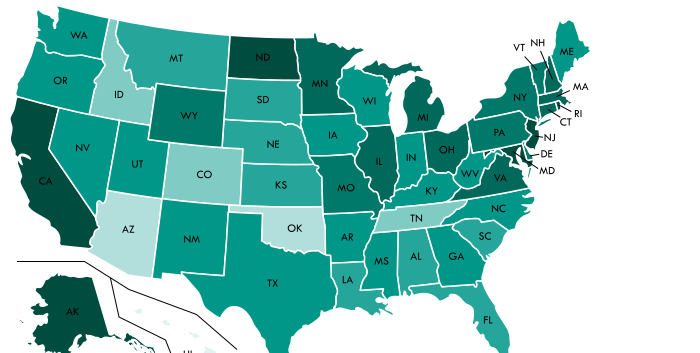
Most common states for finance professors
| Rank | State | Population | # of jobs | Employment/ 1000ppl |
|---|---|---|---|---|
| 1 | Vermont | 623,657 | 122 | 20% |
| 2 | Utah | 3,101,833 | 598 | 19% |
| 3 | Massachusetts | 6,859,819 | 1,201 | 18% |
| 4 | Virginia | 8,470,020 | 1,480 | 17% |
| 5 | North Dakota | 755,393 | 130 | 17% |
| 6 | Colorado | 5,607,154 | 908 | 16% |
| 7 | Minnesota | 5,576,606 | 906 | 16% |
| 8 | Rhode Island | 1,059,639 | 169 | 16% |
| 9 | Delaware | 961,939 | 158 | 16% |
| 10 | Wisconsin | 5,795,483 | 844 | 15% |
| 11 | South Dakota | 869,666 | 128 | 15% |
| 12 | Wyoming | 579,315 | 89 | 15% |
| 13 | Oregon | 4,142,776 | 599 | 14% |
| 14 | Nebraska | 1,920,076 | 276 | 14% |
| 15 | Alaska | 739,795 | 102 | 14% |
| 16 | New York | 19,849,399 | 2,526 | 13% |
| 17 | Washington | 7,405,743 | 994 | 13% |
| 18 | Maryland | 6,052,177 | 801 | 13% |
| 19 | Connecticut | 3,588,184 | 475 | 13% |
| 20 | New Jersey | 9,005,644 | 1,081 | 12% |
Most common cities for finance professors
| Rank | City | # of jobs | Employment/ 1000ppl | Avg. salary |
|---|---|---|---|---|
| 1 | Coral Gables | 1 | 2% | $74,004 |
| 2 | Lawrence | 1 | 1% | $79,459 |
| 3 | Washington | 2 | 0% | $110,694 |
| 4 | Dallas | 1 | 0% | $89,267 |
Finance Professor job outlook: Expert opinions
Our panel of finance professor experts
North Carolina State University
Skidmore College
Ashford University
What general advice would you give to a Finance Professor?
Alex Holte PhD: My advice for someone new to the field of academia is to learn time management skills early and learn what type of service work you find interesting and would like to contribute to. From there, learn how to say “no” to opportunities that may not align with your goals as well. I feel a lot of new professors tend to find the need to be involved in everything, which can result in burning out later in their career.
What Finance Professor skills would you recommend for someone trying to advance their career?
Alex Holte PhD: I would say being able to work with AI may be something that is more important in the next 3-5 years. Right now it’s a new technology and people are just now learning how to integrate it in the workplace, but I feel it is possible the future workforce of tomorrow will necessitate some form of being able to use AI technology.
What will help Finance Professors increase their earning potential?
Alex Holte PhD: When you are starting out at any career, it is important to negotiate your salary. Many candidates feel that they have to accept their first offer, but in reality, at many jobs, there is some room for negotiation. Be mindful however, to not request a salary that is much higher than what is being offered as they may feel like a compromise would not be possible and move on to the next candidate.
What general advice would you give to a Finance Professor?
Justin Whitehill Ph.D.: Perseverance pays off. Its worth it to pursue the career you want and not settle and be unhappy.
What will help Finance Professors increase their earning potential?
Justin Whitehill Ph.D.: I wouldn’t know, I’m a professor.
Jane Kuandre
Associate ProfessorWhat general advice would you give to a Finance Professor?
Jane Kuandre: My advice for someone looking to pursue a career in academia would be to focus on building a strong publication record, developing a network of collaborators, and continuously seeking opportunities for professional development.
What will help Finance Professors increase their earning potential?
Jane Kuandre: Networking is crucial for career advancement in academia as it allows individuals to establish collaborations, gain access to resources, and stay updated on the latest research trends.
Aurelie Matheron
Assistant Professor of FrenchSkidmore College
Romance Languages, Literatures, And Linguistics
What will help Finance Professors increase their earning potential?
Aurelie Matheron: Do some research online about how much someone earns at your stage of the career. If there is a significant gap, point out (diplomatically) that, because of your extensive experience in XYZ, you would like to get a X% increase in your salary. Be reasonable: if you want a 3% increase, ask for 5% (not 10% or more). Justify your negotiation: why should they pay me more? What experience can I show them to justify my request? If you have a higher offer from another place, you can say that “I have received another generous offer and would like to know about the possibility for matching that offer.” Salary is not the only thing you can negotiate: office space, computer/laptop, sabbaticals, course release, etc. Again, be reasonable: if you think you are entitled to XYZ requests, you also have to show why.
Fabio Lanza
ProfessorAshford University
History
What general advice would you give to a Finance Professor?
Fabio Lanza: I tell them not to expect that they can achieve the same, old-style academic career (like mine, for example). A tenure-track job in a research university to be clear. Those jobs exist but they are becoming rarer and rarer. I also tell them that if they forecast incurring in serious (or even non-serious) debt in order to get a PhD, they should not do it. They should not pursue that path at all. In the program, they should take all the chances they have to learn new skills, including skills that don't seem directly related to an academic career.
What will help Finance Professors increase their earning potential?
Fabio Lanza: Difficult to say, given how quickly things change. Digital humanities was and still is fashionable and important. Public history (museum, exhibitions, outreach). And teaching.