Explore jobs
Find specific jobs
Explore careers
Explore professions
Best companies
Explore companies
Job outlook for foreign language interpreters in the United States
Are foreign language interpreter jobs in demand?
Foreign language interpreter job and salary trends over time
Foreign language interpreter jobs over time
Foreign language interpreter job growth rate over time
| Year | # of jobs | % of population |
|---|---|---|
| 2021 | 115 | 0.00% |
| 2020 | 126 | 0.00% |
| 2019 | 130 | 0.00% |
| 2018 | 127 | 0.00% |
| 2017 | 118 | 0.00% |
Average foreign language interpreter salary over time
Foreign language interpreter salary by year
| Year | Avg. salary | Hourly rate | % Change |
|---|---|---|---|
| 2026 | $44,242 | $21.27 | +1.0% |
| 2025 | $43,819 | $21.07 | +3.8% |
| 2024 | $42,213 | $20.29 | +5.8% |
| 2023 | $39,897 | $19.18 | +2.3% |
| 2022 | $38,992 | $18.75 | +4.4% |
Foreign language interpreter jobs by state
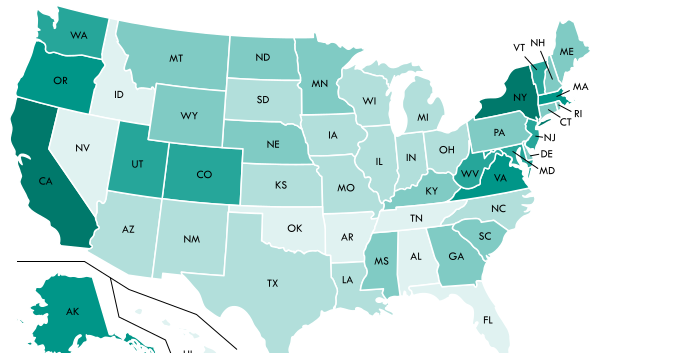
Most common states for foreign language interpreters
| Rank | State | Population | # of jobs | Employment/ 1000ppl |
|---|---|---|---|---|
| 1 | New Hampshire | 1,342,795 | 242 | 18% |
| 2 | Vermont | 623,657 | 114 | 18% |
| 3 | Oregon | 4,142,776 | 488 | 12% |
| 4 | West Virginia | 1,815,857 | 212 | 12% |
| 5 | Delaware | 961,939 | 92 | 10% |
| 6 | Massachusetts | 6,859,819 | 630 | 9% |
| 7 | District of Columbia | 693,972 | 64 | 9% |
| 8 | Virginia | 8,470,020 | 558 | 7% |
| 9 | Maryland | 6,052,177 | 352 | 6% |
| 10 | Connecticut | 3,588,184 | 222 | 6% |
| 11 | Iowa | 3,145,711 | 183 | 6% |
| 12 | Kansas | 2,913,123 | 179 | 6% |
| 13 | New Mexico | 2,088,070 | 126 | 6% |
| 14 | Nebraska | 1,920,076 | 111 | 6% |
| 15 | Rhode Island | 1,059,639 | 61 | 6% |
| 16 | Washington | 7,405,743 | 374 | 5% |
| 17 | South Carolina | 5,024,369 | 243 | 5% |
| 18 | Montana | 1,050,493 | 56 | 5% |
| 19 | South Dakota | 869,666 | 45 | 5% |
| 20 | North Dakota | 755,393 | 40 | 5% |
Most common cities for foreign language interpreters
| Rank | City | # of jobs | Employment/ 1000ppl | Avg. salary |
|---|---|---|---|---|
| 1 | Trenton | 2 | 2% | $56,377 |
| 2 | Ormond Beach | 1 | 2% | $38,176 |
| 3 | Kalamazoo | 1 | 1% | $41,404 |
| 4 | Lauderhill | 1 | 1% | $38,160 |
| 5 | Little Rock | 1 | 1% | $37,861 |
| 6 | West Palm Beach | 1 | 1% | $38,188 |
| 7 | Detroit | 2 | 0% | $43,344 |
| 8 | New York | 2 | 0% | $67,239 |
| 9 | Philadelphia | 2 | 0% | $47,167 |
| 10 | Washington | 2 | 0% | $80,614 |
| 11 | Indianapolis | 1 | 0% | $43,627 |
| 12 | Newark | 1 | 0% | $56,905 |
| 13 | Orlando | 1 | 0% | $38,353 |
Foreign Language Interpreter job outlook: Expert opinions
Our panel of foreign language interpreter experts

NAJIT
Will there be an enduring impact of the coronavirus pandemic on Foreign Language Interpreters?
Aimee Benavides: The pandemic has changed the way a lot of businesses and organizations function, and this has had an enormous impact on interpreters and, to a lesser degree, translators. Court interpreting has traditionally been provided in person at courthouses, legal offices, and conference rooms, throughout the country. Remote interpreting, for the most part, was considered a last resort. Under current circumstances, courts and other public sector offices have had no option but to adopt remote interpreting as the means to get work done, and it is logical that some offices may continue to emphasize the use of remote services, after the pandemic, as a way to cut costs. It will be of utmost importance to insist that interpreter qualifications not be bypassed to save resources, or for the sake of convenience, in critical environments such as hospitals or courts. In order to preserve the essential progress made over the years with regard to language access, it is crucial to adhere to clear, well-founded professional rules in the areas of interpreting and translation. It will also be important for interpreters to adapt to different technologies, determine when they are appropriate, and ultimately uphold best practices. Interpreters who are familiar with online interpreting platforms and remote technology will ultimately have more opportunities and options than those who do not.