Explore jobs
Find specific jobs
Explore careers
Explore professions
Best companies
Explore companies
Job outlook for glass science engineers in the United States
Are glass science engineer jobs in demand?
Glass science engineer job and salary trends over time
Glass science engineer jobs over time
Glass science engineer job growth rate over time
| Year | # of jobs | % of population |
|---|---|---|
| 2021 | 239 | 0.00% |
| 2020 | 274 | 0.00% |
| 2019 | 297 | 0.00% |
| 2018 | 299 | 0.00% |
| 2017 | 302 | 0.00% |
Average glass science engineer salary over time
Glass science engineer salary by year
| Year | Avg. salary | Hourly rate | % Change |
|---|---|---|---|
| 2026 | $99,881 | $48.02 | +2.4% |
| 2025 | $97,500 | $46.87 | +1.0% |
| 2024 | $96,487 | $46.39 | --2.3% |
| 2023 | $98,805 | $47.50 | +1.4% |
| 2022 | $97,448 | $46.85 | +2.2% |
Glass science engineer jobs by state
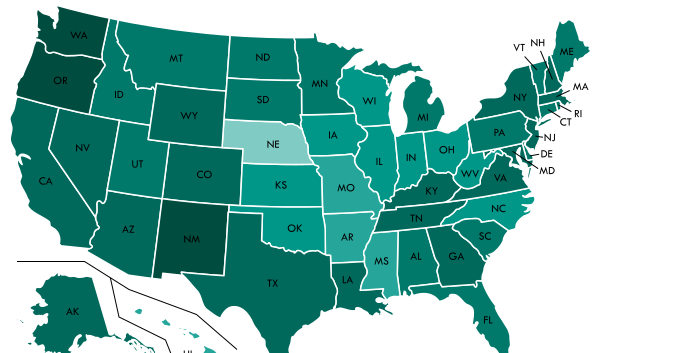
Most common states for glass science engineers
| Rank | State | Population | # of jobs | Employment/ 1000ppl |
|---|---|---|---|---|
| 1 | District of Columbia | 693,972 | 323 | 47% |
| 2 | Delaware | 961,939 | 132 | 14% |
| 3 | Massachusetts | 6,859,819 | 878 | 13% |
| 4 | Virginia | 8,470,020 | 1,053 | 12% |
| 5 | Oregon | 4,142,776 | 483 | 12% |
| 6 | Vermont | 623,657 | 73 | 12% |
| 7 | Washington | 7,405,743 | 816 | 11% |
| 8 | Maryland | 6,052,177 | 680 | 11% |
| 9 | Colorado | 5,607,154 | 548 | 10% |
| 10 | New Hampshire | 1,342,795 | 136 | 10% |
| 11 | Wyoming | 579,315 | 58 | 10% |
| 12 | California | 39,536,653 | 3,628 | 9% |
| 13 | Montana | 1,050,493 | 90 | 9% |
| 14 | North Dakota | 755,393 | 70 | 9% |
| 15 | Alaska | 739,795 | 63 | 9% |
| 16 | Utah | 3,101,833 | 238 | 8% |
| 17 | Arizona | 7,016,270 | 520 | 7% |
| 18 | Minnesota | 5,576,606 | 384 | 7% |
| 19 | Idaho | 1,716,943 | 119 | 7% |
| 20 | South Dakota | 869,666 | 60 | 7% |
Glass Science Engineer job outlook: Expert opinions
Our panel of glass science engineer experts

East Tennessee State University

Rose-Hulman Institute of Technology
Northern Michigan University
Elon University
Merrimack College
Marietta College

University of Baltimore

Crafton Tull
Jared Wilson
Assistant Professor and Faculty CoordinatorEast Tennessee State University
Surveying and Mapping
Are there any particularly good places in the United States for Glass Science Engineers to find work opportunities?
Jared Wilson: Within the field of land surveying and related employment opportunities, work is available. However, in my experience, work may not be in the exact location a person wishes to live. So, a move may be necessary, or potentially traveling to where the work is located. Should a graduate, or person for that matter, want to work, work is available.
Dr. Galen Duree
Head of the Department of Physics and Optical Engineering and ProfessorRose-Hulman Institute of Technology
Department of Physics and Optical Engineering
What experience really stands out on Glass Science Engineer resumes?
Dr. Galen Duree: It depends on what you are applying for. If you are working on product development, then internships or co-ops provide a definite advantage. If you are working on developing new ways of doing things, research experiences in academia or companies are advantageous. Either case, this shows a certain maturity in your career path - you have participated in an activity related to the career you are currently pursuing.
What Glass Science Engineer skills would you recommend for someone trying to advance their career?
Dr. Galen Duree: It again depends on what the graduate sees as their next step - graduate school or a job with a company or lab. If the next step is graduate school, the graduate should investigate what they are interested in pursuing and then where the best school is to get the experience that the graduate thinks he or she wants.
General reading about technologies or reading available articles about subjects the graduate is interested in will help generate questions they can ask potential graduate schools. This time would also be a chance to improve areas where the graduate may feel weak while an undergraduate. Many online resources can help them brush up on week background topics. Do not worry about transfer credits because that is usually not helpful in graduate school, but improve knowledge and experience in areas where the graduate feels weak. If the graduate has identified a graduate school and program to study in, the graduate school might have some recommendations about what to review. All of this will help improve success in graduate school.
If the next step is a job with a company or lab, taking courses to improve communication will help. Many technically competent or even technically brilliant people struggle with effective communication. Techniques about writing reports, making oral presentations, or communicating technical information will help improve success. The gap year also provides time to investigate technologies that the graduate wants to be involved in and the companies or labs in those areas.
Once the graduate has identified areas of interest and companies or labs that the graduate might want to work for, they can be contacted to either answer questions or point the graduate in a direction for further investigation.
In either case, a gap year can provide a chance to refine the graduate's choice for the next steps and help them prepare other skills overlooked during the undergraduate years.
What technology do you think will become more important and prevalent for Glass Science Engineers in the next 3-5 years?
Dr. Galen Duree: People with knowledge, even introductory experience, in quantum effects, quantum computing, optics in general (communication, measurements, imaging, illumination, detection), material science and engineering, biotechnology, and nanotechnology, will be in high demand.
How would you rate the starting salaries for Glass Science Engineers, as well as the prospects for salary advancement?
Michael Rudisill: From what we've seen, salaries haven't been reduced, even though demand is down. I would expect wages and salary progression to remain strong as the need for engineering will only continue to grow.
What type of skills will young Glass Science Engineers need?
John Ring: While our universities consistently educate engineering students with hard skills and strong engineering fundamentals, tomorrow's engineers need to be strong communicators, collaborators, and critical thinkers. Our professional environments are filled with data and information, and the constraint is typically how much time individuals can dedicate to solving a problem. At Elon University, we educate tomorrow's engineers to have the hard skills necessary to analyze the information and situations, apply critical thinking techniques to determine ways to solve the issue, and then concisely and efficiently communicate with colleagues as solutions are being set in motion.
Rickey Caldwell Ph.D.
Assistant Professor of Mechanical EngineeringMerrimack College
Departmet of Mechanical Engineering
Will there be an enduring impact of the coronavirus pandemic on Glass Science Engineers?
Rickey Caldwell Ph.D.: In terms of job opportunities, no. It may take longer to secure that first job, and it may be an employer's job market for the next several years. This means starting salaries may not be as high as a year ago, and yearly raises may be near zero up to 3% (depending on career fields and markets). Additionally, some benefits, such as tuition reimbursement, may not be available at some companies.
However, I strongly suspect that things will get better (as a wild guess) in 3 - 5 years as the economy rebounds. For the immediate future, the full economic effects of the pandemic have not been fully realized. As companies restructure to deal with their impact on their bottom lines and workers are laid-off, more experienced employees are entering the job marking and seeking jobs. This is very similar to the financial system crash around 2008, so that could be referenced for a similar environment, especially its effect on the Midwest. Job seekers must be persistent.
For enduring changes, the pandemic has presented a great opportunity to change the nature of where we do work. This experiment has been tried before at places like Yahoo, for example. Pre-pandemic, some companies allowed workers to work from home several times per month under flexible scheduling. I believe the coronavirus pandemic will make these types of work options a larger part of the business workplace culture. Additionally, many companies are actively working to enhance their diversity, equity, and inclusion in the workplace. With this renewed attention, there may be more opportunities for workers that are women, BIPOC, LBGQT+, and others to rewrite and form new workplace norms to have new working environments. I strongly encourage people to take their seats at this table and create the world you wish to work in.
Are there any particularly good places in the United States for Glass Science Engineers to find work opportunities?
Rickey Caldwell Ph.D.: The engineering centers of the US seem to have strong job markets. Boston, West Coast, Silicon Prairie, DC area are just a few. There are employment opportunities in every industry and every state. It just may take 6 - 18 months to land that first job. Students may have to cast a bigger and wider search net. For example, if you only want to work in city A, it may take longer to find a job. A better strategy is to search regionally. For example, New England, Mid Atlantic, or the Southwest. Additionally, there are sectors that are always looking for new talent, such as energy production, food companies such as Unilever, and the civilian government work at federally funded research and development laboratories (FFRDC) and University Affiliated Research Centers (UARC) such as The MITRE Corporation and the Johns Hopkins University Applied Physics Lab.
Will there be an enduring impact of the coronavirus pandemic on Glass Science Engineers?
Ben Ebenhack: I believe that the impact of the pandemic on the US economy is still unfolding and that we won't be able to see any kind of robust turnaround until vaccines are widely available and seen, in practice, to be effective. Until that time, I suspect that we'll continue to see a lot of volatility as investors speculate about recovery, reopening, etc., but the trends will probably vacillate.
Once the pandemic is clearly seen to be reasonably well-controlled, I think that there will be a good deal of pent-up demand for energy and its services. I expect to see a modest recovery in energy prices, but that may not translate to jobs for a few years. Ultimately, the world's need for energy will drive prices up, and there will probably be another boom. Everyone should remember that half of humanity (~3.5 billion people) lack access to modern energy, on which development depends. With global economic recovery, I would expect that to apply considerable upward pressure on energy (and related resource) demands for the next several decades. Alternative energy will continue to grow, but I don't think it can grow as fast as some optimists expect.
Will there be an enduring impact of the coronavirus pandemic on Glass Science Engineers?
Dr. Giovanni Vincenti: COVID-19 put into perspective the importance of technology for everyone. Those people who would typically work in fully staffed offices and took IT systems for granted have now realized how the lack of dedicated personnel and resources is a significant issue as everyone is working from home. The same realization has also reached upper-management, often creating a nearly immediate need for innovation that would have otherwise remained just a plan for the future. Graduates in the IT field and technology, in general, will benefit from this realization, as projects move from the planning stage into implementation and eventually maintenance. This increment in reliance on IT-related resources will create a greater need for employment.
Are there any particularly good places in the United States for Glass Science Engineers to find work opportunities?
Dr. Giovanni Vincenti: Cities that are typically associated with technology will probably remain hubs of innovation, especially if they have local administrations that are favorable towards entrepreneurship. However, the recent need for companies to leverage the ability to work remotely has opened up the possibilities of workers who may not otherwise be willing to relocate. This trend is probably here to stay for a while, so the ability of graduates to work with virtual collaborators will bring tech jobs to parts of the country that are not typically known for innovation. Even though there probably will not be clusters that will identify new equivalents of Silicon Valley out of nowhere, the fact that the reach of potential employees has extended beyond their geographical immediacy will create major opportunities for any location.
What general advice would you give to a Glass Science Engineer?
Libby Toping: It has definitely been a unique time to start my first job. COVID-19 has caused many of my peers to struggle to find a job, so I think it has caused me to recognize how thankful I am to have a job that I enjoy working and that allows me to improve my community, even in the midst of a pandemic. There are certainly struggles with virtual meetings and mask-wearing, but learning to be flexible and adaptable are skills that I think will make me a better engineer in the long run!