Explore jobs
Find specific jobs
Explore careers
Explore professions
Best companies
Explore companies
Job outlook for global engineering managers in the United States
Global engineering manager job growth summary. After extensive research, interviews, and analysis, Zippia's data science team found that:
The projected global engineering manager job growth rate is 2% from 2018-2028.
About 4,400 new jobs for global engineering managers are projected over the next decade.
Global engineering manager salaries have increased 11% for global engineering managers in the last 5 years.
There are over 50,026 global engineering managers currently employed in the United States.
There are 84,550 active global engineering manager job openings in the US.
The average global engineering manager salary is $110,735.
Are global engineering manager jobs in demand?
Global engineering manager job and salary trends over time
Global engineering manager jobs over time
Global engineering manager job growth rate over time
| Year | # of jobs | % of population |
|---|---|---|
| 2021 | 50,026 | 0.01% |
| 2020 | 52,337 | 0.02% |
| 2019 | 51,888 | 0.02% |
| 2018 | 50,266 | 0.02% |
| 2017 | 48,029 | 0.01% |
Average global engineering manager salary over time
Global engineering manager salary by year
| Year | Avg. salary | Hourly rate | % Change |
|---|---|---|---|
| 2025 | $110,735 | $53.24 | +3.2% |
| 2024 | $107,255 | $51.56 | +2.9% |
| 2023 | $104,241 | $50.12 | +2.2% |
| 2022 | $101,989 | $49.03 | +2.2% |
| 2021 | $99,775 | $47.97 | +1.5% |
Global engineering manager jobs by state
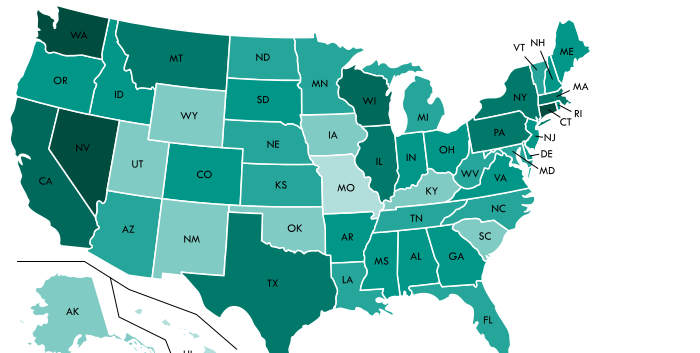
Most common states for global engineering managers
| Rank | State | Population | # of jobs | Employment/ 1000ppl |
|---|---|---|---|---|
| 1 | District of Columbia | 693,972 | 368 | 53% |
| 2 | Massachusetts | 6,859,819 | 1,699 | 25% |
| 3 | Rhode Island | 1,059,639 | 251 | 24% |
| 4 | Washington | 7,405,743 | 1,620 | 22% |
| 5 | Oregon | 4,142,776 | 908 | 22% |
| 6 | Delaware | 961,939 | 213 | 22% |
| 7 | Utah | 3,101,833 | 626 | 20% |
| 8 | North Dakota | 755,393 | 150 | 20% |
| 9 | Virginia | 8,470,020 | 1,636 | 19% |
| 10 | New Hampshire | 1,342,795 | 261 | 19% |
| 11 | Alaska | 739,795 | 130 | 18% |
| 12 | Wyoming | 579,315 | 103 | 18% |
| 13 | Idaho | 1,716,943 | 286 | 17% |
| 14 | Montana | 1,050,493 | 179 | 17% |
| 15 | Colorado | 5,607,154 | 876 | 16% |
| 16 | Minnesota | 5,576,606 | 872 | 16% |
| 17 | Connecticut | 3,588,184 | 576 | 16% |
| 18 | Maryland | 6,052,177 | 921 | 15% |
| 19 | Nebraska | 1,920,076 | 270 | 14% |
| 20 | Maine | 1,335,907 | 182 | 14% |
Most common cities for global engineering managers
| Rank | City | # of jobs | Employment/ 1000ppl | Avg. salary |
|---|---|---|---|---|
| 1 | Bridgewater | 1 | 4% | $113,741 |
| 2 | Alpharetta | 1 | 2% | $106,404 |
| 3 | Smyrna | 1 | 2% | $95,157 |
| 4 | Palm Bay | 1 | 1% | $102,085 |
| 5 | San Mateo | 1 | 1% | $127,247 |
| 6 | Thornton | 1 | 1% | $102,675 |
| 7 | New York | 3 | 0% | $115,001 |
| 8 | Chicago | 2 | 0% | $112,888 |
| 9 | San Francisco | 2 | 0% | $127,350 |
| 10 | Atlanta | 1 | 0% | $106,363 |
| 11 | Boston | 1 | 0% | $113,205 |
| 12 | Dallas | 1 | 0% | $112,961 |
| 13 | Jacksonville | 1 | 0% | $101,503 |
| 14 | Los Angeles | 1 | 0% | $114,263 |
| 15 | Orlando | 1 | 0% | $102,173 |
| 16 | Washington | 1 | 0% | $96,100 |
Global Engineering Manager job outlook: Expert opinions
Our panel of global engineering manager experts
Pennsylvania State University - Abington

University of Iowa

University of Maryland - College Park

San Jose State University
Chapman University

Clemson University

Ohio University
York College of Pennsylvania

Kettering University

University of Utah
California State University - Sacramento
University of Pittsburgh
What will help Global Engineering Managers increase their earning potential?
Yi Yang PhD: First of all, be really good at what you do. Always negotiate for a higher salary based on your qualifications and market value. Additionally, consider exploring opportunities in management and actively contribute to strategic decision-making. Taking calculated risks, such as joining a startup, can also lead to valuable experiences and skill development that can enhance your earning potential in the long run.
What general advice would you give to a Global Engineering Manager?
Yi Yang PhD: For new graduates beginning their careers in engineering, I would advise them to consider the broader impact of their work and look for opportunities to expand their management potential. While engineering is a highly technical field, it's important to recognize the value of leadership roles in preserving a culture of innovation. By taking on these positions, you can help ensure that companies prioritize long-term innovation over short-term gains (cutting R&D to boost the balance sheet), thus preserving the engineering culture that drives meaningful progress.
What Global Engineering Manager skills would you recommend for someone trying to advance their career?
Yi Yang PhD: In the next 3-5 years, I believe management skills will become increasingly important. Engineers who can bridge the gap between technical complexity and business strategy, driving innovation and growth in their organizations will be very valuable.
What skills stand out on Global Engineering Manager resumes?
Casey DeRoo Ph.D.: Rather than a concrete skill, previous experience in managing teams to accomplish engineering-related tasks is sure to make you a standout. Showcasing familiarity with work management software (e.g., Jira) or budget/total effort tracking systems is important. Find out what software the company you're seeking employment with uses, and be sure to highlight this if you're familiar with it.
What soft skills should all Global Engineering Managers possess?
Casey DeRoo Ph.D.: The ability to understand the people on your team and allocate project work accordingly is important. In this role, you may find that you "step back" from the day-to-day of engineering and coordinate work on a project across multiple individuals with unique outlooks and skillsets. Recognize that "one size doesn't fit all" when it comes to management. Harnessing the make-up or the desired professional goals of your team to accomplish your assigned projects leads to better outcomes and productivity. Many skilled engineers lack leadership skills, so highlight these on your resume or during your interview if you have applicable experience.
Donald Yeung
Professor and Associate Chair for Undergraduate Education, Affiliate Professor, Computer Science DepartmentUniversity of Maryland - College Park
Department of Electrical and Computer Engineering
What hard/technical skills are most important for Global Engineering Managers?
Donald Yeung: In terms of hard technical skills, I believe the courses students take along with their GPA in these courses is one level of demonstration. (As I mentioned above, employers know about our program probably down to specific courses, and so if someone gets an A+ in some notoriously challenging course, that's probably known and appreciated). Some employers will give technical interviews and require students to solve problems on their feet. But I think most employers will judge this based on a student's transcript.
What skills will help Global Engineering Managers earn the most?
Donald Yeung: Finally, in terms of compensation, I believe the Computer Engineering degree in our department garners the highest average starting salary across the entire UMD campus. The Electrical Engineering degree is not far behind. I don't know if specific skills within ECE garner more pay. But I can say that these days, Data Science (i.e., Machine Learning and Artificial Intelligence) is the fastest-growing field, probably bar none. The US Bureau of Labor Statistics, I think, puts the growth in this field at around 30% from now until 2026. I would expect the starting salaries in these jobs to be the very highest. So, perhaps having a background in Data Science and Machine Learning might get you a higher-paying job. But I also think it's dangerous for students to look at such statistics to guide what courses they take today (elective courses, that is). What's hot today may not be tomorrow. A career is 40 years, not the next 5 or 10 years.
What skills stand out on Global Engineering Manager resumes?
Donald Yeung: A degree at a highly rated engineering school is always a plus. For example, the ECE dept at UMD has a good reputation among local employers as well as employers elsewhere, such as Silicon Valley. Many of our students go to companies in these areas, and so we have a reputation based on the quality of students that go out. I think employers know what they're getting. Beyond the school from which you receive your degree, your GPA is also important. How well you do in the program you come from is important, too, obviously. And employers also know about grade inflation or deflation at different schools, so they can calibrate any student's GPA against what experience they've had with previous students' records. Besides that, employers also look for experience outside of the degree program, so internships, research experiences, any significant project experience, etc., are also a real plus.
What soft skills should all Global Engineering Managers possess?
Donald Yeung: In terms of soft skills, communication is by far the most important, I would think. This could be ascertained during the interview process. Also, being able to work in a team is a plus, too. This might be demonstrable from large project experiences. For example, our students participate in teaming projects outside of the ECE program like Terp Racing, Hyperloop project, etc. This could demonstrate a student's exposure to working on large teams.
Yasser Dessouky
Professor and ChairSan Jose State University
Industrial and Systems Engineering
What skills stand out on Global Engineering Manager resumes?
Yasser Dessouky: Besides being very comfortable with various professional social-media platforms, the new engineering students must embrace developing their skills in artificial intelligence and data science techniques. Besides being an excellent team member, today's remote world requires engineers to have independent problem-solving skills for a career to thrive.
What skills stand out on Global Engineering Manager resumes?
Tom Springer Ph.D.: -Classroom or work-related experience with electrical circuit design and electrical schematic analysis
-Exposure to control system design and theory, communications systems principles
-Lab experience with power/analog electronics testing or test methodology
-Understanding of digital design using hardware verification languages: System Verilog
-Experience leading engineering projects
What soft skills should all Global Engineering Managers possess?
Tom Springer Ph.D.: -Good communication skills
-Ability to exercise critical thinking and innovative problem solving
-Able to work under supervision and mentoring
-Works well in a team-oriented environment
What hard/technical skills are most important for Global Engineering Managers?
Tom Springer Ph.D.: -Experience/exposure to Automated Test Equipment (ATE) -Setup/Programming
-Understanding of basic software architectures and general syntax of coding languages such as C/C++
-Knowledge using Linux or Unix terminal commands
-Experience using Revision Control Systems: Subversion (SVN), CVS, Git.
-Exposure to System on Chip (SoC) hardware/software
-Experience with Robot Operating System (ROS) or equivalent is a bonus
What skills will help Global Engineering Managers earn the most?
Tom Springer Ph.D.: Skill sets that span domain disciplines are very much in demand. Such as a computer architect or electrical engineer with a strong background in software development
Dr. John Ballato
J. E. Sirrine Endowed Chair and ProfessorClemson University
Department of Materials Science and Engineering
What soft skills should all Global Engineering Managers possess?
Dr. John Ballato: To me, the most important soft skill has always been communication. And, due to the pandemic where people have had to isolate and possibly quarantine, effective communications are even that much more critical. We're spending less face-to-face time and more screen-to-screen time, which gets boring quickly. So, paying attention, being clear and concise in your communications since you don't have the opportunities as often now to simply walk into someone's lab or office and talk through ideas and next steps. Effective communications are also especially important in materials science and engineering because our field is innately interdisciplinary. This means that you might be the only materials scientist on a team that includes marketing, sales, manufacturing, etc. Knowing your audience, including your project team, and learning how to communicate with them is critical.
What hard/technical skills are most important for Global Engineering Managers?
Dr. John Ballato: Important hard/technical skills really depend on the nature of the job/position and the organization. This really relates back to the What Skills Stand Out question. Employers want to know that employees have the requisite "toolbox" of basic skills and a willingness and aptitude to learn on the job. No person comes out of school with all the skills and experiences needed for a given job, so organizations inevitably continue to provide training on product-specific skills. Knowing how to learn, wanting to learn, and admitting what you don't know are as important, if not more so, than any hard/technical skills one gains during their education.
What skills will help Global Engineering Managers earn the most?
Dr. John Ballato: Here, too, the answer depends on the field, job position (and location), and organization. MSE graduates generally are well compensated compared to other engineering fields. The most important thing is that you wake up every morning and are excited about the work you're doing. There's no substitute for enjoying your work, regardless of how much you are paid.
What skills stand out on Global Engineering Manager resumes?
Dr. John Ballato: The phrase "well rounded" may be getting old, but it's still true. We like to see graduates who didn't just go to class but worked in a laboratory or did a co-op/internship and had various extra-curricular activities, both personal and professional. Remember that materials science and engineering are leveraging computer science more and more, whether through atomistic or microstructural modeling or newer technologies such as machine learning (ML) and artificial intelligence (AI). So having some familiarity with those and how they complement experimental/hands-on studies are helpful.
Another point about skills that stand out is a simple one - do your homework. There are few things more irritating than receiving a resume or email asking for a job, and the student clearly didn't care enough to look up what we do. The resume is a copy and paste and isn't personalized to the specific position, Group, or company. That stands out like a sore thumb.
What are the biggest trends we'll see in the Global Engineering Manager job market given the pandemic?
Robert Williams Ph.D.: Clearly a huge change we have seen in the past year, that will have some impact into the future, is widespread telecommuting, i.e. working from home. For employees just entering the job market in 2021, they have my sympathy - I think it would be very hard to start in a new job with only meeting your co-workers and boss via Zoom or Teams. On the other hand, in my own experience as a (reluctant but necessary) remote on-line educator, my time on the job daily is much ore efficient in working from home. Some of my engineer friends in industry have said the same thing, they are much more efficient working from home rather than in the lab, office, or plant.
What technical skills for a Global Engineering Manager stand out to employers?
Robert Williams Ph.D.: Modeling, simulation, CAD software; problem solving; design based on analysis and experiment; computer skills; the ability to learn new software.
Tristan Ericson Ph.D.
Associate ProfessorYork College of Pennsylvania
Civil and Mechanical Engineering
What soft skills should all Global Engineering Managers possess?
Tristan Ericson Ph.D.: We follow engineering students on co-ops and ask employers about what skills graduates must have. Communication skills are consistently cited. This will be even more necessary going forward as more communication is conducted electronically. I always tell students that you could be the best engineering in the world, but it will be no value to you or anyone else if you can't articulate and advocate for your ideas.
How have salaries changed over time for Global Engineering Managers?
Tristan Ericson Ph.D.: There has been gradual growth over time for engineering salaries. In certain industry sectors the pandemic has stalled that growth with some employees getting no increases or taking pay cuts over the past year. I expect that, emerging from the pandemic, engineers will see growth in earning opportunities, especially in new development sectors.
What are the biggest trends we'll see in the Global Engineering Manager job market given the pandemic?
Tristan Ericson Ph.D.: Engineering jobs will still be available. Some companies are struggling in the pandemic, but some are thriving. Our students are still able to find co-ops, and our graduates are still finding jobs. The market has slowed a bit, but not as much as I expected. Rather, we see a shift in job availability as the need for different technologies changes. Most of our summer 2020 graduating seniors found jobs. It took more time for some of them to secure employment than typical, but their ultimate success rate was higher than I would have anticipated in such an uncertain time. Going forward, I think the need for engineering jobs will gradually increase to levels higher than pre-pandemic. Consider the Biden administration's ambitious infrastructure goals. These alone will place increased demand on engineering, but they are also a broader indicator of society's increased need for innovation and product development. The push for vehicle electrification will provide many new job opportunities in that staple industry.
What are the biggest trends we'll see in the Global Engineering Manager job market given the pandemic?
Patrick Atkinson: In the new normal, it seems that companies are looking for employees who are adaptable. Working remotely, amidst the home environment is different from the traditional office environment, but humans are elastic, and we find ways to carry on. Personally, I like the flexibility it provides and I am also up for a challenge. The pandemic has been a disruptor, but it is up to the optimist in all of us to look at this disruption as an opportunity to hit the refresh button. One key area that was unexpected to me was that the attendance for meetings has approached 100%. People are communicating more than ever. As such, employees who can listen and contribute in a constructive fashion are valuable members of the team. That doesn't mean that everyone in a team has to have the same skills, but it would be a good idea to have a few people in each group who work well in an online discussion.
What technical skills for a Global Engineering Manager stand out to employers?
Patrick Atkinson: Broadly speaking, employers are looking for employees who can jump in, take on a project and move things forward. Since engineers are data-driven, knowing how to read and interpret findings from a variety of sources is key. This can be very challenging if the data conflicts between sources or the data is unclear. Whether the data is from a mathematical model, a physical test laboratory, or from the field, learning how to synthesize the findings and balance the strengths/weaknesses of a given data source are key. At the end of the day, every project needs a way forward and it is the engineer's job to optimize a design to meet the objectives for the product.
How have salaries changed over time for Global Engineering Managers?
Patrick Atkinson: To my knowledge, salaries continue to be strong. Jobs like Biomedical Engineering tend to be more insulated from market fluctuations since people always need healthcare.
What certifications/licenses/courses can have the biggest impact for Global Engineering Managers?
Bruce Gale Ph.D.: Any engineering degree is a good one. Adding certifications related to software is a big plus. A systems certificate is important to large government contractors.
What are the biggest trends we'll see in the Global Engineering Manager job market given the pandemic?
Steven Fernandez: No sure, with respect to mechanical engineering there is so many variables as to what new trends ME grads can experience. One of the greatest challenges Mechanical Engineering students face is the broadness of the field of study they have chosen. Surprisingly, many ME grads find themselves at a bit of a loss as to what carrier path to choose when they finally get their degree. As a mechanical engineer you can be designing anything from a supersonic missile, to a food processing line, in multiple functions. Mechanical engineers can be project engineers, design engineers, operation engineers, or manufacturing engineers with all options in just one industrial field. Each industrial field is affected differently by the pandemic. Take Space X, Google, Amazon, and Raytheon which are all industries ME's work in. These company seem to be doing the same if not better during the pandemic. How about the bicycle industry? With more families at home looking for activities there is a backlog of bicycles as the manufacturers cannot keep up with the orders. Try and order a NordicTrack treadmill, or a concept-2 rowing machine and you will be put on a waiting list due to the shortage of supply. Mechanical engineers work in all these industries. On the flip side look at some industries tied to travel and vacation. Yes, Boeing took a hit because of their 737 planes being grounded, but also because of the massive decrease in flight travel. So, all that said, I would say the pandemic trend for now would follow the course as such; industries which are negatively affected due to the loss of public activities will continue to struggle or have slow growth, while other industries where the mass public has been redirected will flourish and grow.
What soft skills should all Global Engineering Managers possess?
Steven Fernandez: As we all know the greatest effect the pandemic has had on industry is the need for distance communication. Companies still need ME's and will in the future, but emphasis will be especially placed on communication skills, especially if a ME grad is interviewing for a position which will require distance communication. Employers are discovering that remote work can be a viable business model saving overhead costs, while complying with county, state, and federal regulations. Once a in-person interview process, in many situations, now ME grads are facing the challenge of selling their skills over a Zoom or skype session. Presentation skills will be key in landing a job when going thru a distance interview.
What type of skills will young Global Engineering Managers need?
Matthew Barry Ph.D.: There are many skills young graduates will need when entering the workforce in the coming years. One of the most important is the use of software, particularly Computer Aided Design (CAD) software in any platform (SolidWorks, CATIA, Autodesk, etc.). CAD is ubiquitous in most engineering jobs and is used by most employees, from draftsmen and machinists to engineers. Students that can proficiently use CAD for constructing parts, models, to set up tooling (such as CAMWorks), construct PCBs, and to do basic analyses (such as Finite Element Analysis (FEA), vibrational analyses and the like) have a tremendous hiring advantage over students that lack these skills. Additionally, students that have experience and proficiency with FEA and/or Computational Fluid Dynamics (CFD) software are in high demand. Finally, in terms of software, students that are able to code (and it doesn't matter what language or software, whether its MATLAB, C, C++, Java, Python) are needed. Most companies develop their own in-house codes and routines to do basic, repetitive tasks, or to develop models that are used in design and analysis. Being able to code is a highly desirable skill. Lastly, students should have some skills and experiences when it comes to hands-on activities. Being a modern engineer requires being able to not only design and analyze something, but to be able to figure out the tooling, assembly, and repair of various components. Having hands-on experience, whether it is with electrical circuitry, machining physical parts, or printing and assembling prototypes, indicates high levels of spatial reasoning, and is a sought after skill by employers.
What experience really stands out on Global Engineering Manager resumes?
Matthew Barry Ph.D.: What really stands out on a resume to me is anything related to hands-on experience. I honestly prefer students and potential employees that have hands-on experience and ok grade point averages (GPAs) compared to students with high GPAs and no hands-on experience. And this hands-on experience does not have to come from internships or co-ops, but could be the result of participating in clubs, or being part of a Makerspace, either as a mentor, or a user.