Explore jobs
Find specific jobs
Explore careers
Explore professions
Best companies
Explore companies
Job outlook for health researchers in the United States
Are health researcher jobs in demand?
Health researcher job and salary trends over time
Health researcher jobs over time
Health researcher job growth rate over time
| Year | # of jobs | % of population |
|---|---|---|
| 2021 | 196 | 0.00% |
| 2020 | 228 | 0.00% |
| 2019 | 230 | 0.00% |
| 2018 | 217 | 0.00% |
| 2017 | 202 | 0.00% |
Average health researcher salary over time
Health researcher salary by year
| Year | Avg. salary | Hourly rate | % Change |
|---|---|---|---|
| 2025 | $83,787 | $40.28 | +3.1% |
| 2024 | $81,297 | $39.08 | +4.7% |
| 2023 | $77,652 | $37.33 | +3.3% |
| 2022 | $75,162 | $36.14 | +1.9% |
| 2021 | $73,734 | $35.45 | --2.1% |
Health researcher jobs by state
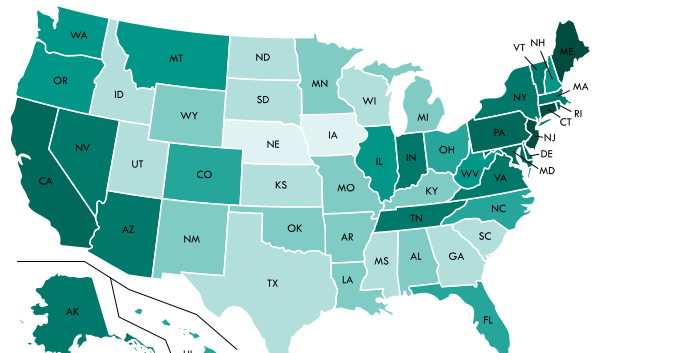
Most common states for health researchers
| Rank | State | Population | # of jobs | Employment/ 1000ppl |
|---|---|---|---|---|
| 1 | District of Columbia | 693,972 | 169 | 24% |
| 2 | Minnesota | 5,576,606 | 1,013 | 18% |
| 3 | Vermont | 623,657 | 115 | 18% |
| 4 | Washington | 7,405,743 | 1,163 | 16% |
| 5 | Indiana | 6,666,818 | 937 | 14% |
| 6 | Ohio | 11,658,609 | 1,345 | 12% |
| 7 | Michigan | 9,962,311 | 1,166 | 12% |
| 8 | Maryland | 6,052,177 | 697 | 12% |
| 9 | Iowa | 3,145,711 | 368 | 12% |
| 10 | Idaho | 1,716,943 | 208 | 12% |
| 11 | North Dakota | 755,393 | 90 | 12% |
| 12 | North Carolina | 10,273,419 | 1,170 | 11% |
| 13 | Virginia | 8,470,020 | 908 | 11% |
| 14 | Tennessee | 6,715,984 | 745 | 11% |
| 15 | Missouri | 6,113,532 | 679 | 11% |
| 16 | Wisconsin | 5,795,483 | 633 | 11% |
| 17 | Arkansas | 3,004,279 | 318 | 11% |
| 18 | Delaware | 961,939 | 108 | 11% |
| 19 | Wyoming | 579,315 | 63 | 11% |
| 20 | Rhode Island | 1,059,639 | 106 | 10% |
Most common cities for health researchers
| Rank | City | # of jobs | Employment/ 1000ppl | Avg. salary |
|---|---|---|---|---|
| 1 | Frankfort | 1 | 4% | $67,826 |
| 2 | Rockville | 2 | 3% | $100,778 |
| 3 | Silver Spring | 2 | 3% | $100,815 |
| 4 | Annapolis | 1 | 3% | $101,244 |
| 5 | Woodlawn | 1 | 3% | $101,392 |
| 6 | Ann Arbor | 1 | 1% | $71,162 |
| 7 | Cambridge | 1 | 1% | $91,634 |
| 8 | Lansing | 1 | 1% | $70,325 |
| 9 | Little Rock | 1 | 1% | $72,292 |
| 10 | Topeka | 1 | 1% | $63,825 |
| 11 | Atlanta | 1 | 0% | $62,978 |
| 12 | Chicago | 1 | 0% | $82,384 |
| 13 | Des Moines | 1 | 0% | $49,727 |
| 14 | Los Angeles | 1 | 0% | $96,629 |
| 15 | Montgomery | 1 | 0% | $69,189 |
| 16 | Oakland | 1 | 0% | $104,373 |
| 17 | Saint Paul | 1 | 0% | $68,878 |
| 18 | Washington | 1 | 0% | $95,298 |
Health Researcher job outlook: Expert opinions
Our panel of health researcher experts
Ohio State University
Vanderbilt University

Duquesne University
University of Wisconsin - Green Bay
Southern Illinois University Edwardsville
University of St Andrews

DePauw University
Kent State University
University of Minnesota Duluth

University of Texas of the Permian Basin

Christian Brothers University
Penn State Altoona
West Virginia State University
Mercyhurst University
Western Illinois University
University of Maryland

Chestnut Hill College
La Sierra University
Dr. Judson Jeffries
ProfessorOhio State University
Ethnic, Cultural Minority, Gender, And Group Studies
What general advice would you give to a Health Researcher?
Dr. Judson Jeffries: Introduce yourself to some of the more noteworthy people in the field at conferences. Establish a relationship with those folks. I am not saying that your circle should include only the most celebrated academics in your field, but you want to get to know maybe 3 to 4 such persons for the following reasons: 1) to position oneself to get sage, counsel and advice from seasoned academics 2) to learn about various opportunities that may not be publicly advertised and 3) at some point the person 's department will need people to evaluate that person for tenure and promotion. Some departments will ask the junior professor for a list of names. At that point the junior professor will be equipped to provide that list. Finally, go into those fields understanding that you have a responsibility to advocate on behalf of those historically marginalized groups that you're studying. What's more, that person needs to understand that what comes with that is doing research that addresses some of the challenges those groups face.
What Health Researcher skills would you recommend for someone trying to advance their career?
Dr. Judson Jeffries: Easy, have a vita that clearly shows strong credentials such as publications and the like, which will help said person get multiple interviews, which may lead to multiple offers. Once that person gets multiple offers, that person cannot be shy about negotiating. Everything is negotiable.
What will help Health Researchers increase their earning potential?
Dr. Judson Jeffries: Grant writing ability. Scholars will become increasingly reliant on securing grants as universities and colleges continue to tighten their belts. This is especially true for state schools where some state legislatures are not as generous with funding as they once were. The state supported The Ohio State University is one such example. There are many more.
Phillis Sheppard Ph.D.
E. Rhodes and Leona B. Carpenter Chair Professor of Religion, Psychology, and Culture and Womanist ThoughtVanderbilt University
Theological And Ministerial Studies
What general advice would you give to a Health Researcher?
Phillis Sheppard Ph.D.: I tell recent graduates to read the contract and the faculty manual. Make sure you understand the long term implications of your early salary. Second, plan for retirement now; do not wait until you are making the salary of your fantasies. Take advantage of opportunities to learn about financial health and management. Third, position yourself. Write and publish directly and clearly in your field of study and adjacent areas. Fourth, create a plan with vision for the career you think you want. Finally, one way or the other, you will carve out a career or job, but a vocation is nurtured by paying attention to where you experience passion and a deep sense of belonging. A vocation is where your heart and intellect find a meaningful place in responding to the world's needs. Your salary best positions you when it supports your whole life and commitments.
Jan Levine
Professor of Law and Director, Legal Research & Writing ProgramDuquesne University
School of Law
What soft skills should all Health Researchers possess?
Jan Levine: While research skills are important, conveying what was found is even more important. Legal research is not conducted in isolation as an experiment in the bibliography; what matters is using what's found to solve a legal problem. So that means demonstrating the application of the fruits of research in a written document, such as an office memorandum, appellate brief, law review article, or another professional setting or context.
What hard/technical skills are most important for Health Researchers?
Jan Levine: Understanding how to plan a research effort, knowing how to update research, so it is timely, finding materials online and in print (which is often ignored or downplayed), demonstrating a critical examination of sources (i.e., reading them closely and coming up with an independent professional assessment of the reliability and validity of the materials), and knowing to find and use non-legal sources of information to apply to a legal problem (including talking with experts, going beyond online and print research). Plus, good researchers know how to use librarians and secondary sources of the law to expand the scope of their work and to be more efficient in their research (both in time and cost). Finally, the ability to organize material is crucial to a well-conducted search for material.
What skills will help Health Researchers earn the most?
Jan Levine: Efficiency in research, clarity in explanation of the use of researched materials, and having a conscious plan of how to conduct research.
Mario Jimenez Chacon
Assistant ProfessorUniversity of Wisconsin - Green Bay
Humanities Department
What soft skills should all Health Researchers possess?
Mario Jimenez Chacon: Interpersonal skills, work ethic, the ability to work in teams, flexibility, and communication skills are all fundamental soft skills. Researchers are also humans and work with humans, so it's essential to have these soft skills to create a welcoming research community.
What hard/technical skills are most important for Health Researchers?
Mario Jimenez Chacon: Of course, a researcher needs to have the ability to perform high-level, intense research; therefore, a qualified researcher needs to have the hard skills associated with their field, for example, the appropriate certification/ degrees or the ability to use technology effectively. Moreover, nowadays, a researcher needs to dominate more than one language; being multilingual is a skill that makes the candidate really stand out.
What skills will help Health Researchers earn the most?
Mario Jimenez Chacon: The skills that will make you earn the most depend very much on their field of research. However, doing the best research possible all the time, having great interpersonal skills, and understanding that one must never stop learning will make you an outstanding candidate in any field.
Dr. Sharon Locke Ph.D.
Director, Center for STEM Research, Education, and Outreach, Professor, Department of Environmental Sciences, ISSP Sustainability Excellence AssociateSouthern Illinois University Edwardsville
Department of Environmental Sciences
What soft skills should all Health Researchers possess?
Dr. Sharon Locke Ph.D.: -Strong written and oral communication are most important. If you cannot write well, you cannot be a successful scientist. Period.
-Evidence of skills in working as part of a team of diverse people and ability to understand the culture and language across scientific/technical disciplines--for example, an environmental chemist who understands something about policy or an environmental health specialist that would be able to collect and interpret data collected from community members.
-Willingness to be a lifelong learner.
-Something that helps an applicant stand out, such as experience with project management software or a foreign language.
Dr. Jeffrey Hughes
Deputy DirectorUniversity of St Andrews
Graduate School for Interdisciplinary Studies
What skills stand out on Health Researcher resumes?
Dr. Jeffrey Hughes: Evidence of working between and across disciplinary boundaries. Evidence of new and innovative research premised on multiple disciplines. Evidence of synergies developed from combining one or more research disciplines.
What soft skills should all Health Researchers possess?
Dr. Jeffrey Hughes: The ability to communicate to academics and practitioners from out-with immediate disciplinary boundaries. The ability to listen to differing perspectives and work to understand differing perspectives through bridging knowledge gaps.
What hard/technical skills are most important for Health Researchers?
Dr. Jeffrey Hughes: This would be dependent upon the disciplines involved and would be hugely varied.
What skills will help Health Researchers earn the most?
Dr. Jeffrey Hughes: I would suggest that cultivating the above skills would result in increased earning potential.
What are the biggest trends we'll see in the Health Researcher job market given the pandemic?
Pedar Foss Ph.D.: The short term is uncertain and depends on the pandemic. Long term, I'm betting on clean energy tech, health tech, and innovative delivery technology.
What Health Researcher skills would you recommend for someone trying to advance their career?
Pedar Foss Ph.D.: I always advise graduates to build experience in written and oral communication because those skills are needed no matter what the field. Read a lot and read widely.
What general advice would you give to a Health Researcher?
Pedar Foss Ph.D.: The advice to students who are graduating is that college prepares them not just for their first job but for a lifetime of adapting to the changing labor landscape. What matters is not what one is doing at age 25, but at age 40. Flexibility, adaptability, and nimbleness, combined with an open mind and exposure to multiple points of view and numerous disciplinary approaches to problems, will ensure that a student can surf their career and not get swamped by a wave of change that overcomes someone who has learned/done only one thing and is therefore stuck in that job.
How do you envision technology impacting Health Researchers in the next 5 years?
Dr. Jason Schenker Ph.D.: As for technology impacting the field, I certainly think that technology has had a substantial impact on the area and will continue to do so over the next five years. Statistical analysis software has continued to advance to handle more complex data sets and more sophisticated data analyses. I also think software related to online collaboration, project management, and communications will play a large role. Additionally, software companies have begun to explore various pricing options and contract lengths to make the software more affordable.
Will there be an enduring impact of the coronavirus pandemic on Health Researchers?
Dr. Jason Schenker Ph.D.: On the positive side, I think the enduring impact of the coronavirus pandemic on graduates will be more flexibility in work schedules and locations. Graduates will be able to apply for jobs all over the country, or perhaps outside the country, without necessarily having to move to a new location. On the negative side, perhaps less commitment from employers to employees, and vice versa.
Will there be an enduring impact of the coronavirus pandemic on Health Researchers?
David Woodward: I believe that the pandemic will have lasting impacts on a lot of different industries, including History/Heritage employment. The most immediate effect will be a contraction of entry-level positions as museums and heritage organizations are in crisis. It is estimated that up to 40% of museums won't survive the pandemic. This is likely a short-term problem as the economy and tourist economy rebounds; new opportunities will develop.
Derek Catsam
Professor of History and Kathlyn Cosper Dunagan Professor in the HumanitiesUniversity of Texas of the Permian Basin
History Department
Will there be an enduring impact of the coronavirus pandemic on Health Researchers?
Derek Catsam: Undoubtedly there will be, and probably already is, some impact that will endure for a while. I would imagine that the data on employment for recent graduates will be a reasonable example of a lagging indicator-as it is, it sometimes takes a little bit of time for recent college graduates to find jobs, so my guess is that we will really be learning about the impact of all of this in the years and months to come. Most institutions are actually not great at tracking graduate job outcomes, so a lot of what you get may well be anecdotal.
Are there any particularly good places in the United States for Health Researchers to find work opportunities?
Derek Catsam: Obviously, the harder a place was hit, the more constricted the job market. There are places that truly did lockdown, and the economic impact (and the lag in recovery) have been hard hit but may well see a better recovery down the road. Some of the places that shut down late and less intensely have found that the virus has hit in waves and may last longer. The entire country was hit hard, but some a lot less hard than others. I think the real insecurity will come when COVID-19 continues to hit intermittently. A good number of our students want to be teachers, and that sector always seems to be hiring because, in many places, there are shortfalls, though what a rough time it is to be a first-time teacher, trying to figure out a new career and figuring out how to do so in whole or in part remotely!
How do you envision technology impacting Health Researchers in the next 5 years?
Derek Catsam: So my discipline is History, which means students take a whole wide range of jobs that may or may not be in "History" per se, but that utilize the skills we try to impart-critical thinking, analytical ability, the ability to read closely and to write effectively, the ability to communicate verbally, and so forth-and so how technology impacts that field will be wildly variable. My guess is that remote meeting apps/websites like Zoom and Teams will become a greater part of our lives, and there may well be more fluidity for people with regard to being able to work remotely (which also may be especially valuable for folks who have long sought ADA accommodations to work remotely full- or part-time). Meanwhile, even before COVID, technology was constantly evolving, and alongside that evolution, our use of and need for and adaptability to technology.
Dr. Neal Palmer Ph.D.
Chair, Associate ProfessorChristian Brothers University
Department of History and Political Science
How do you envision technology impacting Health Researchers in the next 5 years?
Dr. Neal Palmer Ph.D.: History, like all fields, will surely move to more virtual forms of communication and internet-based work. I think history majors and professors will continue to become more creative and skilled in their use of technology to communicate, teach, and research. I expect professional historians will increasingly use virtual platforms to share their research and communicate with the general public. I expect history majors to enter the workforce with increased comfort, confidence, and knowledge regarding technology.
What general advice would you give to a Health Researcher?
Dr. Neal Palmer Ph.D.: I think the pandemic will affect history graduates in many of the same ways it will affect graduates in any major. I hope they will be struck, hopefully, humbled by the power of the natural environment to dictate the terms on which humanity can function. I also hope that it teaches the importance of group cohesion and cooperation in confronting problems. If this happens, I think it could have long-range effects on the personal and political behavior of these graduates as they confront future environmental and social challenges. If you are asking about the more mundane question of jobs, I think history majors should fair well in the post-pandemic world. History majors leave college with communication and thinking skills that will help them adapt and succeed in a fast-changing and unpredictable world.
Are there any particularly good places in the United States for Health Researchers to find work opportunities?
Dr. Neal Palmer Ph.D.: The answer to that question likely won't change from pre- to post-pandemic. Southern cities such as Nashville and Memphis were booming before the pandemic, and that will likely continue. These are good places to find jobs because the cost of living is relatively low, there are vibrant culture and entertainment, and there is not as much college-educated competition for jobs as in larger cities.
What Health Researcher skills would you recommend for someone trying to advance their career?
Dr. Neal Palmer Ph.D.: The answer to that question likely won't change from pre- to post-pandemic. Southern cities such as Nashville and Memphis were booming before the pandemic, and that will likely continue. These are good places to find jobs because the cost of living is relatively low, there are vibrant culture and entertainment, and there is not as much college-educated competition for jobs as in larger cities.
Will there be an enduring impact of the coronavirus pandemic on Health Researchers?
Doug Page Ph.D.: That is difficult to say. What I imagine might be a short-term shifting of in-demand fields, so that our current technology needs might be better addressed. This would include further development and support of software that enables us to meet virtually. That said, History graduates, like others who study within the Humanities, are well-situated to engage in a broad range of areas, given the breadth of their education.
While History is topic-specific, it offers training and practice in those skills that are desired, and allows one to move in the worlds of business, industry, education, law, museums, and others. And, luckily for History graduates, much of the work in all of those fields can be done virtually. Indeed, some exciting and innovative things have been done by museums, especially that makes it possible for more people than ever to "visit" these museums; this could be a big new avenue for History graduates.
Are there any particularly good places in the United States for Health Researchers to find work opportunities?
Doug Page Ph.D.: As I indicated, there is a broad range of occupations that a History graduate can pursue. These opportunities tend to present themselves more apparently in metro areas, where the skill sets of graduates can be best used. However, if some of the fields, in which History majors flourish, retain some virtual presence, that pushes into bigger cities could lessen.
How do you envision technology impacting Health Researchers in the next 5 years?
Doug Page Ph.D.: Our technology is changing and becoming more sophisticated at such a rapid pace; it is challenging to imagine what it will bring to the field of History. I can imagine improvements in the delivery of historical materials in places like the classroom, but also in museums, archives, and libraries. Archival preservation and retrieval are bound to improve, benefitting the public world of libraries and museums, but also corporate and governmental offices as well. If we are extremely lucky, such growing access could create a more informed citizenry, dedicated to using all that History can teach us about ourselves and how to best work together for progress.
Dr. Michael Workman
Associate ProfessorWest Virginia State University
Department of History & Political Science
Will there be an enduring impact of the coronavirus pandemic on Health Researchers?
Dr. Michael Workman: I'm afraid that the Covid-19 pandemic already has affected our History graduates here at WVSU in a big way. Some have delayed plans for grad school; others are hunkering-down and delaying job searches. Those who have taken teaching positions face hurdles reaching students remotely. And those who are engaged in research and writing find themselves unable to travel to perform research at various archives. But I seriously doubt that these impacts will be enduring. This storm cloud may have a silver lining of sorts because many have further developed their computer skills and learned how to access information remotely.
Are there any particularly good places in the United States for Health Researchers to find work opportunities?
Dr. Michael Workman: A History Degree at WVSU equips students for a variety of work opportunities-not just in the field of history. Graduates learn about U.S. & world history, but they also develop skills in research and analysis, writing and argument, as well as presentations that are valuable in many fields, including government and politics, education, and even business. Teaching and working for local, state, and federal government agencies will remain the main fields for our history graduates. With the American public's growing appreciation for history, our graduates will find jobs in historic preservation and interpretation.
Living in a mostly rural state does limit the number of new jobs available, so some graduates will find their way to more urbanized areas, where salaries are usually higher as well. We've also found that some of our graduates truly love our state and are willing to stay and work here, albeit at lower salaries, because of the high
quality of life and family-like relations.
Are there any particularly good places in the United States for Health Researchers to find work opportunities?
Benjamin Scharff Ph.D.: History majors develop a broad range of skills that do well anywhere with a dynamic, robust, and healthy economy. If they plan on pursuing a degree in the field, they are better off searching in states that invest in and emphasize our civic institutions (schools, museums, etc.).
Dr. Timothy Roberts
Professor and Director of Graduate StudiesWestern Illinois University
Department of History
Will there be an enduring impact of the coronavirus pandemic on Health Researchers?
Dr. Timothy Roberts: The coronavirus, of course, has affected education profoundly by accelerating, at least at the moment, the trend away from face-to-face learning and toward distance learning. That transition will hurt students' learning experience, in my opinion, although, besides allowing classes to occur with safe social distancing, distance learning allows nearly anyone with a computer and internet service to take (or, though it's a different kind of hazard, offer) courses.
I think it's easy to imagine that high school and college students who navigate education substantially through online courses will become more independent or self-reliant and tech-savvy. Those are the benefits. The risks are that they may not have the chance to interact with and learn from other students in the class, and not ever experience or be rewarded for learning in any formal setting - a campus, a library, a classroom, a professor's office, a graduation ceremony.
Are there any particularly good places in the United States for Health Researchers to find work opportunities?
Dr. Timothy Roberts: Job-rich areas in history traditionally have been in cities, like other jobs. But again, as distance learning and jobs-from-home become more common, cities may not be as attractive. Some American cities are already seeing a "brain drain." In the last few decades, high school teaching jobs have ebbed and flowed; currently, there is a shortage of qualified teachers, not only in STEM but also in history, in some parts of the country, believe it or not. Reforms are being discussed in some states that that raise high school teachers' salaries, which will create opportunities for qualified new graduates.
Crystal Sehlke
Program Director,University of Maryland
College of Behavioral and Social Sciences
Are there any particularly good places in the United States for Health Researchers to find work opportunities?
Crystal Sehlke: Some sectors are growing: E-commerce, online services, almost anything related to the delivery of goods. Technology skills will remain in demand, and there is an expanding need for data analytics and people who can extract key messages from masses of data. Another area of rapid expansion is human-focused services that can be delivered remotely, such as telehealth and tele-counseling. The popularity of "remote work" in the job and internship market has exploded out of necessity, and some of our current students have benefited from it by applying for remote internships at jobs and organizations that might have posed a geographic challenge prior to COVID-19.
How do you envision technology impacting Health Researchers in the next 5 years?
Crystal Sehlke: As we've found with our own immediate conversion to remote operations, some of the programs, resources, and services that were previously provided in person have had to evolve into different mediums quickly. Post-pandemic, many of these new resources-e.g., self-help online modules, automated training, AI-driven chatbots-will permanently complement in-person resources, which will become more specialized. Professionals in fields that provide information, consultation, or other in-person services will need to become fluent using these technology-based tools.
How do you envision technology impacting Health Researchers in the next 5 years?
Lorraine Coons Ph.D.: Technology has already impacted the field as it has in most academic areas of study. Students interested in careers in archives, museums, and historical societies need to be conversant with computer software specifically related to their work. Teachers, as this pandemic is showing, need to be brought up to speed with online instruction.
Will there be an enduring impact of the coronavirus pandemic on Health Researchers?
Lorraine Coons Ph.D.: Yes, I think this virus has changed us all forever, not just our history graduates. Seniors always feel anxiety as they near the end of their college career because of their fear of the unknown. COVID19 magnified that uncertainty tenfold. I think the memory of this period of their lives will be with them forever, as with us all.
Will there be an enduring impact of the coronavirus pandemic on Health Researchers?
Friedbert Ninow Ph.D.: The pandemic will force us to recognize our vulnerabilities - issues like mental health, coping with physical distancing, acknowledging our fears and worries.
Maintaining social closeness in physical distancing will require us to focus on skill sets we have not emphasized that much before.
What general advice would you give to a Health Researcher?
Friedbert Ninow Ph.D.: A degree in theological and ministerial studies (or more generally in Religious Studies) does not necessarily have to lead into pastoral ministry. There are many opportunities where a Religion degree is a good foundation: Chaplaincy (e.g., Hospital, Army, Jail, etc.), Politics & Society, Journalism, Health Sciences, Arts, etc.
General advice: Let your heart speak first, not possible career chances or salary perspectives, etc. (I understand that this is important, too).