Explore jobs
Find specific jobs
Explore careers
Explore professions
Best companies
Explore companies
Job outlook for high school french teachers in the United States
High school french teacher job growth summary. After extensive research, interviews, and analysis, Zippia's data science team found that:
The projected high school french teacher job growth rate is 5% from 2018-2028.
About 48,700 new jobs for high school french teachers are projected over the next decade.
High school french teacher salaries have increased 8% for high school french teachers in the last 5 years.
There are over 20,796 high school french teachers currently employed in the United States.
There are 67,478 active high school french teacher job openings in the US.
The average high school french teacher salary is $52,276.
Are high school french teacher jobs in demand?
High school french teacher job and salary trends over time
High school french teacher jobs over time
High school french teacher job growth rate over time
| Year | # of jobs | % of population |
|---|---|---|
| 2021 | 20,796 | 0.01% |
| 2020 | 20,200 | 0.01% |
| 2019 | 21,114 | 0.01% |
| 2018 | 21,434 | 0.01% |
| 2017 | 20,938 | 0.01% |
Average high school french teacher salary over time
High school french teacher salary by year
| Year | Avg. salary | Hourly rate | % Change |
|---|---|---|---|
| 2025 | $52,276 | $25.13 | +2.0% |
| 2024 | $51,270 | $24.65 | +2.2% |
| 2023 | $50,156 | $24.11 | +1.9% |
| 2022 | $49,199 | $23.65 | +2.0% |
| 2021 | $48,251 | $23.20 | +1.5% |
High school french teacher jobs by state
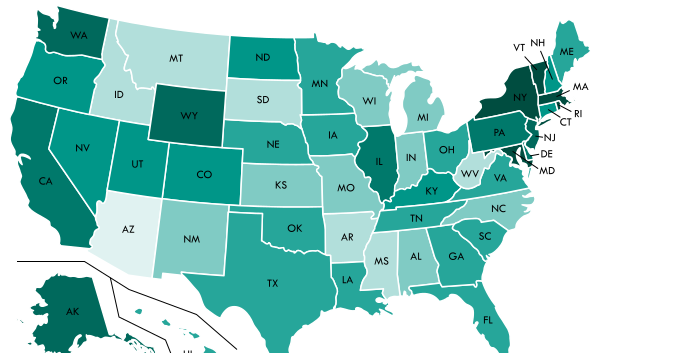
Most common states for high school french teachers
| Rank | State | Population | # of jobs | Employment/ 1000ppl |
|---|---|---|---|---|
| 1 | New Hampshire | 1,342,795 | 248 | 18% |
| 2 | District of Columbia | 693,972 | 124 | 18% |
| 3 | Illinois | 12,802,023 | 1,818 | 14% |
| 4 | Colorado | 5,607,154 | 774 | 14% |
| 5 | New Jersey | 9,005,644 | 1,148 | 13% |
| 6 | Maryland | 6,052,177 | 813 | 13% |
| 7 | Montana | 1,050,493 | 134 | 13% |
| 8 | Delaware | 961,939 | 121 | 13% |
| 9 | Minnesota | 5,576,606 | 690 | 12% |
| 10 | Massachusetts | 6,859,819 | 783 | 11% |
| 11 | New Mexico | 2,088,070 | 236 | 11% |
| 12 | Connecticut | 3,588,184 | 360 | 10% |
| 13 | Michigan | 9,962,311 | 870 | 9% |
| 14 | Virginia | 8,470,020 | 744 | 9% |
| 15 | Missouri | 6,113,532 | 558 | 9% |
| 16 | Oregon | 4,142,776 | 386 | 9% |
| 17 | Kansas | 2,913,123 | 268 | 9% |
| 18 | Nebraska | 1,920,076 | 171 | 9% |
| 19 | Rhode Island | 1,059,639 | 96 | 9% |
| 20 | Vermont | 623,657 | 56 | 9% |
High School French Teacher job outlook: Expert opinions
Our panel of high school french teacher experts

University of La Verne

Rutgers University
La Salle University
Colby-Sawyer College

The University of North Carolina Greensboro
University of Wisconsin - Stevens Point
Dr. Ann Hills
Associate Professor of Spanish & ChairUniversity of La Verne
Modern Languages Department
What are the biggest trends we'll see in the High School French Teacher job market given the pandemic?
Dr. Ann Hills: A general trend, regardless of profession, is adaptability: as technologies evolve to meet the demands of the so-called "new normal," so too must the workforce. Job applicants will need to demonstrate the willingness and ability to navigate a pandemic and post-pandemic landscape by adapting to changes in the way tasks are carried out. It's likely that organizations will retain work practices and modalities that have proved to be efficient, safer, reduce costs, or are otherwise beneficial, so it would behoove candidates to add the necessary skills to their skill set, such as the ability to work remotely and utilize current technologies in a productive way.
Many of our language graduates intend to pursue a job in education, which has undergone a radical transformation (as anyone who is a teacher, a student, or shares a household with a student can attest), and it seems likely that the remote/hybrid learning models will continue long after the pandemic. Beyond a working knowledge of Zoom and good bandwidth, educators will need to demonstrate pedagogical flexibility, innovation, and creativity; the ability to engage students; and empathy towards students.
Another trend is the influence of the healthcare profession-the fastest growing sector of the U.S. economy well before Covid-19-on other professions. In recent years, I've observed many alignments and collaborations between language professionals and the public health sector. Foreign language proficiency and cross-cultural knowledge and sensitivity are invaluable assets across many positions in healthcare organizations, such as translators and interpreters, hospital language & culture specialists, and public health policymakers, to name just a few.
What technical skills for a High School French Teacher stand out to employers?
Dr. Ann Hills: Most jobs these days require a modicum of technical skills, including those oriented around language and culture. In addition to solid research, critical thinking, written and oral skills-part and parcel of a language, literature or linguistics major's expertise-candidates are now expected to demonstrate more technical skills, such as information and multimodal literacies.
For educators at all levels of instruction, the conversion of in-person classes to distance learning has made competence in different types of "Edtech" (education technology) essential. Proficiency with videoconferencing platforms, virtual learning environments, collaboration software, and other digital technologies is extremely advantageous (if not obligatory!). Another impressive skill is website design.
It continues to be important to highlight the "soft skills," such as adaptability, creativity, time management, collaborative decision making and effective communication.
What's a good job out of college for High School French Teachers?
Dr. Ann Hills: The coronavirus has had a devastating effect on many industries and, by extension, job options. Pre-pandemic, I would routinely suggest that language students consider positions in countries in which their language(s) of study are spoken. Many recent graduates teach English abroad right out of college, allowing them to earn money as well as cross-cultural and professional experience; current times have made such opportunities more challenging.
Nevertheless, I believe that graduates with degrees in languages and cultures have skill sets and knowledge that can be translated (pardon the pun) into many fields that continue to be in high demand-indeed, into some fields that are in even higher demand as a result of the pandemic, such as education, healthcare and community engagement. Students of language and culture tend to have a highly developed sense of understanding of, empathy for, and often experience communicating and working with, diverse populations; organizations and private sector employers are realizing that these are critical traits in today's global society and markets, as are concerns for inclusion and equity. In addition to positions that specifically require multilingualism, those that call for critical thinking, superior verbal and written communication skills, and linguistic sophistication should be a good fit for language majors as well.
There are many variables that make a job "good," of course: a livable wage, a reasonable work-life balance, a supportive and respectful environment, a rewarding work product... If you're not fortunate enough to attain your dream job right away-few people are!-take stock of your true passions and future career goals. Consider an entry level job in your desired field or an allied field: this allows you to bank valuable knowledge and experience in that area as you give it a "test drive." If you're interested in education but don't find an available teaching position, apply as a tutor, teaching assistant or substitute teacher. If your passion is literary translation, earn some practical experience working for a commercial translation company.
It's my hope that with determination, creativity and a strong work ethic, we can face the challenges occasioned by the pandemic and find new opportunities for productive collaborations.
Marcy Schwartz Ph.D.
Professor and ChairRutgers University
Department of Spanish and Portuguese
What are the biggest trends we'll see in the High School French Teacher job market given the pandemic?
Marcy Schwartz Ph.D.: We're going to see a shift in emphasis as some newer technologies have been taking off, and other job opportunities (such as tourism, travel, retail and hospitality) have retracted. Hopefully that retraction is temporary, and a gradual return to normal patterns in business, leisure, education, hotel and restaurant management, etc., will recover. Media work, marketing, tech support (in higher education, this is booming as we need more and more support for remote teaching and events), health professions, human resources, social services, and alternative energy sources and engineering seem to be strong.
What technical skills for a High School French Teacher stand out to employers?
Marcy Schwartz Ph.D.: This depends entirely on the industry and the type of work, but clearly the more digitally savvy, the better. World language skills are also key -- interpersonal skills are always valued and all areas of the work force need to prioritize hiring employees who speak languages other than English.
What's a good job out of college for High School French Teachers?
Marcy Schwartz Ph.D.: A good first job out of college should be a training ground in all kinds of professional and life skills. A job that requires multiple skills and tasks allows the candidate to be building professional skills in a broad way, for example, a position that requires marketing, grant writing, and customer relations keeps the candidate from being pigeon-holed in one industry or job sector. Make the most of every opportunity!
What are the biggest trends we'll see in the High School French Teacher job market given the pandemic?
Kimberly Lewinski Ph.D.: I do believe that education as we know it has changed forever. I predict that snow days will be a thing of the past as we have rapidly learned how to adjust instruction in a virtual way. We also know that children learn better in person, so certainly their job is safe. Teachers entering the work force will need to be more tech savvy than ever. The online platforms and new organizational trends for education will continue to be a part of daily education systems. Programs to help ensure all children have access to technology will be ever more important as this will be a very important part of the curriculum.
What type of skills will young High School French Teachers need?
Kimberly Lewinski Ph.D.: My hope is that so many people have gotten a glimpse into the life of a teacher this past year and all the hard work that goes into educating children of all levels. It would be wonderful if teachers begin to gain the respect they deserve now that others could see firsthand it's not as easy as it looks. I always said the problem with recognizing the hard work that goes into teaching is that good teachers make it look undemanding and flawless, straight up easy. People can't see the hours of planning and preparation that are required to make those lessons look so effortless.
What general advice would you give to a High School French Teacher?
R. Todd Coy Ph.D.: Our world today is technologically driven, so it's essential to stay up with that. However, one shouldn't forget the importance of making personal connections with people. "Old fashioned" courtesies, like phone calls or thank you notes to follow up on interviews, etc., can go a long way in helping you stand out from the crowd of form-like emails.
Also, don't think that there is only one path to professional success. Be open to new experiences and flexible in exploring various ways to blend your individual interests and passions into what you want to do and then forge a path that allows you to do pursue those dreams.
What technology do you think will become more important and prevalent for High School French Teachers in the next 3-5 years?
R. Todd Coy Ph.D.: Even before the onset of COVID-19, the increasing importance of technology in areas like education and business communications was apparent. I believe Covid only served to speed up the oncoming changes. Using online formats to deliver professional services like mental health or education will continue to become even more mainstream. Therefore, staying current with the various applications and features found online will allow you to be more effective and marketable.
How would you rate the starting salaries for High School French Teachers, as well as the prospects for salary advancement?
R. Todd Coy Ph.D.: In many professional fields, seeking an advanced degree or training can change the trajectory of one's salary in a positive way. But I think to maximize one's earning potential, they should be flexible and willing to learn specific technologies that will increase their real-world value to prospective employers and, therefore, maximize their earning potential.
Julie Irene Bost
Assistant ProfessorThe University of North Carolina Greensboro
School of Education, Library and Information Science
What experience really stands out on High School French Teacher resumes?
Julie Irene Bost: A range of experiences in various settings, content areas, and age groups. The more experiences a teacher candidate has, the more skills they have to transfer into new settings. A resume really stands out when it includes teaching experiences with students of varying ages, abilities, and backgrounds along with multiple content areas (e.g., reading, math, science, etc.).
What High School French Teacher skills would you recommend for someone trying to advance their career?
Julie Irene Bost: Students should seek out experiences in educational settings as much as possible. This might be a K-12 school, preschool, or community center. Any opportunity where they can practice teaching and behavior management skills is ideal.
What technology do you think will become more important and prevalent for High School French Teachers in the next 3-5 years?
Julie Irene Bost: Virtual learning experiences will continue way beyond remote learning. Teachers need to continue to develop skills for teaching in remote, virtual, and hybrid learning environments. This does not mean being able to use a magnitude of web-based tools, but having a few that they use effectively. It is also important for teachers to think beyond the basic delivery of content and develop strategies to engage the learner and incorporate social-emotional learning.
Maggie Beeber
Undergraduate Advising Coordinator & Teacher Certification OfficerUniversity of Wisconsin - Stevens Point
School of Education
What general advice would you give to a High School French Teacher?
Maggie Beeber: Be flexible when searching for that first job. Spread your wings and be willing to live in a new community. You may find that it changes your whole life and is the perfect fit. Remember how hard you have worked to earn this degree. You are strong and can succeed in anything you put work into. We also want you to remember we are here if you need us.
What technology do you think will become more important and prevalent for High School French Teachers in the next 3-5 years?
Maggie Beeber: Technology in teaching is so quickly evolving, especially in the midst of what we are going through. Take those opportunities given to you by your school district, your teacher's association, and the Department of Public Instruction.
How would you rate the starting salaries for High School French Teachers, as well as the prospects for salary advancement?
Maggie Beeber: As much as we would like to see an increase in teacher salaries, we seldom speak of the other financial benefits most districts offer: one of the best pension plans in the country, health, sometimes vision and dental. Many districts will give raises for years of experience and higher-level degrees like a master's degree, EdD or Ph.D. Some may assist in paying for these.