Explore jobs
Find specific jobs
Explore careers
Explore professions
Best companies
Explore companies
Job outlook for image scientists in the United States
Are image scientist jobs in demand?
Image scientist job and salary trends over time
Image scientist jobs over time
Image scientist job growth rate over time
| Year | # of jobs | % of population |
|---|---|---|
| 2021 | 68 | 0.00% |
| 2020 | 79 | 0.00% |
| 2019 | 80 | 0.00% |
| 2018 | 75 | 0.00% |
| 2017 | 70 | 0.00% |
Average image scientist salary over time
Image scientist salary by year
| Year | Avg. salary | Hourly rate | % Change |
|---|---|---|---|
| 2025 | $87,934 | $42.28 | +3.1% |
| 2024 | $85,320 | $41.02 | +4.7% |
| 2023 | $81,496 | $39.18 | +3.3% |
| 2022 | $78,882 | $37.92 | +1.9% |
| 2021 | $77,383 | $37.20 | --2.1% |
Image scientist jobs by state
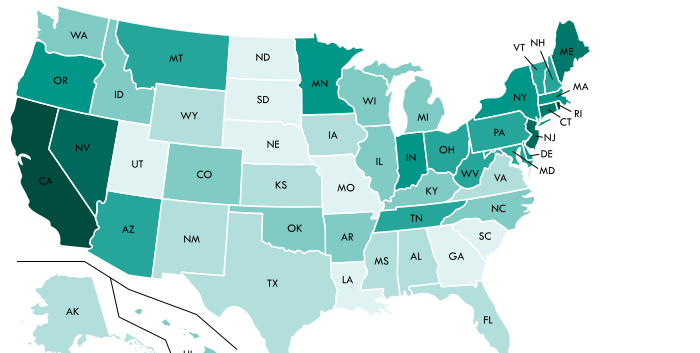
Most common states for image scientists
| Rank | State | Population | # of jobs | Employment/ 1000ppl |
|---|---|---|---|---|
| 1 | Massachusetts | 6,859,819 | 2,122 | 31% |
| 2 | District of Columbia | 693,972 | 143 | 21% |
| 3 | Maryland | 6,052,177 | 954 | 16% |
| 4 | Delaware | 961,939 | 154 | 16% |
| 5 | Virginia | 8,470,020 | 1,063 | 13% |
| 6 | South Dakota | 869,666 | 104 | 12% |
| 7 | New Jersey | 9,005,644 | 967 | 11% |
| 8 | Washington | 7,405,743 | 835 | 11% |
| 9 | Vermont | 623,657 | 66 | 11% |
| 10 | North Dakota | 755,393 | 73 | 10% |
| 11 | Alaska | 739,795 | 71 | 10% |
| 12 | California | 39,536,653 | 3,408 | 9% |
| 13 | New Hampshire | 1,342,795 | 122 | 9% |
| 14 | Illinois | 12,802,023 | 1,027 | 8% |
| 15 | North Carolina | 10,273,419 | 867 | 8% |
| 16 | Minnesota | 5,576,606 | 460 | 8% |
| 17 | Oregon | 4,142,776 | 339 | 8% |
| 18 | Connecticut | 3,588,184 | 299 | 8% |
| 19 | Montana | 1,050,493 | 89 | 8% |
| 20 | Rhode Island | 1,059,639 | 87 | 8% |
Most common cities for image scientists
| Rank | City | # of jobs | Employment/ 1000ppl | Avg. salary |
|---|---|---|---|---|
| 1 | Cambridge | 4 | 4% | $81,291 |
| 2 | San Fernando | 1 | 4% | $105,486 |
| 3 | Lawndale | 1 | 3% | $104,087 |
| 4 | Cupertino | 1 | 2% | $115,520 |
| 5 | Alhambra | 1 | 1% | $104,401 |
| 6 | Baltimore | 1 | 0% | $76,020 |
| 7 | Los Angeles | 1 | 0% | $104,591 |
Image Scientist job outlook: Expert opinions
Our panel of image scientist experts
Washington State University
University of Pittsburgh
University of Nebraska - Omaha
Loyola University New Orleans
Western Washington University
Curry College
William and Mary

Holyoke Community College
Luz Garcini PhD, MPH
Assistant ProfessorWhat general advice would you give to an Image Scientist?
Luz Garcini PhD, MPH: Find a purpose and a meaning in their work and be open to learning from interdisciplinary fields.
What will help Image Scientists increase their earning potential?
Lindsey du Toit: Take every opportunity you can to learn, network, and build an effective team of people that bring a greater breadth and depth of skills and expertise to the work on which you will be focusing. Cultivate a life-long sense of intellectual curiosity and learning. Don’t be afraid to ask questions. Treat ignorance as an opportunity to learn. Questions demonstrate you want to understand the situation/problem effectively and that you are paying attention. Always demonstrate integrity in your work. It is one of the most valuable traits you can bring to your career. Be kind and supportive of your colleagues.
What will help Image Scientists increase their earning potential?
Arjumand Ghazi Ph. D: Having an advanced degree such as a PhD and even a few years postdoc is a good way to start at a higher level. It often allows one to make up for the reduced earnings during the training periods while increasing long-term earnings.
Andrew Riquier Ph.D.
InstructorUniversity of Nebraska - Omaha
Neurobiology And Neurosciences
What general advice would you give to an Image Scientist?
Andrew Riquier Ph.D.: Apply for the positions you want, even if you feel underqualified. I know plenty of people who have applied for jobs they didn't quite meet the requirements for, and got hired for other reasons. In my experience, many recent graduates choose to take time to strengthen their resumes by retaking classes, working jobs they don't particularly want to get experience, etc. There is some value in that, particularly if you have been unsuccessful attaining the position you want, or if you want to see if you even enjoy that type of work. But if you are confident in what you want to do, go for it; in the worst-case scenario, you are in the same position you would be if you hadn't applied, but now you have experience applying and have potentially gained a contact in the field.
Kimberlee Mix PhD
Provost Distinguished Professor of Biological SciencesLoyola University New Orleans
Biochemistry, Biophysics And Molecular Biology
What will help Image Scientists increase their earning potential?
Kimberlee Mix PhD: Keep an open mind in your first position - it may involve repetitive lab work focused on a single technique or protocol. Learn as much as you can about the big picture of your project and know that you have an important part in it. Take advantage of down-time during incubations to socialize with your new colleagues and learn about their career journeys. Ask lots of questions and take good notes.
What Image Scientist skills would you recommend for someone trying to advance their career?
Josh Kaplan Ph.D.: Demonstrating a skill set that is unique, such as experience with a rare technical research approach, or demonstrating that you can save your employer money by utilizing free resources, can be used to negotiate a higher salary.
What will help Image Scientists increase their earning potential?
Josh Kaplan Ph.D.: Be reliable, consistent, and focus on the details. Your neuroscience training required you to develop an attention to detail that permeated many aspects of your work. Further, you had to apply that detailed approach in a consistent manner across a potentially long experimental duration. Your future coworkers and employers will appreciate knowing that you'll be able to apply the instructions for a novel scenario reliably and consistently.
What will help Image Scientists increase their earning potential?
Dr. Nicole Parsons: The evolving landscape of various industries is likely to demand a set of skills that align with technological advancements, changing workplace dynamics, and emerging trends. Some skills that are expected to become more important and prevalent in the next 3-5 years are remote collaboration, digital literacy, cybersecurity, adaptability and flexibility, and a lifelong learning mindset.
Are there any particularly good places in the United States for Image Scientists to find work opportunities?
Don Snyder: Strong tech markets in the U.S. include Austin, Raleigh, Atlanta, Denver, Seattle, San Francisco, Washington, D.C., and Columbus. Some markets are established in tech, while other markets are more up-and-coming. Smaller cities that may be "off the radar" include Huntsville and Tucson. Graduates need to look at different factors when exploring cities, including the cost of living. The dollar will go a lot further in Raleigh than in San Francisco. And some cities that were once more affordable may have a higher cost of living now due to the recent influx of residents.
What general advice would you give to an Image Scientist?
Sage Franetovich: Keep an open mind, and be willing to try new things, and work with all kinds of people. We, the professors, are preparing you for a job market that is constantly changing.