Explore jobs
Find specific jobs
Explore careers
Explore professions
Best companies
Explore companies
Job outlook for industrial engineering technicians in the United States
Are industrial engineering technician jobs in demand?
Industrial engineering technician job and salary trends over time
Industrial engineering technician jobs over time
Industrial engineering technician job growth rate over time
| Year | # of jobs | % of population |
|---|---|---|
| 2021 | 227 | 0.00% |
| 2020 | 230 | 0.00% |
| 2019 | 245 | 0.00% |
| 2018 | 243 | 0.00% |
| 2017 | 238 | 0.00% |
Average industrial engineering technician salary over time
Industrial engineering technician salary by year
| Year | Avg. salary | Hourly rate | % Change |
|---|---|---|---|
| 2026 | $55,055 | $26.47 | +1.4% |
| 2025 | $54,316 | $26.11 | +2.0% |
| 2024 | $53,269 | $25.61 | +2.2% |
| 2023 | $52,135 | $25.07 | +1.8% |
| 2022 | $51,223 | $24.63 | --0.8% |
Industrial engineering technician jobs by state
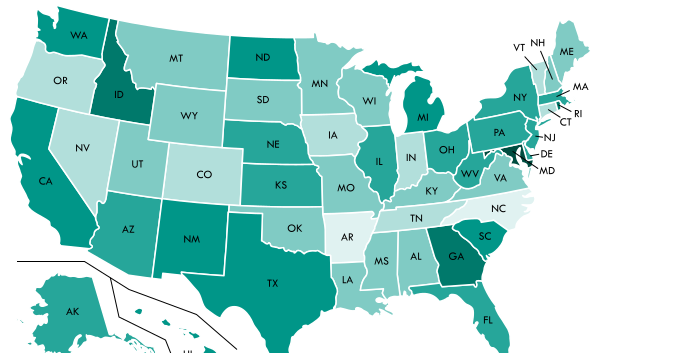
Most common states for industrial engineering technicians
| Rank | State | Population | # of jobs | Employment/ 1000ppl |
|---|---|---|---|---|
| 1 | District of Columbia | 693,972 | 276 | 40% |
| 2 | Delaware | 961,939 | 252 | 26% |
| 3 | Alaska | 739,795 | 196 | 26% |
| 4 | Massachusetts | 6,859,819 | 1,475 | 22% |
| 5 | Iowa | 3,145,711 | 692 | 22% |
| 6 | Utah | 3,101,833 | 647 | 21% |
| 7 | North Dakota | 755,393 | 157 | 21% |
| 8 | Colorado | 5,607,154 | 1,130 | 20% |
| 9 | Connecticut | 3,588,184 | 702 | 20% |
| 10 | Maine | 1,335,907 | 273 | 20% |
| 11 | New Hampshire | 1,342,795 | 272 | 20% |
| 12 | Wyoming | 579,315 | 115 | 20% |
| 13 | Virginia | 8,470,020 | 1,570 | 19% |
| 14 | Rhode Island | 1,059,639 | 206 | 19% |
| 15 | Washington | 7,405,743 | 1,339 | 18% |
| 16 | Oregon | 4,142,776 | 765 | 18% |
| 17 | Idaho | 1,716,943 | 307 | 18% |
| 18 | Wisconsin | 5,795,483 | 991 | 17% |
| 19 | Montana | 1,050,493 | 181 | 17% |
| 20 | South Dakota | 869,666 | 152 | 17% |
Most common cities for industrial engineering technicians
| Rank | City | # of jobs | Employment/ 1000ppl | Avg. salary |
|---|---|---|---|---|
| 1 | Frankfort | 1 | 4% | $50,992 |
| 2 | Annapolis | 1 | 3% | $73,788 |
| 3 | Dover | 1 | 3% | $52,804 |
| 4 | Florence | 1 | 3% | $51,283 |
| 5 | Juneau | 1 | 3% | $56,206 |
| 6 | Hartford | 1 | 1% | $45,936 |
| 7 | Lansing | 1 | 1% | $59,579 |
| 8 | Little Rock | 1 | 1% | $43,615 |
| 9 | Springfield | 1 | 1% | $52,174 |
| 10 | Atlanta | 1 | 0% | $63,919 |
| 11 | Baton Rouge | 1 | 0% | $51,108 |
| 12 | Boston | 1 | 0% | $54,815 |
| 13 | Denver | 1 | 0% | $46,137 |
| 14 | Des Moines | 1 | 0% | $44,341 |
| 15 | Indianapolis | 1 | 0% | $46,653 |
| 16 | Montgomery | 1 | 0% | $51,943 |
| 17 | Phoenix | 1 | 0% | $53,361 |
| 18 | Sacramento | 1 | 0% | $60,394 |
Industrial Engineering Technician job outlook: Expert opinions
Our panel of industrial engineering technician experts
University of Alabama at Huntsville
Michigan Technological University
Bowling Green State University
Oklahoma State University

North Dakota State University

University of Pittsburgh
Clarkson University

Kettering University

Pennsylvania State University

Institute of Industrial and Systems Engineers
What Industrial Engineering Technician skills would you recommend for someone trying to advance their career?
Ana Wooley Ph.D.: For a graduate beginning their career in Industrial Systems Engineering, my advice is to be genuinely proactive and to take initiative. This field, like any other, comes with a steep learning curve as you familiarize yourself with the company's operations, culture, and processes. Actively seek out and engage with experienced colleagues who can mentor and guide you. Don’t hesitate to volunteer for challenging tasks, as these opportunities will significantly improve your learning and skill development. Another piece of advice I would give is not to be discouraged if you find yourself not enjoying your first job. It's important to remember that you never truly know until you experience it firsthand. This initial job can be a great learning opportunity, helping you identify what aspects of the field you don't enjoy and guiding you towards roles that are a better fit for your interests and skills. Every experience, even those that are not ideal, contributes to your overall career growth and helps you identify your career path.
What general advice would you give to an Industrial Engineering Technician?
John Irwin EdD: Engineering technology graduates are masters of technology, gaining a broad and deep understanding of the processes, systems, tools, and techniques necessary to construct, modify, operate, and maintain an engineering design. They act as technological integrators, bridging the gap between the skilled trades and engineering fundamentals. This is a great career path for those who enjoy engineering concepts but would rather spend time working with their hands solving specific technical issues than tackling broader, more complex design challenges.
What Industrial Engineering Technician skills would you recommend for someone trying to advance their career?
John Irwin EdD: They like that the job market is very strong. Companies that are implementing industry 4.0 technologies are in need of Engineering Technology graduates because they are well prepared to meet these challenges. Employers like their problem-solving and hands-on experience with modern industry tools. ET graduates with 4-yr degrees dislike that some company recruiters do not recognize them as engineers and confuse them with 2-yr associate degree technicians.
What will help Industrial Engineering Technicians increase their earning potential?
John Irwin EdD: Engineering technology graduates develop, design, and implement engineering and technology solutions, typically pursuing engineering careers in design, construction, and product improvement. They work both in an office setting with design and simulation software as well as on the production/onsite setting troubleshooting issues for continuous improvements.
Christopher Kluse
Associate Professor, Quality SystemsBowling Green State University
Industrial Production Technologies/Technicians
What general advice would you give to an Industrial Engineering Technician?
Christopher Kluse: To maximize salary, start by being a polished interviewee and salary negotiator. Research all aspects of the position, the industry (i.e automotive, aerospace, medical device, electronics, etc.) which you are potentially going to enter, and understand typical salary expectations. After landing the position, most importantly, demonstrate a solid work ethic, be reliable, (show up to work each and every day) flexible, and be a team player. This will result in favorable salary advances. Your technical skills are often assumed; regardless, employers are generally willing to train or accept a learning curve for someone with a good work ethic who demonstrates reliability, loyalty, and the propensity to grow with the organization. Organizations want long term employees who can and will grow with them. Internal promotion is generally preferred; thus, they prefer to pay current employees (well) vs seeking an outside candidate that is unproven.
What Industrial Engineering Technician skills would you recommend for someone trying to advance their career?
Christopher Kluse: Currently, what I have hear from most of the employers that I work with is – they want a team player who can function effectively in a team setting, an employee who possesses critical thinking, problem solving and communication skills and are willing to put in the time to get the job done. Reliability and work ethic are cherished.
What will help Industrial Engineering Technicians increase their earning potential?
Christopher Kluse: Relative to Industrial Technology, the use of technology and emerging technology within your discipline. Understanding how to manage and analyze large amounts of data for problem-solving and decision making are important. Use of emerging technologies such as AI or virtual reality as tools to improve efficiency, reduce variation/waste, improve performance are expanding technologies. Staying on top of emerging technology is critical. Data analysis, data management, data presentation are skills that employers seek and often cite that recent hires are lacking these skills. The need for soft skills will always be important and has been an employer concern for many years, especially recent college graduates.
What Industrial Engineering Technician skills would you recommend for someone trying to advance their career?
Guiping Hu Ph.D.: Industrial Engineering is a very inclusive, diverse, and dynamic discipline. IE is about choices, other engineering disciplines apply skills to very specific areas. IE gives you the opportunity to work on a variety of businesses. If you are interested in management and interacting with people and improving systems, IE is a great choice for you.
Dr. David Grewell Ph.D.
Department Chair and ProfessorNorth Dakota State University
Industrial and Manufacturing Engineering Department
What soft skills should all Industrial Engineering Technicians possess?
Dr. David Grewell Ph.D.: Communication, problem-solving abilities, leadership, and organizational skills are all key in allowing IE's to be successful in the workplace and to build teams that can collaborate and adapt to unexpected changes, challenges, and setbacks in the workplace. These skills also help them to leverage the resources to solve problems quickly with low costs allowing them to move on to the next challenge facing the world today in today's complex economy, in particular when facing a pandemic.
What hard/technical skills are most important for Industrial Engineering Technicians?
Dr. David Grewell Ph.D.: An IE must be able to break down complex problems into manageable issues and provide solutions for these problems that face the world in today's complex interconnected systems. A background in statistics, design and analysis, process management, and a strong foundation in the engineering disciplines make this possible.
What skills will help Industrial Engineering Technicians earn the most?
Dr. David Grewell Ph.D.: Good communication and leadership skills that are embedded in their curriculum enable IE's to quickly move up the corporate ladder and become the CEO of the nation's leading companies.
What are the biggest trends we'll see in the Industrial Engineering Technician job market given the pandemic?
Karen Bursic Ph.D.: More and more companies are realizing that many of the things that people do can be done just as effectively at home. I think this is particularly true for many of the things that IEs do...from data analytics to building optimization models to engineering economic analysis. So students don't always have to limit their job searches to a particular geographic region given personals situations and companies have bigger candidate pools for many positions. In addition, IEs typically graduate with plenty of experience in communicating their work in multiple ways including using online platforms. Working at home also means job candidates need strong professional and ethical skills which we often integrate into our IE coursework and many of our students learn via our cooperative education program.
What certifications/licenses/courses can have the biggest impact for Industrial Engineering Technicians?
Karen Bursic Ph.D.: Right now, the Lean Six Sigma certifications as well as certifications or coursework in Supply Chain Management.
Will there be an enduring impact of the coronavirus pandemic on Industrial Engineering Technicians?
Tracy Farrell: I believe there will be an enduring impact of the coronavirus pandemic on graduates. Positively, they are now prepared to work in a variety of work environments: in-person, hybrid, and remote only. Navigating the changing schedules and technologies have put graduates at an advantage.
Negatively, some graduates may not have adjusted well to hybrid or remote only learning; therefore, putting them at a disadvantage to be able to adjust easily and successfully to managing time and organizing their "work space" to be productive in hybrid or remote only environments. These graduates will need to improve time management and organizational skills in order to be successful.
What experience really stands out on Industrial Engineering Technician resumes?
Scott Grasman Ph.D.: Graduates that have applied their classroom learning to real work experiences will differentiate themselves from others. Showing that you have particular skills, perhaps through certifications, and highlighting your specific abilities through tangible examples is critical.
In addition to a resume, students could create a portfolio of items that demonstrates their knowledge and ability.
What type of skills will young Industrial Engineering Technicians need?
Scott Grasman Ph.D.: Many surveys have highlighted the need for soft skills: listening, communication, etc. Beyond that, graduates should enter the workforce with a curiosity to seek out and solve problems, to look for mentorship, and not be afraid to take on new challenges.
The working environment is always changing so graduates will need the ability to adapt and to learn new skills. It often gets overlooked but graduates must have valuable technical skill or they will be left out.
What Industrial Engineering Technician skills would you recommend for someone trying to advance their career?
Charles Purdum: Certification, certification, certifications! Lean or Six Sigma green belt (e.g., ASQ.com), project management (e.g., PMI.com), and leadership skills.
James Swisher
Director of Continuing EducationInstitute of Industrial and Systems Engineers
What general advice would you give to an Industrial Engineering Technician?
James Swisher: It's truly an exciting time to be an Industrial and Systems Engineer. The U.S. Bureau of Labor and Statistics projects demand for ISEs to grow by 10% over the next ten years, which is much faster than the rate for all occupations. Firms across a broad range of industries will continue to focus on the skills that ISEs bring to improve efficiencies, enhance quality, and lower costs. In addition, ISEs bring skills in the related fields of big data, artificial intelligence, and project management that make them extremely valuable to organizations. ISEs ability to quickly make an impact in an organization also means that their potential for promotion is very good. It's a great profession to be in.