Explore jobs
Find specific jobs
Explore careers
Explore professions
Best companies
Explore companies
Job outlook for industrial safety engineers in the United States
Are industrial safety engineer jobs in demand?
Industrial safety engineer job and salary trends over time
Industrial safety engineer jobs over time
Industrial safety engineer job growth rate over time
| Year | # of jobs | % of population |
|---|---|---|
| 2021 | 1,281 | 0.00% |
| 2020 | 1,332 | 0.00% |
| 2019 | 1,449 | 0.00% |
| 2018 | 1,469 | 0.00% |
| 2017 | 1,464 | 0.00% |
Average industrial safety engineer salary over time
Industrial safety engineer salary by year
| Year | Avg. salary | Hourly rate | % Change |
|---|---|---|---|
| 2025 | $80,974 | $38.93 | +3.1% |
| 2024 | $78,542 | $37.76 | +2.6% |
| 2023 | $76,583 | $36.82 | +0.7% |
| 2022 | $76,051 | $36.56 | +2.1% |
| 2021 | $74,513 | $35.82 | +2.5% |
Industrial safety engineer jobs by state
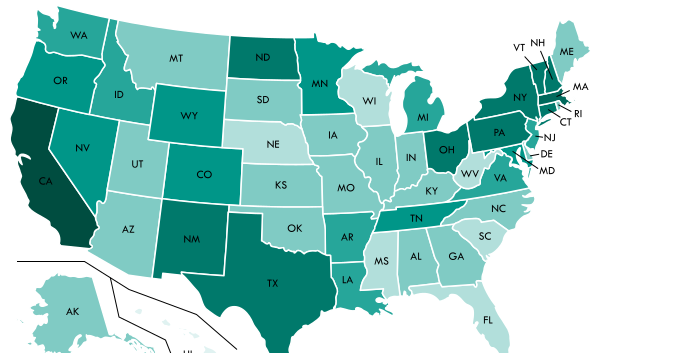
Most common states for industrial safety engineers
| Rank | State | Population | # of jobs | Employment/ 1000ppl |
|---|---|---|---|---|
| 1 | District of Columbia | 693,972 | 245 | 35% |
| 2 | Virginia | 8,470,020 | 895 | 11% |
| 3 | Delaware | 961,939 | 102 | 11% |
| 4 | Iowa | 3,145,711 | 276 | 9% |
| 5 | Massachusetts | 6,859,819 | 567 | 8% |
| 6 | Maryland | 6,052,177 | 511 | 8% |
| 7 | California | 39,536,653 | 2,572 | 7% |
| 8 | Georgia | 10,429,379 | 687 | 7% |
| 9 | North Carolina | 10,273,419 | 670 | 7% |
| 10 | Washington | 7,405,743 | 552 | 7% |
| 11 | Indiana | 6,666,818 | 440 | 7% |
| 12 | Colorado | 5,607,154 | 391 | 7% |
| 13 | Alabama | 4,874,747 | 346 | 7% |
| 14 | Oregon | 4,142,776 | 305 | 7% |
| 15 | New Hampshire | 1,342,795 | 96 | 7% |
| 16 | Alaska | 739,795 | 53 | 7% |
| 17 | Vermont | 623,657 | 41 | 7% |
| 18 | Connecticut | 3,588,184 | 204 | 6% |
| 19 | North Dakota | 755,393 | 46 | 6% |
| 20 | Wyoming | 579,315 | 34 | 6% |
Most common cities for industrial safety engineers
| Rank | City | # of jobs | Employment/ 1000ppl | Avg. salary |
|---|---|---|---|---|
| 1 | Huntsville | 1 | 1% | $76,969 |
| 2 | Salt Lake City | 1 | 1% | $72,110 |
Industrial Safety Engineer job outlook: Expert opinions
Our panel of industrial safety engineer experts
University of Alabama at Huntsville
Northern Illinois University
Oklahoma State University

North Dakota State University

University of Pittsburgh
New Mexico State University
Clarkson University
San Jose State University
What Industrial Safety Engineer skills would you recommend for someone trying to advance their career?
Ana Wooley Ph.D.: For a graduate beginning their career in Industrial Systems Engineering, my advice is to be genuinely proactive and to take initiative. This field, like any other, comes with a steep learning curve as you familiarize yourself with the company's operations, culture, and processes. Actively seek out and engage with experienced colleagues who can mentor and guide you. Don’t hesitate to volunteer for challenging tasks, as these opportunities will significantly improve your learning and skill development. Another piece of advice I would give is not to be discouraged if you find yourself not enjoying your first job. It's important to remember that you never truly know until you experience it firsthand. This initial job can be a great learning opportunity, helping you identify what aspects of the field you don't enjoy and guiding you towards roles that are a better fit for your interests and skills. Every experience, even those that are not ideal, contributes to your overall career growth and helps you identify your career path.
What general advice would you give to an Industrial Safety Engineer?
Theodore Hogan PhD, CIH: Engineering Technology B.S. graduates apply both engineering knowledge and industrial management skills to practical problem solving. The day-to-day work includes collaborating with management and line workers to troubleshoot issues along with planning and implementing process improvements. More experienced Engineering Technology graduates apply these people and problem-solving skills to manage traditional engineers and general business operations.
What general advice would you give to an Industrial Safety Engineer?
Guiping Hu Ph.D.: People like the diversity and flexibility of being an industrial engineer. You can work on all kinds of problems with your industrial engineering skills. However, if you are only looking for a very narrow area in a specific engineering discipline, industrial engineering may not be right for you since we focus on system efficiency improvement and welfare of the workers.
Dr. David Grewell Ph.D.
Department Chair and ProfessorNorth Dakota State University
Industrial and Manufacturing Engineering Department
What hard/technical skills are most important for Industrial Safety Engineers?
Dr. David Grewell Ph.D.: An IE must be able to break down complex problems into manageable issues and provide solutions for these problems that face the world in today's complex interconnected systems. A background in statistics, design and analysis, process management, and a strong foundation in the engineering disciplines make this possible.
What are the biggest trends we'll see in the Industrial Safety Engineer job market given the pandemic?
Karen Bursic Ph.D.: More and more companies are realizing that many of the things that people do can be done just as effectively at home. I think this is particularly true for many of the things that IEs do...from data analytics to building optimization models to engineering economic analysis. So students don't always have to limit their job searches to a particular geographic region given personals situations and companies have bigger candidate pools for many positions. In addition, IEs typically graduate with plenty of experience in communicating their work in multiple ways including using online platforms. Working at home also means job candidates need strong professional and ethical skills which we often integrate into our IE coursework and many of our students learn via our cooperative education program.
What certifications/licenses/courses can have the biggest impact for Industrial Safety Engineers?
Karen Bursic Ph.D.: Right now, the Lean Six Sigma certifications as well as certifications or coursework in Supply Chain Management.
Will there be an enduring impact of the coronavirus pandemic on Industrial Safety Engineers?
Edward Pines Ph.D.: I believe there will be long-term changes in the job market but mostly in the way students will work when they get a job. Remote work is here to stay for many engineers. Commuting to work and all the lifestyle activities that go with commuting to work will continue to decrease. Developing communication skills and developing teaming skills will become even more important for students and new graduates. As the technology improves, it will likely seem more like traveling to meet with colleagues in other locations. Recruiting will change as well so it will be helpful for students to learn how that area evolves.
What's a good job out of college for Industrial Safety Engineers?
Tracy Farrell: A "good" job out of college, in my opinion, is an entry-level position with a company that provides advancement. I would recommend that if graduates did not take advantage of internship opportunities, early and often, they will be at a disadvantage to "think they know it all" and have proven not to be as successful. Entry positions offer valuable training and teach transferable skills that can only be gained in entry-level positions (or internships) like communication skills, time management, organization, teamwork, aspects of all positions.
I strongly recommend that a graduate start interning well before they graduate. Internships can serve as "entry-level positions" providing opportunities for learning, growth, and hands-on experience they would not have otherwise. NYS high school business education programs have been offering internships for years, for credit, and many students do not take advantage of these programs.
What technical skills for an Industrial Safety Engineer stand out to employers?
Tracy Farrell: Technical skills that employers are seeking include "real" computer skills like Microsoft Office Suite tools, proper communication skills via email and website development and postings, developing proper document format that is appropriate to send to stakeholders (i.e., letter formatting, report writing, email formatting); strong communication skills that include speaking professionally and respectfully to stakeholders as well as writing professionally (i.e., making eye contact when speaking, proper handshake, respectful dialogue including questioning); project management - knowing how to organize work and develop a timeline that includes who will be responsible for what and follow through; data analysis - being able to not only present data in an organized and understandable manner; but, be able to interpret data correctly offering the justification behind what they are interpreting and why.
Respectfully, today's graduates do not understand that being able to text and use social media does not prepare them for "real" computer skills. Many students that I have in high school and in college do not have proper writing skills, document formatting skills, or document management skills to know how to save documents properly and where to save to.
Christine Foster
Adjunct ProfessorSan Jose State University
Industrial Systems and Engineering Department
What are the biggest trends we'll see in the Industrial Safety Engineer job market given the pandemic?
Christine Foster: I believe that the pandemic will continue to drive opportunities for occupational safety work within the greater healthcare market, and more specifically in hospitals and clinics as well as biotech/pharma. I also have seen an increased demand for safety professionals overall, as many aspects of the pandemic have driven home the need for safety in industries that have not typically had a focus in this area. Examples of this include food and beverage, where there have been significant outbreaks during the pandemic, and food service where there is great risk for exposure during eating and drinking activities. Regulatory changes will also continue to increase demand for occupational safety expertise.