Explore jobs
Find specific jobs
Explore careers
Explore professions
Best companies
Explore companies
Job outlook for information technology specialist leads in the United States
Information technology specialist lead job growth summary. After extensive research, interviews, and analysis, Zippia's data science team found that:
The projected information technology specialist lead job growth rate is 10% from 2018-2028.
About 83,100 new jobs for information technology specialist leads are projected over the next decade.
Information technology specialist lead salaries have increased 9% for information technology specialist leads in the last 5 years.
There are over 177,211 information technology specialist leads currently employed in the United States.
There are 131,704 active information technology specialist lead job openings in the US.
The average information technology specialist lead salary is $109,011.
Are information technology specialist lead jobs in demand?
Information technology specialist lead job and salary trends over time
Information technology specialist lead jobs over time
Information technology specialist lead job growth rate over time
| Year | # of jobs | % of population |
|---|---|---|
| 2021 | 177,211 | 0.05% |
| 2020 | 178,240 | 0.05% |
| 2019 | 151,317 | 0.05% |
| 2018 | 127,258 | 0.04% |
| 2017 | 122,723 | 0.04% |
Average information technology specialist lead salary over time
Information technology specialist lead salary by year
| Year | Avg. salary | Hourly rate | % Change |
|---|---|---|---|
| 2025 | $109,011 | $52.41 | +3.4% |
| 2024 | $105,419 | $50.68 | +2.3% |
| 2023 | $103,032 | $49.53 | +1.5% |
| 2022 | $101,476 | $48.79 | +1.7% |
| 2021 | $99,819 | $47.99 | +1.6% |
Information technology specialist lead jobs by state
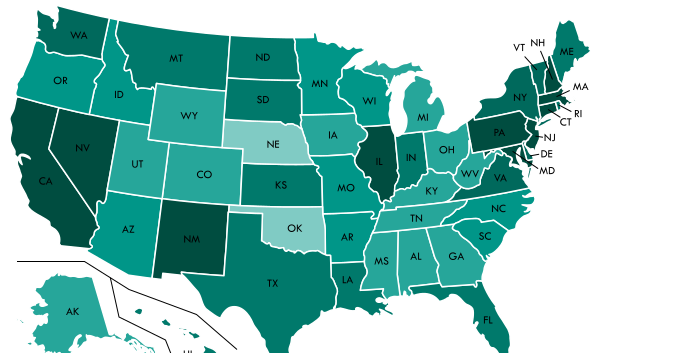
Most common states for information technology specialist leads
| Rank | State | Population | # of jobs | Employment/ 1000ppl |
|---|---|---|---|---|
| 1 | District of Columbia | 693,972 | 515 | 74% |
| 2 | Montana | 1,050,493 | 353 | 34% |
| 3 | Alaska | 739,795 | 250 | 34% |
| 4 | South Dakota | 869,666 | 287 | 33% |
| 5 | Nebraska | 1,920,076 | 588 | 31% |
| 6 | Idaho | 1,716,943 | 487 | 28% |
| 7 | North Dakota | 755,393 | 205 | 27% |
| 8 | Massachusetts | 6,859,819 | 1,655 | 24% |
| 9 | Kansas | 2,913,123 | 702 | 24% |
| 10 | New Mexico | 2,088,070 | 507 | 24% |
| 11 | Vermont | 623,657 | 149 | 24% |
| 12 | Rhode Island | 1,059,639 | 241 | 23% |
| 13 | Nevada | 2,998,039 | 645 | 22% |
| 14 | Virginia | 8,470,020 | 1,775 | 21% |
| 15 | New Hampshire | 1,342,795 | 281 | 21% |
| 16 | Minnesota | 5,576,606 | 1,120 | 20% |
| 17 | Oregon | 4,142,776 | 816 | 20% |
| 18 | Arkansas | 3,004,279 | 614 | 20% |
| 19 | Utah | 3,101,833 | 609 | 20% |
| 20 | Maryland | 6,052,177 | 1,171 | 19% |
Most common cities for information technology specialist leads
| Rank | City | # of jobs | Employment/ 1000ppl | Avg. salary |
|---|---|---|---|---|
| 1 | Santa Clara | 1 | 1% | $126,457 |
| 2 | Stamford | 1 | 1% | $115,769 |
| 3 | Warren | 1 | 1% | $83,670 |
Information Technology Specialist Lead job outlook: Expert opinions
Our panel of information technology specialist lead experts
Governors State University
Northwood University
Palm Beach State College
University of New Haven
Western Illinois University
University of South Florida
Texas A&M University San Antonio

Albertus Magnus College

American University

SUNY Oswego
University of Wisconsin - Milwaukee
George Washington University

University of Arkansas at Little Rock

Rowan University
Arizona State University

Siena College
DePaul University

California Northstate University

University of Nebraska at Omaha
What general advice would you give to an Information Technology Specialist Lead?
Rich Manprisio MPM, PMP: Soft skills are necessary always but in regard to technical skills I see AI having a more prevalent role in IT. Graduates will need to look for ways both to leverage AI to help deal with cybersecurity related issues in addition on how AI can aid in complete infrastructure tasks
What Information Technology Specialist Lead skills would you recommend for someone trying to advance their career?
Rich Manprisio MPM, PMP: Make sure you stay on top of the latest developments with technology. With the fluidity of technology, students today need to have the solid groundwork of a degree in IT but also understand things are continually changing and this need to always be continuing their learning and professional development.
What will help Information Technology Specialist Leads increase their earning potential?
Rich Manprisio MPM, PMP: Certifications help set you apart from other graduates. When just starting out focus on vendor neutral certifications that can show potential employers that you are willing to get the necessary additional certifications that are prevalent in the IT field.
What will help Information Technology Specialist Leads increase their earning potential?
Jason Nichols PhD: Build your experience base through internships and industry projects, and brag about these experiences when you interview. Collect professional certificates to compliment your degree. Security and cloud computing are excellent areas to pursue these in right now. AI and machine learning as well, of course. Build a structured skillset in problem solving and critical thinking, and demonstrate this skillset in your discussions with future employers. Map all of these efforts into a coherent story about yourself in your applications, and how they have shaped you to be a tech-savvy business problem solver, with a strong understanding of both the business and the technology. This foundation prepares you for so very many roles in our field, and businesses recognize and actively seek out this profile in their job candidates. Use the resources available to you. If you need additional time for more formal training, join a masters program. Join us for a masters program, actually. Our AI in Business masters program is launching this Fall, and is open for enrollment currently. Visit us here to learn more: https://wpcarey.asu.edu/masters-programs/ai-business
Professor David Sanford
Associate Professor an Department Chair (MIS, CS, CYB MGT, IS CYB)Northwood University
Computer And Information Sciences
What general advice would you give to an Information Technology Specialist Lead?
Professor David Sanford: Workers like that they are challenged to solve problems and lead technological innovations.
They appreciate the diversity of projects
They enjoy the need for continuous improvement and education
Many see the global impact of their work.
They also desire and appreciate the need for versatile skills
A competitive salary is also an item that employees like
Workers dislike that the work can be stressful
Dealing with tight deadlines and/ or cybersecurity concerns.
This is a positive and a negative: The need to constantly stay up to date with technology can be a bit overwhelming for some.
There may be times of isolation, and
The unexpected system failures can be frustrating as they often require extra hours or the need to be on-call.
The multiple responsibilities and managing repetitive tasks are also issues workers point out in this field.
In short, the workplace offers exciting opportunities but comes with its fair share of pressures and challenges. Different people have different experiences based on their roles and personal preferences.
Dwight Elliot
Professor: Information Management, Cybersecurity & LawPalm Beach State College
Homeland Security
What will help Information Technology Specialist Leads increase their earning potential?
Dwight Elliot: Combination of Theoretical and Practical Knowledge: Ensure that you have a strong
combination of theoretical knowledge and practical hands-on skill sets. You must be able
to articulate your knowledge and experience well in an interview and demonstrate what
you are able to do. Be prepared to show examples of precious work that you have
produced or created.
b) Job Research: Always engage in continuous job search Online and in-person. Read
carefully the job description and determine how your background, knowledge and
experience fits best with the job you are reviewing. Customize your resume to that job if
you feel you have the appropriate matching skill sets. If you do not have all the skills sets
at the time, be willing to set mini-goals to gain those skills and update your resume when
you do add additional skills, then reapply to the appropriate jobs available.
c) Online Job Database: Gradually build your profile on various IT and Cybersecurity jobs
such as: www.dice.com, www.monster.com, and www.cyberseek.org and also at the
organizational and company website. Once you setup an Online profile it will make it
easier to reapply in the future for other jobs that are related to your background.
d) Keywords: Make sure you list certain keywords on your resume that matches the jobs, if
you have those skills, so when a HR representative reviews resumes you have the
appropriate terms on your resume that match the job and the algorithms can identify your
skill set. Only do this if you have the actual knowledge and skill can explain yourself in
an interview. Do not do this if you do not have the actual knowledge and skill, since
being asked a question in an interview that you are unqualified to answer is not a good
look for your career and could be detrimental.
e) Continuous Learning: Be willing to engage in continuous learning, studying beyond
your degree accomplishments, since learning never stops and technology continues to
change. Maybe also pursue certifications.
f) Professional Online Business Portfolio and Brand: Continue to build a strong Online
IT, Networking and Cybersecurity Portfolio, through websites such as Linked in for
example, and also your own secure website that shows demonstrations of the creative
work that you have done in the past for clients and other jobs.
g) IT , Networking and Cybersecurity Events, Seminars and Conferences: Be willing to
always continue to attend events, seminars and conferences (in person and virtual) and
actually meet industry professionals. Do a search these events Online at all times.
What general advice would you give to an Information Technology Specialist Lead?
Dwight Elliot: In addition to the following 10 best practices from the article below, I would like to share the
following approach to career and job success that leads to maximization of salary during a
career:
a) Employers' Vision and Mission: Focus on understanding the vision and mission of the
organization you work for and what is important to them. If the idea, concept, or project
is important to them then it is important to you. Understand the history and background
of the company, the current project, financial and financial growth goals of the company,
who their competitors are, and what competitive edge the company have or some that you
can suggest. Do not just concentrate on what you want from the job (such as a good
salary, everyone says this). Make sure you are providing the employer with value, what
they want and need from you and in return you are laying the foundation and a strong
case for what you want and need from the job. This is an essential component of making
yourself valuable and marketable for salary increases and promotions based on your
performance and your measurable growth contribution to the organization.
b) Environmental Awareness and Communication with Stakeholders: Be sure you take
the time to learn the different internal and external stakeholders within the organization.
Understanding and respecting organizational structures as well as hierarchies and
following processes and communication protocols matter in an organization. You must
know who to speak to about what, when , where and how. Know your job well and how it
is related to the job of other people on your team. Understand and respect the role of all
individuals within the organization, especially those who are above you. If you do not yet
know their role within the organization begin to ask questions nicely of someone who
does know the players well and the history behind certain key positions. Get to learn the
written and unwritten rules. Saying the wrong thing to the wrong person could cost you a
job or be detrimental to your career in the long term. In the alternative, making a good
impression by communicating properly with the right person could open doors for you
now and in the future. This is an essential component of making yourself valuable and
marketable for salary increases and promotions based on your performance and your
measurable growth contribution to the organization.
c) Employer's View: Are You An Asset or Liability? Try your best to understand the
employer's point of view versus your own. Engage in micro level vs. macro level
comparative analysis as best you can. This means you make a concerted effort to think
about what is important to your employers or clients and how you can be instrumental in
meeting their needs at the highest level of performance, then think of how you can benefit
based on your valuable contribution. Ask yourself each day whether you are an asset to
the company or liability?, and be truly honest with yourself. What unique value do you
bring to the team, such as advanced data analytics skills, advanced accounting skills,
advanced technological skills, etc. Is there anything that you are doing that detracts from
this value that can make this valuable asset that you bring non-useful or non-impactful?
This is an essential component of making yourself valuable and marketable for salary
increases and promotions based on your performance and your measurable growth
contribution to the organization.
d) Be Present Physically, Mentally and with Positive Energy: Please be sure that you are
showing up to work ahead of time or at least on time.
a. Physically Present: Many individuals lose job opportunities just based on their
inability to be present and accountable for work on time. High level employees
actually show up to work 30 minutes to an hour early on a consistent basis.
b. Mentally Present: While you are at work you need to be fully engaged in work
related activity. This means that you do not spend an inordinate amount of time on
your cellphone looking at non work related messages, such as social media and
non-work related text. This is not fair to the employer and you will not allow you
to maximize your contribution to the organization or put in the work necessary to
make yourself a valuable asset to the company. What you do with your time is
what you become.
c. Energy, Communication and Positive Presence: Be sure that your energy level
is monitored and you positive in your communications, since this ultimately
affects profits and losses if a customer does not return to do business with you or
an employer because of how they were treated. Your outlook and energy affect
your overall job performance, business and career growth and ultimately your
profits. All your roles within an organization require good communication and
customer service skills. Be sure that your energy level is uplifting, positive and
creates an atmosphere where customers and colleagues feel welcome to do
business with you. This is a "little" thing that can make a big difference.
e) E) Respectful: Ensure that you are respecting others in the same way and even more than
you want them to respect you. Give as much or more than you receive, and your career
will be even more fulfilling. Ultimately a person's attitude determines their altitude in
life.
These are essential components of making yourself valuable and marketable for salary
increases and promotions based on your performance and your measurable growth
contribution to the organization..
f) Documentation of Biography, Website, Linkedin Portfolio and GitHub: Please be
sure that your are consistently updating you BIO, resume, LinkedIn, website or any other
form of professional documentation that ensures your accomplishments, achievements
and status is current and up to date. As you engage in professional development trainings,
gain certifications or additional degrees, and add additional experiences be sure to update
your profile so that you are maximizing your value.
Implementing these best practices consistently will help position you for salary increases and
promotions based on your performance and measurable growth contribution to the organization.
What Information Technology Specialist Lead skills would you recommend for someone trying to advance their career?
Dwight Elliot: Core Skills Areas: data security, networking, software development, cybersecurity, systems
engineering, AI, data analytics, financial and risk analysis, security intelligence, GDPR
Certifications (some important ones):
1) CompTIA A+, Network+, Security+
2) Microsoft Certified: Security, Compliance, and Identity Fundamentals
3) Certified Information Systems Security Professional (CISSP)
4) Certified Information Security Manager (CISM)
5) Certified Information Systems Auditor (CISA)
6) Cisco Certified Internetwork Expert (CCIE)
7) Cisco Certified Network Associate (CCNA)
Soft Skills: honesty, integrity and trust, compliance, communication (in-person and live) then
virtual, patience, accountability and dependability, transparency, trainable and coachable,
teamwork, discipline, commitment, dedication, humility, time management, project management
Adrian Rusu
Professor, Alice E. and Michael J. Fisher Teaching Chair in Computer ScienceUniversity of New Haven
Computer Science
What general advice would you give to an Information Technology Specialist Lead?
Adrian Rusu: By getting involved in internships, co-ops, or other potential real-world experiences in their field of interest, so they can obtain real-world experience beyond classroom during their studies. Generally, employers value graduates who already have relevant real-world experience and who therefore can easier adapt to job requirements.
What Information Technology Specialist Lead skills would you recommend for someone trying to advance their career?
Adrian Rusu: Soft skills will be important as graduates will have the opportunity to interact with a variety of professionals and customers. Relating to and understanding customers' point of view is critical to their ability to deliver technical solutions that meet customers' needs.
In addition to soft skills, technical skills in high demand and emerging areas of interest will be important. Whether graduates have interest in developing information technology infrastructure, providing information security services, or getting involved in business analysis, they would need to deepen their technical skills in those areas.
What will help Information Technology Specialist Leads increase their earning potential?
Adrian Rusu: Since an Information Systems degree covers a variety of different types of jobs, a graduate beginning their career has a variety of opportunities. My advice is to follow their interests and pursue jobs in their area of interest.
Hoyet Hemphill Ph.D.
IDT Program Coordinator and Graduate Advisor, Instructional Design and TechnologyWestern Illinois University
School of Engineering and Technology
What skills stand out on Information Technology Specialist Lead resumes?
Hoyet Hemphill Ph.D.: The next K12 job mostly advertised is Technology specialist, and the majority of the skills include knowledge of data visualization tools like google data studio, strong spreadsheet skills. (Google Sheets is preferred.), ability to collect, organize, analyze, and disseminate significant amounts of information with attention to detail and accuracy, excellent communication and analytical skills, knowledge of data analytics, ability to troubleshoot data questions, excellent organizational skills including attention to detail and multi-tasking skills, excellent client-facing and internal communication skills. Duties most seen include interpreting, summarizing, and communicating data analyses to clients, ability to create forms and strategies to help schools efficiently and effectively collect data, download, review, and interpret school-related data from assessment providers, school spreadsheets, and other systems.
The skills required majorly for the curriculum designer position include understanding by design principles for curriculum design, excellent interpersonal and communication skills, excellent writing skills, ability to create effective and fair assessment methods. The duties include collaborating effectively and extensively with internal and external partners, including content and specialty teams to ensure the curriculum is developed in accordance with all articulated quality standards, overseeing the review/feedback process for all subject curriculum, including coordination of teacher review teams, consensus building, conflict resolution, planning, and decision-making, etc.
Ehsan Sheybani Ph.D.
ProfessorUniversity of South Florida
School of Information Systems and Management
What skills stand out on Information Technology Specialist Lead resumes?
Ehsan Sheybani Ph.D.: Analytical and problem-solving skills, Strong technical skills, The ability to work well under pressure, attention to detail, teamwork skills, organization and time management, interpersonal and communication skills, management and leadership skills.
What soft skills should all Information Technology Specialist Leads possess?
Ehsan Sheybani Ph.D.: Leadership, motivation, communication, conflict management, trust-building, decision-making, organization, and time management.
What skills will help Information Technology Specialist Leads earn the most?
Ehsan Sheybani Ph.D.: Software development, technical sales leadership, mobile app development, business analysis, digital marketing, affiliate marketing, analytical reasoning, artificial intelligence, cloud computing, and blockchain.
Robert Vinaja Ph.D.
Assistant Professor of Computer Information SystemsTexas A&M University San Antonio
Computer Information Systems Department
What skills stand out on Information Technology Specialist Lead resumes?
Robert Vinaja Ph.D.: The skills that stand out will depend on the job position you apply for. I do not think there is a set of universal skills that will stand out for any job. Instead, your resume skills must match the expected requirements for a specific job.
David Garaventa
Director, Computer Information Systems and Cybersecurity Programs, Assistant Professor, CISAlbertus Magnus College
Business Administration and Management Department
What skills stand out on Information Technology Specialist Lead resumes?
David Garaventa: The skills/attributes required across a variety of jobs in the IT fields.
What soft skills should all Information Technology Specialist Leads possess?
David Garaventa: Communication and collaboration skills are critical. Particularly now that many employees are working remotely, it has become more difficult - yet more important than ever - to have IT teams that work effectively together, even when they are not in the same room together. But this is not unique to the IT realm. Whether via remote meetings or through effective written communications, it is no longer enough to simply have "technical skills." Technical skills can be taught to employees more easily than developing employee's soft skills, so when an employee approaches their job with a strong set of communication skills and strong analytic reading and writing abilities, they can often make themselves stand out to employers. The employers will recognize that they have the attributes to be an asset to the team and can then invest in helping them develop any technical areas where they may be lacking.
This is not to say that technical skills don't matter, because they do, especially in the IT field. But suppose an employee brings a strong set of soft skills to an IT team (e.g., collaboration, communication, critical thinking, etc.). In that case, they probably also can learn more technical skills as part of their job function. I once had a colleague say to me that when she is hiring, she has found that technical skill is all over the place...but it's the soft skills that are harder to find. Lastly, having the ability - and a desire - to be continually learning is essential. Technology is not static, and businesses are not static, so thinking critically in different settings across various technology platforms is very important. The tools your department uses today may not be the tools they are using tomorrow, so being fluid, adaptable, and constantly learning is the name of the game.
Anthony Baron
Teaching Assistant, Associate Software EngineerAmerican University
What hard/technical skills are most important for Information Technology Specialist Leads?
Anthony Baron: The main technical/ hard skills, I would say, are mainly the same as in part 1. Another hard skill that will come through with experience in programming is learning how to Google, more specifically knowing exactly what to search to solve an issue in the code.
How do you envision technology impacting Information Technology Specialist Leads in the next 5 years?
Mario Bkassiny Ph.D.: There has been recently a great focus on certain engineering technologies that enable smart systems with fast communications abilities. This has led to a revolution in several technologies such as robotics, artificial intelligence, wireless communications and cloud computing. Innovation in these fields will be essential in the upcoming years in order to keep up with the social and economic needs of modern life. The benefits of these innovations will have a long-lasting effect on our society.
Will there be an enduring impact of the coronavirus pandemic on Information Technology Specialist Leads?
Derek Nazareth Ph.D.: The pandemic will have a lingering effect in several ways. The current holding pattern on hiring that characterizes many organizations will subside as organizations move towards normalcy. However, a number of practices that moved online will remain that way, due to convenience and cost, including recruitment and on-the-job training. Graduates will need to be more savvy in terms of working independently, as well as communicating and collaborating with others in remote fashion. Other practices that organizations were experimenting with pre-pandemic have become more prevalent in some cases. This includes reliance on consultants and external workers as embodied in the gig economy. That would mean more competition for graduates from outside the geographical area. On the flip side, it also offers graduates the opportunity to compete in remote markets.
What will help Information Technology Specialist Leads increase their earning potential?
Derek Nazareth Ph.D.: Adaptability. We live in a world with constantly changing technology and evolving business practices. The traditional jobs of yore are no more. Being able to quickly acquire new skills, learn new technologies, and apply them to different contexts, will ensure sustained employability and the ability to move ahead.
How have salaries changed over time for Information Technology Specialist Leads?
Dr. Matthew Shirrell Ph.D.: Salaries have remained relatively constant, in general, compared to other lines of work. Educational leaders can expect to be well-paid, but they should also not go into educational leadership expecting to get rich. Educational leaders often work long hours, and are often expected to be on call at all hours of the day, including weekends. Relative to the amount of work that educational leaders engage in, and the challenges that educational leaders face, the compensation is not extraordinary. But educational leaders are rewarded in other ways, particularly by the influence their work can have on children and families.
What are the biggest trends we'll see in the Information Technology Specialist Lead job market given the pandemic?
Dr. Matthew Shirrell Ph.D.: The market for educational leaders will remain strong, overall, but the skills that are valued by the job market may shift to some extent. I think that, given the pandemic and other events of the past year, there will be several areas in which job seekers in the field of educational leadership will be in particular demand. First, the past year has seen deep disruptions to schooling, and educational leaders have had to adapt and improvise to meet changing demands. One area in which this has taken place has been in educational leaders' work to ensure equitable and efficient access to online learning for all students and families. I believe that educational leaders with strong backgrounds, training, and understanding of educational technology will be particularly valued in the job market in coming years. Given the events of the past year, there will also continue to be a particular focus on diversity in the field. This will involve recruiting and retaining more diverse leaders, but also an increased attention to leaders' training around issues of diversity. I believe that job seekers who have strong training that has prepared them to work with and support an increasingly diverse student population will have an advantage in the job market. Finally, the trauma that the pandemic has inflicted on many children and families will make the job of educational leaders particularly important in the coming years. I believe that prospective leaders who understand socio-emotional development, and how schools can support the socio-emotional health of students and families, will also be well-positioned in the job market in the years to come.
What technical skills for an Information Technology Specialist Lead stand out to employers?
John Talburt Ph.D.: While employers like to see technical skills like Python and machine learning, they also value experience in more people-oriented and team skills like courses in change management, project management, data governance, and data quality management. These are areas where the technology problems are easier to solve than the cultural change issues.
How have salaries changed over time for Information Technology Specialist Leads?
John Talburt Ph.D.: I see salaries continuing to rise for data skills, especially data science roles. Data science salaries are now on par with and sometimes more than salaires for programming and software development roles. Companies are beginning to value people who can build end-to-end solutions from customer requirements rather than those graduates highly trained in just one particular technology.
These are the major trends I see from the perspective of our programs.
Will there be an enduring impact of the coronavirus pandemic on Information Technology Specialist Leads?
Patricia Coughlan: Human communication has experienced a paradigm shift due to the COVID 19 pandemic. Overly reliant "face to face" communication has shifted to embrace, even reluctantly, tech mediated communication. Yes, before the pandemic some of society was comfortable with emails and mobile phone use, while youthful society was more active on smartphones and social media, but now most everyone is experimenting and getting better at virtual communication. When the Oxford English Dictionary announced that it was not choosing one "Word of the Year" in 2020 but instead listed a series of words that reflect major societal change, it was not surprising to find many words related to workplace communication.
Words including unmute, remote, remotely, were up from previous years' usage by 300% or more (Collins, 2020). Plus, new words were coined and quickly became common place; Have you Zoomed? Were you Zoombombed? Clearly the popularity of workplace communication in our everyday speech shows that attitudes towards tech mediated communication has changed. The hesitance of both employers and jobseekers towards tech-mediated communication is no more. The barriers to using online professional resources or hosting/attending virtual events has diminished and is altering our notion of workspace and carbon footprints. Employers and jobseekers are seeing the potential benefits for maintaining brand relevance, posting timely information, and career networking. A new willingness to use tech is improving site navigation and personal online savviness. Competition in the workplace is now driven by deliberate acts of communication. Jobseekers are more conscious in the information they post.
Employers vet their job postings for accuracy and expectations to entice the most competitive of candidates. The ability at all hours of the day to seek jobs and hire employees from diverse global locations and times zones creates a cosmopolitan workforce. At the minimum, a best of all worlds approach that integrates tech-mediated platforms with "in person" components may exist after COVID-19 distancing restrictions are lifted. Future job opportunities will be better served through tech mediated communication platforms.
Collins, Barry. (2020). Zoom zings into the oxford dictionary words of the year. Forbes. Retrieved February 17, 2021, from forbes.com/sites/barrycollins/2020/11/23/zoom-zings-into-the-oxford-dictionary-words-of-the-year/?sh=5e8b0d78a465
What's a good job out of college for Information Technology Specialist Leads?
Patricia Coughlan: Communication majors are posed for success in the current job market. The nature of the discipline focuses on understanding and executing effective messaging to diverse audiences, in varied contexts, and communication modes (traditional such as writing and new tech platforms such as social media). The ability to understand verbal, non-verbal and written communication positions a Communication major as ready to impact the needs of employers and their clientele in a variety of fields. Because of the broad nature of a Communication Studies degree, graduates have greater flexibility for their career paths and ultimately their earning potential. Typically, Communication majors have the ability to complete courses in strategic, interpersonal, organizational, political, business, health, leadership, small group, family, and intercultural communication. Having a large swath of these courses broadens a student's portfolio.
Moreover, Communication majors are trained to consider ethical issues, rhetorical arguments, diversity, the power of persuasion, social influence, and to conduct research. In today's climate their strengths in mass media and digital communities are in demand. Communication graduates are easily employed as assistants and leaders in Public Relations, Human Resources, Advertising, Politics, Marketing, Event Planning, Social Media, Healthcare, Jurisprudence, plus more. It is impossible to think of a field that does not have the need for effective communication. My advice to my students on how to increase their earning potential begins early when they are freshman - recognize that every company and person has a need to effectively tell their story and your major suits you to help them do just that!
Hemanth Kumar Demakethepalli Venkateswara Ph.D.
Assistant Research ProfessorArizona State University
School of Computing Informatics
Will there be an enduring impact of the coronavirus pandemic on Information Technology Specialist Leads?
Hemanth Kumar Demakethepalli Venkateswara Ph.D.: The current batch of students graduating this year have all been equally affected by the pandemic. Newly graduated students are all facing the same challenge - the downturn in the economy which will affect the entire job market. As always, if the graduate is able to stand out from the crowd, they will have a better chance at landing a good job. The converse is also true - a poor job market will make it difficult for more graduates to find good jobs. The trick as always is to be better prepared. However, this situation will not last forever. The end of the pandemic will revive the chances of landing a good job. So, graduates should not despair if they do not get a good job in these times. They must be prepared to invest more effort towards improving their chances by taking up more courses and earning new certifications.
There is no doubt the pandemic is a defining moment in this century. It has set the marker for a 'Before Covid' and 'After Covid' timeline. However, with successful vaccination, we will soon see the end of the pandemic and get back to living how we did before the pandemic. Nonetheless, the pandemic has demonstrated the possibilities and opportunities in online learning. In the post-pandemic era, educational institutions and online learning platforms will take advantage of the promise in online learning. There will be an increase in demand for online learning leading to more affordable college education. We will reach a new equilibrium in the percentage of online to in-person curriculum. Students will benefit by having the opportunity to attend classes remotely. The benefits of online learning will outweigh the challenges. With improvements in technology and standardization of online pedagogy, online learning will be of great benefit to the institutions, faculty and the students. In this way the pandemic will have an enduring impact on the lives of graduates.
What will help Information Technology Specialist Leads increase their earning potential?
Hemanth Kumar Demakethepalli Venkateswara Ph.D.: Technology is always rapidly changing. A tried and tested approach to improve professionally is by updating oneself through a process of life-long learning. For example, in the AI field, a researcher updates themselves by attending top-tier AI conferences, reading the latest publications from top-tier conferences, re-implementing the results published in a paper, testing out new libraries that are published, and attempting to generate new ideas. A similar approach can be applied to other areas as well.
How have salaries changed over time for Information Technology Specialist Leads?
Jami Cotler Ph.D.: Overtime, I have seen that the competition to hire our students has increased and with this the salaries have also increased. When I first started teaching, some students had a difficult time finding a job after graduating. Now I'm finding that close to 94% of our graduates either have jobs or are enrolled in graduate school when they graduate. Another trend I'm seeing is more students pursuing their PhD directly from undergraduate school rather than going for their master's degree first. The salaries are very competitive for our graduates and companies are offering additional incentives such as free food, longer time off, etc. to find and keep talented students.
What will help Information Technology Specialist Leads increase their earning potential?
Jacob Furst: Anything you do in your work that goes beyond expectations will provide benefit later on. Extra education, certifications, volunteering for tough assignments, getting to know you coworkers better, creating a fun and interesting workplace for you and peers. Again, no magic. Always be looking for ways to be better.
Deepak Khazanchi Ph.D.
Associate Dean for Academic Affairs, Community Engagement & Internationalization Officer, Professor of Information Systems & Quantitative Analysis, Director, Executive Master’s of Science in Information Technology (EMIT) Program, Executive Director, Center for Management of IT (CMIT), Fulbright Grantee (Specialist 2014; Core 2020-21)University of Nebraska at Omaha
College of Information Science & Technology
What's a good job out of college for Information Technology Specialist Leads?
Deepak Khazanchi Ph.D.: I think the "best" and "interesting" jobs in my view will be those that leverage emerging technical skills such as AI/ML, data analytics, cybersecurity and medical informatics, with the nontechnical capabilities mentioned above.