Explore jobs
Find specific jobs
Explore careers
Explore professions
Best companies
Explore companies
Job outlook for information technology systems directors in the United States
Information technology systems director job growth summary. After extensive research, interviews, and analysis, Zippia's data science team found that:
The projected information technology systems director job growth rate is 16% from 2018-2028.
About 82,400 new jobs for information technology systems directors are projected over the next decade.
Information technology systems director salaries have increased 11% for information technology systems directors in the last 5 years.
There are over 169,470 information technology systems directors currently employed in the United States.
There are 146,989 active information technology systems director job openings in the US.
The average information technology systems director salary is $147,331.
Are information technology systems director jobs in demand?
Information technology systems director job and salary trends over time
Information technology systems director jobs over time
Information technology systems director job growth rate over time
| Year | # of jobs | % of population |
|---|---|---|
| 2021 | 169,470 | 0.05% |
| 2020 | 159,947 | 0.05% |
| 2019 | 152,018 | 0.05% |
| 2018 | 137,283 | 0.04% |
| 2017 | 128,712 | 0.04% |
Average information technology systems director salary over time
Information technology systems director salary by year
| Year | Avg. salary | Hourly rate | % Change |
|---|---|---|---|
| 2025 | $147,331 | $70.83 | +3.3% |
| 2024 | $142,662 | $68.59 | +2.7% |
| 2023 | $138,929 | $66.79 | +2.4% |
| 2022 | $135,702 | $65.24 | +2.5% |
| 2021 | $132,369 | $63.64 | +3.2% |
Information technology systems director jobs by state
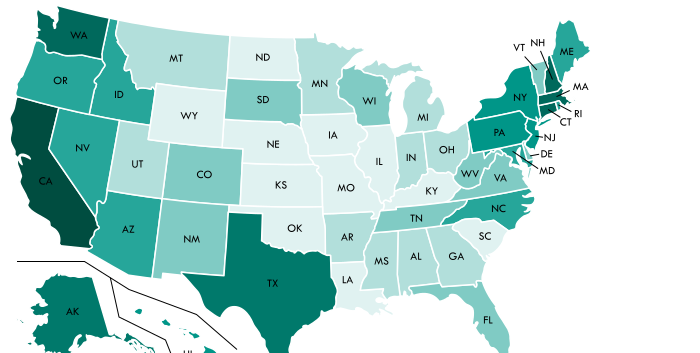
Most common states for information technology systems directors
| Rank | State | Population | # of jobs | Employment/ 1000ppl |
|---|---|---|---|---|
| 1 | District of Columbia | 693,972 | 504 | 73% |
| 2 | South Dakota | 869,666 | 428 | 49% |
| 3 | North Dakota | 755,393 | 284 | 38% |
| 4 | Iowa | 3,145,711 | 1,174 | 37% |
| 5 | Vermont | 623,657 | 204 | 33% |
| 6 | New Hampshire | 1,342,795 | 406 | 30% |
| 7 | Alaska | 739,795 | 223 | 30% |
| 8 | Arkansas | 3,004,279 | 871 | 29% |
| 9 | Rhode Island | 1,059,639 | 312 | 29% |
| 10 | Wyoming | 579,315 | 167 | 29% |
| 11 | Washington | 7,405,743 | 2,038 | 28% |
| 12 | Delaware | 961,939 | 271 | 28% |
| 13 | Minnesota | 5,576,606 | 1,482 | 27% |
| 14 | Oregon | 4,142,776 | 1,057 | 26% |
| 15 | Nebraska | 1,920,076 | 495 | 26% |
| 16 | Massachusetts | 6,859,819 | 1,680 | 24% |
| 17 | Virginia | 8,470,020 | 1,906 | 23% |
| 18 | Oklahoma | 3,930,864 | 894 | 23% |
| 19 | Montana | 1,050,493 | 244 | 23% |
| 20 | Connecticut | 3,588,184 | 782 | 22% |
Most common cities for information technology systems directors
| Rank | City | # of jobs | Employment/ 1000ppl | Avg. salary |
|---|---|---|---|---|
| 1 | Englewood | 1 | 3% | $125,041 |
| 2 | Atlanta | 1 | 0% | $120,170 |
| 3 | Houston | 1 | 0% | $158,082 |
Information Technology Systems Director job outlook: Expert opinions
Our panel of information technology systems director experts

University of Pittsburgh at Johnstown
University of South Florida
DePaul University

University of Washington

University of Florida

University of Florida

Bakersfield College
Portland State University
University of Colorado at Colorado Springs

Indiana University
University of Missouri

University of New Hampshire

University of Illinois at Chicago

Northeastern University
NCWIT
Loyola University Chicago

Kennesaw State University
Pennsylvania State University - Great Valley
Travis Stouffer
Assistant Professor of Information Systems, ChairUniversity of Pittsburgh at Johnstown
Department of Information Systems
What soft skills should all Information Technology Systems Directors possess?
Travis Stouffer: -Conflict Resolution
-Attention to Detail
-Active Listening
What hard/technical skills are most important for Information Technology Systems Directors?
Travis Stouffer: -Human-Centered Design
-UI/UX Design
-Rapid Prototyping (Wireframes, Mockups)
-User Story Writing
-PM Tools (Azure DevOps, Jira)
-Data Management: SQL, ERD's, Normalization
Ehsan Sheybani Ph.D.
ProfessorUniversity of South Florida
School of Information Systems and Management
What skills stand out on Information Technology Systems Director resumes?
Ehsan Sheybani Ph.D.: Analytical and problem-solving skills, Strong technical skills, The ability to work well under pressure, attention to detail, teamwork skills, organization and time management, interpersonal and communication skills, management and leadership skills.
What soft skills should all Information Technology Systems Directors possess?
Ehsan Sheybani Ph.D.: Leadership, motivation, communication, conflict management, trust-building, decision-making, organization, and time management.
What hard/technical skills are most important for Information Technology Systems Directors?
Ehsan Sheybani Ph.D.: Negotiation, relevant technical skills, prioritization and goal setting, project planning, delegating, and budget management.
What skills will help Information Technology Systems Directors earn the most?
Ehsan Sheybani Ph.D.: Software development, technical sales leadership, mobile app development, business analysis, digital marketing, affiliate marketing, analytical reasoning, artificial intelligence, cloud computing, and blockchain.
What type of skills will young Information Technology Systems Directors need?
Delvin Grant: The ability to problem solve, which requires an understanding of the problem and a structured approach towards the solution. The ability to apply concepts learned in one discipline to another. Quite often, students are unable to see how a concept translates from one domain to another, and this stifles innovation.
Will there be an enduring impact of the coronavirus pandemic on Information Technology Systems Directors?
Les Atlas: Most certainly an impact, a very strong impact. The best lesson for us is from the 1919 Spanish Flu pandemic. That strain of flu still circulates as a seasonal virus. Over 100 years laters, it is now considered a Phase 6 pandemic by the World Health Organization. While it is reduced due to current social distancing and mask wearing, the 1919 Spanish Flu virus still causes community-level outbreaks in multiple parts of the globe. Societal changes from this event of over 100 years ago are still with us.
In fact, they changed society. As is well-documented, after a high level of immunity was reached in the 1920's, the resulting labor shortage enabled workers to demand better living and working conditions, as well as better wages and public health care. As just one example of the societal changes due to the 1919 pandemic, the drop in the male labor force empowered male workers, and also changed the gender composition.
The aftermath of the 1919 pandemic was the start of women joining the labour force. In the United States, the proportion of women in the labour force rose from 18 per cent in 1900 to almost 21 per cent in 1920. In that same year, with the ratification of the 19th Amendment of the Constitution, the Congress of the United States guaranteed all American women the right to vote.
The current COVID-19 pandemic will certainly change the way we live, be it our mobility or the kinds of career options people have. After our current year-long experience in remote learning and work, will we go back to the inefficiencies of going to our office every work day? Or will remote work be acceptable, where one's residence will not be dependent upon the locations of employment. Will we avoid future hotspots of infection, choosing to instead reside and travel in areas where infection is decreasing? Will we prefer to travel on aircraft which are certified to be virus-free and frequent restaurants which are documented to be safer? Future marketing will likely make a sharp turn in this direction.
Peter Dobbins Ph.D.
LecturerUniversity of Florida
Computer & Information Science & Engineering Department
What are the biggest trends we'll see in the Information Technology Systems Director job market given the pandemic?
Peter Dobbins Ph.D.: I have heard points toward the "working remotely" model. As Computer Scientists, this is something we have known and in certain cases actually have been doing for a number of years. Industry shifts adapting to COVID have brought the fields surrounding CS into the remote work model... and are finding it works! As one of the first fields to embrace the model (a simple transition given how natural the fit), CS majors will only continue to find remote work opportunities.
What skills stand out on Information Technology Systems Director resumes?
Peter Dobbins Ph.D.: Skills would be the things allowing a student/employee to display their ability to work remotely: initiative, teamwork, independence, self-starter, some of the same things we have always seen were positive attributes.
What are the biggest trends we'll see in the Information Technology Systems Director job market given the pandemic?
Sanethia Thomas Ph.D.: When the pandemic first hit, I had students very concerned about their summer plans of having an internship, but as things worked itself out, and a lot of students maintained their internship by working remotely. In response to the declining job market, I have seen students redirect their efforts in the direction of graduate school. Many have expereinced difficulties finding job opportunities and "landing" the interview. Therefore more students are considering graduate school as we ride the wave of the pandemic.
What skills stand out on Information Technology Systems Director resumes?
Sanethia Thomas Ph.D.: As we are in a competitve market and moreso now due to the pandemic, it is valuable for students to show work experience and how it relates to the job they are applying for. It is a plus if they can show work experience in a remote environment. Students should be able to show that they are capable in working in a team environment and the roles they filled on the team; team lead, technical lead, front end, back end, project manager ect. Students should also have a portoflio of thier work, projects ect.
I often hear employers seek out students who have expereince working in the community or doing some type of social good. Highlighting community/social good works speaks to human side of the applicant, which most employers value.
Are there any particularly good places in the United States for Information Technology Systems Directors to find work opportunities?
Sanethia Thomas Ph.D.: San Fransico Bay remains on top with Seattle, New York, Los Angeles and Pittsburgh closley following.
What are the biggest trends we'll see in the Information Technology Systems Director job market given the pandemic?
Maryam Farahani: In my opinion, technology will play a much bigger role in our day-to-day life compared to the pre-pandemic world. Artificial intelligence and robotics will have a boost in employment numbers. Companies like Amazon, Walmart, Targets and etc, will need more IT and technology specialists to meet their customer's need for online shopping and supplying/delivering products to their customers. Jobs like programmers, data analysts, and technology support positions will have a rise in response to the change in the market due to pandemic.
For so many of the jobs, the need for a physical office is under question now, many employees are working from home and managing/coordinating their projects virtually. This will change the job market forever and job seekers need to learn new skills to adjust to this change.
Right now, healthcare-related job opportunities are growing in response to the rising need. In addition to doctors and nurses, there will be needs for management roles, accountants, technology supports, and lab technicians in health care industry.
Dr. Wayne Wakeland Ph.D.
Professor and Systems Science Program ChairPortland State University
Systems science program
What Information Technology Systems Director skills would you recommend for someone trying to advance their career?
Dr. Wayne Wakeland Ph.D.: For analyst positions, I think that employers want to hire people with strong data analysis skills, which, of course, includes statistics, but also big data, machine learning (algorithms), computer-based modeling, and programming. And, in addition to these apparently rather specialized skills, there is growing recognition that a talent for thinking, communicating, and problem-solving in a very general sense, and being able to cope with/address complexity, is also quite important.
What general advice would you give to an Information Technology Systems Director?
Dr. Wayne Wakeland Ph.D.: Develop a thoughtful combination of technical skills/expertise and qualitative resources/assets/prowess. Purely technical savvy can go a long way, but it is not enough. Employers are eager to hire well-rounded, easy to work with employees and leaders who can go deeper technically as required.
Dr. T.S. Kalkur
Department ChairUniversity of Colorado at Colorado Springs
Electrical and Computer Engineering Department
Will there be an enduring impact of the coronavirus pandemic on Information Technology Systems Directors?
Dr. T.S. Kalkur: Yes, students complained that, while they are earning an online degree, they aren't learning as much.
What experience really stands out on Information Technology Systems Director resumes?
Dr. T.S. Kalkur: Internship experience and tools used in design.
What are the biggest trends we'll see in the Information Technology Systems Director job market given the pandemic?
Bipin Prabhakar: Technology will become a strategic enabler for most businesses. There will be increasing demand for graduates who can help create this technology (Computer Science/Data Science) and for graduates who can leverage technology (information Systems) to create business value.
What skills stand out on Information Technology Systems Director resumes?
Bipin Prabhakar: Skills by themselves on resumes do not provide enough information for the reviewer to assess a candidate. The resume has to showcase the actual capabilities rather than just listing skills. What can you actually do with the listed skill? With that said, deep skills in software development, data science and AI or the broad set of skills required to enable digital transformation will be in demand. Digital transformation requires skills in business analysis, business process and process design, technologies such as next generation ERP systems, AI and ML, cloud architectures and platforms and business analytics.
Are there any particularly good places in the United States for Information Technology Systems Directors to find work opportunities?
Bipin Prabhakar: There are three major sectors that hire technology graduates - the tech companies that tend to be in tech hubs and major cities, major corporations that are all over the country and consulting organizations that tend to have offices in the bigger cities with access to local clients or well-connected airports. Major employers tend to recruit nationally from the top programs across the country. The best time to find work is before graduation and the best place to find work is the campus recruitment process.
What skills stand out on Information Technology Systems Director resumes?
Dale Musser Ph.D.: -Working on teams and collaboration - people skills matter a lot.
-Past accomplishments in delivering results while working with others
-Technical skills in target areas for job. The hottest areas right now: machine learning, large scale apps, and autonomous systems.
Are there any particularly good places in the United States for Information Technology Systems Directors to find work opportunities?
Dale Musser Ph.D.: -Yes, everywhere. IT, CS, and CE are in demand in every corner of the U.S. The hot spots are the tech centers, such as the Bay Area, Seattle, Austin, and Atlanta.
-I tell my students to mostly ignore the job sites and to look at the employment and careers pages on company websites. The best jobs never make it to job sites.
What are the biggest trends we'll see in the Information Technology Systems Director job market given the pandemic?
Dale Musser Ph.D.: -Work at home for now. "You will have an office at the company after the pandemic."
-Transition of companies to new locations. I see some companies leaving the Bay Area for other locations. Reducing space in San Francisco by a number of companies shows that after the pandemic many employees won't be returning to the physical locations they used to work.
-Increased focus on automation and autonomous systems given the proximity issues.
Marc Lessard
ProfessorUniversity of New Hampshire
Physics and Astronomy Department and Space Science Center
What experience really stands out on Information Technology Systems Director resumes?
Marc Lessard: Students who have been significantly involved in research projects have a distinct advantage over those who haven't. Those who began such work (which is typically paid) as sophomores or juniors often will have played a significant role in these real-world research efforts, which can be very different than what might be tackled as part of a capstone project.
Written and oral presentation skills are also essential!
What type of skills will young Information Technology Systems Directors need?
Marc Lessard: This is a very good and important question. Graduates who can address complex problems in creative ways will be the most successful. This might sound obvious, but there seems to be a trend developing where younger engineers tend to want to follow written procedures or instructions for solving problems.
What is more valuable, of course, is being able to use a broad-based background to provide new and creative solutions, or at least to suggest new ideas and engage in discussions to further develop those ideas. The cliche of "thinking outside the box" will always be important.
What general advice would you give to an Information Technology Systems Director?
Matthew Liotine Ph.D.: Most employers tell me that soft skills are equally, if not more important, than technical skills or domain knowledge. This translates into external/internal customer-facing skills, such as communication, team collaboration, writing, presentation, problem-solving, and being resourceful. (Many graduates overlook writing as a vital skill, but they fail to realize that in the course of their jobs, they will likely be required to write lots of memos and tons of emails.) The need to perfect these skills within the confines of a virtual world has become even more challenging and amplified with COVID. I teach in the information systems discipline, and when you view student resumes, many people look the same on paper. The soft skills will make a candidate stand out head and shoulders above the rest. That's why the candidate should pay attention to the screening interviews that they will undergo during the hiring process since employers will use these interviews to vet these skills.
What are the biggest trends we'll see in the Information Technology Systems Director job market given the pandemic?
Matthew Liotine Ph.D.: Currently, much of the hiring is skewed toward online fulfillment roles, which is of no surprise given the pandemic. This includes roles in procurement, which is undergoing a transformation due to COVID. This also means working within the physical environments and operations required to support this activity. Several of our students received offers from Amazon as a result of their hiring push.
What Information Technology Systems Director skills would you recommend for someone trying to advance their career?
Matthew Liotine Ph.D.: If a student decides to take time off before moving on to a job or graduate school, they should use that time to develop skills in which you may not receive formal training while in college. For example, skills like leadership, problem-solving, teamwork, and communication are going to be more vital than ever in the new norm.
What Information Technology Systems Director skills would you recommend for someone trying to advance their career?
Laura A. Meyer M. Ed.: Students should really be working on honing the skills in their areas of focus and interest. With that said, they should also work toward becoming more well-rounded in all areas. A few of my students have realized through job postings, they have found that although they may want to work in data, knowing the basics of programming will be useful as well.
Are there any particularly good places in the United States for Information Technology Systems Directors to find work opportunities?
Adriane Bradberry: Technology increasingly permeates every aspect of society and provides the foundation for most modern innovation. Young graduates with computing skills will be able to apply to some of the most fastest-growing and highest-paying jobs over the next decade-jobs that are available in nearly every industry, including art, finance, healthcare, and entertainment. Students can establish and develop necessary skills by exploring computing programming apps, taking Computer Science or IT courses (online or at a local community college, if these classes are not offered at school), taking math classes, and joining after-school computing clubs. Graduates who develop these skills will contribute to meaningful work-developing innovative solutions that save lives, solve health problems, improve the environment, and keep us connected.
What type of skills will young Information Technology Systems Directors need?
Peter Dordal Ph.D.: I'm leaving off software developers, and answering about our Information Technology graduates.
IT students entering the business world will need to know how to get the maximum leverage out of business systems. In many cases, this will mean writing their own specialized queries to extract the precise business intelligence needed; general-purpose "canned" queries just won't cut it. They will need a broad understanding of what software can accomplish for the enterprise and how to deploy new software effectively; this applies to software used in the office as well as to software used in manufacturing and shipping. And they will need to understand how to lease storage and computing resources from the cloud to meet not only predictable, long-term demands but also sudden short-term business projects.
Students working in database administration and management will need to be able to manage much larger volumes of data than a few years ago. They will need to be familiar with the great variety of new databases in order to pick the best tool for the job.
Students working in network management will need to be able to ensure that everyone has the bandwidth and server access they need, as those demands expand to include extensive video, low-latency real-time connectivity, and the regular transfer of huge amounts of data.
Students in cybersecurity will need to be fully acquainted with all the recommended best practices. However, they will also have to be able to anticipate and guard against potential new vulnerabilities. "By the book" protection is no longer sufficient.
Are there any particularly good places in the United States for Information Technology Systems Directors to find work opportunities?
Peter Dordal Ph.D.: For software developers, yes, there are advantages in working in places where there is a high concentration of other developers. But for students interested in applying IT to business, there are opportunities everywhere.
How do you envision technology impacting Information Technology Systems Directors in the next 5 years?
Peter Dordal Ph.D.: I think the biggest driver for change will be the continued explosive increase in the amount of data available. Ten years ago, it was enough to know customers' names, addresses, and past orders. Now there is a huge stream of information about what customers are looking at, what they are clicking on, what they're doing with your product, and what your customers' customers are doing. Analysis of this kind of information is becoming mainstream.
What experience really stands out on Information Technology Systems Director resumes?
Adeel Khalid Ph.D.: It is the age of diversity. A graduate can stand out when their resume shows a broad portfolio of experiences. In addition to a solid academic record, students who demonstrate that they can take on challenging tasks and work beyond a degree's basic requirements are more likely to be successful. I advise students to get involved in various activities, including undergraduate research projects, student design competitions, student organizations, internships, co-ops, etc. All of these should be highlighted on the resume. When a recruiter sees an overview of a student that shows relevant work experience in the form of work-study, internships, or co-op or research, their resume automatically comes to the top of the pile.
How do you envision technology impacting Information Technology Systems Directors in the next 5 years?
Nil Ergin Ph.D.: Advances in sensors, networking, communication, and computing are shaping the systems and services that are designed and deployed. Systems are becoming increasingly complex and interconnected; thus, more challenging to manage. Systems engineering discipline is becoming an essential element of managing and designing these systems. The field is evolving to address the challenges emerging from these advances in technology, including but not limited to, methods and tools to improve system resiliency, flexibility, agility, security, privacy, along with new ways to manage, design, and evaluate complexity.
Will there be an enduring impact of the coronavirus pandemic on Information Technology Systems Directors?
Nil Ergin Ph.D.: The pandemic disrupts all systems. With disruptions, new forms of services, delivery formats, and jobs will emerge. One overall result of the epidemic is that tech companies consider allowing employees to work remotely, beyond the end of the pandemic. Emerging work from the home norm will enable companies to hire a diverse and distributed workforce and compete for technical talent nationwide. This will also create a demand for IT capabilities and create a network of shared workspaces. Graduates need to diversify their skill sets to adapt and be agile to new forms of change.