Explore jobs
Find specific jobs
Explore careers
Explore professions
Best companies
Explore companies
Job outlook for institutional research coordinators in the United States
Are institutional research coordinator jobs in demand?
Institutional research coordinator job and salary trends over time
Institutional research coordinator jobs over time
Institutional research coordinator job growth rate over time
| Year | # of jobs | % of population |
|---|---|---|
| 2021 | 503 | 0.00% |
| 2020 | 511 | 0.00% |
| 2019 | 456 | 0.00% |
| 2018 | 406 | 0.00% |
| 2017 | 378 | 0.00% |
Average institutional research coordinator salary over time
Institutional research coordinator salary by year
| Year | Avg. salary | Hourly rate | % Change |
|---|---|---|---|
| 2026 | $46,117 | $22.17 | +6.8% |
| 2025 | $43,162 | $20.75 | +4.2% |
| 2024 | $41,410 | $19.91 | +4.1% |
| 2023 | $39,775 | $19.12 | --0.7% |
| 2022 | $40,069 | $19.26 | --0.3% |
Institutional research coordinator jobs by state
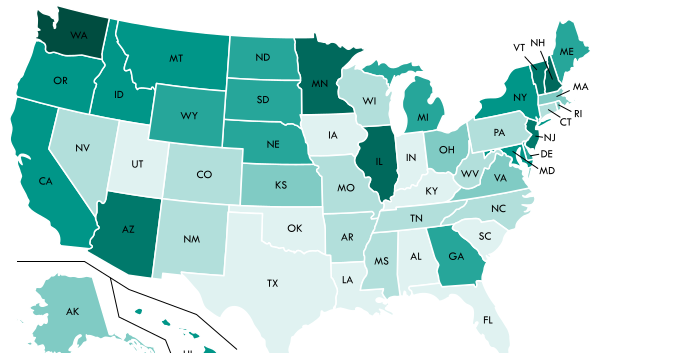
Most common states for institutional research coordinators
| Rank | State | Population | # of jobs | Employment/ 1000ppl |
|---|---|---|---|---|
| 1 | Nebraska | 1,920,076 | 606 | 32% |
| 2 | Delaware | 961,939 | 267 | 28% |
| 3 | North Dakota | 755,393 | 189 | 25% |
| 4 | Iowa | 3,145,711 | 746 | 24% |
| 5 | Kansas | 2,913,123 | 685 | 24% |
| 6 | New Mexico | 2,088,070 | 481 | 23% |
| 7 | South Dakota | 869,666 | 202 | 23% |
| 8 | Idaho | 1,716,943 | 327 | 19% |
| 9 | Arkansas | 3,004,279 | 554 | 18% |
| 10 | Vermont | 623,657 | 115 | 18% |
| 11 | Rhode Island | 1,059,639 | 181 | 17% |
| 12 | Oklahoma | 3,930,864 | 628 | 16% |
| 13 | Oregon | 4,142,776 | 611 | 15% |
| 14 | New Hampshire | 1,342,795 | 208 | 15% |
| 15 | Minnesota | 5,576,606 | 772 | 14% |
| 16 | Alabama | 4,874,747 | 641 | 13% |
| 17 | Pennsylvania | 12,805,537 | 1,588 | 12% |
| 18 | Virginia | 8,470,020 | 1,029 | 12% |
| 19 | Colorado | 5,607,154 | 676 | 12% |
| 20 | Utah | 3,101,833 | 358 | 12% |
Most common cities for institutional research coordinators
| Rank | City | # of jobs | Employment/ 1000ppl | Avg. salary |
|---|---|---|---|---|
| 1 | Grand Island | 1 | 2% | $49,478 |
| 2 | Pensacola | 1 | 2% | $44,111 |
| 3 | Detroit | 1 | 0% | $49,005 |
| 4 | Fresno | 1 | 0% | $54,105 |
| 5 | Washington | 1 | 0% | $56,559 |
Institutional Research Coordinator job outlook: Expert opinions
Our panel of institutional research coordinator experts
Swarthmore College
Florida Gulf Coast University

Stephen F. Austin State University
University of Minnesota
Stevens Institute of Technology

Drexel University
Heidelberg University
What will help Institutional Research Coordinators increase their earning potential?
Michael Brown: I think having a suite of skills is the best strategy. Our graduates learn physics analysis and problem solving skills, but also computer modelling skills, experimental techniques, writing skills, and even how to make an effective presentation.
What are the biggest trends we'll see in the Institutional Research Coordinator job market given the pandemic?
Marianela Rivera Ph.D.: The pandemic has had a strong impact on the job market, and it seems that many of those changes are not necessarily going to go away once the situation goes back to normal. The market is highly competitive, even more than before; therefore candidates should be able to demonstrate that they are not limiting themselves to their degrees. Looking for ways to keep up with technology and teaching trends is a must. Flexibility and the willingness and ability to work remotely I think are some of the most important trends in the job market as well. Candidates should be able to demonstrate that they are able to adapt and that they are willing to keep learning. Another significant factor to keep in mind is the importance given to diverse and inclusive environments. The pandemic has also highlighted issues related to sexism, racism, and inequality. Departments of Romance languages, literatures, and linguistics are looking to become more inclusive, therefore, they look for candidates who support an inclusive curriculum, show experience working with diverse populations of students, and demonstrate a commitment to teaching in and about multicultural environments.
What technical skills for an Institutional Research Coordinator stand out to employers?
Marianela Rivera Ph.D.: In the past, technology was not necessarily one of the main concerns for people interested in romance languages, literatures, and linguistics; however, even before the pandemic, a variety of platforms and resources were made available to facilitate teaching courses related to those fields. The pandemic has highlighted the need to adapt to evolving times, so now technical skills are definitely something employers look for in potential candidates in addition to teaching and research excellence. Knowledge of and experience in online course development, technical writing, social media management, learning management systems, and project management are definitely skills that would stand out to employers.
How have salaries changed over time for Institutional Research Coordinators?
Marianela Rivera Ph.D.: I think in terms of the salary, there has not been a significant change, especially for those who recently graduate and go into the job market; however, there are many more opportunities in terms of professional development and also to promote and implement interdisciplinary projects. Additional financial support is usually available for those who demonstrate interest and/or experience in developing research and/or service-learning projects, but it all depends on the institution.
Hunter Hampton Ph.D.
Assistant ProfessorStephen F. Austin State University
Department of History
What are the biggest trends we'll see in the Institutional Research Coordinator job market given the pandemic?
Hunter Hampton Ph.D.: As someone who graduated from college in 2008 and sought refuge in graduate school, I believe we will see a similar influx in graduate student enrollments over the next two or three years as the economy hopefully recovers. Immediately after I graduated, I applied to about twenty minimum-wage retail jobs. I got two interviews and only one job offer. I saw graduate school as a tool to both buy time in hopes of improved job prospects and increase my qualifications for that future job market. I could see a similar trend now. People that lost their job due to the pandemic may return to finish their undergraduate degree or begin a graduate program for the same reason that I did.
How have salaries changed over time for Institutional Research Coordinators?
Hunter Hampton Ph.D.: This is difficult to answer because of the variety of fields that someone with a history degree can go into. They range from lawyers, museum curators, writers, business owners, teachers, and a few that get a Ph.D to teach at the college level. For my field as a professor specifically, the salaries are near flat over the past four years. I don't foresee them improving in the near future as state funding continues to decline for higher education. But I do believe that the salary for history majors will increase as employers continue to see the value of hiring humanities graduates.
What soft skills should all Institutional Research Coordinators possess?
Lee Penn Ph.D.: I hear over and over again from recruiters - they want candidates with strong backgrounds in their majors PLUS two things.
1 - experience with data science, statistics, or some kind of computer science
2 - soft skills (communication, playing well with other, collaboration, etc...)
What soft skills should all Institutional Research Coordinators possess?
Dr. Ionut Florescu: I believe in terms of soft skills, every graduate should be able to explain the results of their complex models to someone who isn't technically sound. So, presentation skills are extremely important. Then the capability of approaching a presenter at a conference or workshop and ask pertinent questions about what they just presented is really important. We require all our students to not only make presentations but also ask questions during other teams' presentations. I believe the most important thing as a teacher in the course is to criticize them when their presentation is not crisp or when the question isn't clear or appropriate.
How have salaries changed over time for Institutional Research Coordinators?
Dr. Ionut Florescu: Our programs are producing graduates who work in the financial services industry, and our salaries are high compared to other domains. However, in 2019 the year before the pandemic, it was the first time when our graduates were attracted to the technology sector because the compensation was higher. It was also the first time when our Business School data science programs had a higher stating salary than the traditionally finance programs. Thus, I saw a shift in the skills, with statistics now being a required skill and not a "good to have" anymore. I do believe this trend will continue for at least a couple of years. The salaries will go up going forward. They did go down in 2020.
Rogelio Minana Ph.D.
Vice Provost for Global Engagement, Head of Global Studies and Modern LanguagesDrexel University
Office of Global Engagement
What will help Institutional Research Coordinators increase their earning potential?
Rogelio Minana Ph.D.: In any field, having broad global qualifications, from experience studying and living abroad to language skills and the ability to work as part of international teams, provides a clear edge. Data indicates that international/global experience leads to higher graduation rates and higher GPA in college, as well as to higher earnings and higher change of promotion to decision-making positions after graduation. Developing intercultural competency and proactively seeking and appreciating diversity, both domestic and international, are critical not only for a healthy job market but also for a fairer society.
Paige Atterholt
Adjunct ProfessorHeidelberg University
Will there be an enduring impact of the coronavirus pandemic on Institutional Research Coordinators?
Paige Atterholt: I think now, being in year 2 of the pandemic, I think if anything there will be more jobs for graduates. Just looking through the jobs online, there are many opportunities for graduates to get a job. I think the older community retired when things got bad, which opened the door for the younger generation.