Explore jobs
Find specific jobs
Explore careers
Explore professions
Best companies
Explore companies
Job outlook for instructional technology specialists in the United States
Instructional technology specialist job growth summary. After extensive research, interviews, and analysis, Zippia's data science team found that:
The projected instructional technology specialist job growth rate is 7% from 2018-2028.
About 15,000 new jobs for instructional technology specialists are projected over the next decade.
Instructional technology specialist salaries have increased 7% for instructional technology specialists in the last 5 years.
There are over 8,296 instructional technology specialists currently employed in the United States.
There are 61,365 active instructional technology specialist job openings in the US.
The average instructional technology specialist salary is $43,402.
Are instructional technology specialist jobs in demand?
Instructional technology specialist job and salary trends over time
Instructional technology specialist jobs over time
Instructional technology specialist job growth rate over time
| Year | # of jobs | % of population |
|---|---|---|
| 2021 | 8,296 | 0.00% |
| 2020 | 7,854 | 0.00% |
| 2019 | 7,935 | 0.00% |
| 2018 | 6,160 | 0.00% |
| 2017 | 5,922 | 0.00% |
Average instructional technology specialist salary over time
Instructional technology specialist salary by year
| Year | Avg. salary | Hourly rate | % Change |
|---|---|---|---|
| 2026 | $43,402 | $20.87 | +1.0% |
| 2025 | $42,961 | $20.65 | +2.9% |
| 2024 | $41,768 | $20.08 | +1.1% |
| 2023 | $41,315 | $19.86 | +2.1% |
| 2022 | $40,479 | $19.46 | +0.3% |
Instructional technology specialist jobs by state
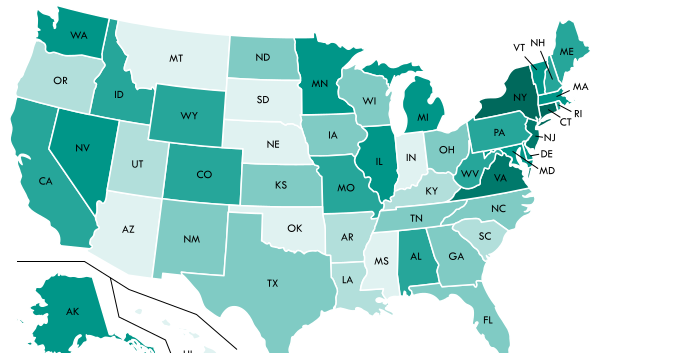
Most common states for instructional technology specialists
| Rank | State | Population | # of jobs | Employment/ 1000ppl |
|---|---|---|---|---|
| 1 | Virginia | 8,470,020 | 1,157 | 14% |
| 2 | North Dakota | 755,393 | 105 | 14% |
| 3 | District of Columbia | 693,972 | 95 | 14% |
| 4 | Massachusetts | 6,859,819 | 870 | 13% |
| 5 | South Dakota | 869,666 | 112 | 13% |
| 6 | Vermont | 623,657 | 79 | 13% |
| 7 | Oregon | 4,142,776 | 508 | 12% |
| 8 | Montana | 1,050,493 | 123 | 12% |
| 9 | Wyoming | 579,315 | 67 | 12% |
| 10 | Washington | 7,405,743 | 803 | 11% |
| 11 | Maryland | 6,052,177 | 663 | 11% |
| 12 | Utah | 3,101,833 | 355 | 11% |
| 13 | Iowa | 3,145,711 | 337 | 11% |
| 14 | Nebraska | 1,920,076 | 209 | 11% |
| 15 | New Hampshire | 1,342,795 | 147 | 11% |
| 16 | Idaho | 1,716,943 | 173 | 10% |
| 17 | Delaware | 961,939 | 97 | 10% |
| 18 | Alaska | 739,795 | 77 | 10% |
| 19 | New Jersey | 9,005,644 | 773 | 9% |
| 20 | Connecticut | 3,588,184 | 315 | 9% |
Most common cities for instructional technology specialists
| Rank | City | # of jobs | Employment/ 1000ppl | Avg. salary |
|---|---|---|---|---|
| 1 | Ames | 1 | 2% | $39,344 |
| 2 | Wheaton | 1 | 2% | $47,986 |
| 3 | Washington | 2 | 0% | $64,288 |
| 4 | Arlington | 1 | 0% | $39,941 |
| 5 | Baltimore | 1 | 0% | $50,846 |
Instructional Technology Specialist job outlook: Expert opinions
Our panel of instructional technology specialist experts
University of Hawaii at Manoa
Indiana University Bloomington
Robert Morris University
Armstrong State University
Illinois State University
Fairfield University

Lamar University
Western Illinois University

Tennessee Tech University
University of Colorado Colorado Springs

East Carolina University
Wayne State University

Concordia University, St. Paul

Alverno College
University of Denver

William & Mary
University of Idaho
What general advice would you give to an Instructional Technology Specialist?
Rich Miller III: People enjoy the variety of problems encountered and the need for quick thinking, problem-solving, and thinking outside the box. Dislikes include the rapid advancement of technology, which can make it challenging to stay ahead.
What Instructional Technology Specialist skills would you recommend for someone trying to advance their career?
Rich Miller III: Educational Technology is a booming field that leverages technology to enhance teaching and learning. It allows for the simulation of real-world tasks for students, making them better prepared for the real world.
What will help Instructional Technology Specialists increase their earning potential?
Rich Miller III: Ed tech is an all-encompassing field that can involve hands-on support, teaching and learning, project management, installing A/V equipment, and more. No two days are alike, and problem-solving skills are essential.
What Instructional Technology Specialist skills would you recommend for someone trying to advance their career?
Dr. Michael Menchaca: Possess a health balance of general design skills and specific tool knowledge. Understand which tools are prevalent by reviewing job descriptions (AI does a great job of this) and augment your skill set. Don't wait for your graduate program to cover every tool; sometimes you have to learn some on your own. Practice presentation and interview skills and look for practicums and internships in your program.
Gamze Ozogul Ph.D.
Department Chair of Learning, Design, and Adult Education, LDAE, Associate Professor of Instructional Systems Technology, ISTIndiana University Bloomington
Educational/Instructional Media Design
What Instructional Technology Specialist skills would you recommend for someone trying to advance their career?
Gamze Ozogul Ph.D.: Adaptability, flexibility, and being open to continuously learning (after the degree completion). Technology, learning environments, learning needs, and content to be mastered by the learners are constantly changing. The educational technologist has to be open to learn continuously and change and adapt to the changes happening in these areas. Additionally, soft skills such as being a team member and clear communication are very important, as educational technologists work in a team or lead a team.
What will help Instructional Technology Specialists increase their earning potential?
Gamze Ozogul Ph.D.: Everyone needs to start somewhere. Learn most from each experience in the field and build your resume, experiences, and skills.
What general advice would you give to an Instructional Technology Specialist?
Dr. Richard Fuller: AI is growing and becoming more and more part of the lexicon of teaching and learning in all areas of prek-12, higher education, and corporate training and development. This will need to be understood on both the offensive side, which is using AI as pedagogy as well as the defensive side to combat academic integrity issues. Online teaching and learning, in both synchronous and asynchronous modalities in addition to more traditional f2f methodologies and pedagogies, will become more and more important as Universities look for more sustainable tools. Much was learned during the pandemic lock-down and this knowledge and skill are being used in a post-pandemic world. Keep an open mind to new innovations in curriculum design and different theories and methods to map, align, and develop curriculum. This ever-changing dynamic is grounded, however, in the fundamentals that were learned through your degree. Additionally, stay up on all the technology that is advancing. This is key in the C&I; and the instructional design world. Tech moves very fast and what you know today is outmoded tomorrow. C&I; must stay current and active to assist others through teaching and design. Knowing how to use tech and different software is tantamount to success as an instructional designer or teacher.
What Instructional Technology Specialist skills would you recommend for someone trying to advance their career?
Dr. Richard Fuller: Be open to opportunities that will present themselves in Prek-12, higher education or corporate training and development. Many places will see the value in hiring employees with the knowledge and skills that come with a Curriculum and Instruction (C&I;) degree and will create positions accordingly. Most organizations see the value of a training and development department with specific uses. Hospitals, k-12 schools, for profit organizations and nonprofit organization incorporate instructional designers with a curriculum and instruction degree. Even higher education (HE) hire instructional designers to work with faculty. HE faculty are subject matter experts but don’t know about instruction or curriculum or how to teach online or in person f2f. They also don’t understand the value or how to design and develop curriculum and transfer that to the classroom. PreK-12 utilize C&I; grads as both trainers and as coordinators of curriculum. This may require an advanced degree (graduate or doctoral), but nonetheless, it is an opportunity and something to think about as you progress through your career. Training and Development is an obvious opportunity in many corporations and organizations as C&I; prepared graduates have a body of knowledge and skills that align with training needs in designing and delivering training for corporate and organizational initiatives in all areas. There are those with a C&I; degree who also hold teaching certificates in some area of Prek-12. This may open other doors for them in teaching in the classroom but with the degree may present additional opportunities in an organization’s administrative capacity or training.
What general advice would you give to an Instructional Technology Specialist?
Debbie Azevedo Ed.D.: Curriculum and Instruction graduates should embrace technology and stay current with educational trends. The educational field is constantly changing, and graduates can keep up with the latest research and educational technology by attending conferences, subscribing to journals, and attending professional development. Being up to date on the latest educational technology can support graduates in enhancing their learning and streamlining curriculum development.
What Instructional Technology Specialist skills would you recommend for someone trying to advance their career?
Debbie Azevedo Ed.D.: Graduates can pursue additional certifications, such as special education or bilingual authorizations. Another idea would be to seek opportunities in the private sector such as working with an edtech company or as an educational specialist, supporting school districts with curriculum and instructional practices.
What will help Instructional Technology Specialists increase their earning potential?
Debbie Azevedo Ed.D.: 1. Collaboration with Colleagues and the Community - Graduates will need skills in teamwork and collaborating on curriculum design to create educational experiences supportive and inclusive of all students. 2. Digital Integration - Graduates will integrate digital tools, including artificial intelligence, into their curriculum to enhance student learning. 3. Data Analysis - The skill of collecting and analyzing student data to inform instruction will be essential in improving student outcomes. 4. Personalized Learning Design - The skill of designing curricula to fit students' needs, including adaptive learning technologies and individualized learning paths, will be critical in the next 3-5 years as learning becomes more student-centered.
What will help Instructional Technology Specialists increase their earning potential?
Dr. Amanda Aguilar: Technology is changing every day. Every field is incorporating technology into their daily functions and education is no different. Don't shy away from it in your classroom but also don't lean on it too much. It is an additional resource to help reach your students.
What general advice would you give to an Instructional Technology Specialist?
Dr. Kymberly Harris PhD: New graduates entering the field of Curriculum & Instruction should prioritize building a diverse skill set, staying current with educational trends, and actively seeking opportunities for professional development. Cultivating strong verbal and written communication skills will enhance collaboration with colleagues, parents, and students. Adapting to evolving educational methodologies, such as culturally relevant pedagogies, will contribute to long-term success.
What will help Instructional Technology Specialists increase their earning potential?
Dr. Kymberly Harris PhD: In the coming years, proficiency in educational technology is expected to become increasingly important. Graduates should focus on honing their skills in integrating digital tools into the curriculum, leveraging data for informed decision-making, and staying abreast of advancements in online and blended learning environments. Additionally, addressing diversity, equity, and inclusion in education will be crucial for educators to create inclusive and culturally responsive learning environments.
What Instructional Technology Specialist skills would you recommend for someone trying to advance their career?
Anthony Piña Ed.D.: Educational Technology is a very broad field with practitioners in various work settings and with differing emphases and responsibilities. Ultimately, potential employers of both full-timers and consultants will want to now 1) what you can do and 2) what you have done. Depending upon your career emphasis, you can: 1) spend some time with trial software and tutorials to gain expertise in specific applications; 2) co-author articles and co-present at conferences to build up your name recognition and credentials; 3) see if colleagues will allow you to participate in their projects: 4) do not pass up opportunities to work-even if it is low-paid or volunteer with non-profits, civic groups, etc. to build your experience and resume--so many of these lead to future jobs.
What will help Instructional Technology Specialists increase their earning potential?
Anthony Piña Ed.D.: Working with and leading people-including managing conflict-is undertaught in our current ed tech programs. Accessibility and Universal Design for Learning will continue to rise in importance. Those going into industry (and increasingly in academe) are expected to have skills in multimedia/video production and interactive authoring, e.g., Articulate, Adobe Captivate. Of course, an ed tech professional will be expected to be up-to-speed in the use and affordances of AI.
What general advice would you give to an Instructional Technology Specialist?
Joshua Elliott Ed.D.: The biggest piece of advice I would give is to stay current. There are a few areas to focus with this. The International Society for Technology in Education (ISTE) is the most important organization in the field There are local organizations in various states that are associated with ISTE also. The ISTE Standards are the driving standards in the field.
* Be proficient with the different tools, but do not get too attached. A lot of people are particularly attached to a particular Device (IPad vs Chromebooks) or tool (Kahoot vs Polleverywhere) but true educational technology leaders need to be flexible. You will be at a real disadvantage if you only work with Apple products but get a job in a district with a one to one Chromebook plan.
* Focus on skills rather than tools.
What Instructional Technology Specialist skills would you recommend for someone trying to advance their career?
Joshua Elliott Ed.D.: Educational technology is something that evolves by its very nature. The big thing is to stay current. The most likely trend is the continued growth and evolution of Artificial Intelligence, but that could always change.
What will help Instructional Technology Specialists increase their earning potential?
Joshua Elliott Ed.D.: There are two main ways. You can take on leadership roles in districts. There are technology directors who focus on the more technical aspects, but there are also educational technology leaders in an increasing number of districts. The latter usually have more knowledge about the learning piece as opposed to the technical aspect. Of course, there will always be overlap in these roles.
* If your schedule permits, delivering professional development or coaching teachers in best practices is always a great option for making more money.
Dr. Johnny O'Connor Ph.D.
Iinterim Department Chair and Assistant professorLamar University
Department of Education Leadership
What hard/technical skills are most important for Instructional Technology Specialists?
Dr. Johnny O'Connor Ph.D.: Over the last two years, the role of a Curriculum and Instruction professional in PK - 12 settings has quickly evolved. While technology continues to be a fundamental part of curriculum and instructional practices, the emergence of COVID-19 has further solidified the relevance of technology in education, as virtual learning environments have been added to the academic offerings of many schools. Furthermore, in addition to having a deep knowledge of research-based curriculum and instructional strategies and the ability to utilize data to inform curriculum and instructional decisions, C&I professionals should now be prepared to demonstrate contemporary knowledge and understanding of instructional tools and practices within a virtual environment. This skill will become even more important as schools adapt to what has been termed as the "new normal" in education.
What skills will help Instructional Technology Specialists earn the most?
Dr. Johnny O'Connor Ph.D.: In most professions, those that offer the most value to an organization earn more. Careers in curriculum and instruction are no exception. The skill level and experience of C&I professionals can vary widely. Nonetheless, only the most well qualified can demand top pay. C&I professionals with the following qualifications can expect to earn more than their less qualified peers:
-Advanced degrees in Curriculum/Instruction and/or Educational Leadership (i.e., M.Ed., Ed.D., Ph.D.)
-Experience with online instructional tools and learning platforms
-Experience developing and facilitating large scale professional development
-Knowledge and experience with curriculum and instruction in multiple content areas
-Experience as an instructional coach
-Ability to design, interpret and implement various models of response to intervention
-Previous leadership role in curriculum and instruction
-Ability to create and design customized curriculum
-Expertise in supporting the curriculum and instruction needs of multiple student groups
-5+ years successful teaching experience in a core subject area
What skills stand out on Instructional Technology Specialist resumes?
Dr. Johnny O'Connor Ph.D.: During my career in PK - 12 public education, I was fortunate to serve in various executive positions. Specifically, as it relates to answering this question, my role as Executive Director of Human Resources offers the best perspective. As an HR executive, my department was often tasked with screening and identifying top candidates for campus and district-level curriculum and instruction positions. Through this experience, as well as my experience as an educational consultant, I found the following skills to stand out on the resumes of top curriculum and instruction candidates:
-Exceptional communication skills
-Strong background and knowledge in pedagogy
-Successful teaching experience
-Advanced degrees and certifications
-Ability to effectively collect and utilize instructional data
-Robust theoretical and practical knowledge of best practices in curriculum and instruction
Hoyet Hemphill Ph.D.
IDT Program Coordinator and Graduate Advisor, Instructional Design and TechnologyWestern Illinois University
School of Engineering and Technology
What skills stand out on Instructional Technology Specialist resumes?
Hoyet Hemphill Ph.D.: For K12 positions compiled so far in Illinois, Instructional coaches appeared mostly in all the searches. The skills required for this position include having basic computer skills required, familiarity with MS Office Suite or similar, familiarity with online form creation and basic use of cloud-based systems (One Drive, Google Drive, etc.), multilingual abilities and teaching experience, management, and leadership experience required, such as instructional coach, team leader, or school administration, ability to use student data to drive instruction, excellent communication and organization skills, knowledge in educational technology tools and Google Suite. The majority of the duties/responsibilities includes designing and facilitating high-quality science professional development, supporting the implementation of high-quality instructional materials in K-12, providing support for teachers to understand and implement the Next Generation Science Standards, providing classroom support to teachers in effective instructional practices through modeling, coaching, mentoring, and co-teaching. The coach must be able to travel to various school sites, collaborates with administrators, teachers, and with district leaders, help develop the necessary school infrastructure to support effective program implementation through grade-level meetings, peer observations, and vertical team meetings based upon the scheduling in the school. Facilitates planning of lessons and analysis of student work, works collaboratively with other project team members to design, and provide various high-quality professional development experiences for project teachers and administrators, promotes instructional approaches in K-12 science that support diversity, equity, and inclusion in the teaching and learning of science, collaborate well with Classroom Coaches, Academic Coaches, and other Elevate team members, etc.
What skills stand out on Instructional Technology Specialist resumes?
Jeremy Wendt: Currently, an in-depth understanding of hybrid and online learning is the most valuable skill set for curriculum or instructional design positions. There are always baseline expectations for curricular development that any qualified candidate will learn through coursework or hands-on experience. However, layering in the ever-changing and evolving online learning environment creates a void in the skillset of the typical curriculum designer or educator.
What soft skills should all Instructional Technology Specialists possess?
Jeremy Wendt: Job candidates must always consider their impact and role on a team. Communication and interaction with a team and organizational hierarchy will continue to be vital regardless of the in-person or online nature of a job. Software and hardware advances have enabled workers to continue as productive employees, but positive human interaction is still the most important soft skill. All companies have routines, expectations, and identities that are unique to the company. Understanding your skills, personality, and expertise in the context of the organization will contribute to the success of the company and your career.
What hard/technical skills are most important for Instructional Technology Specialists?
Jeremy Wendt: The tech skills needed in any curricular environment vary by industry. Within a K-12 school system, educational technologies are widely applied and help manage assignments, grades, attendance, and engage students. Instructional designers will find more technical software that is specific to the organization but will be designed to help employees build curriculum efficiently and effectively. In either case, foundational technology courses are ideal for baseline knowledge, and professional development through conferences and networking will enhance the skillset for a career.
Dr. Margaret Scott Ph.D.
Senior Instructor, University SupervisorUniversity of Colorado Colorado Springs
Department of Leadership, Research, and Foundations
What skills stand out on Instructional Technology Specialist resumes?
Dr. Margaret Scott Ph.D.: Some of the items I would expect to be included are experience designing and facilitating professional learning for educators, experience with leadership of others within the school, knowledge and facilitation of work with academic standards and assessment, and experience working with and providing feedback to colleagues.
What hard/technical skills are most important for Instructional Technology Specialists?
Dr. Margaret Scott Ph.D.: The instructional coach will understand the curriculum, the materials, and the district expectations for an instructional coach and classroom teacher. They will need to be flexible with technology for communication, scheduling, and documenting professional learning and work with teachers. In addition, they will need to understand the available technology for teaching to coach others in its effective use. They need to know the most effective, high-impact instructional practices and model them for others. Additionally, they need to know how to engage in effective feedback conversations with others about planning, teaching, and effective use of data-both about teacher practice and student learning.
What skills will help Instructional Technology Specialists earn the most?
Todd Finley Ph.D.: As in any profession, the skill most useful for earning more is the ability to enhance the effectiveness and bolster the emotions of everyone around you. This often involves positively reframing sticky situations. Given that teaching is an emotionally intensive profession, that last skill is super important.
What hard/technical skills are most important for Instructional Technology Specialists?
Todd Finley Ph.D.: Knowing how to leverage technology in the classroom is a critical curriculum specialist disposition--especially given the COVID-19 landscape when schools might go online again. It's not enough that the curriculum specialist knows about education technology; they also have to help teachers scaffold tech use by students.
Dr. Leah Ketcheson
Assistant Professor, Health and Physical Education Teaching (H-PET)Wayne State University
Kinesiology, Health and Sport Studies
What hard/technical skills are most important for Instructional Technology Specialists?
Dr. Leah Ketcheson: Keeping the delivery of content up to date with multiple forms of representation. Students must digest content in various ways, such as through presentations, videos, discussion boards, etc.
What skills stand out on Instructional Technology Specialist resumes?
Dr. Leah Ketcheson: Flexibility with the delivery of course content. We like to feel confident our instructors are ready to teach online, in person, or in a hybrid model.
What skills will help Instructional Technology Specialists earn the most?
Dr. Leah Ketcheson: Hard work, resiliency, and creativity.
Dr. Barbara Wissink
Associate Professor of Education, Program Chair: Master of Education: with an Emphasis in Literacy with the additional MN K-12 Reading EndorsementConcordia University, St. Paul
Graduate Teacher Education
What soft skills should all Instructional Technology Specialists possess?
Dr. Barbara Wissink: Two soft skills really stand out at this time in the school settings: adaptability and coachability. By adaptability, curriculum and instruction specialists must modify the curriculum and instruction based on the students' needs and the instructional delivery model. During the COVID-19 pandemic, specialists had to learn to adapt their instruction and curricula to ensure that distance learning was relevant and meaningful for their students. In addition, many specialists also were charged with mentoring teachers who were facing the same challenges of creating a meaningful distance learning experience for their students.
Secondly, curriculum and instruction specialists need to be coachable. This soft skill proved necessary during the pandemic, as specialists needed to expand their existing instructional style and learn new ways of delivering content to the students and teachers they interact with in the in-person, distance learning, and hybrid modalities.
Desiree Pointer Mac Ph.D.
Professor of Education, Director of Graduate Education ProgramsAlverno College
School of Professional Studies, Education Division
What skills stand out on Instructional Technology Specialist resumes?
Desiree Pointer Mac Ph.D.: Based on my experience creating and advising others in creating educator preparation programs in the United States, Argentina, Uruguay, and Peru, I believe that the skills that stand out on International Curriculum Specialist resumes highlight outcomes that are not context-specific, but that transcend country- or culture-bound educational contexts. The model of Alverno College (http://alverno.edu) provides one internationally-renowned example of how to do this - it highlights that well-prepared educators, including those charged with developing curricula, should be adept in five advanced educational abilities, which incorporate soft skills and hard/technical skills within the knowledge, skills, and dispositions therein.
What soft skills should all Instructional Technology Specialists possess?
Desiree Pointer Mac Ph.D.: For example, an international curriculum specialist should have the ability to conceptualize, which is to say, they deeply understand the relevant content and learning theory required. In this case, an international curriculum specialist should be widely and deeply read in curriculum theory, current research, and the key debates across contexts. But if we are merely knowledgeable or adept in conceptualization ability alone, we lack other essential abilities. Educators must also have the ability to communicate, that is, to speak clearly, listen effectively, be attentive to subtle non-verbal cues, be responsive to cultural nuance, and be adept in the use of technology to facilitate all of the above.
What hard/technical skills are most important for Instructional Technology Specialists?
Desiree Pointer Mac Ph.D.: They also must have the ability to diagnose, which indicates that they are observant, inquiring, creating assessments and reflecting on their data, and posing new questions as part of a reflective practitioner cycle of inquiry. They must have the ability to coordinate, which means that they can arrange time, space, personal resources, digital environments, and processes effectively so that people can learn most effectively. And lastly, they must have the ability of inclusive interaction, through which they convey passion for their professional work, advocacy for the people they serve, humility in their own learning, curiosity about what they have yet to learn, and the desire to collaborate with communities of practice. Related to all of these, specific technical skills can come into play, especially as identified first by Punya Mishra in conceptualizing "technological pedagogical content knowledge." The technical skills are in service to the pedagogical purposes.
Will there be an enduring impact of the coronavirus pandemic on Instructional Technology Specialists?
Maria Salazar Ph.D.: Our graduates will experience positive and negative impacts as a result of the coronavirus pandemic. Our graduates, like many other across the world, are facing a changing work force that must adapt in real time. Our graduates must be flexible, open, and innovative in order to thrive in the current work force. Our graduates are also dealing with looking after their physical and mental well-being, and that of their loved ones. This puts added pressure on graduates to navigate a changing world, while maintaining mental and physical health. Our graduates have learned how to use technology in new ways for online teaching and learning. They have learned from the challenges and successes they have experienced navigating online environments, and they will use this knowledge to make teaching and learning more powerful. Last, our graduates have become more aware of inequities, such as education and health disparities, that have only been exacerbated by the pandemic. They emerge as relentless advocates for marginalized communities.
What skills stand out on Instructional Technology Specialist resumes?
Meredith Kier Ph.D.: I think moving forward administrators will look for applicants to demonstrate evidence of adaptability, creativity, and flexibility. Further, teacher candidates will need to show how they are able to use educational technologies to foster connectedness and community building among students. The pandemic has made it evident that teachers are able to flourish amidst countless hurdles to meet the needs of diverse students. It can only be hoped for that this unprecedented event will elevate the profession to show the essential need for teachers in the field.
I think that we will continue to need talented candidates in the field who are prepared in culturally-responsive teaching strategies to promote equitable learning outcomes for students. This being said, it is important for teachers to be supported by their administrators and community to cultivate a network of care for students.
Taylor Raney Ph.D.
Director of Teacher Education, Associate Chair, Associate ProfessorUniversity of Idaho
Department of Curriculum and Instruction
What technology do you think will become more important and prevalent for Instructional Technology Specialists in the next 3-5 years?
Taylor Raney Ph.D.: I don't see any technology becoming more important, aside from perhaps expanded access to high-quality Internet, in the next 3-5 years. As long as technology can connect the people behind it to each other, that's what's going to be necessary to get through the world's current state.
Will there be an increase or decrease in demand for Instructional Technology Specialists in the next 5 years?
Taylor Raney Ph.D.: An increase, without question. See my answer to #1 above. Teachers are burning out and leaving the profession when they can, not sticking around into retirement age because they love what they're doing.