Explore jobs
Find specific jobs
Explore careers
Explore professions
Best companies
Explore companies
Job outlook for intake workers in the United States
Intake worker job growth summary. After extensive research, interviews, and analysis, Zippia's data science team found that:
The projected intake worker job growth rate is 9% from 2018-2028.
About 64,000 new jobs for intake workers are projected over the next decade.
Intake worker salaries have increased 12% for intake workers in the last 5 years.
There are over 21,127 intake workers currently employed in the United States.
There are 95,449 active intake worker job openings in the US.
The average intake worker salary is $36,052.
Are intake worker jobs in demand?
Intake worker job and salary trends over time
Intake worker jobs over time
Intake worker job growth rate over time
| Year | # of jobs | % of population |
|---|---|---|
| 2021 | 21,127 | 0.01% |
| 2020 | 20,386 | 0.01% |
| 2019 | 20,360 | 0.01% |
| 2018 | 19,892 | 0.01% |
| 2017 | 19,034 | 0.01% |
Average intake worker salary over time
Intake worker salary by year
| Year | Avg. salary | Hourly rate | % Change |
|---|---|---|---|
| 2025 | $36,052 | $17.33 | +2.2% |
| 2024 | $35,278 | $16.96 | +2.4% |
| 2023 | $34,444 | $16.56 | +4.3% |
| 2022 | $33,037 | $15.88 | +2.6% |
| 2021 | $32,196 | $15.48 | +2.1% |
Intake worker jobs by state
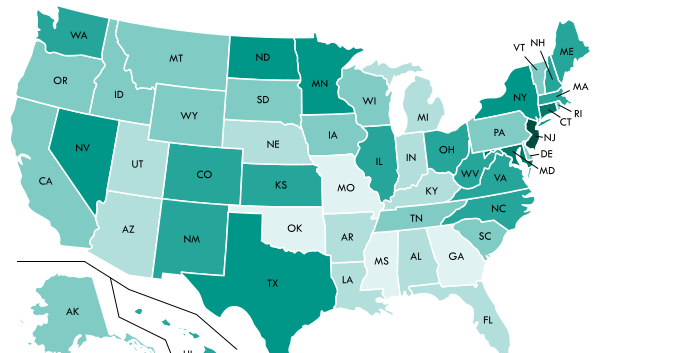
Most common states for intake workers
| Rank | State | Population | # of jobs | Employment/ 1000ppl |
|---|---|---|---|---|
| 1 | Massachusetts | 6,859,819 | 1,878 | 27% |
| 2 | District of Columbia | 693,972 | 153 | 22% |
| 3 | New Hampshire | 1,342,795 | 285 | 21% |
| 4 | Alaska | 739,795 | 156 | 21% |
| 5 | Washington | 7,405,743 | 1,460 | 20% |
| 6 | Nebraska | 1,920,076 | 377 | 20% |
| 7 | South Dakota | 869,666 | 171 | 20% |
| 8 | Colorado | 5,607,154 | 1,054 | 19% |
| 9 | Oregon | 4,142,776 | 732 | 18% |
| 10 | Georgia | 10,429,379 | 1,729 | 17% |
| 11 | Missouri | 6,113,532 | 1,016 | 17% |
| 12 | Connecticut | 3,588,184 | 606 | 17% |
| 13 | Wyoming | 579,315 | 97 | 17% |
| 14 | Virginia | 8,470,020 | 1,348 | 16% |
| 15 | Utah | 3,101,833 | 504 | 16% |
| 16 | Maine | 1,335,907 | 215 | 16% |
| 17 | Delaware | 961,939 | 151 | 16% |
| 18 | New Mexico | 2,088,070 | 303 | 15% |
| 19 | Idaho | 1,716,943 | 265 | 15% |
| 20 | West Virginia | 1,815,857 | 264 | 15% |
Intake Worker job outlook: Expert opinions
Our panel of intake worker experts
Colorado State University - Pueblo
Campbellsville University

The University of Texas Permian Basin
University of Nevada - Reno
University of Illinois-Springfield

Northern Kentucky University
Louisiana State University at Shreveport

Campbellsville University

California State University Northridge
Adelphi University
Adelphi University

University of Nebraska at Omaha
University of Maryland

Georgia State University

Francis Marion University

Arkansas State University

Marshall University
Rocky Mountain Prep
University of Kansas
Adelphi University
What general advice would you give to an Intake Worker?
Pamela Richmond Ph.D.: Challenges social workers can face are high caseloads, not enough resources to assist clients and exposure to horrific aspects of humanity. Social workers enjoy being a part of the change process by recognizing the strengths and resiliency of individuals, families, groups, organizations and communities. Workers advocate for individuals that are marginalized and oppressed, ensuring they have a voice. They enjoy looking at solutions to problems and empowering others to make changes beneficial for their lives.
Dr. Kimberly Mudd-Fegett DSW, MSSW
Associate Professor of Social WorkCampbellsville University
Social Work
What general advice would you give to an Intake Worker?
Dr. Kimberly Mudd-Fegett DSW, MSSW: Social Work is a very large field; therefore, the practice of Social Work varies greatly depending on which field you enter. Overall, nearly all areas of Social Work include working with individuals who are facing some form of crisis or life challenge. Social Workers work to assist in providing education, assistance and most importantly empowerment. Social Workers are trained professionals who work from a set of ethics that govern their professional standards to respect, empathize and value all individuals. Most all Social Workers enter the professional because they feel called to assist and make a difference in the life of others.
Sam Terrazas Ph.D.
Professor and Academic Chair Department of Social WorkThe University of Texas Permian Basin
Department of Social Work
What skills stand out on Intake Worker resumes?
Sam Terrazas Ph.D.: Social work is a profession rooted in professional ethics and requires a wide range of skills that vary depending upon the role a social worker holds in an organization. In general, social work skills that stand out on a resume are skills gained through specialized training and certifications, skills in culturally responsive practice, proficiency in languages, and skills in assessment and evaluation.
What soft skills should all Intake Workers possess?
Sam Terrazas Ph.D.: Social workers need to be skillful in documentation in writing case notes, assessments, and good managers of their time. Managing a client's case requires social workers to be diligent and ensure that all required documentation is completed on time and within professional standards. Social workers must also be effective communicators understanding their own power and the multiple professional roles they hold.
What hard/technical skills are most important for Intake Workers?
Sam Terrazas Ph.D.: Social workers practice in various areas of practice and organizational auspices that may differ in the hard/technical skills that are most important. In general, the hard/technical skills most important can be categorized based on the level of education-BSW (Bachelors of Social Work) versus MSW (Masters of Social Work).
BSW's practice in a range of organizations providing various types of services; however, in general practice in the realm of case management that requires that ability to demonstrate cultural responsiveness, develop an alliance with clients, apply NASW and a state's ethics and professional standards of practice, conduct assessments, and to develop plans to meet a client's goals.
MSW's practice in many areas such as administration, clinical, public policy and advocacy, child welfare, public safety, and health care. Each of these practice areas requires specific technical skills; however, in general, MSW's are trained to assess individuals, families, groups, and communities. To that end, MSW's must understand the cultural context and how socio/economic local, state, federal policies impact social welfare problems such as poverty, intimate partner violence, and mental illness. MSW's must possess strong engagement skills/therapeutic alliance-building, diagnostic/evaluation skills, ethical application of interventions and therapeutic approaches, and advocacy skills.
Lillian Wichinsky Ph.D.
Associate DeanUniversity of Nevada - Reno
School of Social Work
What soft skills should all Intake Workers possess?
Lillian Wichinsky Ph.D.: Social workers need to be prepared to work in integrated health and multidisciplinary settings and act as change agents across systems of care. They work with various communities and people, and therefore soft skills are very important to their success. Some of the most important soft skills include:
-Teamwork. ...
-Communication Skills
-Problem-Solving Skills
-Ethics
-Flexibility/Adaptability
-Leadership skills
What skills stand out on Intake Worker resumes?
Youngjin Kang Ph.D.: In general, I think there are three things that will help job seekers in the field stand out on their resume, including (1) experiences, (2) practical skills, and (3) flexibility. First, let's talk about the experience. As a helping professional, your experience in the field helps you deal with a challenging situation smoothly. There are many unexpected situations where you do not know what to do. Such situations commonly occur in the field as working with your clients (e.g., your client talks about suicidal ideation). You can't experience everything, particularly if you are a student, but both direct and indirect experiences will benefit you. Direct experiences may be gained through previous jobs and internships while pursuing a degree. Indirect experiences may be gained through learning from co-workers, interacting with classmates who are already in the field, and reading and learning while in your degree program. Second, practical skills are important in many ways. Human services professionals' tasks vary by what agency they work for and clients they work with. To be able to complete given tasks, practical skills are helpful; they are not necessarily fancy or difficult-to-achieve, but something that can be practiced and gained if willing to learn. For example, they include but are not limited to documentation, computer skills (e.g., setting up online sessions), knowledge about professional ethics, assessment and intervention, communication skills, referral skills, and knowledge about resources in the communities. Finally, flexibility may help you survive in the field. For example, Covid-19 circumstances, as you may already know, have brought many unprecedented changes and challenges in our lives and the field. Many case workers in the field have been meeting their clients online, and ways of helping their clients had to be changed due to the ongoing pandemic. These changes occurred so quickly, which requires helping professionals in the field to find ways of meeting their client's needs as quickly as possible. In such situations, if helping professionals are not flexible, they would not be able to effectively assist their clients.
What hard/technical skills are most important for Intake Workers?
Youngjin Kang Ph.D.: There are so many to name given that human services professionals should be versatile, but if I have to pick one, I would say assessment skills. One of the important tasks that human services professionals take on is to help their client's needs be met. If you don't know how to accurately assess the client's needs, how can you help them effectively? How can you help meet their needs? Based on the accurate and thorough assessment, human services professionals are able to develop treatment plans and implement best practices in the field.
What skills will help Intake Workers earn the most?
Youngjin Kang Ph.D.: Self-care skills. It is imperative for human services professionals to practice self-care regularly. Human services jobs are emotionally and physically draining and challenging, although they are rewarding. If you do not know how to take care of yourself and your needs, how can you take care of others? If you do not practice self-care regularly, you are likely to experience burnout - no resilience to go back to your highest ability to help others. Many helping professionals put their client's needs first and neglect their needs, but in the long run, this is not a smart thing to do.
Katherina Nikzad-Terhune Ph.D.
Associate Professor, MSW Program Director, School of Social WorkNorthern Kentucky University
College of Health and Human Services
What hard/technical skills are most important for Intake Workers?
Katherina Nikzad-Terhune Ph.D.: We are a dynamic evidence-based profession that requires specialized skills in order to effectively complete the demanding work that our profession entails. The soft skills described above are all intertwined with the hard skills required in the social work profession. Below are examples of hard skills required in the social work profession (note, this list is not exhaustive):
a. Client Evaluation Skills-All social workers, regardless of practice setting, must possess competency in client evaluation. This requires the ability to complete thorough and accurate assessments of our clients and their environment.
b. Diagnosis-While not all social workers will go on to diagnose, those who obtain full licensure often do. Having the ability to diagnose has many lifelong implications for the clients we work with, so it is vital that social workers possess the knowledge, skills, and critical thinking required to provide accurate diagnoses.
c. Intervention- This is often at the heart of what we do as social workers, and this will look different for each client. Social workers need to be skilled in providing evidence-based interventions for patients. This requires sufficient education and training in various evidence-based techniques. Intervention can also come in the form of connecting clients to necessary resources and collaborating with other professionals to help meet the unique needs of clients.
d. Crisis Management- All social workers will likely encounter a crisis situation at some point. We must possess the skills to respond accordingly by making swift and ethical decisions while simultaneously collaborating with other professionals involved.
e. Cultural Competency -Social workers will encounter clients from diverse backgrounds, and therefore need to be mindful and educated about various cultural beliefs and practices. We must also be willing to self-examine our own beliefs and biases and acknowledge what we have yet to learn.
f. Advocacy: All social workers uphold social justice and work to empower our clients and communities through advocacy efforts. Possessing advocacy skills allows us to support our clients, especially vulnerable populations, and ensure they have the opportunities and resources they need.
g. Documentation- Sound and professional documentation is critical in social work. Each encounter we have with a client needs to be documented to ensure accuracy and to ensure appropriate services and interventions. I tell my students to always document as if their records would one day be read aloud in a courtroom.
Kacie Blalock Ph.D.
Associate Professor; Director, Master of CounselingLouisiana State University at Shreveport
Department Of Psychology
What soft skills should all Intake Workers possess?
Kacie Blalock Ph.D.: Soft skills that are essential for counselors include emotional intelligence, empathy, multicultural competency, interpersonal abilities, and authenticity.
What hard/technical skills are most important for Intake Workers?
Kacie Blalock Ph.D.: It is important that counselors are able to effectively take notes and summarize progress, interpret assessments, memorize and recall information, and keep clear yet concise records.
Dr. Dianna Cooper
Associate ProfessorCampbellsville University
Carver School of Social Work
What skills stand out on Intake Worker resumes?
Dr. Dianna Cooper: Several things stand out on a social worker's resume. First, social workers should highlight that they graduated from a CSWE accredited program. This tells the world that they have been trained in the nine competencies that serve as the foundation of social work. It also means that the social worker has completed training in multiple areas, including theory, policy, research, diversity and inclusion, practice with individuals, families, groups, organizations, and communities, and field experience. The field experience part of social work education integrates practice in a real social work setting, so students graduate with experience to show on the resume.
What soft skills should all Intake Workers possess?
Dr. Dianna Cooper: The "change theory" used in social work practice follows several steps, including engaging, assessing, planning, intervening, evaluating, terminating, and following up. Soft skills are most likely to occur in engagement, intervention, and termination. Social workers are trained to "start wherever the client is," understanding that clients can be individuals, families, groups, communities, or organizations. Social workers are trained to respect the client as the expert in their needs, honor self-determination, use a strengths-based approach, and respect difference while using inclusion. The training turns into soft skills such as being empathetic, warm, genuine, and respectful. Social workers also develop skills in knowing when to listen and when to nudge the client toward action. Social workers are trained to intervene and, when change is completed, to terminate. Helping clients know when to end services also requires soft skills of talking about hard topics, seeing a brighter future and setting goals, recognizing when change is happening, and saying goodbye respectfully.
What hard/technical skills are most important for Intake Workers?
Dr. Dianna Cooper: Hard or technical skills are most likely to occur in the stages of assessing, planning, intervening, and evaluating change theory. Social workers are trained to gather lots of information and then analyze strengths and needs. Social workers present their assessments to clients and work together to create goals and the steps that reach goals when executed. The process involves using the client's vision of what "better" looks like. Social workers then use evidence-based techniques to move the client toward the goal and define measures to know when the goal is met. The technical skills used in this process include analyzing many types of information repeatedly, knowing what resources exist and how to refer, knowing how to design effective goals and steps to achieve goals, researching current evidence-based practices, defining and measuring progress, and setting limits and timeframes.
What skills will help Intake Workers earn the most?
Dr. Dianna Cooper: Individuals who complete a master's degree in social work (MSW) are likely to earn higher pay than individuals with a bachelor's degree (BSW). MSWs are also desirable in many settings, including hospitals and medical settings, schools, mental health counseling centers, police departments, probation offices, in-home therapeutic service agencies, and private practice. Most states now require social workers to be licensed. MSWs who want to bill insurances for direct service to clients must be licensed at the clinic level where they practice to credential with insurance companies.
Alejandra Acuna Ph.D.
Associate ProfessorCalifornia State University Northridge
Department of Social Work
What experience really stands out on Intake Worker resumes?
Alejandra Acuna Ph.D.: Experience is valued in social work. Taking advantage of opportunities like internships and volunteer work is smart. Training and certification in an evidence-based program/practice (EBP), curricula, or intervention is a plus, although if there is a particular EBP used by a hiring agency, the agency usually pays for the time and cost of the training once a social worker is hired. Any additional skills relevant to the specific job- software skills, electronic recordkeeping, language proficiency - are worthy of highlighting in a resume. Grant writing skills also add value to resumes.
The reason most industries advertise with the statement, "will train the right person" is that we know (based on research conducted by Harvard University, the Carnegie Foundation, and Stanford Research Center) that interpersonal and intrapersonal communication skills (so-called "soft skills") make up 85% of job success and only 15% of job success comes from technical skills and knowledge. Interpersonal skills can probably be highlighted best in the cover letter and in the interview. Show up and let them see who you are - your warm, authentic, and empathic essence.
Will there be an enduring impact of the coronavirus pandemic on Intake Workers?
Dr. Manoj Pardasani Ph.D.: I believe that the pandemic has somewhat changed our ideas of what constitutes effective practice. As many agencies transitioned to remote services, professionals and recipients of services had to learn how to integrate technology and "distance" into their daily lives. Therefore, when we return to the "new normal," many social work agencies will integrate remote service opportunities into their regular practices. This does not mean that in-person services are going away anytime, but utilizing technology would allow social services to be accessible to a larger (and more diverse) group of consumers. From an educational perspective, we believe that schools of social work will have to integrate technology-assisted practices (intakes, diagnostic assessments, care planning, interventions, etc.) into their curricula. Preparing students to effectively practice in multiple modalities will be critical to the future of our profession. Those social workers already in the field might need to engage with additional training or continuing education opportunities in order to enhance their skills to meet these emerging practice needs.
What type of skills will young Intake Workers need?
Dr. Manoj Pardasani Ph.D.: Some of the skills that social work graduates need in order to successfully enter the workforce haven't changed since the inception of social work education. Social work graduates need to be able to think critically, possess analytical and strategic problem solving skills, be able to engage and work with diverse populations, and be impactful advocates for their clients and programs. But as the world around us evolves, we need to examine what additional skills and knowledge should social workers possess. We believe that social workers need to learn how to be social justice advocates, fighting for equity and equality. They need to be able to work productively in interdisciplinary settings and integrate technology more intensively in their daily practice. As they advance in their careers, many social workers will be presented with opportunities for leadership in organizations and communities. They need skills in transformative leadership, effective management, governance, fiscal planning, board development, and community planning. These will be critical in ensuring social workers retain their leadership role on social service agencies and in governmental organizations.
What experience really stands out on Intake Worker resumes?
Dr. Manoj Pardasani Ph.D.: I believe that employers are looking for different strengths, skills, and knowledge depending on the length of time in practice. For instance, in the case of recent graduates, employers look for internship experiences, fellowships, or specializations taken while obtaining their social work degree. Past volunteer experiences are helpful as well. Employers are interested in candidates who show initiative, are passionate about social work practice, are able to adapt to diverse work environments, and are eager to learn and grow. With experienced social workers, employers are looking at the trajectory of one's career: how have the various employment experiences contributed to the growth and development of this professional? What skills, knowledge and insights have they developed? They are hoping to see a commitment to continued learning and examples of having taken initiative in previous jobs. Overall, for both new and experienced social workers, possessing a social work license is critical. Most positions now require the social worker to be licensed by the state in which they practice, however, social workers have not always been quick to pursue licensure. I believe that is changing and the expectations for social work professionals to be licensed will only grow further.
Will there be an enduring impact of the coronavirus pandemic on Intake Workers?
Livia Polise: The pandemic has also had a deep and personal impact on the lives of social work students, mirroring the impact on communities and clients served in social work settings. Our students have learned to be resilient in the face of uncertainty as well as the importance of seeking out and cultivating support and community. These experiences will enhance the ability of our students to engage in client-centered and empathy-driven social work practices.
What type of skills will young Intake Workers need?
Livia Polise: The pandemic has heightened the realities of systemic disparities and the importance of "case-to-cause" social work practice. New graduates will be called to engage in practice that fully encompasses the social justice mission of the social work profession, addressing the needs of individuals, families and communities, while simultaneously reimagining and rebuilding systems and structures to promote greater equity.
What experience really stands out on Intake Worker resumes?
Livia Polise: The profession's signature pedagogy, field education, provides opportunities for students to develop a foundational skill set that can be transferred to many different practice contexts. Resumes for new graduates may highlight tasks in different settings, the application of skills across diverse domains of practice, and a skill set that encompasses micro, mezzo, and macro levels of experience. Community engagement and social justice actions are activities that demonstrate a commitment to the core values of the profession.
Dr. Susan Reay
Assistant ProfessorUniversity of Nebraska at Omaha
Grace Abbott School of Social Work
What are the biggest trends we'll see in the Intake Worker job market given the pandemic?
Dr. Susan Reay: There is always a need for social work. As an essential worker, individuals who hold social work degrees are positioned for job opportunities in multiple health care sectors to include medical, mental health, corrections, policy, and other vital areas of practice. One of the lessons learned from the pandemic is that social work is here to stay. As a recession proof job, social work is more vital than ever with job opportunities readily available.
What Intake Worker skills would you recommend for someone trying to advance their career?
Dr. Susan Reay: The year after high school students are growing and changing. This year is about self-exploration, regardless of whether or not you are enrolled in an institution of higher learning. I recommend that individuals who decide not to enroll in higher education directly after high school take time to reflect on what they are learning, who they are, and learn from the world around them. Journaling is a great way to do this, or photography or other creative means of reflection.
What general advice would you give to an Intake Worker?
Dr. Susan Reay: It is essential for graduating seniors to develop a lifespan career plan that includes identifying experiences they want, ones they might want to seek out, and the identification of ones they are not interested in exploring. Central to the plan is obtaining quality supervision. I tell all my graduating seniors that no matter what job you take, make sure that you have a quality supervisor. Start looking for mentors and people you can trust. Keep those folks close to you and hold on to them over the life of your career.
Will there be an enduring impact of the coronavirus pandemic on Intake Workers?
Richard Shin Ph.D.: Like most situations, there are challenges and opportunities. As a counselor preparation program, we are concerned that our students are not able to get the experiences associated with physically engaging in their internship sites. There's really no replacement for the range of experiences and situations that interns are required to respond to when they're at their internship sites. On the other hand, the pandemic has provided opportunities for students to learn how to be counselors in the virtual environment. This is priceless because no matter what the world looks like when we reach a more stable place with the virus, we know that professional interactions in the virtual environment are here to stay. Students have honed their technological skills, learned to be creative, and become more comfortable working in this environment. They've also enhanced their resiliency traits by navigating these extremely stressful times, while also studying for their graduate degrees in counseling.
What type of skills will young Intake Workers need?
Richard Shin Ph.D.: Related to above, there have inevitably been some gaps in counselor training over the past year. Our students have not been able to engage in face-to-face, individual or group, counseling. They've not had the opportunity to develop relationships and work collaboratively with colleagues in person. Our graduates will have developed a great set of skills in terms of working in the online environment, but many will need to focus on developing their interpersonal communication, counseling, advocacy, etc. skills that are required of professional counselors.
What experience really stands out on Intake Worker resumes?
Richard Shin Ph.D.: In the most basic sense, graduates who have experiences and skills on their resumes that set them apart from their cohort tend to stand out to employers. What sorts of extra leadership, advocacy, skill development, etc. opportunities have the applicant pursued outside of the program requirements of a counseling program? Everyone will have internship experiences because those are required. However, not everyone will have an example of a brief intervention that you developed and executed, which was focused on addressing the lack of representation of Black and Indigenous students in AP classes in your local high school. Initiating impactful efforts like this will definitely make you stand out.
What are the biggest trends we'll see in the Intake Worker job market given the pandemic?
Dr. Susan Snyder Ph.D.: Although the pandemic has brought a lot of challenges, we saw our graduating students excel in the job market, but most had to adapt to virtual interviews and remote work environments.
What skills stand out on Intake Worker resumes?
Dr. Susan Snyder Ph.D.: Being able to clearly demonstrate experience is helpful. Students should not include passive activities, like attending meetings, or menial tasks, like making copies, but skills that show what they are qualified to do. Good activities could be community organizing, event planning, grant writing, program evaluation, or facilitating groups. Additionally, students who demonstrate strong written and verbal communication skills, including social media skills, tend to do well. Working collaboratively, including across organizations, is important for a lot of different positions our students seek. If students' resumes show that they can also analyze data, they can have even more options.
Are there any particularly good places in the United States for Intake Workers to find work opportunities?
Dr. Susan Snyder Ph.D.: We have had students find jobs in the South and across the country. While the job market is more challenging than in years past, our graduating students have been very successful. Job searches should be approached like full-time jobs, which require you to have good time-management skills, organizational skills, and to be a hard worker.
Will there be an enduring impact of the coronavirus pandemic on Intake Workers?
Dr. Jessica Burke: Yes, there will be an enduring impact on college graduates, as there is an impact on all of us. The job interviewing process will be very different, as I'd expect there to be more Zoom interviews and now wearing a mask during face-to-face interviews. We've been taught to shake hands during interviews, and now that has changed. Once starting a job, all social interactions will be very different with social distancing, more Zoom meetings, and adhering to other CDC guidelines. There will also be more work-from-home jobs available to new graduates than in the past, which it seems some recent graduates would want that opportunity, but others may not.
It seemed many of our students would prefer this type of employment in order to protect their families and themselves from COVID-19. Although a vaccine has been approved, it is uncertain when we will return to normalcy. I also expect an increased demand in the healthcare field and other service sectors. However, students at Francis Marion University will be pretty well-adjusted to these types of changes at their jobs given they have been exposed to distance learning, attending classes through Zoom, and following CDC guidelines on campus.
What type of skills will young Intake Workers need?
Dr. Jessica Burke: Here are the skills I think graduates will need in the coming years: Technological skills and communication skills. The ability to work via the Internet and using video conferencing software will be very important, and along with this very important skill, graduates will need to be able to construct a professionally written e-mail and have really good verbal communication skills. Finally, being able to manage one's time will be extremely important, especially for those who are working from home to ensure deadlines are met, etc.
What experience really stands out on Intake Worker resumes?
Dr. Jessica Burke: The skills that would really stand out on resumes include experience with distance learning; Zoom; and other technological skills, such as creating and editing videos; exceptional written and oral communication skills; and research skills, such as conducting data analysis and being able to correctly interpret the data would not hurt during a time when facts are often distorted.
What are the biggest trends we'll see in the Intake Worker job market given the pandemic?
Dr. Amy Pearce Ph.D.: 2020 has presented many new challenges or further stained existing ones. We've witnessed extraordinary demands on medical clinics, unprecedented unemployment, sudden changes within our educational institutions, and received continual reminders to socially distance or self-quarantine. Humans are social beings. We also prefer experiences that are predictable and controllable. This year we haven't been provided with much of what we require to flourish, or even maintain-hence, the stress mounts. For these reasons, I predict a rise in the mental health profession sectors. The need for clinical and counseling psychologists, mental health counselors, and substance abuse therapists will rise.
What skills stand out on Intake Worker resumes?
Dr. Amy Pearce Ph.D.: Typically, I recommend that all psychology majors gain research experience and communicate their findings via conference presentations, or peer-reviewed publications. Highlighting analytical and quantitative skills, plus software training is recommended. Graduates who know how to collect, enter, analyze, interpret, and report data will be desired. If a student plans to directly enter the workforce in a psychology-related field, then picking up courses to complete undergraduate certificate programs, such as neuropsychological testing or statistics, will be beneficial. As will be any internships or applicable job experiences.
Are there any particularly good places in the United States for Intake Workers to find work opportunities?
Dr. Amy Pearce Ph.D.: A great thing about psychology is the number of options available to degree-earners! Psychology majors aren't confined to one job title or geographical locale. Work opportunities will be largely dictated by the experience and skills acquired along the path of earning a bachelor's degree. This is why, in addition to the requisite coursework, it's important to gain relevant applicable experiences and acquire additional training and skills. The U.S. Department of Labor's Occupational Outlook Handbook, or their O*NET Online, are good places to start searching for projections on specific careers and factors related to employability in psychology. Although a bachelor's degree in psychology doesn't make someone a psychologist, a myriad of opportunities exist in business, academic, and human service settings, which are in every city.
What general advice would you give to an Intake Worker?
Peggy Proudfoot Harman Ph.D.: There are several levels of social work education, and each provides essential qualifications for a variety of professional roles. A Bachelor of Social Work (BSW) from a Council on Social Work Education (CSWE) accredited program provides professionals with the skills to deliver case management, home health social services, and child welfare social services, to name a few. An important point to remember is that all BSW and Master of Social Work (MSW) programs must be accredited by CSWE.
There are approximately 255 CSWE accredited MSW programs in the United States. Not all MSW programs are alike with regard to specializations and program options. MSW program options range from face-to-face classes that are held once or twice weekly, to virtual courses offered through remote learning platforms such as Blackboard featuring synchronous and asynchronous sessions, and finally, totally online courses and programs.
There is a wide range of social work specializations in MSW programs. For example, behavioral health services administration, policy practice, behavioral health services, substance use disorders practice, military social work, and school social work. Many programs that are focused on behavioral health have responded to the fallout from the recent pandemic, taking into consideration client travel and health issues, and are offering courses in tele-behavioral health. These courses prepare students to provide services remotely and will continue to be needed in the future.
The field of social work is always growing, and actually, thrives when the environment is experiencing a crisis. Social workers are experienced in crisis intervention and are highly-trained to conduct assessments and interventions. Both BSW and MSW graduates entering the workforce this year will find that they are in high demand, and employers in this working environment will find social workers who are prepared to provide quality assessments and interventions in the most difficult situations.
Abby Worland
Managing Director of People Rocky Mountain Prep Network Support TeamRocky Mountain Prep
What are the biggest trends we'll see in the Intake Worker job market given the pandemic?
Abby Worland: The pandemic has made job security an increasingly important factor given rising unemployment rates. I think we will see an increase in the retention of currently employed workers in their positions.
I'm curious to see how much of the virtual world we've built will carry over once the pandemic ends. Will more positions convert to remote work permanently? Will schools continue to offer virtual learning as an option? Regardless of what carries over, I feel confident saying that tech literacy and the ability to self-manage your work and your time will be increasingly important skills in the job market.
What Intake Worker skills would you recommend for someone trying to advance their career?
Abby Worland: At the most basic level, all jobs and careers depend on your ability to do two things: solve problems and communicate with others. Spend your gap year developing those skills.
Many people recommend "following your passion" in your work. I would adjust that and recommend instead that you pursue work that has a purpose and mission that align with your personal values. Spend your gap year identifying what those values are. All jobs are going to have tough moments, that is the nature of work, but if the work is meaningful to you, it is far easier to be resilient.
What general advice would you give to an Intake Worker?
Abby Worland: Below are four pieces of advice that I give to early career professionals (and I still tell myself these things on a daily basis!):
- Work very, very hard, and pay attention to detail.
- You will change as a person, so your hopes and plans for your career will also change. Be okay with that.
- Pay attention to the people around you: know them, care about them, and help them.
- Take initiative.
Dr. Florence DiGennaro Reed Ph.D.
Associate Professor and Chairperson, Director of the Performance Management LaboratoryUniversity of Kansas
Department of Applied Behavioral Science
What are the biggest trends we'll see in the Intake Worker job market given the pandemic?
Dr. Florence DiGennaro Reed Ph.D.: This remains to be seen. Given unemployment rates and job options last May, I suspect there will be fewer jobs available when students graduate.
What skills stand out on Intake Worker resumes?
Dr. Florence DiGennaro Reed Ph.D.: In my experience, employers appreciate real-world experience where students/recent graduates can apply the knowledge they learned in their courses to actual work settings. Thus, graduates who have had service-learning practicum courses, internships, or other relevant experiences have resumes that tend to stand out to future employers.
Are there any particularly good places in the United States for Intake Workers to find work opportunities?
Dr. Florence DiGennaro Reed Ph.D.: Human-service settings desperately need employees right now. These settings generally have high turnover, and the pandemic has made it challenging to recruit highly-skilled employees. Locations serving individuals with intellectual and developmental disabilities (clinics, schools, educational centers, group homes, etc.) are getting creative to appeal to graduates. They offer unique and exciting professional development and growth opportunities and may pay for graduate education under certain circumstances.
What type of skills will young Intake Workers need?
Rani Varghese: Graduates will need to have a strong commitment to social justice and embody that commitment in their work. In particular, they need the knowledge, awareness, and skills to engage different kinds of clients across social identities and social locations, in both micro and macro settings. One thing that would definitely benefit graduates is taking up another language, being able to provide bilingual services. They will also need knowledge and skills in trauma-informed practice, especially in evaluating current evidence-based practice models.
Are there any particularly good places in the United States for Intake Workers to find work opportunities?
Rani Varghese: There is a need for social workers in all parts of the country and in all corners of the world. We are in a field where there is an endless need for social workers.
How do you envision technology impacting Intake Workers in the next 5 years?
Rani Varghese: There will be more workers offering online therapy, making services more accessible for clients who have a range of needs. Also, there will be a shift in what I teach, as a faculty member, engaging my students about what social practice looks like beyond face-to-face encounters. I believe that the field will be creative and innovative in thinking more about ways technology can better train students (i.e., simulation) and support clients.